eBook - ePub
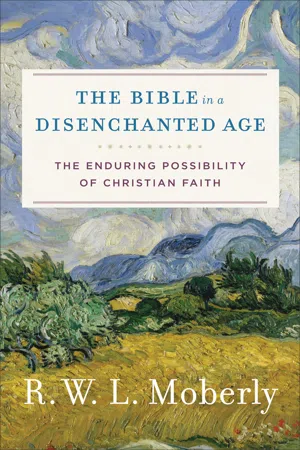
The Bible in a Disenchanted Age (Theological Explorations for the Church Catholic)
The Enduring Possibility of Christian Faith
- 240 pages
- English
- ePUB (mobile friendly)
- Available on iOS & Android
eBook - ePub
The Bible in a Disenchanted Age (Theological Explorations for the Church Catholic)
The Enduring Possibility of Christian Faith
About this book
In our increasingly disenchanted age, can we still regard the Bible as God's Word? Why should we consider it trustworthy and dare to believe what it says? Top Old Testament theologian R. W. L. Moberly explains why the Bible is unlike any other book by exploring the differences between it and other ancient writings. He explains why it makes sense to turn to the Bible with the expectation of finding ultimate truth in it, offering a robust apology for faith in the God of the Bible that's fully engaged with critical scholarship and reasonable in the twenty-first century.
Information
1
Posing the Problem
Introduction
I hope I may be permitted, as an Englishman, to begin with some words from the coronation service of the present queen, Elizabeth II, in Westminster Abbey on June 2, 1953. At an early point in the ceremony the archbishop of Canterbury, together with the moderator of the General Assembly of the Church of Scotland, presented a copy of the Bible to the queen. The archbishop said:
Our gracious Queen:
to keep your Majesty ever mindful of the law and the Gospel of God
as the Rule for the whole life and government of Christian Princes,
we present you with this Book,
the most valuable thing that this world affords.
The moderator then said:
Here is Wisdom;
This is the Royal Law;
These are the lively Oracles of God.1
In these few but weighty words, the Bible is understood to be an artifact of this world that contains the living word of God and so is of incomparable value. It is symbolically presented to the queen at the outset of her reign because its content is understood to be fundamental to her vocation to public life with great responsibilities for other people.
Such an understanding, like any other understanding in the world, is of course contestable. The Bible and its presence in the coronation service would now be regarded by many as, at best, quaint, and mainly as a testimony to the remarkably persistent influence of the religious and political ideologies of the seventeenth century (and earlier), rather than as a good guide to what matters in the modern world. Moreover, I imagine that when the queen’s successor is crowned, there will be battles royal over the wording of this and other parts of the ceremony. Whether the presentation of the Christian Bible, with the words “the most valuable thing that this world affords,” will survive to be used in the next coronation is, I suspect, a moot point.
Nonetheless, in these words we have a way into the subject matter of this book. For the wording of the coronation service on one level simply expresses, no doubt in a rather Protestant formulation, a classic Christian understanding of the significance of the Bible: that it is the word of God in human words, which can give incomparably valuable wisdom and guidance for life in this world.
I appreciate that “the word of God in human words” privileges the genre of Old Testament prophecy, whose self-presentation takes this form, and only relates more obliquely to other literary genres such as narrative, psalm, proverb, gospel, letter, or apocalypse. Nonetheless, there is good Christian precedent for using this or similar wording as shorthand for the Bible as a whole, and for convenience I retain it here.
Of course, this Christian understanding has rarely been uncontroversial; rather, it has been a perennial subject of debate. In the first few centuries of the church, Christian thinkers had to defend their faith from attack by others, and the role of the Bible tended to be central in such debates, of which a paradigm is perhaps Origen’s Against Celsus in the third century. Within Christian cultures there has been constant discussion, in one way or another, about how best to understand what is, and is not, entailed by believing that the Bible gives God’s truth in human language. But ever since the privileged position of Christian churches in Western society began to be questioned and eroded in modern times, from the seventeenth century onwards, the belief that the Bible gives divine truth in human words has been increasingly questioned and doubted, and often simply ridiculed and rejected. Some form of an Enlightenment critique of the Bible is probably a default position for most people in the UK and Europe, and also for many in other parts of the world today.
Those who, like me, wish to uphold and commend the classic Christian understanding of the Bible have a large task on their hands on any reckoning. Nonetheless, there are various factors that I hope make a fresh expression of this issue timely. On the one hand, the diminished and still further diminishing role of the churches in once-Christian but now increasingly secularized societies, especially in Europe and North America,2 means that churches in these regions need to do some learning: learning no longer to take for granted understandings and assumptions that seemed natural in the past; learning how to conduct themselves as a minority; and learning to present their distinctive understanding of life, faith, and truth accordingly.
On the other hand, both the social and the intellectual worlds in which Enlightenment critiques of the Bible and the churches were formulated have also disappeared, and the developments of thought and life of recent years, often summed up (for better or worse) as “postmodern,” offer a fresh context and new challenges for articulating a Christian understanding of things. I hope that the discussion that follows will lead us to engage at least some of these intellectual and existential challenges.
I apologize for the limitations of the mainly Eurocentric perspective of my presentation, when I am well aware that many of the most dynamic contexts of contemporary Christian faith, and not least of my own Anglican Communion, are located in the Southern Hemisphere and beyond the historic areas of Christian culture.3 Churches in China, for example, have always needed to handle themselves as a minority. The fact that Eurocentric debates and perspectives in relation to the Bible have been influential worldwide means, I hope, that much of what I say will resonate widely. I recognize, however, that in terms of contemporary Christian attitudes and challenges worldwide, my approach may sometimes feel a little parochial. Nonetheless—to misquote Luther—I stand here, and I cannot do otherwise.
Setting the Scene
Benjamin Jowett and “Interpreting the Scripture like Any Other Book”
I would like briefly to consider another moment in English history. In March 1860 there appeared one of the most controversial works of Christian theology ever published in England: Essays and Reviews.4 When I read the book today I find its contributions mostly thoughtful and worthwhile, though also a bit dull; so it is hard to appreciate how notorious and controversial the book was when it was first published. But Essays and Reviews appeared at a time when the social and intellectual world was changing quickly. It is perhaps indicative that the other famous book published around this time in England (five months previously, in November 1859) was Charles Darwin’s On the Origin of Species.
Probably the single most controversial essay in Essays and Reviews was “On the Interpretation of Scripture” by the Oxford classical scholar Benjamin Jowett.5 In this essay Jowett was concerned with how Christian faith appeared to him to be losing touch with educated thought. He reckoned that this tended to take one or both of two forms. Either the study of the Bible was defensive and blinkered, in a reactionary posture towards the new insights and learning of the modern world, and/or the study was fanciful and undisciplined, in a way that made biblical meaning appear more or less arbitrary. In Jowett’s judgment, each tendency obscured the Bible’s real character and true value. Each also contributed to a wider problem represented by the church’s use of the Bible—that is, each allowed understandings and issues that had arisen over the ages to get in the way of reading and understanding the Bible in itself in a disciplined and attentive way. To remedy these faults, Jowett put forward one basic precept for biblical interpretation: “Interpret the Scripture like any other book.”6 He did not see this precept as undermining the dignity and significance of the Bible. Rather, the opposite was true: “When interpreted like any other book, by the same rules of evidence and the same canons of criticism, the Bible will still remain unlike any other book.” The results of banishing the defensive and the fanciful would be entirely beneficial: “[The Bible’s] beauty will be freshly seen, as of a picture which is restored after many ages to its original state.”7
In saying this, Jowett envisaged something rather straightforward and commonsensical (and he had already developed the basic idea in a pamphlet in 1848, though this had attracted no notice).8 Moreover, strikingly, he made no appeal whatsoever to the new and controversial mode of biblical scholarship, the “higher criticism,” then being developed in Germany.
The way in which many nineteenth-century British historical and biblical scholars were significantly unaware of their German counterparts, failing to appreciate how some of the basic interpretive frames of reference were changing, is memorably captured in George Eliot’s depiction of Casaubon, as interpreted by Ladislaw to Dorothea, in Middlemarch (1871). Erudition is not enough, for the quality of the conceptual frame of reference within which factual knowledge is deployed makes all the difference.
Jowett thought the issue was simple: just read the Bible as one reads other classical texts, such as those of Plato or Sophocles, on which Jowett worked in his capacity as Regius Professor of Greek. He asked, “Who would write a bulky treatise about the method to be pursued in interpreting Plato or Sophocles?”9 The language and thought of these ancient authors can sometimes be challenging, but good philological learning nonetheless makes their works accessible, and the content of these ancient classics can readily be appreciated as rich and enduring, whatever their possible time-bound limitations, which must also be acknowledged. Just as the restoration of a great picture, through having accumulated dirt and touch-ups by perhaps inferior hands removed, enables someone today to appreciate the power of the original in a fresh way, Jowett supposed that if a modern reader is enabled to read the biblical documents in their intrinsic original meaning, without the dulling overlay of centuries of often fanciful or misguided commentary, the result should surely only be gain. Behind the complexities of Christian doctrinal systems and misguided readings, one can recover the original simplicity of Christian truth.
This approach is expounded at length by Jowett’s friend, F. W. Farrar, in his 1885 Bampton Lectures, History of Interpretation,10 which are dedicated to Jowett. Farrar gives a rather scathing account of classic biblical interpretation as, in essence, a history of misinterpretation from which contemporary readers need to be rescued. Erroneous systems of interpretation arose for many reasons, primary among which wa...
Table of contents
- Cover
- Series Page
- Title Page
- Copyright Page
- Dedication
- Contents
- Series Preface
- Preface
- Abbreviations
- Introduction
- 1. Posing the Problem
- Excursus 1: Why Privilege the Biblical Portrayal of God?
- 2. Approaching the Bible
- Excursus 2: On Terminology for Calendar Dates
- 3. Towards Privileged Perspectives
- 4. Towards Trust and Truth
- Excursus 3: The Historical Framework for Richard Dawkins’s Thinking and Its Conceptual Deficiencies
- Epilogue: Towards Biblical Literacy
- Bibliography
- Index of Authors
- Index of Scripture and Other Ancient Sources
- Index of Subjects
- Back Cover
Trusted by 375,005 students
Access to over 1.5 million titles for a fair monthly price.
Study more efficiently using our study tools.
Frequently asked questions
Yes, you can cancel anytime from the Subscription tab in your account settings on the Perlego website. Your subscription will stay active until the end of your current billing period. Learn how to cancel your subscription
No, books cannot be downloaded as external files, such as PDFs, for use outside of Perlego. However, you can download books within the Perlego app for offline reading on mobile or tablet. Learn how to download books offline
Perlego offers two plans: Essential and Complete
- Essential is ideal for learners and professionals who enjoy exploring a wide range of subjects. Access the Essential Library with 800,000+ trusted titles and best-sellers across business, personal growth, and the humanities. Includes unlimited reading time and Standard Read Aloud voice.
- Complete: Perfect for advanced learners and researchers needing full, unrestricted access. Unlock 1.5M+ books across hundreds of subjects, including academic and specialized titles. The Complete Plan also includes advanced features like Premium Read Aloud and Research Assistant.
We are an online textbook subscription service, where you can get access to an entire online library for less than the price of a single book per month. With over 1.5 million books across 990+ topics, we’ve got you covered! Learn about our mission
Look out for the read-aloud symbol on your next book to see if you can listen to it. The read-aloud tool reads text aloud for you, highlighting the text as it is being read. You can pause it, speed it up and slow it down. Learn more about Read Aloud
Yes! You can use the Perlego app on both iOS and Android devices to read anytime, anywhere — even offline. Perfect for commutes or when you’re on the go.
Please note we cannot support devices running on iOS 13 and Android 7 or earlier. Learn more about using the app
Please note we cannot support devices running on iOS 13 and Android 7 or earlier. Learn more about using the app
Yes, you can access The Bible in a Disenchanted Age (Theological Explorations for the Church Catholic) by R. W. L. Moberly in PDF and/or ePUB format, as well as other popular books in Theology & Religion & Biblical Criticism & Interpretation. We have over 1.5 million books available in our catalogue for you to explore.