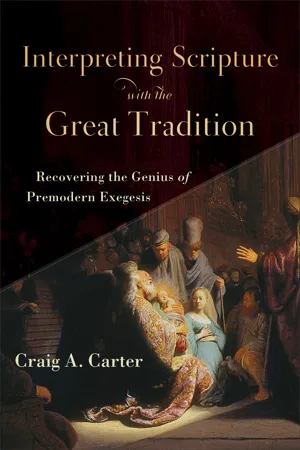
eBook - ePub
Interpreting Scripture with the Great Tradition
Recovering the Genius of Premodern Exegesis
- 304 pages
- English
- ePUB (mobile friendly)
- Available on iOS & Android
eBook - ePub
Interpreting Scripture with the Great Tradition
Recovering the Genius of Premodern Exegesis
About this book
The rise of modernity, especially the European Enlightenment and its aftermath, has negatively impacted the way we understand the nature and interpretation of Christian Scripture. In this introduction to biblical interpretation, Craig Carter evaluates the problems of post-Enlightenment hermeneutics and offers an alternative approach: exegesis in harmony with the Great Tradition. Carter argues for the validity of patristic christological exegesis, showing that we must recover the Nicene theological tradition as the context for contemporary exegesis, and seeks to root both the nature and interpretation of Scripture firmly in trinitarian orthodoxy.
Information
Topic
Theology & ReligionSubtopic
Biblical StudiesPart 1: Theological Hermeneutics
2
Toward a Theology of Scripture
God is not summoned into the presence of reason;
reason is summoned into the presence of God.
John Webster1
This chapter is foundational to my entire proposal. If academic hermeneutics is to be reformed so as to become an adequate basis for the preaching and teaching ministry of healthy, growing churches, it must be reformed on a theological basis. But what does this mean? One thing it must mean is that the role of philosophy in hermeneutics must be secondary to theological description rooted in special revelation. Theology must shape the philosophy that shapes hermeneutics.
Theology is the study of “God in himself” and of “all other things relative to him.”2 In this chapter, we are focusing on the work of God in which he communicates with his fallen, estranged creatures in such a way as to save them. So we are looking at the nature of God and the nature of creatures in relation to the One who created them and who is now engaged in redeeming them. We begin from revelation and therefore from a knowledge of the mighty acts of salvation done by God in history culminating in the death, resurrection, ascension, and heavenly session of our Lord Jesus Christ. Our task here is not to argue for the reality of God or his acts of salvation, but rather to understand who God is on the basis of what he has done.
The possibility of the reception of revelation by the creature is not primarily a matter of human capacity but is rather a possibility created by the powerful ability of the Triune God to make himself known to his creatures through his Word in the power of his Spirit. It is a matter of the capacity of God’s energetic, saving grace to overcome slothful creatures, penetrate the resistance of the rebels, and transform erstwhile enemies into friends. It is activity pictured vividly in the miracles by which Jesus Christ healed the deaf: “And they were astonished beyond measure, saying, ‘He has done all things well. He even makes the deaf hear and the mute speak’” (Mark 7:37).3 The resurrected Jesus Christ is the Word of God and because he is alive and all-powerful, he is able to overcome the obstacles to the receipt of revelation, which are chiefly a matter of sin, rather than being merely epistemological in nature. Or, rather, we could say more precisely that the obstacles, which are epistemological in nature, have their deepest roots in the effects of Adam’s fall and our willing complicity in his sin.
The act of reading a biblical text is not a secular act. It actually is a divine-human encounter. John Webster writes: “The act of reading Scripture—because it is the act of reading Scripture, the herald of the viva vox Dei—is not an instance of something else, but an act which, though it is analogous to other acts, is in its deepest reaches sui generis.”4 Nothing is more fundamental to the Christian life than reading the text of Scripture and submitting one’s life to the One who speaks His Word through the human words of the inspired text. And nothing is more damaging to the Christian life than the attempt to secularize this act of reading; to do so is to act like an atheist. If reading in faith is how we become Christians, reading without faith is how we become atheists. So the stakes are high.
We need not a general hermeneutics but a special hermeneutics. This does not mean, however, that we cannot use reading techniques that are used to interpret other kinds of writings. It just means that in the borrowing process, these methods must be transformed in light of the theological truth found in the Bible. For people trained in the spiritual practice of biblical interpretation, the reading of all texts (and writing itself) is transformed as a result of this spiritual training.5 The simple act of working out the grammar of a Greek sentence is something non-Christians do all the time, but in the case of the Christian interpreter, it is taken up into a larger matrix of reading practices and is thus sanctified for use by the Holy Spirit. Accurate translation is Christian translation when it is done by a believer who seeks to hear the living God speak and stands ready to obey. Reverence for God engenders reverence for the text, which leads to careful attention to the details of the text and its transmission. As Webster puts it, “Like other acts of Christian existence it is a human activity whose substance lies in its reference to and self-renunciation before the presence and action of God.”6 Texts that are memorized are regarded in a different light from texts that are not; all biblical interpreters should spend time memorizing Scripture. Careful, attentive, slow, meditative reading expresses reverence for the text of Scripture. The transformation of the various methods of reading texts derived from the surrounding culture and the process of adapting them in the service of biblical interpretation are testimonies to the fact that, in biblical interpretation, method is less important than what one believes about the nature of the biblical text and the divine reality to which it points: its res.
We need a theological description of the entire event of biblical interpretation in its context, and this means that we need a special hermeneutics that arises out of a true understanding of the inspired status of the text we are reading. As Webster pithily expresses it, “bibliology is prior to hermeneutics.”7 But, as he also pointed out, bibliology itself cannot be the starting point; the nature of the text is inseparable from the res of the text, its subject matter and substance. Bibliology is the account of God speaking through the text, so bibliology itself must be grounded within the doctrine of God. We do not really know what the Bible is until we know who it is who commandeers these human words and reveals himself through them. According to Webster, “Countering the hegemony of pure nature in bibliology and hermeneutics requires appeal to the Christian doctrine of God.”8 The doctrine of God generates a theological understanding of who we are as readers and the nature of the situation in which we read. But note well, it is the Christian doctrine of God to which we must appeal. We are talking about appealing to the specific understanding of God that is derived from the prophets and apostles of Holy Scripture by means of exegesis. It is an appeal to the Holy Trinity. This means that a certain kind of circularity is inevitable in talking about a “Christian doctrine” of anything—not a vicious circle, but rather an expanding circle of understanding.
We must take seriously the back-and-forth nature of dogmatic theology; we as theologians are not Moses coming down from the mountain but are more like Paul reasoning in the synagogue, trying to convince his fellow Jews that Jesus is the Messiah of the Scriptures. Theology involves reading the text, meditating on it, drawing conclusions from it, arguing over it, reflecting on the dogmatic and philosophical implications of those (perhaps revised) conclusions, and then coming back to the text and reading it again from our new perspective. Later readings are shaped by prior readings, yet result in further insight. Is this not everyone’s experience? Who reads the text once and understands it, and all the implications that flow from it, instantaneously? Who has never changed an interpretation based on further reflection and discussion? And yet, who does not have settled convictions about the meaning of the text that one could not imagine changing?
This process of reading, meditating, formulating dogmatic propositions, rereading the text, gaining further insight, and so on is the context in which a theological metaphysics develops that allows us gradually to realize who we are, where we are, what our situation is, who is speaking to us, and how we should respond. This is the setting in which theology is done. Part of becoming a theologian is learning our true identity, the truth about our world, the true nature of our problem, and the true nature of the text we are reading and who is speaking to us. Hans Boersma calls this a “sacramental ontology,”9 which is a good way to describe the biblical understanding of reality that is depicted imaginatively in the fiction of J. R. R. Tolkien and C. S. Lewis.10 Matthew Levering calls for “participatory exegesis,” which is done on the basis of a metaphysics in which history is seen as participating in God.11 Webster speaks of “a textual and hermeneutical ontology.”12 I prefer the language of “theological metaphysics,” by which I mean the metaphysical implications of the Nicene doctrine of God. This variation in terminology should not obscure fundamental agreement on the main point. What we are all talking about is the nature of God, the inspiration of Scripture, our fallen human nature, and the process by which communication between God and us takes place. What is crucial is that we recognize that we do not define the situation into which God is allowed to speak, and we do not set limits on what God is allowed to say. Instead, we come to realize our true situation only as we actually read the Scriptures and believe the Word of God. We are hearers, which places us in a subordinate position ready to receive what is given as gift.
The double meaning of “Word” as referring to the Second Person of the Trinity, who became incarnate in Jesus of Nazareth, and also as the spoken Word of the Triune God, which is inscripturated in the words of the prophets and apostles of Holy Scripture, is a very significant double meaning. We will need to reflect on how to think about the relation between these two meanings of the word “Word” by meditating on the relationship of the eternal Son who became incarnate to the words in the text of Holy Scripture that refer to him. We need to see an analogy but not an identity; not everything that can be said of the incarnation can rightly be said of Scripture.13 Commenting on Telford Work’s proposal in Loving and Active: Scripture in the Economy of Salvation, Webster says that while it is one of the few contemporary works to take seriously the need for a theological ontology of the Bible, it “goes awry” in failing to maintain the Creator-creature distinction with sufficient rigor. As Webster says, “Scripture does not have a divine nature.” But this does not mean that we must secularize Scripture as purely natural, and it does not mean that we “uncouple scriptural signs and divine Word” in “nominalist fashion.”14 What Webster is after here is the distinction between incarnation and sacrament. For him, Scripture functions sacramentally; the doctrine of inspiration (which he unpacks as providence, sanctification, and inspiration) is the theological explanation for how that happens. Scripture functions sacramentally for him, just as it does for Hans Boersma, who shows what deep roots in the Christian tradition such a concept actually has.
Boersma’s recent book, Scripture as Real Presence: Sacramental Exegesis in the Early Church, describes in great detail and with penetrating insight the sacramental exegesis of the early church fathers. Far from being a dispassionate historical description, his book actually is an argument for the contemporary relevance of patristic exegesis. His point is not that we must slavishly copy and repeat the exact exegetical choices of the fathers in every respect but rather that their conviction that “Christ is the hidden treasure present in the visibilia of the Old Testament Scriptures” is as true today as it ever was.15 He notes that the weakness of modern historical exegesis is that “it doesn’t treat the Old Testament as a sacrament (sacramentus) that already contains the New Testament reality (res) of Christ.”16 Boersma points out that Augustine “regularly refers to scriptural texts as sacramenta,”17 which indicates the deep roots of this view of Scripture in the Great Tradition. Webster’s work on Scripture is ...
Table of contents
- Cover
- Title Page
- Copyright Page
- Endorsements
- Dedication
- Contents
- Preface
- Acknowledgments
- Abbreviations
- Introduction
- Part 1: Theological Hermeneutics
- Part 2: Recovering Premodern Exegesis
- Conclusion
- Appendix: Criteria for Limiting the Spiritual Sense
- Bibliography
- Index of Scripture
- Index of Persons
- Index of Subjects
- Back Cover
Trusted by 375,005 students
Access to over 1.5 million titles for a fair monthly price.
Study more efficiently using our study tools.
Frequently asked questions
Yes, you can cancel anytime from the Subscription tab in your account settings on the Perlego website. Your subscription will stay active until the end of your current billing period. Learn how to cancel your subscription
No, books cannot be downloaded as external files, such as PDFs, for use outside of Perlego. However, you can download books within the Perlego app for offline reading on mobile or tablet. Learn how to download books offline
Perlego offers two plans: Essential and Complete
- Essential is ideal for learners and professionals who enjoy exploring a wide range of subjects. Access the Essential Library with 800,000+ trusted titles and best-sellers across business, personal growth, and the humanities. Includes unlimited reading time and Standard Read Aloud voice.
- Complete: Perfect for advanced learners and researchers needing full, unrestricted access. Unlock 1.5M+ books across hundreds of subjects, including academic and specialized titles. The Complete Plan also includes advanced features like Premium Read Aloud and Research Assistant.
We are an online textbook subscription service, where you can get access to an entire online library for less than the price of a single book per month. With over 1.5 million books across 990+ topics, we’ve got you covered! Learn about our mission
Look out for the read-aloud symbol on your next book to see if you can listen to it. The read-aloud tool reads text aloud for you, highlighting the text as it is being read. You can pause it, speed it up and slow it down. Learn more about Read Aloud
Yes! You can use the Perlego app on both iOS and Android devices to read anytime, anywhere — even offline. Perfect for commutes or when you’re on the go.
Please note we cannot support devices running on iOS 13 and Android 7 or earlier. Learn more about using the app
Please note we cannot support devices running on iOS 13 and Android 7 or earlier. Learn more about using the app
Yes, you can access Interpreting Scripture with the Great Tradition by Craig A. Carter in PDF and/or ePUB format, as well as other popular books in Theology & Religion & Biblical Studies. We have over 1.5 million books available in our catalogue for you to explore.