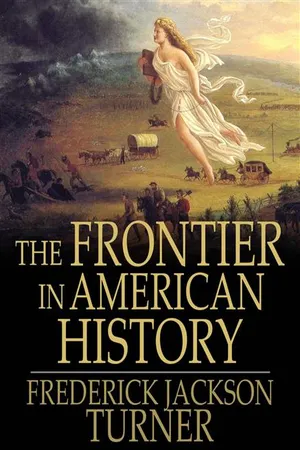
- 333 pages
- English
- ePUB (mobile friendly)
- Available on iOS & Android
eBook - ePub
Information
Topic
GeschichteSubtopic
WeltgeschichtePreface
*
In republishing these essays in collected form, it has seemed best to issue them as they were originally printed, with the exception of a few slight corrections of slips in the text and with the omission of occasional duplication of language in the different essays. A considerable part of whatever value they may possess arises from the fact that they are commentaries in different periods on the central theme of the influence of the frontier in American history. Consequently they may have some historical significance as contemporaneous attempts of a student of American history, at successive transitions in our development during the past quarter century to interpret the relations of the present to the past. Grateful acknowledgment is made to the various societies and periodicals which have given permission to reprint the essays.
Various essays dealing with the connection of diplomatic history and the frontier and others stressing the significance of the section, or geographic province, in American history, are not included in the present collection. Neither the French nor the Spanish frontier is within the scope of the volume.
The future alone can disclose how far these interpretations are correct for the age of colonization which came gradually to an end with the disappearance of the frontier and free land. It alone can reveal how much of the courageous, creative American spirit, and how large a part of the historic American ideals are to be carried over into that new age which is replacing the era of free lands and of measurable isolation by consolidated and complex industrial development and by increasing resemblances and connections between the New World and the Old.
But the larger part of what has been distinctive and valuable in America's contribution to the history of the human spirit has been due to this nation's peculiar experience in extending its type of frontier into new regions; and in creating peaceful societies with new ideals in the successive vast and differing geographic provinces which together make up the United States. Directly or indirectly these experiences shaped the life of the Eastern as well as the Western States, and even reacted upon the Old World and influenced the direction of its thought and its progress. This experience has been fundamental in the economic, political and social characteristics of the American people and in their conceptions of their destiny.
Writing at the close of 1796, the French minister to the United States, M. Adet, reported to his government that Jefferson could not be relied on to be devoted to French interests, and he added: "Jefferson, I say, is American, and by that name, he cannot be sincerely our friend. An American is the born enemy of all European peoples." Obviously erroneous as are these words, there was an element of truth in them. If we would understand this element of truth, we must study the transforming influence of the American wilderness, remote from Europe, and by its resources and its free opportunities affording the conditions under which a new people, with new social and political types and ideals, could arise to play its own part in the world, and to influence Europe.
FREDERICK J. TURNER.
HARVARD UNIVERSITY, March, 1920.
I - The Significance of the Frontier in American History[1]
*
In a recent bulletin of the Superintendent of the Census for 1890 appear these significant words: "Up to and including 1880 the country had a frontier of settlement, but at present the unsettled area has been so broken into by isolated bodies of settlement that there can hardly be said to be a frontier line. In the discussion of its extent, its westward movement, etc., it can not, therefore, any longer have a place in the census reports." This brief official statement marks the closing of a great historic movement. Up to our own day American history has been in a large degree the history of the colonization of the Great West. The existence of an area of free land, its continuous recession, and the advance of American settlement westward, explain American development.
Behind institutions, behind constitutional forms and modifications, lie the vital forces that call these organs into life and shape them to meet changing conditions. The peculiarity of American institutions is, the fact that they have been compelled to adapt themselves to the changes of an expanding people—to the changes involved in crossing a continent, in winning a wilderness, and in developing at each area of this progress out of the primitive economic and political conditions of the frontier into the complexity of city life. Said Calhoun in 1817, "We are great, and rapidly—I was about to say fearfully—growing!"[2] So saying, he touched the distinguishing feature of American life. All peoples show development; the germ theory of politics has been sufficiently emphasized. In the case of most nations, however, the development has occurred in a limited area; and if the nation has expanded, it has met other growing peoples whom it has conquered. But in the case of the United States we have a different phenomenon. Limiting our attention to the Atlantic coast, we have the familiar phenomenon of the evolution of institutions in a limited area, such as the rise of representative government; the differentiation of simple colonial governments into complex organs; the progress from primitive industrial society, without division of labor, up to manufacturing civilization. But we have in addition to this a recurrence of the process of evolution in each western area reached in the process of expansion. Thus American development has exhibited not merely advance along a single line, but a return to primitive conditions on a continually advancing frontier line, and a new development for that area. American social development has been continually beginning over again on the frontier. This perennial rebirth, this fluidity of American life, this expansion westward with its new opportunities, its continuous touch with the simplicity of primitive society, furnish the forces dominating American character. The true point of view in the history of this nation is not the Atlantic coast, it is the Great West. Even the slavery struggle, which is made so exclusive an object of attention by writers like Professor von Holst, occupies its important place in American history because of its relation to westward expansion.
In this advance, the frontier is the outer edge of the wave—the meeting point between savagery and civilization. Much has been written about the frontier from the point of view of border warfare and the chase, but as a field for the serious study of the economist and the historian it has been neglected.
The American frontier is sharply distinguished from the European frontier—a fortified boundary line running through dense populations. The most significant thing about the American frontier is, that it lies at the hither edge of free land. In the census reports it is treated as the margin of that settlement which has a density of two or more to the square mile. The term is an elastic one, and for our purposes does not need sharp definition. We shall consider the whole frontier belt, including the Indian country and the outer margin of the "settled area" of the census reports. This paper will make no attempt to treat the subject exhaustively; its aim is simply to call attention to the frontier as a fertile field for investigation, and to suggest some of the problems which arise in connection with it.
In the settlement of America we have to observe how European life entered the continent, and how America modified and developed that life and reacted on Europe. Our early history is the study of European germs developing in an American environment. Too exclusive attention has been paid by institutional students to the Germanic origins, too little to the American factors. The frontier is the line of most rapid and effective Americanization. The wilderness masters the colonist. It finds him a European in dress, industries, tools, modes of travel, and thought. It takes him from the railroad car and puts him in the birch canoe. It strips off the garments of civilization and arrays him in the hunting shirt and the moccasin. It puts him in the log cabin of the Cherokee and Iroquois and runs an Indian palisade around him. Before long he has gone to planting Indian corn and plowing with a sharp stick; he shouts the war cry and takes the scalp in orthodox Indian fashion. In short, at the frontier the environment is at first too strong for the man. He must accept the conditions which it furnishes, or perish, and so he fits himself into the Indian clearings and follows the Indian trails. Little by little he transforms the wilderness, but the outcome is not the old Europe, not simply the development of Germanic germs, any more than the first phenomenon was a case of reversion to the Germanic mark. The fact is, that here is a new product that is American. At first, the frontier was the Atlantic coast. It was the frontier of Europe in a very real sense. Moving westward, the frontier became more and more American. As successive terminal moraines result from successive glaciations, so each frontier leaves its traces behind it, and when it becomes a settled area the region still partakes of the frontier characteristics. Thus the advance of the frontier has meant a steady movement away from the influence of Europe, a steady growth of independence on American lines. And to study this advance, the men who grew up under these conditions, and the political, economic, and social results of it, is to study the really American part of our history.
In the course of the seventeenth century the frontier was advanced up the Atlantic river courses, just beyond the "fall line," and the tidewater region became the settled area. In the first half of the eighteenth century another advance occurred. Traders followed the Delaware and Shawnese Indians to the Ohio as early as the end of the first quarter of the century.[3] Gov. Spots5ood, of Virginia, made an expedition in 1714 across the Blue Ridge. The end of the first quarter of the century saw the advance of the Scotch-Irish and the Palatine Germans up the Shenandoah Valley into the western part of Virginia, and along the Piedmont region of the Carolinas.[4] The Germans in New York pushed the frontier of settlement up the Mohawk to German Flats.[5] In Pennsylvania the town of Bedford indicates the line of settlement. Settlements soon began on the New River, or the Great Kanawha, and on the sources of the Yadkin and French Broad.[6] The King attempted to arrest the advance by his proclamation of 1763,[7] forbidding settlements beyond the sources of the rivers flowing into the Atlantic; but in vain. In the period of the Revolution the frontier crossed the Alleghanies into Kentucky and Tennessee, and the upper waters of the Ohio were settled.[8] When the first census was taken in 1790, the continuous settled area was bounded by a line which ran near the coast of Maine, and included New England except a portion of Vermont and New Hampshire, New York along the Hudson and up the Mohawk about Schenectady, eastern and southern Pennsylvania, Virginia well across the Shenandoah Valley, and the Carolinas and eastern Georgia.[9] Beyond this region of continuous settlement were the small settled areas of Kentucky and Tennessee, and the Ohio, with the mountains intervening between them and the Atlantic area, thus giving a new and important character to the frontier. The isolation of the region increased its peculiarly American tendencies, and the need of transportation facilities to connect it with the East called out important schemes of internal improvement, which will be noted farther on. The "West," as a self-conscious section, began to evolve.
From decade to decade distinct advances of the frontier occurred. By the census of 1820[10] the settled area included Ohio, southern Indiana and Illinois, southeastern Missouri, and about one-half of Louisiana. This settled area had surrounded Indian areas, and the management of these tribes became an object of political concern. The frontier region of the time lay along the Great Lakes, where Astor's American Fur Company operated in the Indian trade,[11] and beyond the Mississippi, where Indian traders extended their activity even to the Rocky Mountains; Florida also furnished frontier conditions. The Mississippi River region was the scene of typical frontier settlements.[12]
The rising steam navigation[13] on western waters, the opening of the Erie Canal, and the westward extension of cotton[14] culture added five frontier states to the Union in this period. Grund, writing in 1836, declares: "It appears then that the universal disposition of Americans to emigrate to the western wilderness, in order to enlarge their dominion over inanimate nature, is the actual result of an expansive power which is inherent in them, and which by continually agitating all classes of society is constantly throwing a large portion of the whole population on the extreme confines of the State, in order to gain space for its development. Hardly is a new State or Territory formed before the same principle manifests itself again and gives rise to a further emigration; and so is it destined to go on until a physical barrier must finally obstruct its progress."[15]
In the middle of this century the line indicated by the present eastern boundary of Indian Territory, Nebraska, and Kansas marked the frontier of the Indian country.[16] Minnesota and Wisconsin still exhibited frontier conditions,[17] but the distinctive frontier of the period is found in California, where the gold discoveries had sent a sudden tide of adventurous miners, and in Oregon, and the settlements in Utah.[18] As the frontier had leaped over the Alleghanies, so now it skipped the Great Plains and the Rocky Mountains; and in the same way that the advance of the frontiersmen beyond the Alleghanies had caused the rise of important questions of transportation and internal improvement, so now the settlers beyond the Rocky Mountains needed means of communication with the East, and in the furnishing of these arose the settlement of the Great Plains and the development of still another kind of frontier life. Railroads, fostered by land grants, sent an increasing tide of immigrants into the Far West. The United States Army fought a series of Indian wars in Minnesota, Dakota, and the Indian Territory.
By 1880 the settled area had been pushed into northern Michigan, Wisconsin, and Minnesota, along Dakota rivers, and in the Black Hills region, and was ascending the rivers of Kansas and Nebraska. The development of mines in Colorado had drawn isolated frontier settlements into that region, and Montana and Idaho were receiving settlers. The frontier was found in these mining camps and the ranches of the Great Plains. The superintendent of the census for 1890 reports, as previously stated, that the settlements of the West lie so scattered over the region that there can no longer be said to be a frontier line.
In these successive frontiers we find natural boundary lines which have served to mark and to affect the characteristics of the frontiers, namely: the "fall line;" the Alleghany Mountains; the Mississippi; the Missouri where its direction approximates north and south; the line of the arid lands, approximately the ninety-ninth meridian; and the Rocky Mountains. The fall line marked the frontier of the seventeenth century; the Alleghanies that of the eighteenth; the Mississippi that of the first quarter of the nineteenth; the Missouri that of the middle of this century (omitting the California movement); and the belt of the Rocky Mountains and the arid tract, the present frontier. Each was won by a series of Indian wars.
At the Atlantic frontier one can study the germs of processes repeated at each successive frontier. We have the complex European life sharply precipitated by the wilderness into the simplicity of primitive conditions. The first frontier had to meet its Indian question, its question of the disposition of the public domain, of the means of intercourse with older settlements, of the extension of political organization, of religious and educational activity. And the settlement of these and similar questions for one frontier served as a guide for the next. The American student needs not to go to the "prim little townships of Sleswick" for illustrations of the law of continuity and development. For example, he may study the origin of our land policies in the colonial land policy; he may see how the system grew by adapting the statutes to the customs of the successive frontiers.[19] He may see how the mining experience in the lead regions of Wisconsin, Illinois, and Iowa was applied to the mining laws of the Sierras,[20] and how our Indian policy has been a series of experimentations on successive frontiers. Each tier of new States has found in the older ones material for its constitutions.[21] Each frontier has made similar contributions to American character, as will be discussed farther on.
But with all these similarities there are essential differences due to the place element and the time element. It is evident that the farming frontier of the Mississippi Valley presents different conditions from the mining frontier of the Rocky Mountains. The frontier reached by the Pacific Railroad, surveyed into rectangles, guarded by the United States Army, and recruited by the daily immigrant ship, moves forward at a swifter pace and in a different way than the frontier reached by the birch canoe or the pack horse. The geologist traces patiently the shores of ancient seas, maps their areas, and compares the older and the newer. It would be a work worth the historian's labors to mark these various frontiers and in detail compare one with another. Not only would there result a more adequate conception of American development and characteristics, but invaluable additions would be made to the history of society.
Loria,[22] the Italian economist, has urged the study of colonial life as an aid in understanding the stages of European development, affirming that colonial settlement is for economic science what the mountain is for geology, bringing to light primitive stratifications. "America," he says, "has the key to the historical enigma which Europe has sought for centuries in vain, and the land which has no history reveals luminously the course of universal history." There is much truth in this. The United States lies like a huge page in ...
Table of contents
- THE FRONTIER IN AMERICAN HISTORY
- Contents
- Preface
- Endnotes
Trusted by 375,005 students
Access to over 1.5 million titles for a fair monthly price.
Study more efficiently using our study tools.
Frequently asked questions
Yes, you can cancel anytime from the Subscription tab in your account settings on the Perlego website. Your subscription will stay active until the end of your current billing period. Learn how to cancel your subscription
No, books cannot be downloaded as external files, such as PDFs, for use outside of Perlego. However, you can download books within the Perlego app for offline reading on mobile or tablet. Learn how to download books offline
Perlego offers two plans: Essential and Complete
- Essential is ideal for learners and professionals who enjoy exploring a wide range of subjects. Access the Essential Library with 800,000+ trusted titles and best-sellers across business, personal growth, and the humanities. Includes unlimited reading time and Standard Read Aloud voice.
- Complete: Perfect for advanced learners and researchers needing full, unrestricted access. Unlock 1.5M+ books across hundreds of subjects, including academic and specialized titles. The Complete Plan also includes advanced features like Premium Read Aloud and Research Assistant.
We are an online textbook subscription service, where you can get access to an entire online library for less than the price of a single book per month. With over 1.5 million books across 990+ topics, we’ve got you covered! Learn about our mission
Look out for the read-aloud symbol on your next book to see if you can listen to it. The read-aloud tool reads text aloud for you, highlighting the text as it is being read. You can pause it, speed it up and slow it down. Learn more about Read Aloud
Yes! You can use the Perlego app on both iOS and Android devices to read anytime, anywhere — even offline. Perfect for commutes or when you’re on the go.
Please note we cannot support devices running on iOS 13 and Android 7 or earlier. Learn more about using the app
Please note we cannot support devices running on iOS 13 and Android 7 or earlier. Learn more about using the app
Yes, you can access Frontier in American History by in PDF and/or ePUB format, as well as other popular books in Geschichte & Weltgeschichte. We have over 1.5 million books available in our catalogue for you to explore.