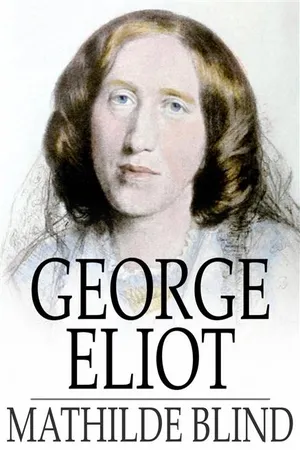
eBook - ePub
Information
Publisher
The Floating PresseBook ISBN
9781776537112
Year
2014Chapter I - Introductory
*
Speaking of the contributions made to literature by her own sex, George
Eliot, in a charming essay written in 1854, awards the palm of
intellectual pre-eminence to the women of France. "They alone," says the
great English author, "have had a vital influence on the development of
literature. For in France alone the mind of woman has passed, like an
electric current, through the language, making crisp and definite what
is elsewhere heavy and blurred; in France alone, if the writings of
women were swept away, a serious gap would be made in the national
history."
The reason assigned by George Eliot for this literary superiority of
Frenchwomen consists in their having had the courage of their sex. They
thought and felt as women, and when they wrote, their books became the
fullest expression of their womanhood. And by being true to themselves,
by only seeking inspiration from their own life-experience, instead of
servilely copying that of men, their letters and memoirs, their novels
and pictures have a distinct, nay unique, value, for the student of art
and literature. Englishwomen, on the other hand, have not followed the
spontaneous impulses of nature. They have not allowed free play to the
peculiarly feminine element, preferring to mould their intellectual
products on the masculine pattern. For that reason, says George Eliot,
their writings are "usually an absurd exaggeration of the masculine
style, like the swaggering gait of a bad actress in male attire."
This novel theory, concerning a specifically feminine manifestation of
the intellect, is doubly curious when one compares it with Madame de
Staël's famous saying, "Le génie n'a pas de sexe." But an aphorism,
however brilliant, usually contains only one half the truth, and there
is every reason to think that women have already, and will much more
largely, by-and-by, infuse into their works certain intellectual and
emotional qualities which are essentially their own. Shall we, however,
admit George Eliot's conclusion that Frenchwomen alone have hitherto
shown any of this original bias? Several causes are mentioned by her in
explanation of this exceptional merit. Among these causes there is one
which would probably occur to every one who began to reflect on this
subject. The influence of the "Salon" in developing and stimulating the
finest feminine talents has long been recognised. In this school for
women the gift of expression was carried to the utmost pitch of
perfection. By their active co-operation in the discussion of the most
vital subjects, thought became clear, luminous, and forcible; sentiment
gained indescribable graces of refinement; and wit, with its brightest
scintillations, lit up the sombre background of life.
But among other causes enumerated as accounting for that more
spontaneous productivity of Frenchwomen, attributed to them by George
Eliot, there is one which would probably have occurred to no other mind
than hers, and which is too characteristic of her early scientific
tendencies to be omitted. For according to her, the present superiority
of Frenchwomen is mainly due to certain physiological peculiarities of
the Gallic race. Namely, to the "small brain and vivacious temperament
which permit the fragile system of woman to sustain the superlative
activity requisite for intellectual creativeness," whereas "the larger
brain and slower temperament of the English and Germans are in the
womanly organisation generally dreamy and passive. So that the
physique of a woman may suffice as the substratum for a superior
Gallic mind, but is too thin a soil for a superior Teutonic one."
So knotty and subtle a problem must be left to the scientist of the
future to decide. Perhaps some promising young physiologist, profiting
by the "George Henry Lewes Studentship" founded by George Eliot, may
some day satisfactorily elucidate this question. In the meanwhile it is
at least gratifying to reflect that she does not deny the future
possibilities of even English and German women. She admits that
conditions might arise which in their case also would be favourable to
the highest creative effort; conditions which would modify the existing
state of things according to which, to speak in her own scientific
phraseology: "The woman of large capacity can seldom rise beyond the
absorption of ideas; her physical conditions refuse to support the
energy required for spontaneous activity; the voltaic pile is not strong
enough to produce crystallisations."
But was the author of 'Adam Bede' not herself destined to be a
triumphant refutation of her theory? Or had those more favourable
circumstances mentioned as vague possibilities already arisen in her
case? Not that we believe, for that matter, in the superior claims of
illustrious Frenchwomen. It is true George Eliot enumerates a formidable
list of names. But on the whole we may boast of feminine celebrities
that need not shrink from the comparison.
There is, of course, much truth in the great Englishwoman's generous
praise of her French compeers. "Mme. de Sévigné remains," she says, "the
single instance of a woman who is supreme in a class of literature which
has engaged the ambition of men; Mme. Dacier still reigns the queen of
blue-stockings, though women have long studied Greek without shame; Mme.
de Staël's name still rises to the lips when we are asked to mention a
woman of great intellectual power; Mme. Roland is still the unrivalled
type of the sagacious and sternly heroic yet lovable woman; George Sand
is the unapproached artist who, to Jean Jacques' eloquence and deep
sense of external nature, unites the clear delineation of character and
the tragic depth of passion."
Shall we be forced to admit that the representative women of England
cannot justly be placed on as high a level? Is it so certain that they,
too, did not speak out of the fulness of their womanly natures? That
they too did not feel the genuine need to express modes of thought and
feeling peculiar to themselves, which men, if at all, had but
inadequately expressed hitherto?
Was not Queen Elizabeth the best type of a female ruler, one whose keen
penetration enabled her to choose her ministers with infallible
judgment? Did not Fanny Burney distil the delicate aroma of girlhood in
one of the most delightful of novels? Or what of Jane Austen, whose
microscopic fidelity of observation has a well-nigh scientific accuracy,
never equalled unless in the pages of the author we are writing of? Sir
Walter Scott apparently recognised the eminently feminine inspiration of
her writings, as he says: "That young lady had a talent for describing
the involvements, and feelings, and characters of ordinary life, which
is for me the most wonderful I ever met with. The Bow-wow strain I can
do myself like any now agoing; but the exquisite touch, which renders
ordinary commonplace things and characters interesting from the truth of
the descriptions and the sentiment, is denied to me." Then turning to
the Brontës, does not one feel the very heartbeats of womanhood in those
powerful utterances that seem to spring from some central emotional
energy? Again, does not Mrs. Browning occupy a unique place among poets?
Is there not a distinctively womanly strain of emotion in the throbbing
tides of her high-wrought melodious song? And, to come to George Eliot
herself, will any one deny that, in the combination of sheer
intellectual power with an unparalleled vision for the homely details of
life, she takes precedence of all writers of this or any other country?
To some extent this wonderful woman conforms to her own standard. She
undoubtedly adds to the common fund of crystallised human experience, as
literature might be called, something which is specifically feminine.
But, on the other hand, her intellect excels precisely in those
qualities habitually believed to be masculine, one of its chief
characteristics consisting in the grasp of abstract philosophical ideas.
This faculty, however, by no means impairs those instinctive processes
of the imagination by which true artistic work is produced; George Eliot
combining in an unusual degree the subtlest power of analysis with that
happy gift of genius which enabled her to create such characters as Amos
Barton, Hetty, Mrs. Poyser, Maggie, and Tom Tulliver, Godfrey Cass and
Caleb Garth, which seem to come fresh from the mould of Nature itself.
Indeed, she has hardly a rival among women in this power of objective
imagination by which she throws her whole soul into natures of the most
varied and opposite types, whereas George Sand only succeeds greatly
when she is thoroughly in sympathy with her creations.
After George Eliot's eulogium of French women, one feels tempted to
institute a comparison between these two great contemporaries, who
occupied the same leading position in their respective countries. But it
will probably always remain a question of idiosyncracy which of the two
one is disposed to rank higher, George Eliot being the greatest realist,
George Sand the greatest idealist, of her sex. The works of the French
writer are, in fact, prose poems rather than novels. They are not
studies of life, but life interpreted by the poet's vision. George Sand
cannot give us a description of any scene in nature, of her own
feelings, of a human character, without imparting to it some magical
effect as of objects seen under the transfiguring influence of moonlight
or storm clouds; whereas George Eliot loves to bathe her productions in
the broad pitiless midday light, which leaves no room for illusion, but
reveals all nature with uncompromising directness. The one has more of
that primitive imagination which seizes on the elemental side of
life—on the spectacle of the starry heavens or of Alpine solitudes, on
the insurrection and tumult of human passion, on the shocks of
revolution convulsing the social order—while the other possesses, in a
higher degree, the acute intellectual perception for the orderly
sequence of life, for that unchangeable round of toil which is the lot
of the mass of men, and for the earth in its homelier aspects as it
tells on our daily existence. In George Sand's finest work there is a
sweet spontaneity, almost as if she were an oracle of Nature uttering
automatically the divine message. But, on the other hand, when the
inspiration forsakes her, she drifts along on a windy current of words,
the fatal facility of her pen often beguiling the writer into vague
diffuseness and unsubstantial declamation.
In this respect, also, our English novelist is the opposite of George
Sand, for George Eliot invariably remains the master of her genius:
indeed, she thoroughly fulfils Goethe's demand that if you set up for an
artist you must command art. This intellectual self-restraint never
forsakes George Eliot, who always selects her means with a thorough
knowledge of the ends to be attained. The radical difference in the
genius of these two writers, to both of whom applies Mrs. Browning's apt
appellation of "large-brained woman and large-hearted man," extends
naturally to their whole tone of thought. George Sand is impassioned,
turbulent, revolutionary, the spiritual daughter of Rousseau, with an
enthusiastic faith in man's future destiny. George Eliot, contemplative,
observant, instinctively conservative, her imagination dearly loving to
do "a little Toryism on the sly," is as yet the sole outcome of the
modern positive spirit in imaginative literature—the sole novelist who
has incorporated in an artistic form some of the leading ideas of Comte,
of Mazzini, and of Darwin. In fact, underlying all her art there is the
same rigorous teaching of the inexorable laws which govern the life of
man. The teaching that not liberty but duty is the condition of
existence; the teaching of the incalculable effects of hereditary
transmission, with the solemn responsibilities it involves; the teaching
of the inherent sadness and imperfection in human nature, which render
resignation the first virtue of man.
In fact, as a moral influence, George Eliot cannot so much be compared
with George Sand, or with any other novelist of her generation, as with
Carlyle. She had, indeed, a far more explicit ethical code to offer than
the author of 'Sartor Resartus.' For though the immense force of the
latter's personality, glowing through his writings, had a tonic effect
in promoting a healthy moral tone, there was little of positive moral
truth to be gathered from them. But the lessons which George Eliot would
fain teach to men were most unmistakable in their bearing—the lessons
of pitying love towards fellow-men; of sympathy with all human
suffering; of unwavering faithfulness towards the social bond,
consisting in the claims of race, of country, of family; of unflagging
aspiration after that life which is most beneficent to the community,
that life, in short, towards which she herself aspired in the now famous
prayer to reach
"That purest heaven, be to other souls
The cup of strength in some great agony,
Enkindle generous ardour, feed pure love,
Beget the smiles that have no cruelty—
Be the sweet presence of a good diffused,
And in diffusion ever more intense."
The cup of strength in some great agony,
Enkindle generous ardour, feed pure love,
Beget the smiles that have no cruelty—
Be the sweet presence of a good diffused,
And in diffusion ever more intense."
Chapter II - Childhood and Early Home
*
Mary Ann Evans, better known as "George Eliot," was born on November 22nd, 1819, at South Farm, a mile from Griff, in the parish of Colton, in Warwickshire. Both the date and place of her birth have been incorrectly stated, hitherto, in the notices of her life. The family moved to Griff House in March of the following year, when she was only six months old. Her father, Robert Evans, of Welsh origin, was a Staffordshire man from Ellaston, near Ashbourne, and began life as a carpenter. In the kitchen at Griff House may still be seen a beautifully-fashioned oaken press, a sample of his workmanship. A portrait of him, also preserved there, is known among the family as "Adam Bede." It is not as good a likeness as that of a certain carefully painted miniature, the features of which bear an unmistakable resemblance to those of the daughter destined to immortalise his name. A strongly marked, yet handsome face, massive in structure, and with brown eyes, whose shrewd, penetrating glance is particularly noticeable, betoken the man of strong practical intelligence, of rare energy and endurance. His career and character are partially depicted in Adam Bede, Caleb Garth, and Mr. Hackit—portraitures in which the different stages of his life are recorded with a mingling of fact and fiction. A shadowing forth of the same nature is discernible in the devotion of Stradivarius to his noble craft; and even in the tender paternity of Mr. Tulliver there are indications of another phase of the same individuality.
Like Adam Bede, Mr. Evans from carpenter rose to be forester, and from forester to be land-agent. It was in the latter capacity alone that he was ever known in Warwickshire. At one time he was surveyor to five estates in the midland counties—those of Lord Aylesford, Lord Lifford, Mr. Bromley Davenport, Mrs. Gregory, and Sir Roger Newdigate. The last was his principal employer. Having early discerned the exceptional capacity of the man, Sir Roger induced him to settle in Warwickshire, and take charge of his estates. Sir Roger's seat, Arbury Hall, is the original of the charming description of Cheverel Manor in 'Mr. Gilfil's Love Story.' It is said that Mr. Evans's trustworthiness had become proverbial in the county. But while faithfully serving his employers he also enjoyed great popularity among their tenants. He was gentle, but of indomitable firmness; and while stern to the idle and unthrifty, he did not press heavily on those who might be behindhand with their rent, owing to ill-luck or misfortune, on quarter days.
Mr. Evans was twice married. He had lost his first wife, by whom he had a son and a daughter, before settling in Warwickshire. Of his second wife, whose maiden name was Pearson, very little is known. She must, therefore, according to Schiller, have been a pattern of womanhood; for he says that the best women, like the best ruled states, have no history. We have it on very good authority, however, that Mrs. Hackit, in 'Amos Barton,' is a faithful likeness of George Eliot's mother. This may seem startling at first, but, on reflection, she is the woman one might have expected, being a strongly-marked figure, with a heart as tender as her tongue is sharp. She is described as a thin woman, with a chronic liver-complaint, of indefatigable industry and epigrammatic speech; who, "in the utmost enjoyment of spoiling a friend's self-satisfaction, was never known to spoil a stocking." A notable housewife, whose clockwork regularity in all domestic affairs was such that all her farm-work was done by nine o'clock in the morning, when she would sit down to her loom. "In the same spirit, she brought out her furs on the first of November, whatever might be the temperature. She was not a woman weakly to accommodate herself to shilly-shally proceedings. If the season didn't know what it ought to do, Mrs. Hackit did. In her best days it was always sharp weather at 'Gunpowder Plot,' and she didn't like new fashions." Keenly observant and quick of temper, she was yet full of good nature, her sympathy showing itself in the active helpfulness with which she came to the assistance of poor Milly Barton, and the love she showed to her children, who, however, declined kissing her.
Is there not a strong family resemblance between this character and Mrs. Poyser, that masterpiece of George Eliot's art? Mary Ann's gift of pointed speech was therefore mother-wit, in the true sense, and her rich humour and marvellous powers of observation were derived from the same side, while her conscientiousness, her capacity, and that faculty of taking pains, which is so large a factor in the development of genius, came more directly from the father.
Mr. Evans had three children by his second wife, Christiana, Isaac, and Mary Ann. "It is interesting, I think," writes George Eliot, in reply to some questions of an American lady, "to know whether a writer was born in a central or border district—a condition which always has a strongly determining influence. I was born in Warwickshire, but certain family traditions connected with more northerly districts made these districts a region of poetry to me in my early childhood." In the autobiographical sonnets, entitled 'Brother and Sister,' we catch a glimpse of the mother preparing her children for their accustomed ramble, by stroking down the tippet and setting the frill in order; then standing on the door-step to follow their lessening figures "with the benediction of her gaze." Mrs. Evans was aware, to a certain extent, of her daughter's unusual capacity, being anxious not only that she should have the best education attainable in the neighbourhood, but also that good moral influences should be brought to bear upon her: still, the girl's constant habit of reading, even in bed, caused the practical mother not a little annoyance.
The house, where the family lived at that time, and in which the first twenty years of Mary Ann Evans's life were spent, is situated in a rich verdant landscape, where the "grassy fields, each with a sort of personality given to it by the capricious hedge-rows," blend harmoniously with the red-roofed cottages scattered in a happy haphazard fashion amid orchards and elder-bushes. Sixty years ago the country was much more thickly wooded than now, and from the windows of Griff House might be seen the oaks and elms that had still survived from Shakespeare's forest of Arden. The house of the Evans family, half manor-house, half farm, was an old-fashioned building, two stories high, with red brick walls thickly covered with ivy. Like the Garths, they were probably "very fond of their old house." A lawn, interspersed with trees, stretched in front towards the gate, flanked by two stately Norway firs, while a sombre old yew almost touched some of the upper windows with its wide-spreading branches. A farm-yard was at the back, with low rambling sheds and stables; and beyond that, bounded by quiet meadows, one may still see the identical "leafy, flowery, bushy" garden, which George Eliot so often delighted in describing, at a time when her early life, with all its tenderly hoarded associations, had become to her but a haunting memory of bygone things. A garden where roses and cabbages jostle each other, where vegetables have to make room for gnarled old apple-trees, and where, amid the raspberry bushes and row of currant trees, you expect to come upon Hetty herself, "stooping to gather the low-hanging fruit."
Such was the place where the childhood of George Eliot was spent. Here she drew i...
Table of contents
- GEORGE ELIOT
- Contents
- Prefatory Note
- Chapter I - Introductory
- Chapter II - Childhood and Early Home
- Chapter III - Youthful Studies and Friendships
- Chapter IV - Translation of Strauss and Feuerbach.—Tour on the Continent
- Chapter V - The 'Westminster Review'
- Chapter VI - George Henry Lewes
- Chapter VII - Scenes of Clerical Life
- Chapter VIII - Adam Bede
- Chapter IX - The Mill on the Floss
- Chapter X - Silas Marner
- Chapter XI - Romola
- Chapter XII - Her Poems
- Chapter XIII - Felix Holt and Middlemarch
- Chapter XIV - Daniel Deronda
- Chapter XV - Last Years
Trusted by 375,005 students
Access to over 1.5 million titles for a fair monthly price.
Study more efficiently using our study tools.