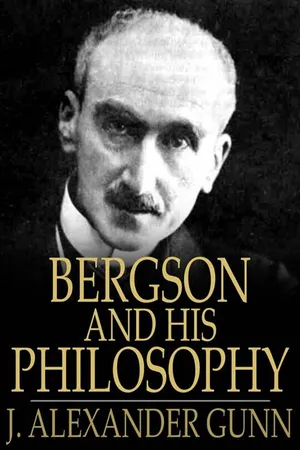
- 197 pages
- English
- ePUB (mobile friendly)
- Available on iOS & Android
eBook - ePub
Trusted by 375,005 students
Access to over 1.5 million titles for a fair monthly price.
Study more efficiently using our study tools.
Information
Topic
PhilosophySubtopic
Philosophical MetaphysicsChapter I - Life of Bergson
*
Birth and education—Teaches at Clermont-Ferrand—Les donnees immediates de la conscience—Matiere et Memoire—Chair of Greek Philosophy, then of Modern Philosophy, College de France—L'Evolution creatrice—Relations with William James—Visits England and America—Popularity—Neo-Catholics and Syndicalists—Election to Academie francaise—War-work—L'Energie spirituelle.
Bergson's life has been the quiet and uneventful one of a French professor, the chief landmarks in it being the publication of his three principal works, first, in 1889, the Essai sur les donnees immediates de la conscience, then Matiere et Memoire in 1896, and L'Evolution creatrice in 1907. On October 18th, 1859, Henri Louis Bergson was born in Paris in the Rue Lamartine, not far from the Opera House.[2] He is descended from a prominent Jewish family of Poland, with a blend of Irish blood from his mother's side. His family lived in London for a few years after his birth, and he obtained an early familiarity with the English language from his mother. Before he was nine years old his parents crossed the Channel and settled in France, Henri becoming a naturalized citizen of the Republic.
In Paris from 1868 to 1878 he attended the Lycee Fontaine, now known as the Lycee Condorcet. While there he obtained a prize for his scientific work and also won a prize when he was eighteen for the solution of a mathematical problem. This was in 1877, and his solution was published the following year in Annales de Mathematiques. It is of interest as being his first published work. After some hesitation over his career, as to whether it should lie in the sphere of the sciences or that of "the humanities," he decided in favour of the latter, and when nineteen years of age, he entered the famous Ecole Normale Superieure. While there he obtained the degree of Licencie-es-Lettres, and this was followed by that of Agrege de philosophie in 1881.
The same year he received a teaching appointment at the Lycee in Angers, the ancient capital of Anjou. Two years later he settled at the Lycee Blaise-Pascal in Clermont-Ferrand, chief town of the Puy de Dome department, whose name is more known to motorists than to philosophers. The year after his arrival at Clermont-Ferrand he displayed his ability in "the humanities" by the publication of an excellent edition of extracts from Lucretius, with a critical study of the text and the philosophy of the poet (1884), a work whose repeated editions are sufficient evidence of its useful place in the promotion of classical study among the youth of France. While teaching and lecturing in this beautiful part of his country (the Auvergne region), Bergson found time for private study and original work. He was engaged on his Essai sur les donnees immediates de la conscience. This essay, which, in its English translation, bears the more definite and descriptive title, Time and Free Will, was submitted, along with a short Latin Thesis on Aristotle, for the degree of Docteur-es-Lettres, to which he was admitted by the University of Paris in 1889. The work was published in the same year by Felix Alcan, the Paris publisher, in his series La Bibliotheque de philosophie contemporaine.
It is interesting to note that Bergson dedicated this volume to Jules Lachelier, then ministre de l'instruction publique, who was an ardent disciple of Ravaisson and the author of a rather important philosophical work Du fondement de l'Induction (1871), who in his view of things endeavoured "to substitute everywhere force for inertia, life for death, and liberty for fatalism." [3]
Bergson now settled again in Paris, and after teaching for some months at the Municipal College, known as the College Rollin, he received an appointment at the Lycee Henri-Quatre, where he remained for eight years. In 1896 he published his second large work, entitled Matiere et Memoire. This rather difficult, but brilliant, work investigates the function of the brain, undertakes an analysis of perception and memory, leading up to a careful consideration of the problems of the relation of body and mind. Bergson, we know, has spent years of research in preparation for each of his three large works. This is especially obvious in Matiere et Memoire, where he shows a very thorough acquaintance with the extensive amount of pathological investigation which has been carried out in recent years, and for which France is justly entitled to very honourable mention.
In 1898 Bergson became Maitre de conferences at his Alma Mater, L'Ecole Normale Superieure, and was later promoted to a Professorship. The year 1900 saw him installed as Professor at the College de France, where he accepted the Chair of Greek Philosophy in succession to Charles L'Eveque. The College de France, founded in 1530, by Francois I, is less ancient, and until recent years has been less prominent in general repute than the Sorbonne, which traces back its history to the middle of the thirteenth century. Nevertheless, it is one of the intellectual headquarters of France, indeed of the whole world. While the Sorbonne is now the seat of the University of Paris, the College is an independent institution under the control of the Ministre de l'Instruction publique. The lectures given by the very eminent professors who fill its forty-three chairs are free and open to the general public, and are attended mainly by a large number of women students and by the senior students from the University. The largest lecture room in the College was given to Bergson, but this became quite inadequate to accommodate his hearers.
At the First International Congress of Philosophy, which was held in Paris, during the first five days of August, 1900, Bergson read a short, but important, paper, Sur les origines psychologiques de notre croyance a la loi de causalite. In 1901 Felix Alcan published in book form a work which had just previously appeared in the Revue de Paris entitled Le Rire, one of the most important of his minor productions. This essay on the meaning of the Comic was based on a lecture which he had given in his early days in the Auvergne. The study of it is essential to an understanding of Bergson's views of life, and its passages dealing with the place of the artistic in life are valuable. In 1901 he was elected to the Academie des Sciences morales et politiques, and became a member of the Institute. In 1903 he contributed to the Revue de metaphysique et de morale a very important essay entitled Introduction a la metaphysique, which is useful as a preface to the study of his three large books.
On the death of Gabriel Tarde, the eminent sociologist, in 1904, Bergson succeeded him in the Chair of Modern Philosophy. From the 4th to the 8th of September of that year he was at Geneva attending the Second International Congress of Philosophy, when he lectured on Le Paralogisme psycho-physiologique, or, to quote its new title, Le Cerveau et la Pensee: une illusion philosophique. An illness prevented his visiting Germany to attend the Third Congress held at Heidelberg.
His third large work—his greatest book—L'Evolution creatrice, appeared in 1907, and is undoubtedly, of all his works, the one which is most widely known and most discussed. It constitutes one of the most profound and original contributions to the philosophical consideration of the theory of Evolution. Un livre comme L'Evolution creatrice, remarks Imbart de la Tour, n'est pas seulment une oeuvre, mais une date, celle d'une direction nouvelle imprimee a la pensee. By 1918, Alcan, the publisher, had issued twenty-one editions, making an average of two editions per annum for ten years. Since the appearance of this book, Bergson's popularity has increased enormously, not only in academic circles, but among the general reading public.
He came to London in 1908 and visited William James, the American philosopher of Harvard, who was Bergson's senior by seventeen years, and who was instrumental in calling the attention of the Anglo-American public to the work of the French professor. This was an interesting meeting and we find James' impression of Bergson given in his Letters under date of October 4, 1908. "So modest and unpretending a man but such a genius intellectually! I have the strongest suspicions that the tendency which he has brought to a focus, will end by prevailing, and that the present epoch will be a sort of turning point in the history of philosophy."
As in some quarters erroneous ideas prevail regarding both the historical and intellectual relation between James and Bergson, it may be useful to call attention to some of the facts here. As early as 1880 James contributed an article in French to the periodical La Critique philosophique, of Renouvier and Pillon, entitled Le Sentiment de l'Effort.[4] Four years later a couple of articles by him appeared in Mind: What is an Emotion?[5] and On some Omissions of Introspective Psychology.[6] Of these articles the first two were quoted by Bergson in his work of 1889, Les donnees immediates de la conscience. In the following years 1890-91 appeared the two volumes of James' monumental work, The Principles of Psychology, in which he refers to a pathological phenomenon observed by Bergson. Some writers taking merely these dates into consideration, and overlooking the fact that James' investigations had been proceeding since 1870, registered from time to time by various articles which culminated in The Principles, have mistakenly assigned to Bergson's ideas priority in time.[7] On the other hand insinuations have been made to the effect that Bergson owes the germ-ideas of his first book to the 1884 article by James On Some Omissions of Introspective Psychology, which he neither refers to nor quotes. This particular article deals with the conception of thought as a stream of consciousness, which intellect distorts by framing into concepts. We must not be misled by parallels. Bergson has replied to this insinuation by denying that he had any knowledge of the article by James when he wrote Les donnees immediates de la conscience.[8] The two thinkers appear to have developed independently until almost the close of the century. In truth they are much further apart in their intellectual position than is frequently supposed.[9] Both have succeeded in appealing to audiences far beyond the purely academic sphere, but only in their mutual rejection of "intellectualism" as final is there real harmony or unanimity between them. It will not do to press too closely analogies between the Radical Empiricism of the American and the Doctrine of Intuition of the Frenchman. Although James obtains a certain priority in point of time in the development and enunciation of his ideas, we must remember that he confessed that he was baffled by many of Bergson's notions. James certainly neglected many of the deeper metaphysical aspects of Bergson's thought, which did not harmonize with his own, and are even in direct contradiction. In addition to this Bergson is no pragmatist, for him "utility," so far from being a test of truth, is rather the reverse, a synonym for error.
Nevertheless, William James hailed Bergson as an ally very enthusiastically. Early in the century (1903) we find him remarking in his correspondence: "I have been re-reading Bergson's books, and nothing that I have read since years has so excited and stimulated my thoughts. I am sure that that philosophy has a great future, it breaks through old cadres and brings things into a solution from which new crystals can be got." The most noteworthy tributes paid by him to Bergson were those made in the Hibbert Lectures (A Pluralistic Universe), which James gave at Manchester College, Oxford, shortly after he and Bergson met in London. He there remarked upon the encouragement he had received from Bergson's thought, and referred to the confidence he had in being "able to lean on Bergson's authority." [10] "Open Bergson, and new horizons loom on every page you read. It is like the breath of the morning and the song of birds. It tells of reality itself, instead of merely reiterating what dusty-minded professors have written about what other previous professors have thought. Nothing in Bergson is shop-worn or at second-hand." [11] The influence of Bergson had led him "to renounce the intellectualist method and the current notion that logic is an adequate measure of what can or cannot be." [12] It had induced him, he continued, "TO GIVE UP THE LOGIC, squarely and irrevocably" as a method, for he found that "reality, life, experience, concreteness, immediacy, use what word you will, exceeds our logic, overflows, and surrounds it." [13]
Naturally, these remarks, which appeared in book form in 1909, directed many English and American readers to an investigation of Bergson's philosophy for themselves. A certain handicap existed in that his greatest work had not then been translated into English. James, however, encouraged and assisted Dr. Arthur Mitchell in his preparation of the English translation of L'Evolution creatrice. In August of 1910 James died. It was his intention, had he lived to see the completion of the translation, to introduce it to the English reading public by a prefatory note of appreciation. In the following year the translation was completed and still greater interest in Bergson and his work was the result. By a coincidence, in that same year (1911), Bergson penned for the French translation of James' book, Pragmatism,[14] a preface of sixteen pages, entitled Verite et Realite. In it he expressed sympathetic appreciation of James' work, coupled with certain important reservations.
In April (5th to 11th) Bergson attended the Fourth International Congress of Philosophy held at Bologna, in Italy, where he gave a brilliant address on L'Intuition philosophique. In response to invitations received he came again to England in May of that year, and has paid us several subsequent visits. These visits have always been noteworthy events and have been marked by important deliverances. Many of these contain important contributions to thought and shed new light on many passages in his three large works, Time and Free Will, Matter and Memory, and Creative Evolution. Although necessarily brief statements, they are of more recent date than his books, and thus show how this acute thinker can develop and enrich his thought and take advantage of such an opportunity to make clear to an English audience the fundamental principles of his philosophy.
He visited Oxford and delivered at the University, on the 26th and 27th of May, two lectures entitled La Perception du Changement, which were published in French in the same year by the Clarendon Press. As Bergson has a delightful gift of lucid and brief exposition, when the occasion demands such treatment, these lectures on Change form a most valuable synopsis or brief survey of the fundamental principles of his thought, and serve the student or general reader alike as an excellent introduction to the study of the larger volumes. Oxford honoured its distinguished visitor by conferring upon him the degree of Doctor of Science. Two days later he delivered the Huxley Lecture at Birmingham University, taking for his subject Life and Consciousness. This subsequently appeared in The Hibbert Journal (Oct., 1911), and since revised, forms the first essay in the collected volume L'Energie spirituelle or Mind-Energy. In October he was again in England, where he had an enthusiastic reception, and delivered at London University (University College) four lectures on La Nature de l'Ame. In 1913 he visited the United States of America, at the invitation of Columbia University, New York, and lectured in several American cities, where he was welcomed by very large audiences. In February, at Columbia University, he lectured both in French and English, taking as his subjects: Spiritualite et Liberte and The Method of Philosophy. Being again in England in May of the same year, he accepted the Presidency of the British Society for Psychical Research, and delivered to the Society an impressive address: Fantomes des Vivants et Recherche psychique.
Meanwhile, his popularity increased, and translations of his works began to appear in a number of languages, English, German, Italian, Danish, Swedish, Magyar, Polish and Russian. In 1914 he was honoured by his fellow-countrymen in being elected as a member of the Academie francaise. He was also made President of the Academie des Sciences morales et politiques, and in addition he became Officier de la Legion d'Honneur, and Officier de l'Instruction publique. He found disciples of many varied types, and in France movements such as Neo-Catholicism or Modernism on the one hand and Syndicalism on the other, endeavoured to absorb and to appropriate for their own immediate use and propaganda some of the central ideas of his teaching. That important continental organ of socialist and syndicalist theory, Le Mouvement socialiste, suggested that the realism of Karl Marx and Prudhon is hostile to all forms of intellectualism, and that, therefore, supporters of Marxian socialism should welcome a philosophy such as that of Bergson. Other writers, in their eagerness, asserted the collaboration of the Chair of Philosophy at the College de France with the aims of the Confederation Generale du Travail and the Industrial Workers of the World. It was claimed that there is harmony between the flute of personal philosophical meditation and the trumpet of social revolution. These statements are considered in the chapter dealing with the political implications of Bergson's thought.
While social revolutionaries were endeavouring to make the most out of Bergson, many leaders of religious thought, particularly the more liberal-minded theologians of all creeds, e.g., the Modernists and Neo-Catholic Party in his own country, showed a keen interest in his writings, and many of them endeavoured to find encouragement and stimulus in his work. The Roman Catholic Church, however, which still believes that finality was reached in philosophy with the work of Thomas Aquinas, in the thirteenth century, and consequently makes that mediaeval philosophy her official, orthodox, and dogmatic view, took the step of banning Bergson's three books by placing them upon the Index (Decree of June 1, 1914).
It was arranged by the Scottish Universities that Bergson should deliver in 1914 the famous Gifford Lectures, and one course was planned for the spring and another for the autumn. The first course, consisting of eleven lectures, under the title of The Problem of Personality, was delivered at Edinburgh University in the Spring of that year.
Then came the War. The course of lectures planned for the autumn months had to be a...
Table of contents
- BERGSON AND HIS PHILOSOPHY
- Contents
- Preface
- Introduction
- Chapter I - Life of Bergson
- Chapter II - The Reality of Change
- Chapter III - Perception
- Chapter IV - Memory
- Chapter V - The Relation of Soul and Body
- Chapter VI - Time—True and False
- Chapter VII - Freedom of the Will
- Chapter VIII - Evolution
- Chapter IX - The Gospel of Intuition
- Chapter X - Ethical and Political Implications
- Chapter XI - Relation to Religion and Theology
- Chapter XII - Reflections
- Bibliography
- Endnotes
Frequently asked questions
Yes, you can cancel anytime from the Subscription tab in your account settings on the Perlego website. Your subscription will stay active until the end of your current billing period. Learn how to cancel your subscription
No, books cannot be downloaded as external files, such as PDFs, for use outside of Perlego. However, you can download books within the Perlego app for offline reading on mobile or tablet. Learn how to download books offline
Perlego offers two plans: Essential and Complete
- Essential is ideal for learners and professionals who enjoy exploring a wide range of subjects. Access the Essential Library with 800,000+ trusted titles and best-sellers across business, personal growth, and the humanities. Includes unlimited reading time and Standard Read Aloud voice.
- Complete: Perfect for advanced learners and researchers needing full, unrestricted access. Unlock 1.5M+ books across hundreds of subjects, including academic and specialized titles. The Complete Plan also includes advanced features like Premium Read Aloud and Research Assistant.
We are an online textbook subscription service, where you can get access to an entire online library for less than the price of a single book per month. With over 1.5 million books across 990+ topics, we’ve got you covered! Learn about our mission
Look out for the read-aloud symbol on your next book to see if you can listen to it. The read-aloud tool reads text aloud for you, highlighting the text as it is being read. You can pause it, speed it up and slow it down. Learn more about Read Aloud
Yes! You can use the Perlego app on both iOS and Android devices to read anytime, anywhere — even offline. Perfect for commutes or when you’re on the go.
Please note we cannot support devices running on iOS 13 and Android 7 or earlier. Learn more about using the app
Please note we cannot support devices running on iOS 13 and Android 7 or earlier. Learn more about using the app
Yes, you can access Bergson and His Philosophy by in PDF and/or ePUB format, as well as other popular books in Philosophy & Philosophical Metaphysics. We have over 1.5 million books available in our catalogue for you to explore.