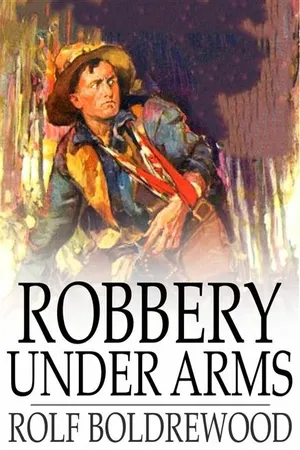
- 649 pages
- English
- ePUB (mobile friendly)
- Available on iOS & Android
eBook - ePub
Information
Subtopic
ClassicsIndex
LiteratureChapter 1
*
My name's Dick Marston, Sydney-side native. I'm twenty-nine years old,
six feet in my stocking soles, and thirteen stone weight. Pretty strong
and active with it, so they say. I don't want to blow—not here, any
road—but it takes a good man to put me on my back, or stand up to me
with the gloves, or the naked mauleys. I can ride anything—anything
that ever was lapped in horsehide—swim like a musk-duck, and track like
a Myall blackfellow. Most things that a man can do I'm up to, and that's
all about it. As I lift myself now I can feel the muscle swell on my arm
like a cricket ball, in spite of the—well, in spite of everything.
The morning sun comes shining through the window bars; and ever since he
was up have I been cursing the daylight, cursing myself, and them that
brought me into the world. Did I curse mother, and the hour I was born
into this miserable life?
Why should I curse the day? Why do I lie here, groaning; yes, crying
like a child, and beating my head against the stone floor? I am not mad,
though I am shut up in a cell. No. Better for me if I was. But it's all
up now; there's no get away this time; and I, Dick Marston, as strong as
a bullock, as active as a rock-wallaby, chock-full of life and spirits
and health, have been tried for bush-ranging—robbery under arms they
call it—and though the blood runs through my veins like the water in
the mountain creeks, and every bit of bone and sinew is as sound as the
day I was born, I must die on the gallows this day month.
Die—die—yes, die; be strung up like a dog, as they say. I'm blessed
if ever I did know of a dog being hanged, though, if it comes to that,
a shot or a bait generally makes an end of 'em in this country. Ha, ha!
Did I laugh? What a rum thing it is that a man should have a laugh in
him when he's only got twenty-nine days more to live—a day for every
year of my life. Well, laughing or crying, this is what it has come to
at last. All the drinking and recklessness; the flash talk and the idle
ways; the merry cross-country rides that we used to have, night or
day, it made no odds to us; every man well mounted, as like as not on a
racehorse in training taken out of his stable within the week; the sharp
brushes with the police, when now and then a man was wounded on each
side, but no one killed. That came later on, worse luck. The jolly
sprees we used to have in the bush townships, where we chucked our money
about like gentlemen, where all the girls had a smile and a kind word
for a lot of game upstanding chaps, that acted like men, if they did
keep the road a little lively. Our 'bush telegraphs' were safe to let
us know when the 'traps' were closing in on us, and then—why the coach
would be 'stuck up' a hundred miles away, in a different direction,
within twenty-four hours. Marston's gang again! The police are in
pursuit! That's what we'd see in the papers. We had 'em sent to us
regular; besides having the pick of 'em when we cut open the mail bags.
And now—that chain rubbed a sore, curse it!—all that racket's over.
It's more than hard to die in this settled, infernal, fixed sort of way,
like a bullock in the killing-yard, all ready to be 'pithed'. I used to
pity them when I was a boy, walking round the yard, pushing their noses
through the rails, trying for a likely place to jump, stamping and
pawing and roaring and knocking their heads against the heavy close
rails, with misery and rage in their eyes, till their time was up.
Nobody told THEM beforehand, though!
Have I and the likes of me ever felt much the same, I wonder, shut up
in a pen like this, with the rails up, and not a place a rat could creep
through, waiting till our killing time was come? The poor devils of
steers have never done anything but ramble off the run now and again,
while we—but it's too late to think of that. It IS hard. There's no
saying it isn't; no, nor thinking what a fool, what a blind, stupid,
thundering idiot a fellow's been, to laugh at the steady working life
that would have helped him up, bit by bit, to a good farm, a good wife,
and innocent little kids about him, like that chap, George Storefield,
that came to see me last week. He was real rightdown sorry for me,
I could tell, though Jim and I used to laugh at him, and call him a
regular old crawler of a milker's calf in the old days. The tears came
into his eyes reg'lar like a woman as he gave my hand a squeeze and
turned his head away. We was little chaps together, you know. A man
always feels that, you know. And old George, he'll go back—a fifty-mile
ride, but what's that on a good horse? He'll be late home, but he can
cross the rock ford the short way over the creek. I can see him turn his
horse loose at the garden-gate, and walk through the quinces that lead
up to the cottage, with his saddle on his arm. Can't I see it all, as
plain as if I was there?
And his wife and the young 'uns 'll run out when they hear father's
horse, and want to hear all the news. When he goes in there's his meal
tidy and decent waiting for him, while he tells them about the poor chap
he's been to see as is to be scragged next month. Ha! ha! what a rum
joke it is, isn't it?
And then he'll go out in the verandah, with the roses growin' all over
the posts and smellin' sweet in the cool night air. After that he'll
have his smoke, and sit there thinkin' about me, perhaps, and old days,
and what not, till all hours—till his wife comes and fetches him in.
And here I lie—my God! why didn't they knock me on the head when I was
born, like a lamb in a dry season, or a blind puppy—blind enough, God
knows! They do so in some countries, if the books say true, and what a
hell of misery that must save some people from!
Well, it's done now, and there's no get away. I may as well make the
best of it. A sergeant of police was shot in our last scrimmage, and
they must fit some one over that. It's only natural. He was rash, or
Starlight would never have dropped him that day. Not if he'd been sober
either. We'd been drinking all night at that Willow Tree shanty. Bad
grog, too! When a man's half drunk he's fit for any devilment that
comes before him. Drink! How do you think a chap that's taken to the
bush—regularly turned out, I mean, with a price on his head, and a
fire burning in his heart night and day—can stand his life if he don't
drink? When he thinks of what he might have been, and what he is! Why,
nearly every man he meets is paid to run him down, or trap him some way
like a stray dog that's taken to sheep-killin'. He knows a score of men,
and women too, that are only looking out for a chance to sell his blood
on the quiet and pouch the money. Do you think that makes a chap mad
and miserable, and tired of his life, or not? And if a drop of grog
will take him right out of his wretched self for a bit why shouldn't he
drink? People don't know what they are talking about. Why, he is that
miserable that he wonders why he don't hang himself, and save the
Government all the trouble; and if a few nobblers make him feel as if
he might have some good chances yet, and that it doesn't so much matter
after all, why shouldn't he drink?
He does drink, of course; every miserable man, and a good many women as
have something to fear or repent of, drink. The worst of it is that
too much of it brings on the 'horrors', and then the devil, instead of
giving you a jog now and then, sends one of his imps to grin in your
face and pull your heartstrings all day and all night long. By George,
I'm getting clever—too clever, altogether, I think. If I could forget
for one moment, in the middle of all the nonsense, that I was to die
on Thursday three weeks! die on Thursday three weeks! die on Thursday!
That's the way the time runs in my ears like a chime of bells. But it's
all mere bosh I've been reading these long six months I've been chained
up here—after I was committed for trial. When I came out of the
hospital after curing me of that wound—for I was hit bad by that black
tracker—they gave me some books to read for fear I'd go mad and cheat
the hangman. I was always fond of reading, and many a night I've read to
poor old mother and Aileen before I left the old place. I was that weak
and low, after I took the turn, and I felt glad to get a book to take
me away from sitting, staring, and blinking at nothing by the hour
together. It was all very well then; I was too weak to think much. But
when I began to get well again I kept always coming across something in
the book that made me groan or cry out, as if some one had stuck a knife
in me. A dark chap did once—through the ribs—it didn't feel so bad, a
little sharpish at first; why didn't he aim a bit higher? He never was
no good, even at that. As I was saying, there'd be something about a
horse, or the country, or the spring weather—it's just coming in now,
and the Indian corn's shooting after the rain, and I'LL never see it; or
they'd put in a bit about the cows walking through the river in the hot
summer afternoons; or they'd go describing about a girl, until I began
to think of sister Aileen again; then I'd run my head against the wall,
or do something like a madman, and they'd stop the books for a week; and
I'd be as miserable as a bandicoot, worse and worse a lot, with all
the devil's tricks and bad thoughts in my head, and nothing to put them
away.
I must either kill myself, or get something to fill up my time till
the day—yes, the day comes. I've always been a middling writer, tho' I
can't say much for the grammar, and spelling, and that, but I'll put it
all down, from the beginning to the end, and maybe it'll save some other
unfortunate young chap from pulling back like a colt when he's first
roped, setting himself against everything in the way of proper breaking,
making a fool of himself generally, and choking himself down, as I've
done.
The gaoler—he looks hard—he has to do that, there's more than one
or two within here that would have him by the throat, with his heart's
blood running, in half a minute, if they had their way, and the warder
was off guard. He knows that very well. But he's not a bad-hearted chap.
'You can have books, or paper and pens, anything you like,' he said,
'you unfortunate young beggar, until you're turned off.'
'If I'd only had you to see after me when I was young,' says I—
'Come; don't whine,' he said, then he burst out laughing. 'You didn't
mean it, I see. I ought to have known better. You're not one of that
sort, and I like you all the better for it.'
*
Well, here goes. Lots of pens, a big bottle of ink, and ever so much
foolscap paper, the right sort for me, or I shouldn't have been here.
I'm blessed if it doesn't look as if I was going to write copies again.
Don't I remember how I used to go to school in old times; the rides
there and back on the old pony; and pretty little Grace Storefield that
I was so fond of, and used to show her how to do her lessons. I believe
I learned more that way than if I'd had only myself to think about.
There was another girl, the daughter of the poundkeeper, that I wanted
her to beat; and the way we both worked, and I coached her up, was a
caution. And she did get above her in her class. How proud we were! She
gave me a kiss, too, and a bit of her hair. Poor Gracey! I wonder where
she is now, and what she'd think if she saw me here to-day. If I could
have looked ahead, and seen myself—chained now like a dog, and going to
die a dog's death this day month!
Anyhow, I must make a start. How do people begin when they set to work
to write their own sayings and doings? There's been a deal more doing
than talking in my life—it was the wrong sort—more's the pity.
Well, let's see; his parents were poor, but respectable. That's what
they always say. My parents were poor, and mother was as good a soul as
ever broke bread, and wouldn't have taken a shilling's worth that wasn't
her own if she'd been starving. But as for father, he'd been a poacher
in England, a Lincolnshire man he was, and got sent out for it. He
wasn't much more than a boy, he said, and it was only for a hare or
two, which didn't seem much. But I begin to think, being able to see the
right of things a bit now, and having no bad grog inside of me to turn a
fellow's head upside down, as poaching must be something like cattle
and horse duffing—not the worst thing in the world itself, but mighty
likely to lead to it.
Dad had always been a hard-working, steady-going sort of chap, good at
most things, and like a lot more of the Government men, as the convicts
were always called round our part, he saved some money as soon as he had
done his time, and married mother, who was a simple emigrant girl
just out from Ireland. Father was a square-built, good-looking chap,
I believe, then; not so tall as I am by three inches, but wonderfully
strong and quick on his pins. They did say as he could hammer any man
in the district before he got old and stiff. I never saw him 'shape' but
once, and then he rolled into a man big enough to eat him, and polished
him off in a way that showed me—though I was a bit of a boy then—that
he'd been at the game before. He didn't ride so bad either, though he
hadn't had much of it where he came from; but he was afraid of nothing,
and had a quiet way with colts. He could make pretty good play in thick
country, and ride a roughish horse, too.
Well, our farm was on a good little flat, with a big mountain in front,
and a scrubby, rangy country at the back for miles. People often asked
him why he chose such a place. 'It suits me,' he used to say, with a
laugh, and talk of something else. We could only raise about enough corn
and potatoes, in a general way, for ourselves from the flat; but there
were other chances and pickings which helped to make the pot boil, and
them we'd have been a deal better without.
First of all, though our cultivation paddock was small, and the good
land seemed squeezed in between the hills, there was a narrow tract up
the creek, and here it widened out into a large well-grassed flat. This
was where our cattle ran, for, of course, we had a team of workers and
a few milkers when we came. No one ever took up a farm in those days
without a dray and a team, a year's rations, a few horses and milkers,
pigs and fowls, and a little furniture. They didn't collar a 40-acre
selection, as they do now—spend all their money in getting the land and
squat down as bare as robins—a man with his wife and children all
under a sheet of bark, nothing on their backs, and very little in their
bellies. However, some of them do pretty well, though they do say they
have to live on 'possums for a time. We didn't do much, in spite of our
grand start.
The flat was well enough, but there were other places in the gullies
beyond that that father had dropped upon when he was out shooting. He
was a tremendous chap for poking about on foot or on horseback, and
though he was an Englishman, he was what you call a born bushman. I
never saw any man almost as was his equal. Wherever he'd been once,
there he could take you to again; and what was more, if it was in the
dead of the night he could do it just the same. People said he was as
good as a blackfellow, but I never saw one that was as good as he was,
all round. In a strange country, too. That was what beat me—he'd know
the way the creek run, and noticed when the cattle headed to camp, and
a lot of things that other people couldn't see, or if they did, couldn't
remember again. He was a great man for solitary walks, too—he and an
old dog he had, called Crib, a cross-bred mongrel-looking brute, most
like what they call a lurcher in England, father said. Anyhow, he could
do most anything but talk. He could bite to some purpose, drive cattle
or sheep, catch a kangaroo, if it wasn't a regular flyer, fight like a
bulldog, and swim like a retriever, track anything, and fetch and carry,
but bark he wouldn't. He'd stand and look at dad as if he worshipped
him, and he'd make him some sign and off he'd go like a child that's got
a message. Why he was so fond of the old man we boys couldn't make out.
We were afraid of him, and as far as we could see he never patted or
made much of Crib. He thrashed him unmerciful as he did us boys. Still
the dog was that fond of him you'd think he'd like to die for him there
and then. But dogs are not like boys, or men either—better, perhaps.
Well, we were all born at the hut by the creek, I suppose, for I
remember it as soon as I could remember anything. It was a snug hut
enough, for father was a good bush carpenter, and didn't turn his
back to any one for splitting and fencing, hut-building and
shingle-splitting; he had had a year or two at sawing, too, but after
he was married he dropped that. But I've heard mother say that he took
great pride in the hut when he brought her to it first, and said it was
the best-built hut within fifty miles. He split every slab, cut every
post and wallplate and rafter himself, with a man to help him at odd
times; and after the frame was up, and the bark on the roof, he camped
underneath and finished every bit of it—chimney, flooring, doors,
windows, and partitions—by himself. Then he dug up a little garden
in front, and planted a dozen or two peaches and quinces in it; put a
couple of roses—a red and a white one—by the posts of the verandah,
and it was all ready for his pretty Norah, as she says he used to call
her then. If I've heard her tell about the garden and the quince trees
and the two roses once, I've heard her tell it a hundred times. Poor
mother! we used to get round her—Aileen, and Jim, and I—and say, 'Tell
us about the garden, mother.' She'd never refuse; those were her happy
days, she always said. She used to cry afterwards—nearly always.
The first thing almost that I can remember was riding the old pony,
'Possum, out to bring in the milkers. Father was away somewhere, so
mother took us all out and put me on the pony, and let me have a
whip. Aileen walked alongside, and very proud I was. My legs stuck out
straight on the old pony's fat back. Mother had ridden him up when she
came—the first horse she ever rode, she said. He was a quiet little old
roan, with a bright eye and legs like gate-posts, but he never fell down
with us boys, for all that. If we fell off he stopped still and began
to feed, so that he suited us all to pieces. We soon got sharp enough
to flail him along with a quince stick, and we used to bring up the
milkers, I expect, a good deal faster than was good for them. After a
bit we could milk, leg-rope, and bail up for ourselves, and help dad
brand the calves, which began to come pretty thick. There were only
three of us children—my brother Jim, who was two years younger than I
was, and then Aileen, who was four years behind him. I know we were both
able to nurse the baby a while after she came, and neither of us wanted
better fun than to be allowed to watch her, or rock the cradle, or as a
great treat to carry her a few steps. Somehow we was that fond and proud
of her from the first that we'd have done anything in the world for her.
And so we would now—I was going to say—but that poor Jim lies under a
forest oak on a sandhill, and I—well, I'm here, and if I'd listened
to her advice I should have been a free man. A free man! How it sounds,
doesn't it? with the sun shining, and the blue sky over your head, and
the birds twittering, and the grass beneath your feet! I wonder if I
shall go mad before my time's up.
Mother was a Roman Catholic—most Irishwomen are; and dad was a
Protestant, if he was anything. However, that says nothing. People that
don't talk much about their religion, or follow it up at all, won't
change it for all that. So father, though mother tried him hard enough
when they were first married, wouldn't hear of turning, not if he was to
be killed for it, as I once heard him say. 'No!' he says, 'my father and
grandfather, and all the lot, was Church people, and so I shall live
and die. I don't know as it would make much matter to me, but such as
my notions is, I shall stick to 'em as long as the craft holds together.
You can bring up the girl in your own way; it's made a good woman of
you, or found you one, which is most likely, and so she may take her
chance. But I stand for Church and King, and so shall the boys, as sure
as my name's Ben Marston.'
Chapter 2
*
Father was one of those people that gets shut of a deal of trouble in this world by always sticking to one thing. If he said he'd do this or that he always did it and nothing else. As for turning him, a wild bull half-way down a range was a likelier try-on. So nobody ever bothered him after he'd once opened his mouth. They knew it was so much lost labour. I sometimes thought Aileen was a bit like him in her way of sticking to things. But then she was always right, you see.
So that clinched it. Mother gave in like a wise woman, as she was. The clergyman from Bargo came one day and christened me and Jim—made one job of it. But mother took Aileen herself in the spring cart all the way to the township and had her christened in the chapel, in the middle of the service all right and regular, by Father Roche.
There's good and bad of every sort, and I've met plenty that were no chop of all churches; but if Father Roche, or Father anybody else, had any hand in making mother and Aileen half as good as they were, I'd turn to-morrow, if I ever got out again. I don't suppose it was the religion that made much difference in our case, for Patsey Daly and his three brothers, that lived on the creek higher up, were as much on the cross as men could be, and many a time I've seen them ride to chapel and attend mass, and look as if they'd never seen a 'clearskin' in their lives. Patsey was hanged afterwards for bush-ranging and gold robbery, and he had more than one man's blood to answer for. Now we weren't like that; we never troubled the church one way or the other. We knew we were doing what we oughtn't to do, and scorned to look pious and keep two faces under one hood.
By degrees we all grew older, began to...
Table of contents
- ROBBERY UNDER ARMS
- Contents
- Preface to New Edition
- Chapter 1
- Chapter 2
- Chapter 3
- Chapter 4
- Chapter 5
- Chapter 6
- Chapter 7
- Chapter 8
- Chapter 9
- Chapter 10
- Chapter 11
- Chapter 12
- Chapter 13
- Chapter 14
- Chapter 15
- Chapter 16
- Chapter 17
- Chapter 18
- Chapter 19
- Chapter 20
- Chapter 21
- Chapter 22
- Chapter 23
- Chapter 24
- Chapter 25
- Chapter 26
- Chapter 27
- Chapter 28
- Chapter 29
- Chapter 30
- Chapter 31
- Chapter 32
- Chapter 33
- Chapter 34
- Chapter 35
- Chapter 36
- Chapter 37
- Chapter 38
- Chapter 39
- Chapter 40
- Chapter 41
- Chapter 42
- Chapter 43
- Chapter 44
- Chapter 45
- Chapter 46
- Chapter 47
- Chapter 48
- Chapter 49
- Chapter 50
- Chapter 51
- Chapter 52
- Endnotes
Trusted by 375,005 students
Access to over 1.5 million titles for a fair monthly price.
Study more efficiently using our study tools.
Frequently asked questions
Yes, you can cancel anytime from the Subscription tab in your account settings on the Perlego website. Your subscription will stay active until the end of your current billing period. Learn how to cancel your subscription
No, books cannot be downloaded as external files, such as PDFs, for use outside of Perlego. However, you can download books within the Perlego app for offline reading on mobile or tablet. Learn how to download books offline
Perlego offers two plans: Essential and Complete
- Essential is ideal for learners and professionals who enjoy exploring a wide range of subjects. Access the Essential Library with 800,000+ trusted titles and best-sellers across business, personal growth, and the humanities. Includes unlimited reading time and Standard Read Aloud voice.
- Complete: Perfect for advanced learners and researchers needing full, unrestricted access. Unlock 1.5M+ books across hundreds of subjects, including academic and specialized titles. The Complete Plan also includes advanced features like Premium Read Aloud and Research Assistant.
We are an online textbook subscription service, where you can get access to an entire online library for less than the price of a single book per month. With over 1.5 million books across 990+ topics, we’ve got you covered! Learn about our mission
Look out for the read-aloud symbol on your next book to see if you can listen to it. The read-aloud tool reads text aloud for you, highlighting the text as it is being read. You can pause it, speed it up and slow it down. Learn more about Read Aloud
Yes! You can use the Perlego app on both iOS and Android devices to read anytime, anywhere — even offline. Perfect for commutes or when you’re on the go.
Please note we cannot support devices running on iOS 13 and Android 7 or earlier. Learn more about using the app
Please note we cannot support devices running on iOS 13 and Android 7 or earlier. Learn more about using the app
Yes, you can access Robbery Under Arms by in PDF and/or ePUB format, as well as other popular books in Literature & Classics. We have over 1.5 million books available in our catalogue for you to explore.