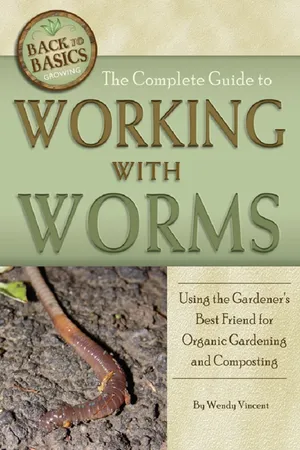
The Environmental Protection Agency (EPA) reports that if we composted 100 percent of our food scraps, we could prevent the equivalent of 20 million metric tons of carbon dioxide emissions each year, the equivalent of more than 3.8 million vehicles greenhouse gas emissions. Composting is one of the easiest and least expensive ways you can reduce your household waste and improve your garden, and using worms in your compost bin will provide you with the best compost available.
- English
- ePUB (mobile friendly)
- Available on iOS & Android
eBook - ePub
About this book

Chapter 1: The Vermicomposting Cycle Versus Traditional Composting — A Quick Overview
The origins of composting are as muddied as the garden after a downpour. Perhaps, it began when humans began to cultivate food crops in order to supplement food-gathering and hunting practices. It has been theorized that humans might have noticed crops grew better in locations where animals left waste. This theory surmises that manure might have been the first form of composting practiced by humans.
Other places in documented ancient history point to cultures having had a word for compost in their vernacular. The Greeks, Romans, Israeli Tribes, and places in the Bible all refer to natural fertilizers being used in the cultivation of crops. Fertilizers created through the composting process mentioned included manure, blood, straw, and ash from fires. Crushed bones, lime, and waste wool are later mentioned in Arabic writings from the tenth century on. The monks of the Middle Ages documented monastic use of compost in their enclosed gardens as well. Renaissance literature is laden with references to compost. Native Americans used fish bones and remnants as a compost to fertilize their crops. European settlers to America also noted the use of composting in various forms.
Compost in recent history has been used on the North American continent by both Native American tribes and, subsequently, by European settlers. Composting needs and methods have taken on a variety of forms over the years. Through centuries of trial and error, various composting practices have been used, abandoned, and revisited as viable forms of fertilizing to recycle and produce high crop yields. The recent atmosphere of being sensitive to the ecosystem has brought the focus back to organic methods of composting. Compost is more than just a fertilizer. Composting, in addition to being beneficial in the garden, is also thought to be a valuable form of recycling. Composting plays a vital part in the cycle of life and is a miniature replica of the life and death process.
As a form of recycling, composting provides the opportunity to dispose of organic waste biologically. Compost recycling makes huge leaps toward conserving energy, controlling waste, and enhancing the health of our food supply. Composting builds and rejuvenates soil quality. A variety of composting methods make composting a practical and viable practice for almost anyone.
What Happens in a Compost Bin?
Composting is the process of converting organic matter through decomposition into a useful byproduct. Composting can occur naturally or be fostered through human intervention. The process of decomposition in nature occurs at a variety of levels. To enhance this natural process, composting can be monitored carefully in a controlled environment with much success. Composting cultivates reclamation, recycling, proper treatment, and disposal of waste to save and reuse natural resources. A common understanding is that organic matter is melded together in a pile or bin, and decomposition just “happens.”
Not quite. Although it does occur naturally, the composting process actually involves a series of actions accomplished by the interconnected relationships of various organisms. A more complex definition of composting than the earlier one is the oxidative biological decomposition of organic materials in which organic waste is reduced to smaller volumes of materials that continue to decompose slowly, which results in balancing the carbon ratio to other elements to provide needed nutrients to plants.
To better comprehend the scientific definition of composting, it is helpful to have a basic understanding of the organisms involved and their basic functionality. The organisms within the decomposition progress are classified based upon their various functions. There are first-order consumers, second-order consumers, and third-order consumers. First-order consumers feed directly on decaying animal and plant materials. Second-order consumers feed on the first-order, and third-order feed on second order.
Third-order feeds on >> second-order feeds on >> first-order feeds on >> decaying plants and animals
The “pecking order” system of microbial decomposition keeps the various organization populations in check. This ensures one population does not increase too rapidly and disrupt the process.
The various organisms found in the compost pile also can be classified by their functions. There are chemical and physical decomposing organisms. Chemical decomposers are considered microscopic organisms, such as bacteria, fungi, protozoa, and antinomycetes. The not-so-microscopic organisms, such as worms, snails, beetles, centipedes, and even mites, are classified as physical decomposers. Bacteria are the toughest workers of the chemical decomposers while worms are the strongest team member of the physical decomposers. Both teams assist the decomposition process by using both carbon and nitrogen within the compost materials as a fuel, along with oxygen and water to produce carbon dioxide and heat to create nutrient-rich compost, or humus.
Definitions:
Bacteria are microorganisms that are generally one-celled and can exist either independently or be dependent on another organism for life.
Fungi are parasites that feed on dead organic material and reproduce by means of spores.
Protozoa are single-celled organisms that only can be divided with the help of a host.
Antinomycetes are rod-shaped members of the bacteria family.
The breaking down of organic matter is consummated through a sequence of microorganism activity. Each microorganism reaches its optimal population when the conditions within the compost pile are “just right.” The physical decomposers, such as beetles and worms referred to as first consumers, do the majority of the initial breakdown of organic waste into smaller particles. The second consumers are the bacteria, fungi, protozoa, and antinomycetes that step in next to initiate the composting process and begin to create heat. These microorganisms are considered mesophilic (work at a certain temperature) and work best at temperatures between 10 and 45 degrees C (50 and 113 degrees F).
As the temperature within the compost pile increases based on the resulting oxidation process, the next level of microorganisms step in (third consumers). Referred to as thermophiles, these guys operate best at temperatures between 45 and 75 degrees C (113 and 167 degrees F). The compost reaches this temperature within a 25- to 72-hour period and remains at that level for several weeks. This period is considered the “active” stage of the composting process.
The increased temperature within the pile kills off weed seeds and other pathogens. Throughout this active stage, the compost needs to receive a constant supply of oxygen to keep the process going. Mixing or turning the compost pile adds oxygen, also called aerating. Once the active phase slows down, temperatures decrease and the mesophilic organisms get to work again to further decompose and convert the organic material to humus, or finished compost.
The rate of composting, or how fast organic waste is converted into humus, can be affected by a variety of factors. When the composting conditions are controlled rather than occurring in a natural state, the process is hasten...
Table of contents
- Author Dedication and Acknowledgments
- Song of the Worm
- Table of Contents
- Introduction: Reducing, Recycling, and Red Worms
- Chapter 1: The Vermicomposting Cycle Versus Traditional Composting — A Quick Overview
- Chapter 2: The Gardener’s Best Friend — Worms
- Chapter 3: Getting Started — Setting up the Worm Composting Bin
- Chapter 4: The Worms
- Chapter 5: Caring for Your Worm Bin
- Chapter 6: Common Concerns in the Worm Bin
- Chapter 7: Other Critters in the Bin
- Chapter 8: Harvesting
- Chapter 9: Using Worm Compost and Castings
- Chapter 10: Growing Worms and Vermicompost for Sale
- Chapter 11: Marketing your Worm Business Via the Internet
- Conclusion
- Appendix A: Miscellaneous Worms
- Appendix B: Sample Business Plan
- Appendix C: Resources
- Glossary
- Bibliography
- Author Biography
Trusted by 375,005 students
Access to over 1.5 million titles for a fair monthly price.
Study more efficiently using our study tools.
Information
Publisher
Atlantic Publishing Group, Inc.Year
2015Topic
Biological SciencesSubtopic
AgronomyeBook ISBN
9781601388575
Index
Biological SciencesFrequently asked questions
Yes, you can cancel anytime from the Subscription tab in your account settings on the Perlego website. Your subscription will stay active until the end of your current billing period. Learn how to cancel your subscription
No, books cannot be downloaded as external files, such as PDFs, for use outside of Perlego. However, you can download books within the Perlego app for offline reading on mobile or tablet. Learn how to download books offline
We are an online textbook subscription service, where you can get access to an entire online library for less than the price of a single book per month. With over 1.5 million books across 990+ topics, we’ve got you covered! Learn about our mission
Look out for the read-aloud symbol on your next book to see if you can listen to it. The read-aloud tool reads text aloud for you, highlighting the text as it is being read. You can pause it, speed it up and slow it down. Learn more about Read Aloud
Yes! You can use the Perlego app on both iOS and Android devices to read anytime, anywhere — even offline. Perfect for commutes or when you’re on the go.
Please note we cannot support devices running on iOS 13 and Android 7 or earlier. Learn more about using the app
Please note we cannot support devices running on iOS 13 and Android 7 or earlier. Learn more about using the app
Yes, you can access Complete Guide to Working with Worms Using the Gardener's Best Friend for Organic Gardening and Composting Revised 2nd Edition by in PDF and/or ePUB format, as well as other popular books in Biological Sciences & Agronomy. We have over 1.5 million books available in our catalogue for you to explore.