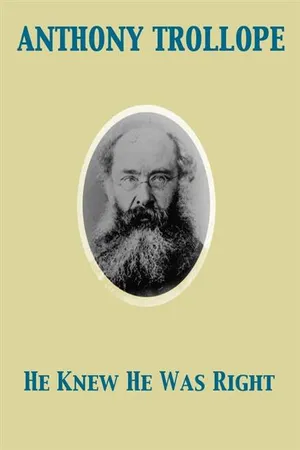
- 1,383 pages
- English
- ePUB (mobile friendly)
- Available on iOS & Android
eBook - ePub
Information
Topic
LittératureSubtopic
ClassiquesCHAPTER I - SHEWING HOW WRATH BEGAN
When Louis Trevelyan was twenty-four years old, he
had all the world before him where to choose; and, among other
things, he chose to go to the Mandarin Islands, and there fell in
love with Emily Rowley, the daughter of Sir Marmaduke, the
governor. Sir Marmaduke Rowley, at this period of his life, was a
respectable middle-aged public servant, in good repute, who had,
however, as yet achieved for himself neither an exalted position
nor a large fortune. He had been governor of many islands, and had
never lacked employment; and now, at the age of fifty, found
himself at the Mandarins, with a salary of 3,000 pounds a year,
living in a temperature at which 80 in the shade is considered to
be cool, with eight daughters, and not a shilling saved. A governor
at the Mandarins who is social by nature and hospitable on
principle, cannot save money in the islands even on 3,000 pounds a
year when he has eight daughters. And at the Mandarins, though
hospitality is a duty, the gentlemen who ate Sir Rowley's dinners
were not exactly the men whom he or Lady Rowley desired to welcome
to their bosoms as sons-in-law. Nor when Mr Trevelyan came that
way, desirous of seeing everything in the somewhat indefinite
course of his travels, had Emily Rowley, the eldest of the flock,
then twenty years of age, seen as yet any Mandariner who exactly
came up to her fancy. And, as Louis Trevelyan was a remarkably
handsome young man, who was well connected, who had been ninth
wrangler at Cambridge, who had already published a volume of poems,
and who possessed 3,000 pounds a year of his own, arising from
various perfectly secure investments, he was not forced to sigh
long in vain. Indeed, the Rowleys, one and all, felt that
providence had been very good to them in sending young Trevelyan on
his travels in that direction, for he seemed to be a very pearl
among men. Both Sir Marmaduke and Lady Rowley felt that there might
be objections to such a marriage as that proposed to them, raised
by the Trevelyan family. Lady Rowley would not have liked her
daughter to go to England, to be received with cold looks by
strangers. But it soon appeared that there was no one to make
objections. Louis, the lover, had no living relative nearer than
cousins. His father, a barrister of repute, had died a widower, and
had left the money which he had made to an only child. The head of
the family was a first cousin who lived in Cornwall on a moderate,
property a very good sort of stupid fellow, as Louis said, who
would be quite indifferent as to any marriage that his cousin might
make. No man could be more independent or more clearly justified in
pleasing himself than was this lover. And then he himself proposed
that the second daughter, Nora, should come and live with them in
London. What a lover to fall suddenly from the heavens into such a
dovecote!
'I haven't a penny-piece to give either of them,'
said Sir Rowley.
'It is my idea that girls should not have fortunes,'
said Trevelyan. 'At any rate, I am quite sure that men should never
look for money. A man must be more comfortable, and, I think, is
likely to be more affectionate, when the money has belonged to
himself.'
Sir Rowley was a high-minded gentleman, who would
have liked to have handed over a few thousand pounds on giving up
his daughters; but, having no thousands of pounds to hand over, he
could not but admire the principles of his proposed son-in-law. As
it was about time for him to have his leave of absence, he and
sundry of the girls went to England with Mr Trevelyan, and the
wedding was celebrated in London by the Rev. Oliphant Outhouse, of
Saint Diddulph-in-the-East, who had married Sir Rowley's sister.
Then a small house was taken and furnished in Curzon Street,
Mayfair, and the Rowleys went back to the seat of their government,
leaving Nora, the second girl, in charge of her elder sister.
The Rowleys had found, on reaching London, that they
had lighted upon a pearl indeed. Louis Trevelyan was a man of whom
all people said all good things. He might have been a fellow of his
college had he not been a man of fortune. He might already so Sir
Rowley was told have been in Parliament, had he not thought it to
be wiser to wait awhile. Indeed, he was very wise in many things.
He had gone out on his travels thus young not in search of
excitement, to kill beasts, or to encounter he knew not what
novelty and amusement but that he might see men and know the world.
He had been on his travels for more than a year when the winds blew
him to the Mandarins. Oh, how blessed were the winds! And,
moreover, Sir Rowley found that his son-in-law was well spoken of
at the clubs by those who had known him during his university
career, as a man popular as well as wise, not a book-worm, or a dry
philosopher, or a prig. He could talk on all subjects, was very
generous, a man sure to be honoured and respected; and then such a
handsome, manly fellow, with short brown hair, a nose divinely
chiselled, an Apollo's mouth, six feet high, with shoulders and
legs and arms in proportion a pearl of pearls! Only, as Lady Rowley
was the first to find out, he liked to have his own way.
'But his way is such a good way,' said Sir
Marmaduke. 'He will be such a good guide for the girls!'
'But Emily likes her way too,' said Lady Rowley.
Sir Marmaduke argued the matter no further, but
thought, no doubt, that such a husband as Louis Trevelyan was
entitled to have his own way. He probably had not observed his
daughter's temper so accurately as his wife had done. With eight of
them coming up around him, how should he have observed their
tempers? At any rate, if there were anything amiss with Emily's
temper, it would be well that she should find her master in such a
husband as Louis Trevelyan.
For nearly two years the little household in Curzon
Street went on well, or if anything was the matter no one outside
of the little household was aware of it. And there was a baby, a
boy, a young Louis, and a baby in such a household is apt to make
things go sweetly.
The marriage had taken place in July, and after the
wedding tour there had been a winter and a spring in London; and
then they passed a month or two at the sea-side, after which the
baby had been born. And then there came another winter and another
spring. Nora Rowley was with them in London, and by this time Mr
Trevelyan had begun to think that he should like to have his own
way completely. His baby was very nice, and his wife was clever,
pretty, and attractive. Nora was all that an unmarried sister
should be. But but there had come to be trouble and bitter words.
Lady Rowley had been right when she said that her daughter Emily
also liked to have her own way.
'If I am suspected,' said Mrs Trevelyan to her
sister one morning, as they sat together in the little back
drawing-room, 'life will not be worth having.'
'How can you talk of being suspected, Emily?'
'What does he mean then by saying that he would
rather not have Colonel Osborne here? A man older than my own
father, who has known me since I was a baby!'
'He didn't mean anything of that kind, Emily. You
know he did not, and you should not say so. It would be too
horrible to think of.'
'It was a great deal too horrible to be spoken, I
know. If he does not beg my pardon, I shall I shall continue to
live with him, of course, as a sort of upper servant, because of
baby. But he shall know what I think and feel.'
'If I were you I would forget it.'
'How can I forget it? Nothing that I can do pleases
him. He is civil and kind to you because he is not your master; but
you don't know what things he says to me. Am I to tell Colonel
Osborne not to come? Heavens and earth! How should I ever hold up
my head again if I were driven to do that? He will be here today I
have no doubt; and Louis will sit there below in the library, and
hear his step, and will not come up.'
'Tell Richard to say you are not at home.'
'Yes; and everybody will understand why. And for
what am I to deny myself in that way to the best and oldest friend
I have? If any such orders are to be given, let him give them and
then see what will come of it.'
Mrs Trevelyan had described Colonel Osborne truly as
far as words went, in saying that he had known her since she was a
baby, and that he was an older man than her father. Colonel
Osborne's age exceeded her father's by about a month, and as he was
now past fifty, he might be considered perhaps, in that respect, to
be a safe friend for a young married woman. But he was in every
respect a man very different from Sir Marmaduke. Sir Marmaduke,
blessed and at the same time burdened as he was with a wife and
eight daughters, and condemned as he had been to pass a large
portion of his life within the tropics, had become at fifty what
many people call quite a middle-aged man. That is to say, he was
one from whom the effervescence and elasticity and salt of youth
had altogether passed away. He was fat and slow, thinking much of
his wife and eight daughters, thinking much also of his dinner. Now
Colonel Osborne was a bachelor, with no burdens but those imposed
upon him by his position as a member of Parliament a man of fortune
to whom the world had been very easy. It was not therefore said so
decidedly of him as of Sir Marmaduke, that he was a middle-aged
man, although he had probably already lived more than two-thirds of
his life. And he was a good-looking man of his age, bald indeed at
the top of his head, and with a considerable sprinkling of grey
hair through his bushy beard; but upright in his carriage, active,
and quick in his step, who dressed well, and was clearly determined
to make the most he could of what remained to him of the advantages
of youth. Colonel Osborne was always so dressed that no one ever
observed the nature of his garments, being no doubt well aware that
no man after twenty-five can afford to call special attention to
his coat, his hat, his cravat, or his trousers; but nevertheless
the matter was one to which he paid much attention, and he was by
no means lax in ascertaining what his tailor did for him. He always
rode a pretty horse, and mounted his groom on one at any rate as
pretty. He was known to have an excellent stud down in the shires,
and had the reputation of going well with hounds. Poor Sir
Marmaduke could not have ridden a hunt to save either his
government or his credit. When, therefore, Mrs Trevelyan declared
to her sister that Colonel Osborne was a man whom she was entitled
to regard with semi- parental feelings of veneration because he was
older than her father, she made a comparison which was more true in
the letter than in the spirit. And when she asserted that Colonel
Osborne had known her since she was a baby, she fell again into the
same mistake. Colonel Osborne had indeed known her when she was a
baby, and had in old days been the very intimate friend of her
father; but of herself he had seen little or nothing since those
baby days, till he had met her just as she was about to become Mrs
Trevelyan; and though it was natural that so old a friend should
come to her and congratulate her and renew his friendship,
nevertheless it was not true that he made his appearance in her
husband's house in the guise of the useful old family friend, who
gives silver cups to the children and kisses the little girls for
the sake of the old affection which he has borne for the parents.
We all know the appearance of that old gentleman, how pleasant and
dear a fellow he is, how welcome is his face within the gate, how
free he makes with our wine, generally abusing it, how he tells our
eldest daughter to light his candle for him, how he gave silver
cups when the girls were born, and now bestows tea-services as they
get married a most useful, safe, and charming fellow, not a year
younger-looking or more nimble than ourselves, without whom life
would be very blank. We all know that man; but such a man was not
Colonel Osborne in the house of Mr Trevelyan's young bride.
Emily Rowley, when she was brought home from the
Mandarin Islands to be the wife of Louis Trevelyan, was a very
handsome young woman, tall, with a bust rather full for her age,
with dark eyes eyes that looked to be dark because her eye-brows
and eye-lashes were nearly black, but which were in truth so
varying in colour, that you could not tell their hue. Her brown
hair was very dark and very soft; and the tint of her complexion
was brown also, though the colour of her cheeks was often so bright
as to induce her enemies to say falsely of her that she painted
them. And she was very strong, as are some girls who come from the
tropics, and whom a tropical climate has suited. She could sit on
her horse the whole day long, and would never be weary with dancing
at the Government House balls. When Colonel Osborne was introduced
to her as the baby whom he had known, he thought it would be very
pleasant to be intimate with so pleasant a friend meaning no harm
indeed, as but few men do mean harm on such occasions but still,
not regarding the beautiful young woman whom he had seen as one of
a generation succeeding to that of his own, to whom it would be his
duty to make himself useful on account of the old friendship which
he bore to her father.
It was, moreover, well known in London though not
known at all to Mrs Trevelyan that this ancient Lothario had before
this made himself troublesome in more than one family. He was fond
of intimacies with married ladies, and perhaps was not averse to
the excitement of marital hostility. It must be remembered,
however, that the hostility to which allusion is here made was not
the hostility of the pistol or the horsewhip nor indeed was it
generally the hostility of a word of spoken anger. A young husband
may dislike the too-friendly bearing of a friend, and may yet
abstain from that outrage on his own dignity and on his wife, which
is conveyed by a word of suspicion. Louis Trevelyan having taken a
strong dislike to Colonel Osborne, and having failed to make his
wife understand that this dislike should have induced her to throw
cold water upon the Colonel's friendship, had allowed himself to
speak a word which probably he would have willingly recalled as
soon as spoken. But words spoken cannot be recalled, and many a man
and many a woman who has spoken a word at once regretted, are far
too proud to express that regret. So it was with Louis Trevelyan
when he told his wife that he did not wish Colonel Osborne to come
so often to his house. He had said it with a flashing eye and an
angry tone; and though she had seen the eye flash before, and was
familiar with the angry tone, she had never before felt herself to
be insulted by her husband. As soon as the word had been spoken
Trevelyan had left the room and had gone down among his books. But
when he was alone he knew that he had insulted his wife. He was
quite aware that he should have spoken to her gently, and have
explained to her, with his arm round her waist, that it would be
better for both of them that this friend's friendship should be
limited. There is so much in a turn of the eye and in the tone
given to a word when such things have to be said so much more of
importance than in the words themselves. As Trevelyan thought of
this, and remembered what his manner had been, how much anger he
had expressed, how far he had been from having his arm round his
wife's waist as he spoke to her, he almost made up his mind to go
upstairs and to apologise. But he was one to whose nature the
giving of any apology was repulsive. He could not bear to have to
own himself to have been wrong. And then his wife had been most
provoking in her manner to him. When he had endeavoured to make her
understand his wishes by certain disparaging hints which he had
thrown out as to Colonel Osborne, saying that he was a dangerous
man, one who did not show his true character, a snake in the grass,
a man without settled principles, and such like, his wife had taken
up the cudgels for her friend, and had openly declared that she did
not believe a word of the things that were alleged against him.
'But still for all that it is true,' the husband had said. 'I have
no doubt that you think so,' the wife had replied. 'Men do believe
evil of one another, very often. But you must excuse me if I say
that I think you are mistaken. I have known Colonel Osborne much
longer than you have done, Louis, and papa has always had the
highest opinion of him.' Then Mr Trevelyan had become very angry,
and had spoken those words which he could not recall. As he walked
to and fro among his books downstairs, he almost felt that he ought
to beg his wife's pardon. He knew his wife well enough to be sure
that she would not forgive him unless he did so. He would do so, he
thought, but not exactly now. A moment would come in which it might
be easier than at present. He would be able to assure her when he
went up to dress for dinner, that he had meant no harm. They were
going out to dine at the house of a lady of rank, the Countess
Dowager of Milborough, a lady standing high in the world's esteem,
of whom his wife stood a little in awe; and he calculated that this
feeling, if it did not make his task easy would yet take from it
some of its difficulty. Emily would be, not exactly cowed, by the
prospect of Lady Milborough's dinner, but perhaps a little reduced
from her usual self-assertion. He would say a word to her when he
was dressing, assuring her that he had not intended to animadvert
in the slightest degree upon her own conduct.
Luncheon was served, and the two ladies went down
into the dining-room. Mr Trevelyan did not appear. There was
nothing in itself singular in that, as he was accustomed to declare
that luncheon was a meal too much in the day, and that a man should
eat nothing beyond a biscuit between breakfast and dinner. But he
would sometimes come in and eat his biscuit standing on the
hearth-rug, and drink what he would call half a quarter of a glass
of sherry. It would probably have been well that he should have
done so now; but he remained in his library behind the dining-room,
and when his wife and his sister-in-law had gone upstairs, he
became anxious to learn whether, Colonel Osborne would come on that
day, and, if so, whether he would be admitted. He had been told
that Nora Rowley was to be called for by another lady, a Mrs
Fairfax, to go out and look at pictures. His wife had declined to
join Mrs Fairfax's party, having declared that, as she was going to
dine out, she would not leave her baby all the afternoon. Louis
Trevelyan, though he strove to apply his mind to an article which
he was writing for a scientific quarterly review, could not keep
himself from anxiety as to this expected visit from Colonel
Osborne. He was not in the least jealous. He swore to himself fifty
times over that any such feeling on his part would be a monstrous
injury to his wife. Nevertheless he knew that he would be gratified
if on that special day Colonel Osborne should be informed that his
wife was not at home. Whether the man were admitted or not, he
would beg his wife's pardon; but he could, he thought, do so with
more thorough efficacy and affection if she should have shown a
disposition to comply with his wishes on this day.
'Do say a word to Richard,' said Nora to her sister
in a whisper as they were going upstairs after luncheon.
'I will not,' said Mrs Trevelyan.
'May I do it?'
'Certainly not, Nora. I should feel that I were
demeaning myself were I to allow what was said to me in such a
manner to have any effect upon me.'
'I think you are so wrong, Emily. I do indeed.'
'You must allow me to be the best judge what to do
in my own house, and with my own husband.'
'Oh, yes; certainly.'
'If he gives me any command I will obey it. Or if he
had expressed his wish in any other words I would have complied.
But to be told that he would rather not have Colonel Osborne here!
If you had seen his manner and heard his words, you would not have
been surprised that I should feel it as I do. It was a gross insult
and it was not the first.'
As she spoke the fire flashed from her eye, and the
bright red colour of her cheek told a tale of her anger which her
sister well knew how to read. Then there was a knock at the door,
and they both knew that Colonel Osborne was there. Louis Trevelyan,
sitting in his library, also knew of whose coming that knock gave
notice.
CHAPTER II - COLONEL OSBORNE
It has been already said that Colonel Osborne was a bachelor, a man of fortune, a member of Parliament, and one who carried his half century of years lightly on his shoulders. It will only be necessary to say further of him that he was a man popular with those among whom he lived, as a politician, as a sportsman, and as a member of society. He could speak well in the House, though he spoke but seldom, and it was generally thought of him that he might have been something considerable, had it not suited him better to be nothing at all. He was supposed to be a Conservative, and generally voted with the conservative party; but he could boast that he was altogether independent, and on an occasion would take the trouble of proving himself to be so. He was in possession of excellent health; had all that the world could give; was fond of books, pictures, architecture, and china; had various tastes, and the means of indulging t...
Table of contents
- CHAPTER I - SHEWING HOW WRATH BEGAN
- CHAPTER II - COLONEL OSBORNE
- CHAPTER III - LADY MILBOROUGH'S DINNER PARTY
- CHAPTER IV - HUGH STANBURY
- CHAPTER V - SHEWING HOW THE QUARREL PROGRESSED
- CHAPTER VI- SHEWING HOW RECONCILIATION WAS MADE
- CHAPTER VII - MISS JEMIMA STANBURY, OF EXETER
- CHAPTER VIII - 'I KNOW IT WILL DO'
- CHAPTER IX - SHEWING HOW THE QUARREL PROGRESSED AGAIN
- CHAPTER X - HARD WORDS
- CHAPTER XI - LADY MILBOROUGH AS AMBASSADOR
- CHAPTER XII - MISS STANBURY'S GENEROSITY
- CHAPTER XIII - THE HONOURABLE MR GLASCOCK
- CHAPTER XIV - THE CLOCK HOUSE AT NUNCOMBE PUTNEY
- CHAPTER XV - WHAT THEY SAID ABOUT IT IN THE CLOSE
- CHAPTER XVI - DARTMOOR
- CHAPTER XVII - A GENTLEMAN COMES TO NUNCOMBE PUTNEY
- CHAPTER XVIII - THE STANBURY CORRESPONDENCE
- CHAPTER XI - BOZZLE, THE EX-POLICEMAN
- CHAPTER XXI - SHEWING HOW COLONEL OSBORNE WENT TO COCKCHAFFINGTON
- CHAPTER XXI - SHEWING HOW COLONEL OSBORNE WENT TO NUNCOMBE PUTNEY
- CHAPTER XXII - SHEWING HOW MISS STANBURY BEHAVED TO HER TWO NIECES
- CHAPTER XXIII - COLONEL OSBORNE AND MR BOZZLE RETURN TO LONDON
- CHAPTER XXIV - NIDDON PARK
- CHAPTER XXV - HUGH STANBURY SMOKES HIS PIPE
- CHAPTER XXVI - A THIRD PARTY IS SO OBJECTIONABLE
- CHAPTER XXVII - MR TREVELYAN'S LETTER TO HIS WIFE
- CHAPTER XXVIII - GREAT TRIBULATION
- CHAPTER XXIX - MR AND MRS OUTHOUSE
- CHAPTER XXX - DOROTHY MAKES UP HER MIND
- CHAPTER XXXI - MR BROOKE BURGESS
- CHAPTER XXXII - THE 'FULL MOON' AT ST. DIDDULPH'S
- CHAPTER XXXIII - HUGH STANBURY SMOKES ANOTHER PIPE
- CHAPTER XXXIV - PRISCILLA'S WISDOM
- CHAPTER XXXV - MR GIBSON'S GOOD FORTUNE
- CHAPTER XXXVI - MISS STANBURY'S WRATH
- CHAPTER XXXVII - MONT CENIS
- CHAPTER XXXVIII - VERDICT OF THE JURY 'MAD, MY LORD'
- CHAPTER XXXIX - MISS NORA ROWLEY IS MALTREATED
- CHAPTER XL - 'C. G.'
- CHAPTER XLI - SHEWING WHAT TOOK PLACE AT ST DIDDULPH'S
- CHAPTER XLII - MISS STANBURY AND MR GIBSON BECOME TWO
- CHAPTER XLIII - LABURNUM COTTAGE
- CHAPTER XLIV - BROOKE BURGESS TAKES LEAVE OF EXETER
- CHAPTER XLV - TREVELYAN AT VENICE
- CHAPTER XLVI - THE AMERICAN MINISTER
- CHAPTER XLVII - ABOUT FISHING, AND NAVIGATION, AND HEAD-DRESSES
- CHAPTER XLVIII - MR GIBSON IS PUNISHED
- CHAPTER XLIX - MR BROOKE BURGESS AFTER SUPPER
- CHAPTER L - CAMILLA TRIUMPHANT
- CHAPTER LI - SHEWING WHAT HAPPENED DURING MISS STANBURY'S ILLNESS
- CHAPTER LII - MR OUTHOUSE COMPLAINS THAT IT'S HARD
- CHAPTER LIII - HUGH STANBURY IS SHEWN TO BE NO CONJUROR
- CHAPTER LIV - MR GIBSON'S THREAT
- CHAPTER LV - THE REPUBLICAN BROWNING
- CHAPTER LVI - WITHERED GRASS
- CHAPTER LVII - DOROTHY'S FATE
- CHAPTER LVIII - DOROTHY AT HOME
- CHAPTER LIX - MR BOZZLE AT HOME
- CHAPTER LX - ANOTHER STRUGGLE
- CHAPTER LXI - PARKER'S HOTEL, MOWBRAY STREET
- CHAPTER LXII - LADY ROWLEY MAKES AN ATTEMPT
- CHAPTER LXIII - SIR MARMADUKE AT HOME
- CHAPTER LXIV - SIR MARMADUKE AT HIS CLUB
- CHAPTER LXV - MYSTERIOUS AGENCIES
- CHAPTER LXVI - OF A QUARTER OF LAMB
- CHAPTER LXVII - RIVER'S COTTAGE
- CHAPTER LXVIII - MAJOR MAGRUDER'S COMMITTEE
- CHAPTER LXIX - SIR MARMADUKE AT WILLESDEN
- CHAPTER LXX - SHEWING WHAT NORA ROWLEY THOUGHT ABOUT CARRIAGES
- CHAPTER LXXI - SHEWING WHAT HUGH STANBURY THOUGHT ABOUT THE DUTY OF MAN
- CHAPTER LXXII - THE DELIVERY OF THE LAMB
- CHAPTER LXXIII - DOROTHY RETURNS TO EXETER
- CHAPTER LXXIV - THE LIONESS AROUSED
- CHAPTER LXXV - THE ROWLEYS GO OVER THE ALPS
- CHAPTER LXXVI - 'WE SHALL BE SO POOR'
- CHAPTER LXXVII - THE FUTURE LADY PETERBOROUGH
- CHAPTER LXXVIII - CASALUNGA
- CHAPTER LXXIX - 'I CAN SLEEP ON THE BOARDS'
- CHAPTER LXXX - 'WILL THEY DESPISE HIM?'
- CHAPTER LXXXI - MR GLASCOCK IS MASTER
- CHAPTER LXXXII - MRS FRENCH'S CARVING KNIFE
- CHAPTER LXXXIII - BELLA VICTRIX
- CHAPTER LXXXIV - SELF-SACRIFICE
- CHAPTER LXXXV - THE BATHS OF LUCCA
- CHAPTER LXXXVI - MR GLASCOCK AS NURSE
- CHAPTER LXXXVII - MR GLASCOCK'S MARRIAGE COMPLETED
- CHAPTER LXXXVIII - CROPPER AND BURGESS
- CHAPTER LXXXIX - 'I WOULDN'T DO IT, IF I WAS YOU'
- CHAPTER LIX - LADY ROWLEY CONQUERED
- CHAPTER XCI - FOUR O'CLOCK IN THE MORNING
- CHAPTER XCII - TREVELYAN DISCOURSES ON LIFE
- CHAPTER XCIII -'SAY THAT YOU FORGIVE ME'
- CHAPTER XCIV - A REAL CHRISTIAN
- CHAPTER XCV - TREVELYAN BACK IN ENGLAND
- CHAPTER XCVI - MONKHAMS
- CHAPTER XCVII - MRS BROOKE BURGESS
- CHAPTER XCVIII - ACQUITTED
- CHAPTER XCIX - CONCLUSION
- Copyright
Trusted by 375,005 students
Access to over 1.5 million titles for a fair monthly price.
Study more efficiently using our study tools.
Frequently asked questions
Yes, you can cancel anytime from the Subscription tab in your account settings on the Perlego website. Your subscription will stay active until the end of your current billing period. Learn how to cancel your subscription
No, books cannot be downloaded as external files, such as PDFs, for use outside of Perlego. However, you can download books within the Perlego app for offline reading on mobile or tablet. Learn how to download books offline
Perlego offers two plans: Essential and Complete
- Essential is ideal for learners and professionals who enjoy exploring a wide range of subjects. Access the Essential Library with 800,000+ trusted titles and best-sellers across business, personal growth, and the humanities. Includes unlimited reading time and Standard Read Aloud voice.
- Complete: Perfect for advanced learners and researchers needing full, unrestricted access. Unlock 1.5M+ books across hundreds of subjects, including academic and specialized titles. The Complete Plan also includes advanced features like Premium Read Aloud and Research Assistant.
We are an online textbook subscription service, where you can get access to an entire online library for less than the price of a single book per month. With over 1.5 million books across 990+ topics, we’ve got you covered! Learn about our mission
Look out for the read-aloud symbol on your next book to see if you can listen to it. The read-aloud tool reads text aloud for you, highlighting the text as it is being read. You can pause it, speed it up and slow it down. Learn more about Read Aloud
Yes! You can use the Perlego app on both iOS and Android devices to read anytime, anywhere — even offline. Perfect for commutes or when you’re on the go.
Please note we cannot support devices running on iOS 13 and Android 7 or earlier. Learn more about using the app
Please note we cannot support devices running on iOS 13 and Android 7 or earlier. Learn more about using the app
Yes, you can access He Knew He Was Right by Trollope, Anthony in PDF and/or ePUB format, as well as other popular books in Littérature & Classiques. We have over 1.5 million books available in our catalogue for you to explore.