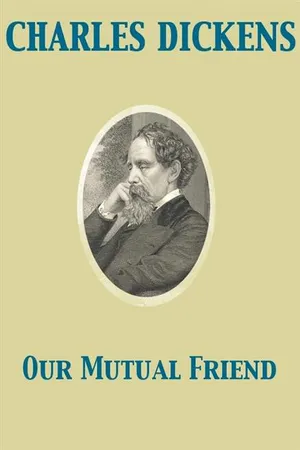
- 1,331 pages
- English
- ePUB (mobile friendly)
- Available on iOS & Android
eBook - ePub
Information
Subtopic
ClassicsIndex
LiteratureChapter 1 - ON THE LOOK OUT
In these times of ours, though concerning the exact
year there is no need to be precise, a boat of dirty and
disreputable appearance, with two figures in it, floated on the
Thames, between Southwark bridge which is of iron, and London
Bridge which is of stone, as an autumn evening was closing in.
The figures in this boat were those of a strong man
with ragged grizzled hair and a sun-browned face, and a dark girl
of nineteen or twenty, sufficiently like him to be recognizable as
his daughter. The girl rowed, pulling a pair of sculls very easily;
the man, with the rudder-lines slack in his hands, and his hands
loose in his waistband, kept an eager look out. He had no net,
hook, or line, and he could not be a fisherman; his boat had no
cushion for a sitter, no paint, no inscription, no appliance beyond
a rusty boathook and a coil of rope, and he could not be a
waterman; his boat was too crazy and too small to take in cargo for
delivery, and he could not be a lighterman or river-carrier; there
was no clue to what he looked for, but he looked for something,
with a most intent and searching gaze. The tide, which had turned
an hour before, was running down, and his eyes watched every little
race and eddy in its broad sweep, as the boat made slight head-way
against it, or drove stern foremost before it, according as he
directed his daughter by a movement of his head. She watched his
face as earnestly as he watched the river. But, in the intensity of
her look there was a touch of dread or horror.
Allied to the bottom of the river rather than the
surface, by reason of the slime and ooze with which it was covered,
and its sodden state, this boat and the two figures in it obviously
were doing something that they often did, and were seeking what
they often sought. Half savage as the man showed, with no covering
on his matted head, with his brown arms bare to between the elbow
and the shoulder, with the loose knot of a looser kerchief lying
low on his bare breast in a wilderness of beard and whisker, with
such dress as he wore seeming to be made out of the mud that
begrimed his boat, still there was a business-like usage in his
steady gaze. So with every lithe action of the girl, with every
turn of her wrist, perhaps most of all with her look of dread or
horror; they were things of usage.
'Keep her out, Lizzie. Tide runs strong here. Keep
her well afore the sweep of it.'
Trusting to the girl's skill and making no use of
the rudder, he eyed the coming tide with an absorbed attention. So
the girl eyed him. But, it happened now, that a slant of light from
the setting sun glanced into the bottom of the boat, and, touching
a rotten stain there which bore some resemblance to the outline of
a muffled human form, coloured it as though with diluted blood.
This caught the girl's eye, and she shivered.
'What ails you?' said the man, immediately aware of
it, though so intent on the advancing waters; 'I see nothing
afloat.'
The red light was gone, the shudder was gone, and
his gaze, which had come back to the boat for a moment, travelled
away again. Wheresoever the strong tide met with an impediment, his
gaze paused for an instant. At every mooring-chain and rope, at
every stationery boat or barge that split the current into a
broad-arrowhead, at the offsets from the piers of Southwark Bridge,
at the paddles of the river steamboats as they beat the filthy
water, at the floating logs of timber lashed together lying off
certain wharves, his shining eyes darted a hungry look. After a
darkening hour or so, suddenly the rudder-lines tightened in his
hold, and he steered hard towards the Surrey shore.
Always watching his face, the girl instantly
answered to the action in her sculling; presently the boat swung
round, quivered as from a sudden jerk, and the upper half of the
man was stretched out over the stern.
The girl pulled the hood of a cloak she wore, over
her head and over her face, and, looking backward so that the front
folds of this hood were turned down the river, kept the boat in
that direction going before the tide. Until now, the boat had
barely held her own, and had hovered about one spot; but now, the
banks changed swiftly, and the deepening shadows and the kindling
lights of London Bridge were passed, and the tiers of shipping lay
on either hand.
It was not until now that the upper half of the man
came back into the boat. His arms were wet and dirty, and he washed
them over the side. In his right hand he held something, and he
washed that in the river too. It was money. He chinked it once, and
he blew upon it once, and he spat upon it once, - 'for luck,' he
hoarsely said - before he put it in his pocket.
'Lizzie!'
The girl turned her face towards him with a start,
and rowed in silence. Her face was very pale. He was a hook-nosed
man, and with that and his bright eyes and his ruffled head, bore a
certain likeness to a roused bird of prey.
'Take that thing off your face.'
She put it back.
'Here! and give me hold of the sculls. I'll take the
rest of the spell.'
'No, no, father! No! I can't indeed. Father! - I
cannot sit so near it!'
He was moving towards her to change places, but her
terrified expostulation stopped him and he resumed his seat.
'What hurt can it do you?'
'None, none. But I cannot bear it.'
'It's my belief you hate the sight of the very
river.'
'I - I do not like it, father.'
'As if it wasn't your living! As if it wasn't meat
and drink to you!'
At these latter words the girl shivered again, and
for a moment paused in her rowing, seeming to turn deadly faint. It
escaped his attention, for he was glancing over the stern at
something the boat had in tow.
'How can you be so thankless to your best friend,
Lizzie? The very fire that warmed you when you were a babby, was
picked out of the river alongside the coal barges. The very basket
that you slept in, the tide washed ashore. The very rockers that I
put it upon to make a cradle of it, I cut out of a piece of wood
that drifted from some ship or another.'
Lizzie took her right hand from the scull it held,
and touched her lips with it, and for a moment held it out lovingly
towards him: then, without speaking, she resumed her rowing, as
another boat of similar appearance, though in rather better trim,
came out from a dark place and dropped softly alongside.
'In luck again, Gaffer?' said a man with a squinting
leer, who sculled her and who was alone, 'I know'd you was in luck
again, by your wake as you come down.'
'Ah!' replied the other, drily. 'So you're out, are
you?'
'Yes, pardner.'
There was now a tender yellow moonlight on the
river, and the new comer, keeping half his boat's length astern of
the other boat looked hard at its track.
'I says to myself,' he went on, 'directly you hove
in view, yonder's Gaffer, and in luck again, by George if he ain't!
Scull it is, pardner - don't fret yourself - I didn't touch him.'
This was in answer to a quick impatient movement on the part of
Gaffer: the speaker at the same time unshipping his scull on that
side, and laying his hand on the gunwale of Gaffer's boat and
holding to it.
'He's had touches enough not to want no more, as
well as I make him out, Gaffer! Been a knocking about with a pretty
many tides, ain't he pardner? Such is my out-of-luck ways, you see!
He must have passed me when he went up last time, for I was on the
lookout below bridge here. I a'most think you're like the wulturs,
pardner, and scent 'em out.'
He spoke in a dropped voice, and with more than one
glance at Lizzie who had pulled on her hood again. Both men then
looked with a weird unholy interest in the wake of Gaffer's
boat.
'Easy does it, betwixt us. Shall I take him aboard,
pardner?'
'No,' said the other. In so surly a tone that the
man, after a blank stare, acknowledged it with the retort:
' - Arn't been eating nothing as has disagreed with
you, have you, pardner?'
'Why, yes, I have,' said Gaffer. 'I have been
swallowing too much of that word, Pardner. I am no pardner of
yours.'
'Since when was you no pardner of mine, Gaffer Hexam
Esquire?'
'Since you was accused of robbing a man. Accused of
robbing a live man!' said Gaffer, with great indignation.
'And what if I had been accused of robbing a dead
man, Gaffer?'
'You COULDN'T do it.'
'Couldn't you, Gaffer?'
'No. Has a dead man any use for money? Is it
possible for a dead man to have money? What world does a dead man
belong to? 'Tother world. What world does money belong to? This
world. How can money be a corpse's? Can a corpse own it, want it,
spend it, claim it, miss it? Don't try to go confounding the rights
and wrongs of things in that way. But it's worthy of the sneaking
spirit that robs a live man.'
'I'll tell you what it is - .'
'No you won't. I'll tell you what it is. You got off
with a short time of it for putting you're hand in the pocket of a
sailor, a live sailor. Make the most of it and think yourself
lucky, but don't think after that to come over ME with your
pardners. We have worked together in time past, but we work
together no more in time present nor yet future. Let go. Cast
off!'
'Gaffer! If you think to get rid of me this way -
.'
'If I don't get rid of you this way, I'll try
another, and chop you over the fingers with the stretcher, or take
a pick at your head with the boat-hook. Cast off! Pull you, Lizzie.
Pull home, since you won't let your father pull.'
Lizzie shot ahead, and the other boat fell astern.
Lizzie's father, composing himself into the easy attitude of one
who had asserted the high moralities and taken an unassailable
position, slowly lighted a pipe, and smoked, and took a survey of
what he had in tow. What he had in tow, lunged itself at him
sometimes in an awful manner when the boat was checked, and
sometimes seemed to try to wrench itself away, though for the most
part it followed submissively. A neophyte might have fancied that
the ripples passing over it were dreadfully like faint changes of
expression on a sightless face; but Gaffer was no neophyte and had
no fancies.
Chapter 2 - THE MAN FROM SOMEWHERE
Mr and Mrs Veneering were bran-new people in a bran-new house in a bran-new quarter of London. Everything about the Veneerings was spick and span new. All their furniture was new, all their friends were new, all their servants were new, their plate was new, their carriage was new, their harness was new, their horses were new, their pictures were new, they themselves were new, they were as newly married as was lawfully compatible with their having a bran-new baby, and if they had set up a great-grandfather, he would have come home in matting from the Pantechnicon, without a scratch upon him, French polished to the crown of his head.
For, in the Veneering establishment, from the hall-chairs with the new coat of arms, to the grand pianoforte with the new action, and upstairs again to the new fire-escape, all things were in a state of high varnish and polish. And what was observable in the furniture, was observable in the Veneerings - the surface smelt a little too much of the workshop and was a trifle sticky.
There was an innocent piece of dinner-furniture that went upon easy castors and was kept over a livery stable-yard in Duke Street, Saint James's, when not in use, to whom the Veneerings were a source of blind confusion. The name of this article was Twemlow. Being first cousin to Lord Snigsworth, he was in frequent requisition, and at many houses might be said to represent the dining-table in its normal state. Mr and Mrs Veneering, for example, arranging a dinner, habitually started with Twemlow, and then put leaves in him, or added guests to him. Sometimes, the table consisted of Twemlow and half a dozen leaves; sometimes, of Twemlow and a dozen leaves; sometimes, Twemlow was pulled out to his utmost extent of twenty leaves. Mr and Mrs Veneering on occasions of ceremony faced each other in the centre of the board, and thus the parallel still held; for, it always happened that the more Twemlow was pulled out, the further he found himself from the center, and nearer to the sideboard at one end of the room, or the window-curtains at the other.
But, it was not this which steeped the feeble soul of Twemlow in confusion. This he was used to,and could take soundings of. The abyss to which he could find no bottom, and from which started forth the engrossing and ever-swelling difficulty of his life, was the insoluble question whether he was Veneering's oldest friend, or newest friend. To the excogitation of this problem, the harmless gentleman had devoted many anxious hours, both in his lodgings over the livery stable-yard, and in the cold gloom, favourable to meditation, of Saint James's Square. Thus. Twemlow had first known Veneering at his club, where Veneering then knew nobody but the man who made them known to one another, who seemed to be the most intimate friend he had in the world, and whom he had known two days - the bond of union between their souls, the nefarious conduct of the committee respecting the cookery of a fillet of veal, having been accidentally cemented at that date. Immediately upon this, Twemlow received an invitation to dine with Veneering, and dined: the man being of the party. Immediately upon that, Twemlow received an invitation to dine with the man, and dined: Veneering being of the party. At the man's were a Member, an Engineer, a Payer-off of the National Debt, a Poem on Shakespeare, a Grievance, and a Public Office, who all seem to be utter strangers to Veneering. And yet immediately after that, Twemlow received an invitation to dine at Veneerings, expressly to meet the Member, the Engineer, the Payer-off of the National Debt, the Poem on Shakespeare, the Grievance, and the Public Office, and, dining, discovered that all of them were the most intimate friends Veneering had in the world, and that the wives of all of them (who were all there) were the objects of Mrs Veneering's most devoted affection and tender confidence.
Thus it had come about, that Mr Twemlow had said to himself in his lodgings, with his hand to his forehead: 'I must not think of this. This is enough to soften any man's brain,' - and yet was always thinking of it, and could never form a conclusion.
This evening the Veneerings give a banquet. Eleven leaves in the Twemlow; fourteen in company all told. Four pigeon-breasted retainers in plain clothes stand in line in the hall. A fifth retainer, proceeding up the staircase with a mournful air - as who should say, 'Here is another wretched creature come to dinner; such is life!' - announces, 'Mis-ter Twemlow!'
Mrs Veneering welcomes her sweet Mr Twemlow. Mr Veneering welcomes his dear Twemlow. Mrs Veneering does not expect that Mr Twemlow can in nature care much for such insipid things as babies, but so old a friend must please to look at baby. 'Ah! You will know the friend of your family better, Tootleums,' says Mr Veneering, nodding emotionally at that new article, 'when you begin to take notice.' He then begs to make his dear Twemlow known to his two friends, Mr Boots and Mr Brewer - and clearly has no distinct idea which is which.
But now a fearful circumstance occurs.
'Mis-ter and Mis-sus Podsnap!'
'My dear,' says Mr Veneering to Mrs Veneerin...
Table of contents
- BOOK THE FIRST - THE CUP AND THE LIP
- Chapter 1 - ON THE LOOK OUT
- Chapter 2 - THE MAN FROM SOMEWHERE
- Chapter 3 - ANOTHER MAN
- Chapter 4 - THE R. WILFER FAMILY
- Chapter 5 - BOFFIN'S BOWER
- Chapter 6 - CUT ADRIFT
- Chapter 7 - MR WEGG LOOKS AFTER HIMSELF
- Chapter 8 - MR BOFFIN IN CONSULTATION
- Chapter 9 - MR AND MRS BOFFIN IN CONSULTATION
- Chapter 10 - A MARRIAGE CONTRACT
- Chapter 11 - PODSNAPPERY
- Chapter 12 - THE SWEAT OF AN HONEST MAN'S BROW
- Chapter 13 - TRACKING THE BIRD OF PREY
- Chapter 14 - THE BIRD OF PREY BROUGHT DOWN
- Chapter 15 - TWO NEW SERVANTS
- Chapter 16 - MINDERS AND RE-MINDERS
- Chapter 17 - A DISMAL SWAMP
- BOOK THE SECOND - BIRDS OF A FEATHER
- Chapter 1 - OF AN EDUCATIONAL CHARACTER
- Chapter 2 - STILL EDUCATIONAL
- Chapter 3 - A PIECE OF WORK
- Chapter 4 - CUPID PROMPTED
- Chapter 5 - MERCURY PROMPTING
- Chapter 6 - A RIDDLE WITHOUT AN ANSWER
- Chapter 7 - IN WHICH A FRIENDLY MOVE IS ORIGINATED
- Chapter 8 - IN WHICH AN INNOCENT ELOPEMENT OCCURS
- Chapter 9 - IN WHICH THE ORPHAN MAKES HIS WILL
- Chapter 10 - A SUCCESSOR
- Chapter 11 - SOME AFFAIRS OF THE HEART
- Chapter 12 - MORE BIRDS OF PREY
- Chapter 13 - A SOLO AND A DUETT
- Chapter 14 - STRONG OF PURPOSE
- Chapter 15 - THE WHOLE CASE SO FAR
- Chapter 16 - AN ANNIVERSARY OCCASION
- BOOK THE THIRD - A LONG LANE
- Chapter 1 - LODGERS IN QUEER STREET
- Chapter 2 - A RESPECTED FRIEND IN A NEW ASPECT
- Chapter 3 - THE SAME RESPECTED FRIEND IN MORE ASPECTS THAN ONE
- Chapter 4 - A HAPPY RETURN OF THE DAY
- Chapter 5 - THE GOLDEN DUSTMAN FALLS INTO BAD COMPANY
- Chapter 6 - THE GOLDEN DUSTMAN FALLS INTO WORSE COMPANY
- Chapter 7 - THE FRIENDLY MOVE TAKES UP A STRONG POSITION
- Chapter 8 - THE END OF A LONG JOURNEY
- Chapter 9 - SOMEBODY BECOMES THE SUBJECT OF A PREDICTION
- Chapter 10 - SCOUTS OUT
- Chapter 11 - IN THE DARK
- Chapter 12 - MEANING MISCHIEF
- Chapter 13 - GIVE A DOG A BAD NAME, AND HANG HIM
- Chapter 14 - MR WEGG PREPARES A GRINDSTONE FOR MR BOFFIN'S NOSE
- Chapter 15 - THE GOLDEN DUSTMAN AT HIS WORST
- Chapter 16 - THE FEAST OF THE THREE HOBGOBLINS
- Chapter 17 - A SOCIAL CHORUS
- BOOK THE FOURTH - A TURNING
- Chapter 1 - SETTING TRAPS
- Chapter 2 - THE GOLDEN DUSTMAN RISES A LITTLE
- Chapter 3 - THE GOLDEN DUSTMAN SINKS AGAIN
- Chapter 4 - A RUNAWAY MATCH
- Chapter 5 - CONCERNING THE MENDICANT'S BRIDE
- Chapter 6 - A CRY FOR HELP
- Chapter 7 - BETTER TO BE ABEL THAN CAIN
- Chapter 8 - A FEW GRAINS OF PEPPER
- Chapter 9 - TWO PLACES VACATED
- Chapter 10 - THE DOLLS' DRESSMAKER DISCOVERS A WORD
- Chapter 11 - EFFECT IS GIVEN TO THE DOLLS' DRESSMAKER'S DISCOVERY
- Chapter 12 - THE PASSING SHADOW
- Chapter 13 - SHOWING HOW THE GOLDEN DUSTMAN HELPED TO SCATTER DUST
- Chapter 14 - CHECKMATE TO THE FRIENDLY MOVE
- Chapter 15 - WHAT WAS CAUGHT IN THE TRAPS THAT WERE SET
- Chapter 16 - PERSONS AND THINGS IN GENERAL
- Chapter 17 - THE VOICE OF SOCIETY
- POSTSCRIPT - IN LIEU OF PREFACE
- Copyright
Trusted by 375,005 students
Access to over 1.5 million titles for a fair monthly price.
Study more efficiently using our study tools.
Frequently asked questions
Yes, you can cancel anytime from the Subscription tab in your account settings on the Perlego website. Your subscription will stay active until the end of your current billing period. Learn how to cancel your subscription
No, books cannot be downloaded as external files, such as PDFs, for use outside of Perlego. However, you can download books within the Perlego app for offline reading on mobile or tablet. Learn how to download books offline
Perlego offers two plans: Essential and Complete
- Essential is ideal for learners and professionals who enjoy exploring a wide range of subjects. Access the Essential Library with 800,000+ trusted titles and best-sellers across business, personal growth, and the humanities. Includes unlimited reading time and Standard Read Aloud voice.
- Complete: Perfect for advanced learners and researchers needing full, unrestricted access. Unlock 1.5M+ books across hundreds of subjects, including academic and specialized titles. The Complete Plan also includes advanced features like Premium Read Aloud and Research Assistant.
We are an online textbook subscription service, where you can get access to an entire online library for less than the price of a single book per month. With over 1.5 million books across 990+ topics, we’ve got you covered! Learn about our mission
Look out for the read-aloud symbol on your next book to see if you can listen to it. The read-aloud tool reads text aloud for you, highlighting the text as it is being read. You can pause it, speed it up and slow it down. Learn more about Read Aloud
Yes! You can use the Perlego app on both iOS and Android devices to read anytime, anywhere — even offline. Perfect for commutes or when you’re on the go.
Please note we cannot support devices running on iOS 13 and Android 7 or earlier. Learn more about using the app
Please note we cannot support devices running on iOS 13 and Android 7 or earlier. Learn more about using the app
Yes, you can access Our Mutual Friend by Dickens, Charles in PDF and/or ePUB format, as well as other popular books in Literature & Classics. We have over 1.5 million books available in our catalogue for you to explore.