- 403 pages
- English
- ePUB (mobile friendly)
- Available on iOS & Android
eBook - ePub
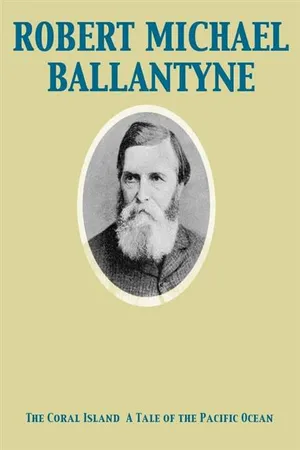
Coral Island A Tale of the Pacific Ocean
Information
Topic
LittératureSubtopic
ClassiquesCHAPTER I.
The beginning— My early life and character— I thirst
for adventure in foreign lands and go to sea.
Roving has always been, and still is, my ruling
passion, the joy of my heart, the very sunshine of my existence. In
childhood, in boyhood, and in man’s estate, I have been a rover;
not a mere rambler among the woody glens and upon the hill-tops of
my own native land, but an enthusiastic rover throughout the length
and breadth of the wide wide world.
It was a wild, black night of howling storm, the
night in which I was born on the foaming bosom of the broad
Atlantic Ocean. My father was a sea-captain; my grandfather was a
sea-captain; my great-grandfather had been a marine. Nobody could
tell positively what occupation his father had followed; but
my dear mother used to assert that he had been a midshipman, whose
grandfather, on the mother’s side, had been an admiral in the royal
navy. At anyrate we knew that, as far back as our family could be
traced, it had been intimately connected with the great watery
waste. Indeed this was the case on both sides of the house; for my
mother always went to sea with my father on his long voyages, and
so spent the greater part of her life upon the water.
Thus it was, I suppose, that I came to inherit a
roving disposition. Soon after I was born, my father, being old,
retired from a seafaring life, purchased a small cottage in a
fishing village on the west coast of England, and settled down to
spend the evening of his life on the shores of that sea which had
for so many years been his home. It was not long after this that I
began to show the roving spirit that dwelt within me. For some time
past my infant legs had been gaining strength, so that I came to be
dissatisfied with rubbing the skin off my chubby knees by walking
on them, and made many attempts to stand up and walk like a man;
all of which attempts, however, resulted in my sitting down
violently and in sudden surprise. One day I took advantage of my
dear mother’s absence to make another effort; and, to my joy, I
actually succeeded in reaching the doorstep, over which I tumbled
into a pool of muddy water that lay before my father’s cottage
door. Ah, how vividly I remember the horror of my poor mother when
she found me sweltering in the mud amongst a group of cackling
ducks, and the tenderness with which she stripped off my dripping
clothes and washed my dirty little body! From this time forth my
rambles became more frequent, and, as I grew older, more distant,
until at last I had wandered far and near on the shore and in the
woods around our humble dwelling, and did not rest content until my
father bound me apprentice to a coasting vessel, and let me go to
sea.
For some years I was happy in visiting the
sea-ports, and in coasting along the shores of my native land. My
Christian name was Ralph, and my comrades added to this the name of
Rover, in consequence of the passion which I always evinced for
travelling. Rover was not my real name, but as I never received any
other I came at last to answer to it as naturally as to my proper
name; and, as it is not a bad one, I see no good reason why I
should not introduce myself to the reader as Ralph Rover. My
shipmates were kind, good-natured fellows, and they and I got on
very well together. They did, indeed, very frequently make game of
and banter me, but not unkindly; and I overheard them sometimes
saying that Ralph Rover was a “queer, old-fashioned fellow. ” This,
I must confess, surprised me much, and I pondered the saying long,
but could come at no satisfactory conclusion as to that wherein my
old-fashionedness lay. It is true I was a quiet lad, and seldom
spoke except when spoken to. Moreover, I never could understand the
jokes of my companions even when they were explained to me: which
dulness in apprehension occasioned me much grief; however, I tried
to make up for it by smiling and looking pleased when I observed
that they were laughing at some witticism which I had failed to
detect. I was also very fond of inquiring into the nature of things
and their causes, and often fell into fits of abstraction while
thus engaged in my mind. But in all this I saw nothing that did not
seem to be exceedingly natural, and could by no means understand
why my comrades should call me “an old-fashioned fellow. ”
Now, while engaged in the coasting trade, I fell in
with many seamen who had travelled to almost every quarter of the
globe; and I freely confess that my heart glowed ardently within me
as they recounted their wild adventures in foreign lands, — the
dreadful storms they had weathered, the appalling dangers they had
escaped, the wonderful creatures they had seen both on the land and
in the sea, and the interesting lands and strange people they had
visited. But of all the places of which they told me, none
captivated and charmed my imagination so much as the Coral Islands
of the Southern Seas. They told me of thousands of beautiful
fertile islands that had been formed by a small creature called the
coral insect, where summer reigned nearly all the year round, —
where the trees were laden with a constant harvest of luxuriant
fruit, — where the climate was almost perpetually delightful, — yet
where, strange to say, men were wild, bloodthirsty savages,
excepting in those favoured isles to which the gospel of our
Saviour had been conveyed. These exciting accounts had so great an
effect upon my mind, that, when I reached the age of fifteen, I
resolved to make a voyage to the South Seas.
I had no little difficulty at first in prevailing on
my dear parents to let me go; but when I urged on my father that he
would never have become a great captain had he remained in the
coasting trade, he saw the truth of what I said, and gave his
consent. My dear mother, seeing that my father had made up his
mind, no longer offered opposition to my wishes. “But oh, Ralph, ”
she said, on the day I bade her adieu, “come back soon to us, my
dear boy, for we are getting old now, Ralph, and may not have many
years to live. ”
I will not take up my reader’s time with a minute
account of all that occurred before I took my final leave of my
dear parents. Suffice it to say, that my father placed me under the
charge of an old mess-mate of his own, a merchant captain, who was
on the point of sailing to the South Seas in his own ship, the
Arrow. My mother gave me her blessing and a small Bible; and her
last request was, that I would never forget to read a chapter every
day, and say my prayers; which I promised, with tears in my eyes,
that I would certainly do.
Soon afterwards I went on board the Arrow, which was
a fine large ship, and set sail for the islands of the Pacific
Ocean.
CHAPTER II.
The departure— The sea— My companions— Some account
of the wonderful sights we saw on the great deep— A dreadful storm
and a frightful wreck.
It was a bright, beautiful, warm day when our ship
spread her canvass to the breeze, and sailed for the regions of the
south. Oh, how my heart bounded with delight as I listened to the
merry chorus of the sailors, while they hauled at the ropes and got
in the anchor! The captain shouted— the men ran to obey— the noble
ship bent over to the breeze, and the shore gradually faded from my
view, while I stood looking on with a kind of feeling that the
whole was a delightful dream.
The first thing that struck me as being different
from anything I had yet seen during my short career on the sea, was
the hoisting of the anchor on deck, and lashing it firmly down with
ropes, as if we had now bid adieu to the land for ever, and would
require its services no more.
“There, lass, ” cried a broad-shouldered jack-tar,
giving the fluke of the anchor a hearty slap with his hand after
the housing was completed— “there, lass, take a good nap now, for
we shan’t ask you to kiss the mud again for many a long day to
come! ”
And so it was. That anchor did not “kiss the mud”
for many long days afterwards; and when at last it did, it was for
the last time!
There were a number of boys in the ship, but two of
them were my special favourites. Jack Martin was a tall, strapping,
broad-shouldered youth of eighteen, with a handsome, good-humoured,
firm face. He had had a good education, was clever and hearty and
lion-like in his actions, but mild and quiet in disposition. Jack
was a general favourite, and had a peculiar fondness for me. My
other companion was Peterkin Gay. He was little, quick, funny,
decidedly mischievous, and about fourteen years old. But Peterkin’s
mischief was almost always harmless, else he could not have been so
much beloved as he was.
“Hallo! youngster, ” cried Jack Martin, giving me a
slap on the shoulder, the day I joined the ship, “come below and
I’ll show you your berth. You and I are to be mess-mates, and I
think we shall be good friends, for I like the look o’ you. ”
Jack was right. He and I and Peterkin afterwards
became the best and stanchest friends that ever tossed together on
the stormy waves.
I shall say little about the first part of our
voyage. We had the usual amount of rough weather and calm; also we
saw many strange fish rolling in the sea, and I was greatly
delighted one day by seeing a shoal of flying fish dart out of the
water and skim through the air about a foot above the surface. They
were pursued by dolphins, which feed on them, and one flying-fish
in its terror flew over the ship, struck on the rigging, and fell
upon the deck. Its wings were just fins elongated, and we found
that they could never fly far at a time, and never mounted into the
air like birds, but skimmed along the surface of the sea. Jack and
I had it for dinner, and found it remarkably good.
When we approached Cape Horn, at the southern
extremity of America, the weather became very cold and stormy, and
the sailors began to tell stories about the furious gales and the
dangers of that terrible cape.
“Cape Horn, ” said one, “is the most horrible
headland I ever doubled. I’ve sailed round it twice already, and
both times the ship was a’most blow’d out o’ the water. ”
“An’ I’ve been round it once, ” said another, “an’
that time the sails were split, and the ropes frozen in the blocks,
so that they wouldn’t work, and we wos all but lost. ”
“An’ I’ve been round it five times, ” cried a third,
“an’ every time wos wuss than another, the gales wos so
tree-mendous! ”
“And I’ve been round it no times at all, ” cried
Peterkin, with an impudent wink of his eye, “an’ that time I
wos blow’d inside out! ”
Nevertheless, we passed the dreaded cape without
much rough weather, and, in the course of a few weeks afterwards,
were sailing gently, before a warm tropical breeze, over the
Pacific Ocean. Thus we proceeded on our voyage, sometimes bounding
merrily before a fair breeze, at other times floating calmly on the
glassy wave and fishing for the curious inhabitants of the deep, —
all of which, although the sailors thought little of them, were
strange, and interesting, and very wonderful to me.
At last we came among the Coral Islands of the
Pacific, and I shall never forget the delight with which I gazed, —
when we chanced to pass one, — at the pure, white, dazzling shores,
and the verdant palm-trees, which looked bright and beautiful in
the sunshine. And often did we three long to be landed on one,
imagining that we should certainly find perfect happiness there!
Our wish was granted sooner than we expected.
One night, soon after we entered the tropics, an
awful storm burst upon our ship. The first squall of wind carried
away two of our masts; and left only the foremast standing. Even
this, however, was more than enough, for we did not dare to hoist a
rag of sail on it. For five days the tempest raged in all its fury.
Everything was swept off the decks except one small boat. The
steersman was lashed to the wheel, lest he should be washed away,
and we all gave ourselves up for lost. The captain said that he had
no idea where we were, as we had been blown far out of our course;
and we feared much that we might get among the dangerous coral
reefs which are so numerous in the Pacific. At day-break on the
sixth morning of the gale we saw land ahead. It was an island
encircled by a reef of coral on which the waves broke in fury.
There was calm water within this reef, but we could only see one
narrow opening into it. For this opening we steered, but, ere we
reached it, a tremendous wave broke on our stern, tore the rudder
completely off, and left us at the mercy of the winds and
waves.
“It’s all over with us now, lads, ” said the captain
to the men; “get the boat ready to launch; we shall be on the rocks
in less than half an hour. ”
The men obeyed in gloomy silence, for they felt that
there was little hope of so small a boat living in such a sea.
“Come boys, ” said Jack Martin, in a grave tone, to
me and Peterkin, as we stood on the quarterdeck awaiting our fate;
— “Come boys, we three shall stick together. You see it is
impossible that the little boat can reach the shore, crowded with
men. It will be sure to upset, so I mean rather to trust myself to
a large oar, I see through the telescope that the ship will strike
at the tail of the reef, where the waves break into the quiet water
inside; so, if we manage to cling to the oar till it is driven over
the breakers, we may perhaps gain the shore. What say you; will you
join me? ”
We gladly agreed to follow Jack, for he inspired us
with confidence, although I could perceive, by the sad tone of his
voice, that he had little hope; and, indeed, when I looked at the
white waves that lashed the reef and boiled against the rocks as if
in fury, I felt that there was but a step between us and death. My
heart sank within me; but at that moment my thoughts turned to my
beloved mother, and I remembered those words, which were among the
last that she said to me— “Ralph, my dearest child, always remember
in the hour of danger to look to your Lord and Saviour Jesus
Christ. He alone is both able and willing to save your body and
your soul. ” So I felt much comforted when I thought thereon.
The ship was now very near the rocks. The men were
ready with the boat, and the captain beside them giving orders,
when a tremendous wave came towards us. We three ran towards the
bow to lay hold of our oar, and had barely reached it when the wave
fell on the deck with a crash like thunder. At the same moment the
ship struck, the foremast broke off close to the deck and went over
the side, carrying the boat and men along with it. Our oar got
entangled with the wreck, and Jack seized an axe to cut it free,
but, owing to the motion of the ship, he missed the cordage and
struck the axe deep into the oar. Another wave, however, washed it
clear of the wreck. We all seized hold of it, and the next instant
we were struggling in the wild sea. The last thing I saw was the
boat whirling in the surf, and all the sailors tossed into the
foaming waves. Then I became insensible.
On recovering from my swoon, I found myself lying on
a bank of soft grass, under the shelter of an overhanging rock,
with Peterkin on his knees by my side, tenderly bathing my temples
with water, and endeavouring to stop the blood that flowed from a
wound in my forehead.
CHAPTER III.
The Coral Island— Our first cogitations after landing, and the result of them— We conclude that the island is uninhabited.
There is a strange and peculiar sensation experienced in recovering from a state of insensibility, which is almost indescribable; a sort of dreamy, confused consciousness; a half-waking half-sleeping condition, accompanied with a feeling of weariness, which, however, is by no means disagreeable. As I slowly recovered and heard the voice of Peterkin inquiring whether I felt better, I thought that I must have overslept myself, and should be sent to the mast-head for being lazy; but before I could leap up in haste, the thought seemed to vanish suddenly away, and I fancied that I must have been ill. Then a balmy breeze fanned my cheek, and I thought of home, and the garden at the back of my father’s cottage, with its luxuriant flowers, and the sweet-scented honey-suckle that my dear mother trained so carefully upon the trellised porch. But the roaring of the surf put these delightful thoughts to flight, and I was back again at sea, watching the dolphins and the flying-fish, and reefing topsails off the wild and stormy Cape Horn. Gradually the roar of the surf became louder and more distinct. I thought of being wrecked far far away from my native land, and slowly opened my eyes to meet those of my companion Jack, who, with a look of intense anxiety, was gazing into my face.
“Speak to us, my dear Ralph, ” whispered Jack, tenderly, “are you better now? ”
I smiled and looked up, saying, “Better; why, what do you mean, Jack? I’m quite well. ”
“Then what are you shamming for, and frightening us in this way? ” said Peterkin, smiling through his tears; for the poor boy had been really under the impression that I was dying.
I now raised myself on my elbow, and putting my hand to my forehead, found that it had been cut pretty severely, and that I had lost a good deal of blood.
“Come, come, Ralph, ” said Jack, pressing me gently backward, “lie down, my boy; you’re not right yet. Wet your lips with this water, it’s cool and clear as crystal. I got it from a spring close at hand. There now, don’t say a word, hold your tongue, ” said he, seeing me about to speak. “I’ll tell you all about it, but you must not utter a syllable till you have rested well. ”
“Oh! don’t stop him from speaking, Jack, ” said Peterkin, who, now that his fears for my safety were removed, busied himself in erecting a shelter of broken branches in order to protect me from the wind; which, however, was almost unnecessary, for the rock beside which I had been laid completely broke the force of the gale. “Let him speak, Jack; it’s a comfort to hear that he’s alive, after lying there stiff and white and sulky for a whole hour, just like an Egyptian mummy. Never saw such a fellow as you are, Ralph; always up to mischief. You’ve almost knocked out all my teeth and more than half choked me, and now you go shamming dead! It’s very wicked of you, indeed it is. ”
While Peterkin ran on in this style, my faculties became quite clear again, and I began to understand my position. “What do you mean by saying I half c...
Table of contents
- The Coral Island:
- Preface
- CHAPTER I.
- CHAPTER II.
- CHAPTER III.
- CHAPTER IV.
- CHAPTER V.
- CHAPTER VI.
- CHAPTER VII.
- CHAPTER VIII.
- CHAPTER IX.
- CHAPTER X.
- CHAPTER XI.
- CHAPTER XII.
- CHAPTER XIII.
- CHAPTER XIV.
- CHAPTER XV.
- CHAPTER XVI.
- CHAPTER XVII.
- CHAPTER XVIII.
- CHAPTER XIX.
- CHAPTER XX.
- CHAPTER XXI.
- CHAPTER XXII.
- CHAPTER XXIII.
- CHAPTER XXIV.
- CHAPTER XXV.
- CHAPTER XXVI.
- CHAPTER XXVII.
- CHAPTER XXVIII.
- CHAPTER XXIX.
- CHAPTER XXX.
- CHAPTER XXXI.
- CHAPTER XXXII.
- CHAPTER XXXIII.
- CHAPTER XXXIV.
- CHAPTER XXXV.
- Copyright
Trusted by 375,005 students
Access to over 1.5 million titles for a fair monthly price.
Study more efficiently using our study tools.
Frequently asked questions
Yes, you can cancel anytime from the Subscription tab in your account settings on the Perlego website. Your subscription will stay active until the end of your current billing period. Learn how to cancel your subscription
No, books cannot be downloaded as external files, such as PDFs, for use outside of Perlego. However, you can download books within the Perlego app for offline reading on mobile or tablet. Learn how to download books offline
Perlego offers two plans: Essential and Complete
- Essential is ideal for learners and professionals who enjoy exploring a wide range of subjects. Access the Essential Library with 800,000+ trusted titles and best-sellers across business, personal growth, and the humanities. Includes unlimited reading time and Standard Read Aloud voice.
- Complete: Perfect for advanced learners and researchers needing full, unrestricted access. Unlock 1.5M+ books across hundreds of subjects, including academic and specialized titles. The Complete Plan also includes advanced features like Premium Read Aloud and Research Assistant.
We are an online textbook subscription service, where you can get access to an entire online library for less than the price of a single book per month. With over 1.5 million books across 990+ topics, we’ve got you covered! Learn about our mission
Look out for the read-aloud symbol on your next book to see if you can listen to it. The read-aloud tool reads text aloud for you, highlighting the text as it is being read. You can pause it, speed it up and slow it down. Learn more about Read Aloud
Yes! You can use the Perlego app on both iOS and Android devices to read anytime, anywhere — even offline. Perfect for commutes or when you’re on the go.
Please note we cannot support devices running on iOS 13 and Android 7 or earlier. Learn more about using the app
Please note we cannot support devices running on iOS 13 and Android 7 or earlier. Learn more about using the app
Yes, you can access Coral Island A Tale of the Pacific Ocean by Robert Michael Ballantyne in PDF and/or ePUB format, as well as other popular books in Littérature & Classiques. We have over 1.5 million books available in our catalogue for you to explore.