eBook - ePub
Information
PART I: THREE HORIZONS
A HEATED CONVERSATION
WHEN something occurs that gives us pause for thought about our present circumstances we tend to start a conversation about the future. Somebody might have presented us with a tempting opportunity. Or a colleague might have been ‘let go’ during hard times. Or we might have read a report on climate change suggesting recent weird weather patterns are a sign of things to come.
These snippets of information or experience make us question the present pattern of our lives. Our minds naturally fill with thoughts about possible future consequences. Should I take a chance and grasp the opportunity? What if I am next in line for the sack? Might it be time to start taking climate change seriously? What is naturally stirring in us is what I call our ‘future consciousness’.
We can see it stirring in group settings too, although it is rarely acknowledged. Imagine the following conversation, typical of what might take place in the Boardroom of an education department or agency about the enduring connection between poor economic and social circumstances and poor educational performance.
The depressing statistics are presented, going back over several decades. In spite of countless initiatives, the correlation between poverty and poor educational performance seems as solid as ever. It is not long before the Chairman voices a thought that many around the table are having. “Inequality is an intractable issue”, he says. “The link between poverty and poor attainment has been with us for generations. I really think we will still be here in ten years’ time discussing exactly the same issue.”
To some this sounds defeatist. A Board member with more recent experience in the classroom points to telling examples of small-scale projects which she knows have made a real difference. “If we had less hand-wringing and more action we could get behind these projects… and invent others. Of course the gap can be closed.”
This prompts a third person to speak up. “It is simply intolerable”, she says, “that in the 21st century, in a wealthy nation like ours, the circumstances of your birth still count for so much. I don’t think we can hold our heads up as a national agency effectively perpetuating a system in which poverty is fate. It is time to stand up and be counted.”
A passionate discussion ensues, ebbing backwards and forwards between the voice of concern (“I really can’t see things improving”), the voice of enterprise (“there must be something we can try”) and the voice of aspiration (“if we can imagine a world of radical equality then surely we can build it”). The perspectives seem incompatible. Accusations fly, particularly against the voice of aspiration, which is felt to be at odds with the real world. “If you really believe that’s possible, I want some of the pills you’re taking.”
Eventually, as lunch draws near, the Chairman brings the discussion to a close. He has been surprised by the passion released and a little concerned by the deep tensions the conversation has revealed. But he has not himself been persuaded to shift from his long-held view that when it comes to educational attainment, poverty is indeed fate and no amount of ‘innovation’ in the system will make any real difference.
Even so, he senses that something must be done, if only to maintain cohesion in the Board. So he duly records an intention to commission more detailed research into the causes of the problem, and to engage a specialist futures consultancy in a scenarios project in order to get a better handle on the long-term future. Passions subside and the Board moves on to the next agenda item: HR.
It is the contention of this book that the group did not need to engage a futures consultancy to have a conversation about the future. They were already having one. The strongly held views expressed were in fact different perspectives on the future potential of the present moment. Most such conversations naturally reveal three dominant perspectives. The Chairman has presided over the growing success of the dominant system but now sees nothing but trouble ahead. The entrepreneur senses in this the scope for new thinking, new ideas, new approaches and wants to try something different. The visionary, increasingly impatient with both views, wants to make a stand and press for radical action.
These positions correspond in our framework to three horizons – three possible patterns in which the present might play out into the future. All three are always present, in any conversation and indeed in our own thinking. Being able to identify them and work skilfully with them, in groups, communities, nations, and within ourselves, is a practice that we can all develop. It restores our sense of agency in the face of a future that is, and always has been, radically open. We call this Three Horizons thinking – in the service of the conscious practice of ‘future consciousness’.

THE FUTURE IN THE PRESENT
HOW can people work together to create transformational change in the face of the uncertain future? There are two main sorts of change – that which continues the pattern of how we are doing things today, and that which starts a new pattern. A caterpillar grows by getting longer and fatter, but this can only go on for a while before it reaches the limit. The caterpillar cannot turn into a butterfly by eating more, taking exercise, or anything else – it has to go through a transformation in how it is organised and how it relates to the world around it. The caterpillar changes the pattern of its life, abandoning the old and adopting the new. Similarly, we recognise the need for transformational change when we see that the way things are getting done now has limits; that we cannot get beyond these limits however much we try to improve the existing system, and that we must, as a result, create a new pattern of life for the future we want and need.
A caterpillar ‘knows’ what it has to become, its path of transformation is mapped out for it, but transformation for us is a process of exploration, and to explore we must travel over the horizon towards the unknown. We can only see the world from where we are: we may be on a beach or at the top of a mountain, but wherever we stand, the world that we can see gradually gives way to the horizon of sight. As our direct perception fails so our knowledge and imagination must take over. Perhaps some people have explored a little way and come back with stories of what they have seen, or perhaps there are high mountains peeping over the horizon and rivers flowing from them that carry clues to what lies beyond. If we are happy where we are, and have no need to travel, such speculation can stay as day dreams, but if we want to set out to new lands we must use these fragments to equip ourselves for an unpredictable journey over the horizon to an envisioned destination. We can only learn more by setting out on the journey; we must choose a direction and be ready to learn and adapt as we go.
When we have to act to realise our intentions in a complex and uncertain world, we are faced with the same problem: the familiar way of doing things is all around us, but gradually gives way to a future that lies over the horizon of what we can know. We can see change and innovation going on, we can look for signs in the present of the deeper trends that will shape events, and we can envision the future that we hope can be reached. But if we are to get anywhere we have to choose our direction and set off, unsure of what we will find, guided by a blend of knowledge, imagination and our values.
Three Horizons is a way to think about the future that recognises deep uncertainty but responds with an active orientation; that allows us to understand more clearly how our actions and those of others we engage with might shape the future we are trying to explore. This is especially important when we look at issues of broad societal concern, where we are all, as members of society, actors in the future. In these cases we are particularly concerned to find ways for the many different constituencies in society to come together to unlock the future from the dominance of old ways of doing things – ways that are no longer working for us.
Three Horizons thinking offers a way to find and shape our own intentions more clearly as we look over the first horizon of the known towards the second and third horizons of innovation and transformation towards the future. It transforms the potential of the present moment by revealing each horizon as a different quality of the future in the present, reflecting how we act differently to maintain the familiar or pioneer the new. The outcome of Three Horizons work is a map of transformational potential which enables us to act with more skill, freedom and creativity in the present, both individually and together. There are two constituencies for such work: those who act as players in each horizon within the patterns and those whose ability to set policy and govern can enable or disable the actions of the players.
The foundation of the Three Horizons approach is that it is well aligned with three natural forms of awareness which everybody can adopt towards the future and quite easily describe. By default, many people inhabit just one horizon in their work, and view other horizons with varying degrees of perplexity, misunderstanding or hostility – like the Chairman in the little cameo above. However, everyone has a natural capacity to work with the other horizons, and the core of Three Horizons practice is the flexibility to work with all three modes of awareness. As people make this step individually they can also make it together – developing a shared culture of future consciousness that in turn opens up a greater freedom of action. This deeper, collective awareness is itself a third horizon vision – a ‘future consciousness’ of transformational capacity for everyone.

THE THREE HORIZONS
A simple linear view of change places us in the present moment looking towards how we want things to be in future, and it typically divides time into now, the mid-term and long-term future. That way of thinking places the future as outside the present moment, seen only as something that might or might not happen, and makes it appear in the guise of the unknown or unknowable and the risky. Yet we act with future intent all the time, linking what we are doing today to some future outcome, and it is helpful to see that we do this naturally in three quite distinct ways. These are in fact different ways not only of looking at the future but of bringing it into being, and so they are three ways of relating the future to our actions in the present.
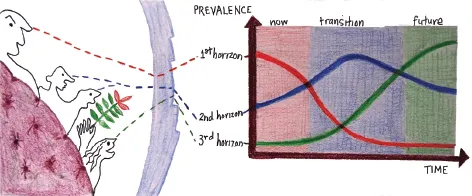
We can represent these three relationships of the present to the future as three horizons which describe a pattern of change over time in our area of interest, as shown in the picture at the beginning of this section.
The first horizon describes the current way of doing things, and the way we can expect it to change if we all keep behaving in the ways we are used to. H1 systems are what we all depend on to get things done in the world. Throughout the day we make use of a myriad societal systems – shops, schools, banks, hospitals, transport – and most of the time we don’t want, or need, to think about them too much; we all help perpetuate the system by taking part in it. While we talk a lot about the pace of change, it is worth remembering that lots of things must stay the same for daily life to go on. Innovation and change in our H1 systems is happening, but it is about sustaining and extending the way things are done now in a planned and orderly way; uncertainties and risks are to be eliminated or prepared for – the lights must be kept on.
Nothing lasts forever, and over time we inevitably find that our H1 ways of doing things are falling short – no longer meeting expectations, failing to move towards new opportunities, or out of step with emerging conditions. More than that, we have a sense that our H1 methods of improvement and innovation do not ever get us where we want to go and are just sustaining the old approach with its failings; that approach is losing its ‘fitness for purpose’.
The third horizon is the future system. It is those new ways of living and working that will fit better with the emerging need and opportunity. H3 change is transformative, bringing a new pattern into existence that is beyond the reach of the H1 system. There will be many competing visions of the future and early pioneers are likely to look quite unrealistic – and some of them are. As we build our own Three Horizons map we bring our own vision to bear and take a view on how it relates to the visions of others and the trends that are playing out for all of us.
The second horizon is the transition and transformation zone of emerging innovations that are responding to the shortcomings of the first horizon and anticipating the possibilities of the third horizon. New ways of doing things emerge in messy ways, brought about through some combination of deliberate action and opportunistic adaptation in the light of circumstances. Entrepreneurs must judge the moment, and bring together ideas and resources to try a new way of doing things here and now. They live in an ambiguous territory where the old ways are dominant but the new is becoming possible; they can look to the past and fit in with familiar patterns of life, or try to become the seed that grows into the new. Entrepreneurship is hard and most attempts to do new things fail; it is much easier to serve the old systems, and established H1 players typically dominate.
The foundation of the Three Horizons approach is to explore the future as the interaction between the three horizons. We seek to understand all the actors, including ourselves, in terms of the role they play in sustain...
Table of contents
- Cover
- Copyright
- Contents
- Introduction
- PART I: THREE HORIZONS
- PART II – THE PRACTICE OF FUTURE CONSCIOUSNESS
- PART III – JOURNEYS IN THREE HORIZONS
- PART IV – THE PATTERNING OF HOPE
- Acknowledgements
- Notes
- Bibliography
Trusted by 375,005 students
Access to over 1.5 million titles for a fair monthly price.
Study more efficiently using our study tools.
Frequently asked questions
Yes, you can cancel anytime from the Subscription tab in your account settings on the Perlego website. Your subscription will stay active until the end of your current billing period. Learn how to cancel your subscription
No, books cannot be downloaded as external files, such as PDFs, for use outside of Perlego. However, you can download books within the Perlego app for offline reading on mobile or tablet. Learn how to download books offline
Perlego offers two plans: Essential and Complete
- Essential is ideal for learners and professionals who enjoy exploring a wide range of subjects. Access the Essential Library with 800,000+ trusted titles and best-sellers across business, personal growth, and the humanities. Includes unlimited reading time and Standard Read Aloud voice.
- Complete: Perfect for advanced learners and researchers needing full, unrestricted access. Unlock 1.5M+ books across hundreds of subjects, including academic and specialized titles. The Complete Plan also includes advanced features like Premium Read Aloud and Research Assistant.
We are an online textbook subscription service, where you can get access to an entire online library for less than the price of a single book per month. With over 1.5 million books across 990+ topics, we’ve got you covered! Learn about our mission
Look out for the read-aloud symbol on your next book to see if you can listen to it. The read-aloud tool reads text aloud for you, highlighting the text as it is being read. You can pause it, speed it up and slow it down. Learn more about Read Aloud
Yes! You can use the Perlego app on both iOS and Android devices to read anytime, anywhere — even offline. Perfect for commutes or when you’re on the go.
Please note we cannot support devices running on iOS 13 and Android 7 or earlier. Learn more about using the app
Please note we cannot support devices running on iOS 13 and Android 7 or earlier. Learn more about using the app
Yes, you can access Three Horizons by in PDF and/or ePUB format, as well as other popular books in Social Sciences & Sociology. We have over 1.5 million books available in our catalogue for you to explore.