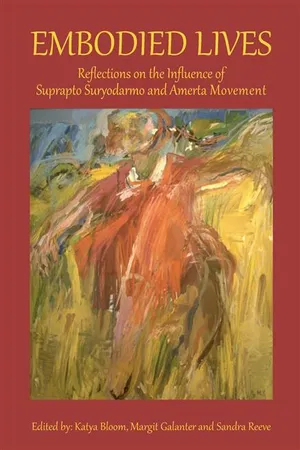
eBook - ePub
Information
1. PRESENCE
I am in a tropical paradise – unfortunately the mosquitoes are here too.
I feel a bit imprisoned. My choices are: being covered with ‘off’ repellent, covering up with clothes, being bitten or staying inside. “How to be happy in prison?” I hear Prapto speaking in my mind. Or, I think he said, “being confident in hell”, but it is not really that bad.
I go inside – my head is busy, keep it simple, just walking is always a good start, walking and variations, running.
My intention: to get into my body and out of my head – this is my other prison.
This piece wants to be written and of course it should be the best, should be written with space and humour, profound, rich, light, poetic and with a sense of three-dimensional embodiment; all of this, and maybe more.
I walk, I run, head in front – yes – I enjoy this stupid run.
Head in front… it reminds me of my Self Portrait Dance 30 years ago at the San Francisco Dancers’ Workshop. My head separate from my body, being in a box full of judgements. It was a great self-caricature, funny and sad. My head was making me feel crazy.
Stopping now in my movement, I see a bamboo stick, it looks friendly, I …take it and move with it. Sounds come and – no – I do not follow this known melody, I am curious what evolves when I relax into listening while moving.
I come to sit on the cool grey floor, the bamboo in my hands, deep sounds arise from a deep place and an image from a movie comes – The Long Walk Home – the bamboo is brown, has segments and is warm in my hands. I look at my feet, the bamboo, my hands; I see my clothes and my position in the space and think “this would make a great photo”. I hear the birds, lean into my back and ‘wait’ for a new movement to come.
I ‘wait’, open, receiving the presence of life.
I hold the bamboo and the bamboo holds me; looking through the window, I remember the first feedback I got from Prapto, on my first visit to Java in 1987: “look near”.
It was like zooming with my eyes from far to near, to myself. While zooming I became aware of the space and sensing the space made me breathe. I touched the way to be connected with space and, through the space, with the far and near.
I am here now, in my body, in the space with the bamboo and enjoy the colours, the movements of the leaves and the play of light and shadow, the birds singing.
Summertime and the living is easy…..I sing the few words I know.
Reflecting
The movement described above is a snapshot, an awareness practice, an ‘improvisation’ in Bolivia in December 2012.
It is filled with the atmosphere of this particular environment. However the essence of my movement practice and the witnessing of myself could happen anywhere.
I moved alone, but that is only true if I count only human beings. There were different sounds from insects and all kinds of animals, there was the atmosphere of my friend, who created this space, the hot air and who knows who else was also taking part, hiding in corners and holes. I was happy to share and be part of this living environment.
Entering the flow of a movement process is deeply satisfying, but it does not always happen.
Working in and with the ‘here and now’ is exciting for me.
I am curious about what the body offers, which movements come, which images or feelings arise, what will unfold. I am interested in what the body receives and in how it responds, in what it has to say, what knowledge it holds and when it gives it freely.
When I went inside (into the movement space) I had my intention: to get into my body. I was guided by my awareness and mindfulness.
I started from what I have, as Prapto used to say, which means with all my resources gathered in my life, including my familiar judge. I do not have to think any more what to do or how to start.
No preparation any more: every movement counts on the stage of life. Movement is not seen as a symbol nor is it seen as functional; it is not for getting better, it simply is.
Starting with walking felt good; it is so basic, my feet on the ground, taking a step, stamping in different directions, playing with balancing, falling on the feet, jumping, being creative, silly, all variations; it helps not to get stuck, not to become too serious or go too deep into a search for meaning. Being simple, just muscles, body and having fun and enjoying it.
Now I wonder how to bring the directness and aliveness of it into writing. How to write or speak not about the experience, but from it. Speaking ‘about’ often feels like drawing a veil over the experience, so we can control it; it creates distance, which sometimes is needed too. Finding the words, speaking from the experience, from being engaged and present with all the senses and feelings is so exciting, almost scary at times; it is real, alive and vibrant. Sometimes there are no words… maybe a poem, a sound, maybe only stillness.
Learning to trust my intuition and allowing for magical moments.
One needs the Dreieinige Gehirn, the Triune Brain, the interplay of all our brain areas, no hierarchy, a great field to be in; unfortunately the judge thinks he is the boss.
He comes in when my prefrontal cortex is stressed.
But the sanest and most subtle task of this prefrontal part of the brain is to give space for our listening to (sensing) the body and our feelings – and to be aware of it, reflect on it, understand its meaning.
An Experiment
Some time ago I was asked to offer a short walking experiment in a dance research group.
I had chosen an awareness experiment.
I asked the group members to lift one foot – noticing how they did it and whether they still had a sense of the ground – then to put that foot down – how did it arrive on the ground? I asked them to notice if they followed the foot with the whole body. Did they bring their whole being to the new place… maybe facing a different direction? Being in a new place means being closer or further away from, for example, walls, windows, the others. Did their eyes follow the movement? Or the movement follow their eyes? What did they see, and how did it feel? What did they sense?
Later I read my instructions as written down by a group member as she had heard them; she said: “…lifting the foot for the next step and putting it in a new place… how do the eyes react?”
“Interesting”, I thought, “that task sounds and feels quite different”. I sensed the speed in it, the forward orientation. The “for the next step” indicates for me the functional, the next and the new, the future. As if all is there, outside, in front. The action described is the same, but the attitude and process of awareness is very different.
Culturally, we in the West are very much forward oriented: the front is interesting and the future too. This became very clear to me after I had lived for some time in Java. I had noticed many times how much I was in front, in the future; I was already there. Food was already prepared, in my mind, while I was still ordering it; I was impatient.
In my movement practice as well as in Sumarah – a Javanese meditation, a path of awareness and acceptance (translated literally: giving up the fight, surrender) – the back is important, the physical back, becoming aware of one’s own back, one’s own background, the support one can get from having someone behind. There is space and time behind too.
Having a back, feeling it and leaning into it, can be like resting in a Lehnstuhl, an easy chair. It gives us space and breathing, then our body has volume, is three-dimensional and becomes our container.
Fields of Awareness
The experience of the participants in this research group was calmness, expanse and a space of awareness. I sensed the aliveness of the space and the more the space was filled with awareness, the more we began to be connected, a sharing of one field for which we all were responsible.
How to stay alive in interdependency and not shrink into dependency? This could be the next task.
We have an effect on each other and on our environment, through our being and our doing, and the environment has an effect on us too.
We resonate: this gives us a sense of what is present in ourselves and in the space.
It can be written down quickly – ‘being in resonance’ – but not quickly achieved.
It is a never-ending process, a refinement of awareness, of consciousness, of sensing and feeling, also of understanding and distinguishing.
In a group, if we are in tune and one person changes their place or position or shifts their awareness, then we all need to change too; we respond, adapt, improvise; it is an ongoing process. Someone releases some stress, a tightness, lets go of a burden, and often the whole group will take a deep breath: the release is in the air. Everyone contributes, everyone’s creation, expression and release, everyone’s change makes a difference to the whole.
At my first encounter with Prapto’s work I was amazed (I was just back from California and had learnt to be amazed) by the differences in participants’ movement qualities and style; everyone moved in their own unique way, and at the same time there was something special in the air, a connecting atmosphere.
Something in common was in the space and between people moving, like a soft energy. I got interested, even though nothing very exciting seemed to happen.
Seeing them being supported in their own ways and still being connected, sharing the space, was just the opposite of what I had experienced in my family, but I did not think of it then.
Gerald Hüther, a German neurobiologist, says: we human beings have two longings: one is to be free and the other is to be verbunden. The dictionary offers me for verbunden: connected, related, etc. I add ‘being a part of’.
Moving in a group can be like being part of one organism, with a heightened awareness. Sometimes it feels like being under a microscope.
Form and structure evolves from the contact and being in resonance with the living and organised organism.
Following the body and being connected with the living environment we enter the unpredictable nature of life, at times not understanding why we need to move like this, or in that direction, and at the same time being clear that this is what needs to happen, what needs to be done.
Having an intention or a task helps to start the movement practice, it gives a guideline for moving (and living): for being aware, witnessing oneself, growing the ability to respond, to be present and connected to the energy of life. It requires trust in the wisdom of the body and its knowledge. It is surprising, touching, cleansing, authentic, easy, somehow limitless, free and connected. We compose, we create, wir gestalten while we move/dance.
Our physical presence, being rooted and grounded in the body, is our base, our home. The body is our instrument, this is where it happens, here we speak – nonverbally – here we receive the nonverbal. It is important to get to know and be present in the body otherwise there is no : body, and we are lost, in the world of fine energy, vibrations and resonances.
I was in Parangtritis, a village in Java on the Indian Ocean. I watched a group practising movement in the endless white dunes. Why did their range of movement and use of space ge...
Table of contents
- COVER
- TITLE PAGE
- COPYRIGHT
- CONTENTS
- ACKNOWLEDGEMENTS
- INTRODUCTION
- 1. PRESENCE
- 2. AMERTA MOVEMENT AND ARCHAEOLOGY
- 3. CULTURAL ASPECTS OF THE MOVEMENT WORK
- 4. AMERTA AND TIBETAN BUDDHISM
- 5. THE EYE OF THE HAND
- 6. A DOG PRACTICING ‘TALKING BODY’
- 7. “MAKE LESS THE HOPING”
- 8. TOUCHING FORGOTTEN REALITIES
- 9. THE ECHO OF LIFE
- 10. I ALWAYS DO THREE THINGS
- 11. A PRESENCING DIAL
- 12. AMERTA MOVEMENT AND SOMATIC COSTUME
- 13. CRYSTALLIZATION-PERFORMANCE
- 14. BEING AND DOING IN THE WILD GARDEN
- 15. ‘MANTRA GERAK’/MOVEMENT MANTRA
- 16. THE MUSICAL PORTAL
- 17. NEAR THE UNKNOWN
- 18. FAMILY
- 19. THE INFANT’S LANGUAGE
- 20. “GOING OUT OF THE SITUATION” AND “STOP, DON’T FOLLOW THAT, WALK!”
- 21. AMERTA MOVEMENT AND AUTISM
- 22. “FIND YOUR POSITION”
- 23. “BODY BODY”
- 24. EVER-SPEAKING BEING
- 25. MOVING IN THE LAW
- 26. THE BREATHING EYE
- 27. JOY
- 28. “RE-MEMBERING” BUTTERFLY BEACH
- 29. I WILL TRACE THE CONSTELLATION OF MY STARS WITH MY FINGERS
- 30. AWAKENING ART AND DHARMA NATURE TIME
- AFTERWORD: A PRAPTO COMPANION
Trusted by 375,005 students
Access to over 1.5 million titles for a fair monthly price.
Study more efficiently using our study tools.
Frequently asked questions
Yes, you can cancel anytime from the Subscription tab in your account settings on the Perlego website. Your subscription will stay active until the end of your current billing period. Learn how to cancel your subscription
No, books cannot be downloaded as external files, such as PDFs, for use outside of Perlego. However, you can download books within the Perlego app for offline reading on mobile or tablet. Learn how to download books offline
Perlego offers two plans: Essential and Complete
- Essential is ideal for learners and professionals who enjoy exploring a wide range of subjects. Access the Essential Library with 800,000+ trusted titles and best-sellers across business, personal growth, and the humanities. Includes unlimited reading time and Standard Read Aloud voice.
- Complete: Perfect for advanced learners and researchers needing full, unrestricted access. Unlock 1.5M+ books across hundreds of subjects, including academic and specialized titles. The Complete Plan also includes advanced features like Premium Read Aloud and Research Assistant.
We are an online textbook subscription service, where you can get access to an entire online library for less than the price of a single book per month. With over 1.5 million books across 990+ topics, we’ve got you covered! Learn about our mission
Look out for the read-aloud symbol on your next book to see if you can listen to it. The read-aloud tool reads text aloud for you, highlighting the text as it is being read. You can pause it, speed it up and slow it down. Learn more about Read Aloud
Yes! You can use the Perlego app on both iOS and Android devices to read anytime, anywhere — even offline. Perfect for commutes or when you’re on the go.
Please note we cannot support devices running on iOS 13 and Android 7 or earlier. Learn more about using the app
Please note we cannot support devices running on iOS 13 and Android 7 or earlier. Learn more about using the app
Yes, you can access embodied Lives by in PDF and/or ePUB format, as well as other popular books in Medios de comunicación y artes escénicas & Terapia ocupacional. We have over 1.5 million books available in our catalogue for you to explore.