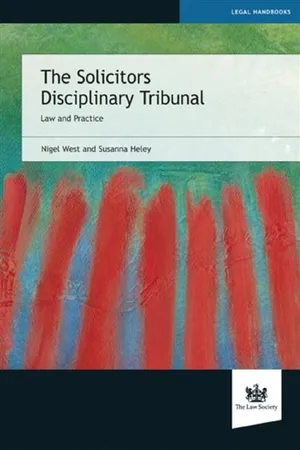
- 384 pages
- English
- ePUB (mobile friendly)
- Available on iOS & Android
eBook - ePub
Information
CHAPTER 1
The constitution of the Solicitors Disciplinary Tribunal
1.1THE STATUTORY FRAMEWORK AND THE PROCEDURAL RULES
The Solicitors Disciplinary Tribunal (the Tribunal) is a statutory tribunal established in 1975 by section 46(1) of the Solicitors Act 1974 to consider applications and complaints made against solicitors and their employees under any provision of the Solicitors Act 1974 (except so far as other provision is made by the Act or any regulations under it).
Section 46 of SA 1974 provides the Tribunal with a wide discretion to regulate its own procedure:
•By s.46(9)(b), SA 1974, the Tribunal may make rules about the procedure and practice to be adopted in making, hearing and determining applications and complaints (including rules making provision about the composition of the Tribunal).
•By s.46(12), SA 1974, the rules are made by way of statutory instrument.
•By s.46(5A), SA 1974, the Tribunal may do anything calculated to facilitate, or incidental or conducive to, the carrying out of any of its functions.
The Tribunal has two current sets of rules:
1.The Solicitors (Disciplinary Proceedings) Rules (SDPR) 2007,1 which govern the general procedure for the Tribunal, its day-to-day function and first instance applications made to it; and
2.The Solicitors Disciplinary Tribunal (Appeals and Amendment) Rules (AAR) 2011,2 which govern the Tribunal’s appellate jurisdiction.
1.2THE TRIBUNAL’S STATUTORY JURISDICTION TO HEAR APPLICATIONS AND APPEALS
1.2.1The statutes conferring jurisdiction on the Tribunal
The Tribunal’s initial jurisdiction was limited to applications and complaints relating to solicitors and their clerks and was contained in SA 1974. The jurisdiction has been extended over time to include other regulated persons. This section provides a list of the different statutes and regulations which now confer jurisdiction on the Tribunal to hear applications and complaints. The jurisdiction arising from each particular statute and regulation is considered in detail in other chapters of this book.3
The statutes and regulations conferring jurisdiction are:
•SA 1974 (applications and complaints arising under SA 1974 save where another body is specified in relation to a particular application or complaint).
•Administration of Justice Act (AJA) 1985, Sched.2, para.16(1) and (1A) (applications and complaints relating to legal services bodies, their managers and employees).
•European Communities (Lawyer’s Practice) Regulations (ECLPR) 2000, reg.26(4)(a) (applications and complaints relating to registered European lawyers).4
•Courts and Legal Services Act (CLSA) 1990, Sched.14, para.15(2) (applications and complaints relating to registered foreign lawyers).5
•Legal Services Act 2007 (Appeals from Licensing Authority Decisions) (No.2) Order 2011, para.4 (appellate jurisdiction over disciplinary decisions relating to alternative business structures).6
1.2.2Applications and complaints excluded from Tribunal jurisdiction
The Tribunal does not have jurisdiction to deal with applications and complaints on the following matters:
•Service complaints (including negligence).7
•Decisions to impose practising certificate conditions.8
•Appeals against the imposition of practising certificate conditions.9
•Appeals against admission10 and recognition11 decisions.
•Appeals against decisions not to restore a solicitor’s name to the roll.12
•Decisions to intervene.13
•Appeals against decisions to intervene.14
•First instance complaints relating to alternative business structures.15
1.2.3Concurrent jurisdiction
There is a concurrent jurisdiction between the SRA and the Tribunal in relation to orders against solicitors’ employees under s.43, SA 1974 (see Chapter 12) and the internal disciplinary powers of the SRA which can be appealed to the Tribunal (see Chapter 20).
1.3PRACTICE DIRECTIONS
By rule 21(3) SDPR, the Tribunal (or a panel of at least five members of whom not less than two shall be lay members) may give such notices or make such directions concerning the practices or procedures of the Tribunal as are consistent with SDPR and as shall seem appropriate. The Tribunal shall promulgate notices or directions given or made under ...
Table of contents
- Cover
- Half Title
- Related titles from Law Society Publishing
- Title
- Copyright
- Contents
- Foreword
- About the authors
- Acknowledgements
- Table of cases
- Table of statutes
- Table of statutory instruments
- Table of EU legislation and international conventions
- Abbreviations
- 1 The constitution of the Solicitors Disciplinary Tribunal
- 2 The SRA decision to prosecute
- 3 Jurisdiction, issue and service
- 4 Public hearings and publicity
- 5 Rule 5 statements, answers and witness statements
- 6 Standard Directions and Practice Direction 6
- 7 Disclosure
- 8 Interim applications
- 9 Evidence
- 10 Dishonesty cases
- 11 Types of misconduct
- 12 Section 43 orders, RELs and RFLs
- 13 Settlements
- 14 The trial
- 15 Sanctions
- 16 Costs
- 17 Appeals from the SDT
- 18 Termination of an indefinite suspension
- 19 Restoration
- 20 Appeals to the Tribunal
- Appendix 1
- Appendix 2
- Appendix 3
- Appendix 4
- Index
Trusted by 375,005 students
Access to over 1.5 million titles for a fair monthly price.
Study more efficiently using our study tools.
Frequently asked questions
Yes, you can cancel anytime from the Subscription tab in your account settings on the Perlego website. Your subscription will stay active until the end of your current billing period. Learn how to cancel your subscription
No, books cannot be downloaded as external files, such as PDFs, for use outside of Perlego. However, you can download books within the Perlego app for offline reading on mobile or tablet. Learn how to download books offline
Perlego offers two plans: Essential and Complete
- Essential is ideal for learners and professionals who enjoy exploring a wide range of subjects. Access the Essential Library with 800,000+ trusted titles and best-sellers across business, personal growth, and the humanities. Includes unlimited reading time and Standard Read Aloud voice.
- Complete: Perfect for advanced learners and researchers needing full, unrestricted access. Unlock 1.5M+ books across hundreds of subjects, including academic and specialized titles. The Complete Plan also includes advanced features like Premium Read Aloud and Research Assistant.
We are an online textbook subscription service, where you can get access to an entire online library for less than the price of a single book per month. With over 1.5 million books across 990+ topics, we’ve got you covered! Learn about our mission
Look out for the read-aloud symbol on your next book to see if you can listen to it. The read-aloud tool reads text aloud for you, highlighting the text as it is being read. You can pause it, speed it up and slow it down. Learn more about Read Aloud
Yes! You can use the Perlego app on both iOS and Android devices to read anytime, anywhere — even offline. Perfect for commutes or when you’re on the go.
Please note we cannot support devices running on iOS 13 and Android 7 or earlier. Learn more about using the app
Please note we cannot support devices running on iOS 13 and Android 7 or earlier. Learn more about using the app
Yes, you can access Solicitors Disciplinary Tribunal by in PDF and/or ePUB format, as well as other popular books in Jura & Ethik & berufliche Verantwortung in Rechtsangelegenheiten. We have over 1.5 million books available in our catalogue for you to explore.