- 344 pages
- English
- ePUB (mobile friendly)
- Available on iOS & Android
eBook - ePub
Information
Part 1: Engaging with messy situations
Part 1 explores complex, intractable and interconnected messy problems – the ones that seem to defy resolution. It proposes engaging purposefully with such problems by including the problem solver and the problem context in the process of dealing with the problem itself.
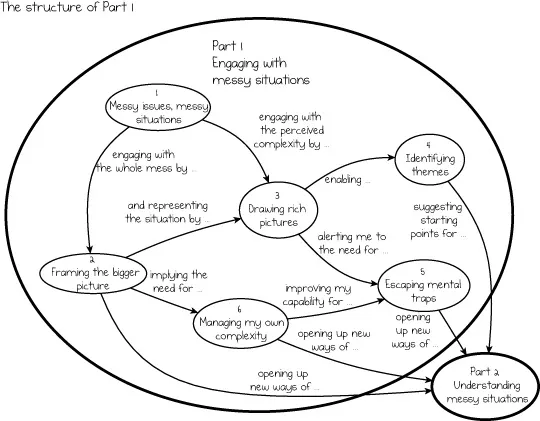
The starting point for Part 1 is the idea of messes: apparently intractable problems that seem to affect everything around them. Chapter 1 provides the foundation for the book and the problems it addresses. Chapters 2 and 3 present ideas for engaging with the problem and its context. Chapter 4 suggests starting points for other tools and techniques in the book. Chapters 5 and 6 bring you – the problem solver – and your thinking, into the picture by reviewing how your thinking can enable, or disable, improving the situation. Part 2 provides techniques for understanding the situation.
CHAPTER 1
Messy issues, messy situations
It’s not the tragedies that kill us, it’s the messes.
Dorothy Parker1 (1893 – 1967)
In many books, Chapter 1 begins with a story. This chapter follows the pattern but here it will be your story. In my workshops, the first activity creates an important ‘Aha! moment.’ I invite you to take a few moments to tell yourself the stories that begin this chapter.
•First, think of your plans for this evening or the weekend. I imagine you have some task or issue you intend to sort out. It may take an hour or more but dealing with it will improve your life in some small way. Just identify one of these issues.
•Next, take yourself back to the trickiest, most puzzling and most troubling issue you ever had to address. It may even be a current issue. What is going on? Who is involved? Why is it an issue? What approaches have you tried? What was the outcome?
•Finally – and this is where, if you can resist the temptation to read on, you will set yourself up for this book’s adventures – identify the key differences between the ‘deal-with-it-this-evening’ issue and the tricky-and-troubling issue. It might help to make some notes.
I asked you to do the exercise because it builds on your own experience. Experiential learning – learning from experience – is a powerful launch pad for learning new skills for dealing with tricky-and-troubling problems. You already know almost everything in this chapter but may not have thought about it before. What follows will help you to think about the implications for dealing with problems.
Workshop participants quickly spot differences between their deal-with-it-this-evening issues and their tricky-and-troubling issues. It enables them to recognise that while some problems are soluble with a bit of effort, others defy our best efforts. Together we have worked out some of the characteristic differences. The tricky-and-troubling issues, which I shall call messes:
•are bigger
•are more worrying
•are more puzzling
•go on longer
•take more time
•draw in more people
•create more conflict
•are emotionally charged
•have more things to think about.
The routine deal-with-it-this-evening issues are simpler and smaller. I refer to them as difficulties. It may take longer than one evening to deal with difficulties but, for the purposes of the exercise, I want to be sure you recognise the difference between a difficulty and a mess.
DIFFICULTIES AND MESSES; TAME PROBLEMS AND WICKED PROBLEMS
The differences between these two types of issues began to emerge in the planning context of the 1970s. Russell Ackoff2, the American management scientist and systems thinker, named them difficulties and messes. At the same time, Horst Rittel and Melvin Webber noticed a similar distinction, which they labelled tame problems and wicked problems. Rittel, Webber and Ackoff were all responding to the same observation – the inadequacy of most problem-solving approaches when dealing with messes. In this book, I use the more general terminology of difficulties and messes, building on the ideas and insights of Ackoff, Rittel, Webber and the many clients and workshop participants with whom I have explored the ideas.
Almost all the well-known strategies for understanding, managing and dealing with issues, only work for difficulties. They do not work well for dealing with messes. Either they do not work at all or they make things worse. Most problem-solving strategies are designed for difficulties. Many of these start with ‘defining the problem’ – stating the problem in a way that makes it soluble. But the problem with messes is that they defy definition. This is the Aha! moment3 many people experience when they understand that messes and difficulties are different. It explains why their best efforts sometimes have very little result.
This book is about dealing with messes. Dealing with messes is harder than dealing with difficulties so it is tempting to ignore them. People often persevere with the strategies designed for difficulties, even when they fail or make things worse. Strategies for dealing with difficulties are often simple to understand in the abstract or through examples but experience is the best way to learn strategies for dealing with messes. This may explain why strategies for dealing with messes are less well known.
In this chapter, I reflect on my experience of difficulties and messes – and the experience of people I have worked with – and I invite you to look at your experience through the mirror of ‘difficulties and messes’ (see the figure in the Introduction) as I reflect on my own experience of messes. Your experience will be different from mine but, by drawing on your experience, I hope you will develop a richer understanding than if I were just to present lots of theory.
I asked you to think of your own two stories because your stories will enable you to make sense of what follows. Most people experience rather than know about the differences between difficulties and messes, so it makes more sense to explore the differences by drawing on your experience. You will then recognise some of the differences rather than just reading about them. If I had offered an example of a mess, you might have been tempted to treat it as a difficulty and so miss the point. It is harder to dismiss your own experience of messes as puzzling, worrying and frustrating.
TWO SORTS OF ISSUES
Humans are problem-solving animals and, while we do not always welcome problems, dealing with problems is what we do. When we do not have a problem set by our outside world, we set about improving the routine stuff. Human problems range from minor irritations to near or actual catastrophes, from private to global, from hitches to persistent and intractable tangles. They are the very stuff of human experience.
Difficulties are routine. They may be a bit tricky but we know where we are going, what the main steps are, and the order in which to do things. We can even anticipate where obstacles may arise and take steps to deal with them. We can make a reasonable estimate of how long it will take. For example, I recently bought a car. I knew what sort of car I wanted and I knew what my budget was. I knew it might take a few days but if I tackled it carefully, I could find some suitable cars and choose between them. There were several stages but it was a difficulty not a mess. I wanted a car with good fuel economy and a reputation for reliability but I am not an expert on cars or on what I should look for. I would spend a few evenings working out what the issues were, refining my ideas about what I wanted and researching the market. I would then spend a few evenings looking at cars on sale locally and getting likely candidates checked by an independent expert. I guessed it would take about a week but I allowed two weeks for unplanned hitches. When I thought I had found the one I wanted, I discovered that the dealership I was going to buy from had been caught making fraudulent claims about their cars. Back tracking and deciding on a different car added an extra stage but did not change the essence of the task of deciding on a new car.
Difficulties involve fewer people than messes, reducing the need to negotiate. In a difficulty, I can confidently predict the consequences of my own, and others’, actions because the component tasks form a simple sequence. Deciding on and then buying a car benefited from a few moments of mental rehearsal but, despite some irritations, it was not something that worried me. Although I had predicted some potential pitfalls (I would need to make sure my friendly expert would be available when I needed him), I had correctly foreseen that they would be easy to deal with.
Messes are nothing like this. They are bigger, worse, more worrying and more serious than difficulties. In a mess, everything seems interconnected and offers no clear starting point. Everything seems to depend on everything else and getting it wrong may precipitate serious consequences. This makes messes worrying. Messes often involve more people, each with their own idea of what the issue really is. Negotiating any plan of action is tricky when it is unclear who is affected and how. Messes take a long time to resolve, if they get resolved at all. They tend to haunt affected people over months – or even years. They cover a larger area and touch on a wider range of concerns. They can feel overwhelming with many more things to think about than a difficulty.
For most people, however, scale on its own does not capture the most troubling features of messes. Uncertainty is part of the essential nature of a mess. It starts with the mess itself – it is unclear what the problem is. It is also unclear what a solution would look like or how it might be found. In a mess, it does not seem to make sense to talk about a ‘solution’ because parts of the mess seem immutably problematic. People argue about the nature of the problem and its possible solutions. They may even deny that a problem exists. Messes cannot be pinned down like difficulties and I cannot specify a solution. In a difficulty, I know what to do even if how to do it is a little less clear. In a mess, I may have no idea where to start or what to do. Learning my way through is the only way to make progress without making it worse. Quick fixes will not work because the problem and the priorities are unclear. Instead, I try to look for improvements rather than solutions: a solution for one person may make things worse for others. It is not just that people will disagree or have different agendas in mind, but ‘solving’ one part of the mess may significantly reduce the options available for solving other parts of the mess. An improvement, in this context, should at least make things no more difficult...
Table of contents
- Front Cover
- Copyright Page
- Contents
- Acknowledgements
- Introduction
- Part 1: Engaging with messy situations
- Part 2: Understanding messy situations
- Part 3: Exploring purposeful action in messy situations
- Part 4: Inquiring through action
- Appendix: The roots of systems thinking
- Glossary
- Index
- About the author
- About Triarchy Press
- Other Systems Thinking titles from Triarchy Press
Trusted by 375,005 students
Access to over 1.5 million titles for a fair monthly price.
Study more efficiently using our study tools.
Frequently asked questions
Yes, you can cancel anytime from the Subscription tab in your account settings on the Perlego website. Your subscription will stay active until the end of your current billing period. Learn how to cancel your subscription
No, books cannot be downloaded as external files, such as PDFs, for use outside of Perlego. However, you can download books within the Perlego app for offline reading on mobile or tablet. Learn how to download books offline
Perlego offers two plans: Essential and Complete
- Essential is ideal for learners and professionals who enjoy exploring a wide range of subjects. Access the Essential Library with 800,000+ trusted titles and best-sellers across business, personal growth, and the humanities. Includes unlimited reading time and Standard Read Aloud voice.
- Complete: Perfect for advanced learners and researchers needing full, unrestricted access. Unlock 1.5M+ books across hundreds of subjects, including academic and specialized titles. The Complete Plan also includes advanced features like Premium Read Aloud and Research Assistant.
We are an online textbook subscription service, where you can get access to an entire online library for less than the price of a single book per month. With over 1.5 million books across 990+ topics, we’ve got you covered! Learn about our mission
Look out for the read-aloud symbol on your next book to see if you can listen to it. The read-aloud tool reads text aloud for you, highlighting the text as it is being read. You can pause it, speed it up and slow it down. Learn more about Read Aloud
Yes! You can use the Perlego app on both iOS and Android devices to read anytime, anywhere — even offline. Perfect for commutes or when you’re on the go.
Please note we cannot support devices running on iOS 13 and Android 7 or earlier. Learn more about using the app
Please note we cannot support devices running on iOS 13 and Android 7 or earlier. Learn more about using the app
Yes, you can access Growing Wings on the Way by in PDF and/or ePUB format, as well as other popular books in Business & Management. We have over 1.5 million books available in our catalogue for you to explore.