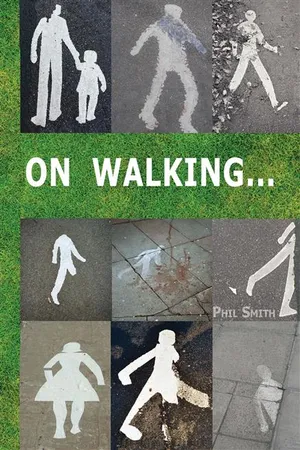
eBook - ePub
Information
Subtopic
Performing ArtsA few highlights from other drifts and wanders (1)

29.9.11
“For the valley of the Waveney I see the vale of Tenoctitlan, for the slopes of Stowe the snowy shapes of the volcanoes Popo and Iztac, for the spire of Earsham and towers of Ditchingham, of Bungay, and of Beccles, the soaring pyramids of sacrifice gleaming with the sacred fires, and for the cattle in the meadows the horsemen of Cortes sweeping to war.” This is from Montezuma’s Daughter by H. Rider Haggard, who wrote at Ditchingham Hall, which is on my route. I have raided it from the shelves of my B&B bedroom, along with I Walked By Night, a poacher’s autobiography ghosted by Rider Haggard’s daughter, Lilas, and other volumes of ‘local interest’.
I learn that the anchorite Julian of Norwich in her cell participated in the liturgy through a squint in the wall: can I find squints in Norwich through which to participate in the liturgy of the city? “Fear not the language of the world”; George Borrow grew up here, taught to wander by the gypsies he ran away with. “Under the West Norwich streets there are old chalk workings. They open up occasionally and a bus disappears…” (D.J. Taylor, Real Life).
Perhaps Lorraine and I should walk the Hall as if its floors are made of ice or glass?
In nearby Wright’s Court eight bodies were piled, dead from diphtheria, the illness Mum survived, contracted simultaneously with TB; she passed on an immunity to me. When the gravediggers returned to the pile, the body of an elderly woman on the top had disappeared. Does it still walk? Hauntings at 19 Magdalen Street, close by, formerly a brothel, a girl strangled; a ghost disturbs bags of clothes in the charity shop, folding them neatly and stacking those suitable for a young woman.
My walk is framed by its postponement due to Mum’s dying and by the interment of Mum’s ashes a few days after the walk’s intended completion.
Obelisks in the breakfast room; rays of light frozen in stone. The coffee jug is an urn. The holder of brown and tomato sauces a grave. The butter knife an Egyptian death tool; the mouth-opener. At breakfast, an episodic tale, disrupted by bacon; a grain of truth in every ‘family legend’.
The bran flakes holder explodes in my hands and I surreptitiously clear up the mess between chapters of the owner’s tale of all he knows about his house. An island of Regency in a pub yard, The Gothic House is a narrow, almost freestanding, three-storey, multi-story building. What its owner has to say about it is not remarkable, but his way of saying it is; his prose is as complex and interwoven as anything by Sebald, if not quite so worked. The owner presents solid evidence and then reveals it to be mistaken, then family hearsay which he mocks and subsequently resurrects, local rumour which he undoes before reclaiming it. Through his tale he weaves three mayors who become one mayor in public service three times and a mistress hidden away with her maid who, together, become a respectable French governess and her daughter. Some of his deductive leaps leave him short of the far side, but his aim is never for a bridge of logic but rather a setting of many points in motion about each other simultaneously. He describes what he is doing as arranging a few pieces of the jigsaw. I say to him that the problem with the past is that there is never any flat surface on which to arrange the pieces. Half way through my fried egg I realise that I have found, already, one of those special characters who unexpectedly people these walks from time to time…
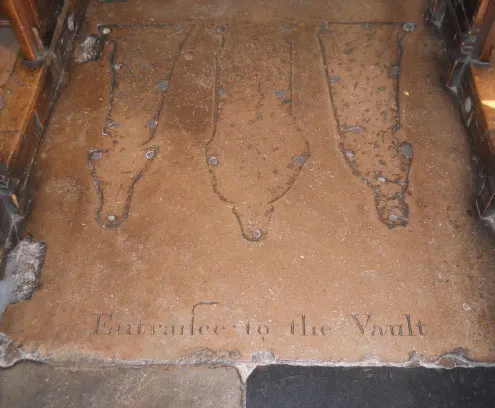
Encounters
Ascended
ON MY WALK in the footsteps of the acorn-planting Charles Hurst I met a woolly-hatted psychogeographer who drove a JCB. In half an hour of conversation, he took me on an imaginary journey through underwater ballrooms and plague villages and along roads to nowhere.
In Guernsey I met a man who levered himself along the cliff top on crutches. While photographing the sea, he described to me in detail how the island was run by a mafia. I turned down his offer of a lift because I wanted to see things on foot, but maybe that was a mistake.
In a Tibshelf graveyard I nodded to a woman who burst into tears. I looked into her empty eyes. I helped her to find a place to bury her dying husband: a miner whose role as a conduit for a divine source of inspired words she was preparing to assume.
Outside a pub in a Nottinghamshire village a woman pulled down her blouse to show me the purple bruising of heart massage, pointed to the pavement and, unknowingly repeating words from Hitchcock’s Vertigo, said: “and there I died”.
All the time we have the chance to meet extraordinary folk, but they do not necessarily immediately appear exceptional. So when a Dersu Uzala (as in Akira Kurosawa’s movie of that name) comes to your campfire like a bear out of the darkness, try not to turn him or her away. At any one time there are only seven Ascended Mistresses or Masters at work on the Earth, so it would be a shame to turn one away, particularly as you cannot find them by looking; without anonymity they would not be what they are.
“of course there are always a few psychopaths, but mostly there are fallen angels”
Suspended sentience
WALK AS IF THE CITY, the river, the sea, the field were sentient beings. Walk as if you were a city, ...
Table of contents
- Cover
- Copyright
- Contents
- Who me?
- Superstitions
- What I do when I walk
- Sebald walk: Taken from my notebooks
- Walking bodies
- Tactics of sensitivity
- Knees
- Crab Man’s razor
- Don’t take your own food
- A skill
- A few highlights from other drifts and wanders (1)
- Encounters
- Democracy
- O my International Lettristes! O my Situationists!
- Getting started
- Scratching from start
- Mythogeography
- Jouissance
- Environmentalism
- Pilgrimage
- Dodgy
- Walk in the footsteps of others
- Being ready
- Leaderless
- Holey
- Tactics and things
- Deep topography
- Autotopography
- Cemetery Walk (2003)
- Walking in the Suburbs (2013)
- Doppel
- A few highlights from other drifts and wanders (2)
- Cryptic
- Coincidences
- Note
- The wobbly art of memory
- Holey space
- Follow animal tracks
- Bluster
- The right to more
- Rhythms
- Psychogeography
- Walk to the ends of the earth
- Atmospheres
- Alchemical crossing
- Walking in character
- Undercovers
- Walking as an ordeal
- The man in the mask
- Women and walking
- Re:enactment
- Urfaces
- A few highlights from other drifts and wanders (3)
- A few highlights from other drifts and wanders (4)
- The fire doors of perception
- The last tactic
- Appendix
- References
- Dedication
- Acknowledgements
- About the Author
Trusted by 375,005 students
Access to over 1.5 million titles for a fair monthly price.
Study more efficiently using our study tools.
Frequently asked questions
Yes, you can cancel anytime from the Subscription tab in your account settings on the Perlego website. Your subscription will stay active until the end of your current billing period. Learn how to cancel your subscription
No, books cannot be downloaded as external files, such as PDFs, for use outside of Perlego. However, you can download books within the Perlego app for offline reading on mobile or tablet. Learn how to download books offline
Perlego offers two plans: Essential and Complete
- Essential is ideal for learners and professionals who enjoy exploring a wide range of subjects. Access the Essential Library with 800,000+ trusted titles and best-sellers across business, personal growth, and the humanities. Includes unlimited reading time and Standard Read Aloud voice.
- Complete: Perfect for advanced learners and researchers needing full, unrestricted access. Unlock 1.5M+ books across hundreds of subjects, including academic and specialized titles. The Complete Plan also includes advanced features like Premium Read Aloud and Research Assistant.
We are an online textbook subscription service, where you can get access to an entire online library for less than the price of a single book per month. With over 1.5 million books across 990+ topics, we’ve got you covered! Learn about our mission
Look out for the read-aloud symbol on your next book to see if you can listen to it. The read-aloud tool reads text aloud for you, highlighting the text as it is being read. You can pause it, speed it up and slow it down. Learn more about Read Aloud
Yes! You can use the Perlego app on both iOS and Android devices to read anytime, anywhere — even offline. Perfect for commutes or when you’re on the go.
Please note we cannot support devices running on iOS 13 and Android 7 or earlier. Learn more about using the app
Please note we cannot support devices running on iOS 13 and Android 7 or earlier. Learn more about using the app
Yes, you can access On Walking by in PDF and/or ePUB format, as well as other popular books in Media & Performing Arts & Performing Arts. We have over 1.5 million books available in our catalogue for you to explore.