- 256 pages
- English
- ePUB (mobile friendly)
- Available on iOS & Android
eBook - ePub
Information
Print ISBN
9781550228335
1. Introduction to Game Theory in Poker
Game Theory — A Historical Perspective
Some believe that the study of Game Theory began with the works of Daniel Bernoulli. A mathematician born in 1700, Bernoulli is probably best known for his work with the properties and relationships of pressure, density, velocity and fluid flow. Known as “Bernoulli’s Principle,” this work forms the basis of jet engine production and operation today. Pressured by his father to enter the world of commerce, he is also credited with introducing the concepts of expected utility and diminishing returns. This work in particular can be of use when “pricing” bets or bluffs in no-limit poker.
Others believe the first real mathematical tool to become available to game theorists was “Bayes’ Theorem,” published posthumously in England in the 18th century. Thomas Bayes was born in 1702 and was an ordained minister. His work involved using probabilities as a basis for logical inference. (The author has developed and used artificially intelligent systems based on “Bayes’ Theorem” to trade derivatives in today’s financial markets.)
Yet still others believe that the study of Game Theory began with the publication of Antoine Augustin Cournot’s The Recherches in the early 1800s. The work dealt with the optimization of output as a best dynamic response.
Émile Borel was probably the first to formally define important concepts in the use of strategy in games. Born in 1871 in Saint-Affrique, France, he demonstrated an early penchant for mathematics. In 1909 the Sorbonne created a special chair of “Theory of Functions” which Borel held through 1940. During the years 1921–27 he published several papers on Game Theory and several papers on poker. Important to poker players are his discussions on the concepts of imperfect information, mixed strategies and credibility.
In 1944 Princeton University Press published Theory of Games and Economic Behavior by John von Neumann and Oskar Morgenstern. While not the first work to define certain concepts of strategy in games, it is widely recognized as one that has fostered Game Theory as we know it today.
Also important to poker players is the work of Julia Bowman Robinson. Born in 1919, she discovered her passion for mathematics after a bout with scarlet fever and was the first woman admitted to the Academy of Sciences. For poker players her most important work was An Iterative Method of Solving a Game.
Credited by many as being a primary shepherd of modern Game Theory is John Forbes Nash, Jr. Diagnosed as a paranoid schizophrenic, Nash was long troubled by delusions. This condition, now in remission, became the subject of a popular film. His work earned him 1/3 of the 1994 Nobel Prize in Economic Sciences. Born in the Appalachian town of Bluefield, West Virginia in 1928, Nash became well known for a 28-page work he did at age 21 which defined his “Nash Equilibrium” concerning strategic behavior in non-cooperative games. Poker players are most drawn to the story that while he was in a bar near Princeton and being goaded into approaching an attractive blond-haired lady, he suddenly shouted and then ran off to complete his work on “The Mathematics of Competition” which is one basis of Game Theory today.
Game Theory and Poker
More than the study and application of a set of principles, Game Theory in poker is primarily about two goals:
1. The study and understanding of the opposition
2. The development of an efficient strategy to dominate the competition.
To be of maximum value, this study and understanding must be translated into effective action, and these actions must be the antithesis of everything a poker opponent thinks or does.
The difference between an antithesis and a correct response defines the utility of Game Theory in poker. An opponent makes an obvious bluff. You are certain that your hand will not even beat the bluff. A correct response in poker is to fold your hand when you know you are beat. The antithesis is to raise or re-raise and make your opponent fold his.
This is an example of a move. In an environment of ever-increasing odds and stakes such as a poker tournament, good hands just don’t come along often enough for a player to make it on the strength of his hand alone. A winning player must make moves and the study and application of the principles of Game Theory can help him to know
1. When and where to make the move
2. How likely the move is to succeed.
Expressed in the specific terminology of advanced theorists, poker can be defined as an asynchronous, non-cooperative, constant-sum (zero-sum), dynamic game of mixed strategies. While the game is played in an atmosphere of common knowledge and no player possesses complete knowledge, some players are better able to process this common knowledge into a more complete knowledge than are their opponents. A player is most able to make the best-reply dynamic (sometimes referred to as the Cournot adjustment) and earn a cardinal payoff after using the process of backward induction to construct and deploy a dominant strategy.
In poker, beyond a certain set of rules, players do not cooperate with each other because each is trying to win at the expense of all others (zero-sum). Moreover, they will repeatedly change their strategies at different intervals and for different reasons (therefore, asynchronously).
While information about stakes, pot-size, board-cards and players’ actions and reactions is available as common knowledge to all players at the table, no player has complete knowledge of such factors as the other players’ cards or intentions.
The one characteristic common to most outstanding players is their ability to better process and better use — that is, they get more value from — the information that is commonly available to everyone else at the table.
Two of the most basic assumptions of Game Theory are that all players
1. Have equal common knowledge
2. Will act in a rational manner.
But in poker, while all players at any given table have access to the same common information, not all of them are smart enough to do something with it. Players who know more about odds and probabilities, and whose instincts and keen observation enable them to better process the common knowledge around them, will take far better advantage of this information and will have correspondingly higher positive expectations.
So while all the players at the table have access to the same common knowledge, some players are able to base their actions on knowledge that is more complete. That all players in all games will always act rationally is never a safe assumption in poker.
Equilibrium versus Evolution
According to the “Nash Equilibrium,” a game is said to be in a state of equilibrium when no player can earn more by a change in strategy. It has been argued that, using the process of backward induction, players will evolve their strategies to the point of equilibrium.
In poker, the astute player’s strategy will always be in a state of evolution so that his opponents, in order not to be dominated, will also be compelled to modify their strategies. In a real game of poker there is constant evolution and therefore hardly ever a point of absolute equilibrium.
Efficiency and Diminishing Returns
The concept of efficiency and the notion of diminishing returns relate to the conservation and the most effective use of power/momentum and resources. In poker this is about a player’s chips, cards and table image. These two concepts are particularly helpful to the no-limit player when it comes to “pricing” bets and raises.
In any game, and most especially in no-limit poker tournaments, a player’s “Mo” (power) comes from an amalgamation of
1. His image at the table
2. The size of his stack
3. The strength of his hand.
If a player is rich in one, he can lean on the other two. If a player has a very strong hand, not only will he win chips, he will add to his image at the table. If he is possessed of a strong image, he can steal with smaller bets. If his stack is huge, players with smaller stacks will often avoid conflict and he will be able to play weaker hands.
In tournament poker, a player’s stack goes down in value with the passage of time. At any point, a player’s stack size is finite and, therefore, he must carefully consider pricing when he makes his bet. He must consider
1. At what price will his opponent be “priced out” of the hand
2. At what price will his opponent be “priced into” calling
3. Given a careful study of the opposition, what is the best price to achieve the best result without risking more chips than absolutely necessary.
Conventional poker wisdom has long held that a primary obligation of the big stack is to knock out the small stacks. A game theorist would say that the primary obligation of the big stack is to not pump up the small stacks. The increasing stakes and other, more desperate players will eliminate most of the short stacks — which will leave the big stacks to carefully pick their spots and eliminate anyone left.
Strategy
The value of applying Game Theory principles in any arena is primarily to help a player develop an efficient strategy that dominates the competition.
From a practical perspective, Game Theory is about strategic development. As no effective strategy is likely to be developed in a vacuum, its formation must be the result of a close study of not only the opposition but also past interactions.
As more players play more poker, many of them increase their skills, and the result is that the game becomes ever tougher to beat.
The players who have dominated the game in the past and the players who will do so in the future are the few who can convert the common knowledge available to every player at the table into more complete knowledge.
Assuming that all greatly successful players are possessed of advanced knowledge of or instinct for odds and strategy, the primary property of their game that differentiates them from the rest of the field is an uncanny ability to discern an opponent’s strength and likely action or reaction.
Today the bulk of poker is about one game — No-Limit Texas Hold’em. In a game where you can either greatly increase or lose all your chips in a single move, knowledge of opponents and their tendencies in certain situations becomes much more important than either stack size or the power of a hand.
With complete information on odds and strategy available to a growing and increasingly more able and competitive pool, the one area of opportunity open to aspiring poker kings is the study and application of Game Theory in poker.
The most difficult calculation in all of poker, especially in No-Limit Texas Hold’em, is that of a player’s Total Odds of winning the pot. This calculation includes far more than the odds of making a certain hand — it includes the odds of making the hand, the likelihood that your opponent’s hand is stronger or weaker, and (most difficult of all) the probability of an opponent’s action or reaction to your action or reaction.
The only hope of coming to a reasonably accurate calculation of this matrix of probabilities is via the very essence of Game Theory. You must make a detailed and almost instantaneous analysis of your opponent and his strengths, weaknesses and other propensities.
2. The Basic Calculations
Odds & Probabilities
Odds and Probabilities are simply two methods of expressing the relationship of Positives,Negatives and Total Possibilities. They represent the same basic information and each can be easily converted into the other.
Odds
Odds in poker are expressed as a ratio of the Negatives to the Positives:
WILLNOTs : WILLs
With a well-shuffled deck of cards, what are the Odds that the first card from the deck will be one of the 4 Aces?
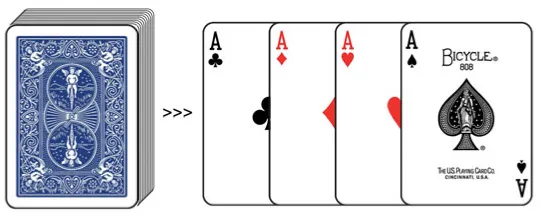
Total Possibilities = 52 Cards in the Deck
Positives/WILLs = 4 Aces in the Deck
Negatives/WILLNOTs = 48 Cards ...
Positives/WILLs = 4 Aces in the Deck
Negatives/WILLNOTs = 48 Cards ...
Table of contents
- Cover Page
- Preface
- Introduction
- 1. Introduction to Game Theory in Poker
- 2. The Basic Calculations
- 3. Odds in Texas Hold’em
- 4. Consolidated Odds Tables
- 5. Odds in Omaha Hi-Lo
- About the Author
Trusted by 375,005 students
Access to over 1.5 million titles for a fair monthly price.
Study more efficiently using our study tools.