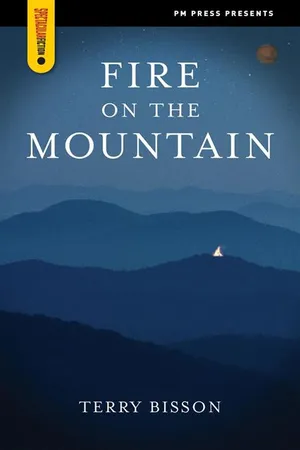
eBook - ePub
Information
Introduction
I am, by any measure, a sci-fi head.
I have read almost all the works of the Master—Isaac Asimov, the works of Frank Herbert (and indeed, several of his sons), Robert Heinlein, Arthur C. Clarke, Frederik Pohl, William Gibson, Octavia Butler, Ursula K. LeGuin, et al.
I am a sci-fi head.
Yet few works have moved me as deeply, as thoroughly, as Terry Bisson’s Fire On The Mountain.
Part of it is sheer fascination, the fruit of all well done sci-fi, for if all fiction is creative, sci-fi goes another step further into worlds known and unknown, into that undiscovered country of the future.
But Bisson’s work breaks into a future that rarely raises its head in this genre.
Again, I say this as a true head, who has not only read classics, but viewed the film versions of such works with a critical eye. Have you noticed how much of sci-fi is not so much futuristic, as it is a projection of a future where whites are many and people of color are few? Have you ever watched a movie such as Logan’s Run, and spent the first two-thirds of the movie wondering where all the black folks are?
Then along comes Bisson. His works ripple with Black life, with voices and opinions and ideas as real as the paper you’re reading these words on (assuming, of course, that you’re reading on paper!).
I admit to more than being a sci-fi head. I’m hopelessly sentimental, so much so that to read Fire today wrings tears from me, not just at the sheer beauty of his prose, his fertile turn of phrase, but above all, for his vision, one born in a revolutionary, and profoundly humanistic, consciousness.
Over these long years in the gulag, I have heard some men deprecate fiction as literature not worthy of one’s time and attention. “I don’t do fiction, man,” some have said. But fiction has a power that we often ignore, for did not Lincoln remark, upon meeting the novelist Harriet Beecher Stowe (who wrote Uncle Tom’s Cabin), “So, you’re the little lady who started this big war?”
Of course, this was the rhetoric of an astute politician, but as with all rhetoric, there was a grain of truth in it, for Stowe’s work forced millions to think about something they didn’t want to ponder—American slavery. It is in this fecund spirit that Bisson’s Fire rages in the dark night of Black American life.
All great fiction borrows from what might have been: but what world might have we been born into had John Brown succeeded?
With this single poignant story, Bisson molds a world as sweet as banana cream pies, and as briny as hot tears.
As these words are penned, the elections are in full swing, and a Black person may, or may not, be elected president. But, as time is our teacher, such a development means little when it comes to the freedom and independence of millions of Black people, even as the emergence of Black mayors has meant little more than their presiding over cities that mark our fall, rather than our ascendance.
Bisson’s narrative, here and elsewhere, uses fiction to answer the “What ifs” of human nature with brilliance and insight.
According to classic multi-dimensional theory, there are thousands (millions?) of alternative universes where every probability has its potential fruition. If that is so, there is one where Fire On The Mountain is not sci-fi but a history book on what was.
This is a splendid work of imagination, guaranteed to make your spine tingle.
Mumia Abu-Jamal
Death Row, U.S.A. (Summer 2008)
Death Row, U.S.A. (Summer 2008)
Most of the good things in this book are from
Cheikh Anta Diop, W.E.B. DuBois, Leonard Ehrlich,
R.A. Lafferty, Truman Nelson, Mark Twain and
Malcolm X.
The bad things are, without exception, the author’s own.
Cheikh Anta Diop, W.E.B. DuBois, Leonard Ehrlich,
R.A. Lafferty, Truman Nelson, Mark Twain and
Malcolm X.
The bad things are, without exception, the author’s own.
“The present, due to its staggering complexities, is almost as conjectural as the past.”
—George Jackson
“Dawn also has its terrors.”
—Victor Hugo
“America is our country, more than it is the whites’ . . . we have enriched it with our blood and tears.”
—David Walker
“My love to all who love their neighbors.”
—John Brown

In 1859 the abolitionist John Brown, fresh from a successful guerrilla war that kept Kansas from entering the Union as a slave state, attacked the federal arsenal at Harper’s Ferry, Virginia, with a small force of armed men. Brown came to Virginia to fulfill a lifelong dream: to carry the war against slavery “into Africa” (as he put it) by putting a small army of runaway slaves and abolitionists onto the Blue Ridge, and heading south. Brown’s idea was that such a force, even if militarily weak, would terrorize the slave owners, embolden the slaves, and hasten the polarization which was already splitting the nation apart. Others obviously agreed: he had raised funds to buy the most modern weaponry, and recruited the experienced Black slavery-fighter, Harriet Tubman, to be his second-in-command.
The raid was symbolically timed for Independence Day, July 4, 1859; but Tubman fell sick and key supplies were delayed. After a three-month delay, Brown and twenty-one men struck Harper’s Ferry on October 16, without Tubman. Through a combination of military errors and bad luck, they were cut off in the town and defeated by U.S. Marines led by a West Point graduate named Robert E. Lee. Brown and five others were hanged for “treason” and entered legend as martyrs instead of liberators. Even at the gallows they were dignified and unrepentant; even in failure, their raid terrorized the South, electrified the nation, and precipitated the Civil War, which broke out less than a year later.
Fire on the Mountain is a story of what might have happened if John Brown’s raid had succeeded.

FIRE
ON THE
MOUNTAIN
ON THE
MOUNTAIN

Yasmin Abraham Martin Odinga drove across the border at noon. The man and woman at the station looked at her Nova Africa plates and Sea Islands University sticker and waved her on through without even asking for papers. Yasmin figured she was probably the first stranger they had seen all morning. Laurel Gap was not a busy crossing, and most of the traffic, from the looks of the road and the trucks and the area, was church picnickers and relatives home for Sunday visits—all known to them. Mostly white folks on either side of the border through here. Mostly older. Even socialist mountains give up their young to the cities.
An hour later Yasmin was in the Valley, heading north, with the high, straight, timbered wall of the Blue Ridge to her right, clothed in its October reds and golds. She scanned the radio back and forth between country on A.M. and sacred on A.X., ignoring the talk shows, enjoying the high silvery singing. There was no danger of running across the Mars news, not on Sunday morning here in what Leon had often impatiently but always affectionately called “the Holy Land.” She eased on up to 90, 100, 120, enjoying the smooth power of the big Egyptian car. She had a 200-klick run down the valley to Staunton and she couldn’t shake the uncomfortable feeling that she was late.
She was looking forward to seeing her mother-in-law, Pearl. She was and she wasn’t looking forward to seeing her daughter, Harriet.
She had something to tell them both, but it wasn’t for them she was late. It was for the old man. She patted the ancient black leather doctor’s bag beside her on the seat. In it were her great-grandfather’s papers, which she was taking to Harper’s Ferry to be read on the hundredth anniversary of John Brown’s Attack, fifty years after they were written, according to the old doctor’s very precise instructions. Except that it was October and she was three months late. She had been asked to stay an extra month in Africa to finish the Olduvai Project; a month had turned into three, and she had missed the Fourth of July Centennial. A fax had been sent to the museum director, but it wasn’t the same. Now she was bringing the original, according to the old man’s will, in the stiff old pill-smelling doctor’s bag that had held them for the thirty-six years since he had died (the year she was born), hoping maybe that it would make it up to him.
It’s hard to know how to please the dead.
Near Roanoke she was slowed, then stopped, by buffalo. There was no hurrying the great herds that paced the continent’s grassy corridors, east to west; they always had the right-of-way across highways and even borders. These were heading south and west toward Cumberland Gap, where even the mountains would stand aside to let them pass.
There was more traffic on toward Staunton: dairy tankers deadheading home for the weekend, vans of early apple pickers from Quebec and Canada, Sunday go-to-meeting buses—even a few cars, mostly little inertial hummers. Things were changing since the Second Revolutionary War. She heard more singing and reached over to scan the radio up, but it was the Atlanta-Baltimore airship, the silver-and-orange John Brown, motoring grandly past in the lee of the mountain; it sounded so joyful that Yasmin raced it for a few klicks before falling back and letting it go, worrying about potholes. The roads in the U.S.S.A. were still unrebuilt, wide but rough, straight and shabby, like the long, low, worn-out mountains themselves. Appalachia, on either side of the border, was a well-worn part of the world.

I am Dr. Abraham. When you read this, in 1959, what I have to say will be illuminated by the light of history, or perhaps obscured by the mists of time. Decide for yourself. I write as an old man (it is 1909), but I experienced these events as a boy. I was ignorant and profoundly so, for I was not only a n’African and doubly a slave (for no child is free) but an unlettered twelve-year-old unaware even of how unaware I was: of how vast was the world that awaited my knowing. There was only beginning to stir within me that eagerness, my enemies would say greed, for knowledge that has since guided, my enemies would say misled, my exact half century of steps thereafter. Fifty years ago today, in 1859, I was barely beginning to hunger and I knew not what I hungered for, for hunger was the natural state of affairs in the Shenandoah. Whatever the bourgeois historians tell us, and they are still among us, some in Party garb; whatever lies they might polish and toss, the slave South was a poor land. P-O-O-R. Great-grandson, do you even know what poor means fifty years in the future, in your day of socialism, electricity, nitrogen-fed catfish, world peace, and mules so smart they would talk, if mules had anything in particular to say to us humans? In 1859 kids in Virginia and Caroline (called Carolina before Independence) didn’t grow up, half of them— of us I mean; of “colored,” which is what we were beginning to call ourselves, forgetting that we were Africans at all. We thought Africa was where the old folks went when they died, and why not? That was what the old folks told us. The Shenandoah Valley was poor even for the whites, for it had the slavery without the cotton. There were plenty of what people called “poor whites.” Nobody ever said “poor colored”; that went without saying, like cold snow or wet rain. Ignorance was the unshakable standard. The average man or woman, black or white, was as unlettered as a fencepost and about as ashamed of the deficiency. I could, in fact, read (this was my sworn secret from all but Mama and Cricket, for she had “learned me” my letters in the hope that someone, somehow, someday might teach me to do what she couldn’t—combine them into words. And she was right, the trick was done by a tinker from Lebanon who laid up in our livery stable in the winter of ‘57 while he healed his bone-sick horse. Arabs know two things, horses and letters, and he taught me enough of both to get by. I had to bite my tongue whenever my master (for I was as owned as the Arab’s horse), Joachim Deihl, gave up on a medicine label in frustration. But a “colored” boy reading was not to be tolerated even by a relatively tolerant Pennsylvania German like Deihl. Yes, I fought with John Brown. Old Captain John Brown, and Tubman, too. In fact, I helped bury the Old Man, as I will tell. I could show you his grave, but we swore an oath, six of us, six thousand of us, so I won’t. If General Tubman is the Mother of Our Country and Frederick Douglass the Father, our Dixie Bolivar, then bloody old Shenandoah Brown, the scourge of Kansas, the avenging angel of Osawatomie and the Swamp of the Swan, the terror of the Blue Ridge, is some kind of Godfather. Blood may be thicker than water, but politics is thicker than either, great-grandson, and I loved the old man. I count myself as much his kin as any of his actual sons, that brave abolitionist family band who were the boldest of all his soldiers, willing even at times to stand up to their Captain, a thing which I saw no other (except Kagi) ever do. No, I never rode into battle with Captain John Brown, for he was too old and I was too young; he was as old as I am now, and I was as young as your own child, if you have one. But I fetched him his potboiled chicory-cut coffee on many a frosty morning while he and Tubman consulted with Green and stern Kagi: then I watched him while he watched them ride off to war; then he would sit by the fire reading his Bible and his Mazzini while his coffee got cold, while I helped Doc Hunter make his rounds, but always keeping one eye on the Old Man as the Doc ordered.
Many a frosty morning. Fifty years ago.
The backs of my hands on this typewriter tell me that I’m sixty-two now, an old man myself: but I was fourteen on those frosty wartime mountain mornings, sixteen when he died, and twelve when it all started on the Fourth of July, 1859, and it wasn’t frosty that morning.
Staunton was getting to be a big town. The three-county Red Star of the South Dairy Co-op and the smaller poultry- and catfish-processing plants were gradua...
Table of contents
- COVER PAGE
- TITLE PAGE
- COPYRIGHT PAGE
- DEDICATION
- CONTENTS
- INTRODUCTION
Trusted by 375,005 students
Access to over 1.5 million titles for a fair monthly price.
Study more efficiently using our study tools.
Frequently asked questions
Yes, you can cancel anytime from the Subscription tab in your account settings on the Perlego website. Your subscription will stay active until the end of your current billing period. Learn how to cancel your subscription
No, books cannot be downloaded as external files, such as PDFs, for use outside of Perlego. However, you can download books within the Perlego app for offline reading on mobile or tablet. Learn how to download books offline
Perlego offers two plans: Essential and Complete
- Essential is ideal for learners and professionals who enjoy exploring a wide range of subjects. Access the Essential Library with 800,000+ trusted titles and best-sellers across business, personal growth, and the humanities. Includes unlimited reading time and Standard Read Aloud voice.
- Complete: Perfect for advanced learners and researchers needing full, unrestricted access. Unlock 1.5M+ books across hundreds of subjects, including academic and specialized titles. The Complete Plan also includes advanced features like Premium Read Aloud and Research Assistant.
We are an online textbook subscription service, where you can get access to an entire online library for less than the price of a single book per month. With over 1.5 million books across 990+ topics, we’ve got you covered! Learn about our mission
Look out for the read-aloud symbol on your next book to see if you can listen to it. The read-aloud tool reads text aloud for you, highlighting the text as it is being read. You can pause it, speed it up and slow it down. Learn more about Read Aloud
Yes! You can use the Perlego app on both iOS and Android devices to read anytime, anywhere — even offline. Perfect for commutes or when you’re on the go.
Please note we cannot support devices running on iOS 13 and Android 7 or earlier. Learn more about using the app
Please note we cannot support devices running on iOS 13 and Android 7 or earlier. Learn more about using the app
Yes, you can access Fire On The Mountain by in PDF and/or ePUB format, as well as other popular books in Literature & Literature General. We have over 1.5 million books available in our catalogue for you to explore.