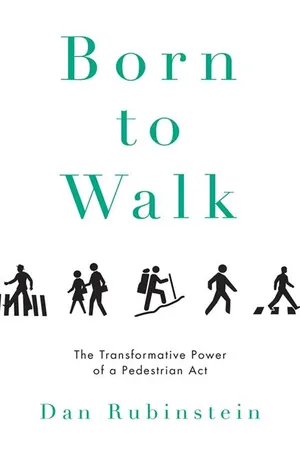
The humble act of putting one foot in front of the other transcends age, geography, culture and class, and is one of the most economical and environmentally responsible modes of transit. Yet with our modern fixation on speed, this healthy pedestrian activity has been largely left behind. At a personal and professional crossroads, writer, editor and obsessive walker Dan Rubinstein travelled throughout the UK, the US and Canada to walk with people who saw the act not only as a form of transportation and recreation, but also as a path to a better world.
- 348 pages
- English
- ePUB (mobile friendly)
- Available on iOS & Android
eBook - ePub
About this book
Information
SOURCES
The majority of the interviews referenced below were completed specifically for this book. Others were simultaneously conducted for articles that were published in The Walrus, the Globe and Mail, The Economist, enRoute, Canadian Business, Ottawa Magazine, Spacing, Cottage Life and explore, where portions of the book have appeared.
PROLOGUE
“Perhaps walking is best imagined”: Rebecca Solnit, Wanderlust: A History of Walking (Penguin, 2001), 250.
“I walk in order to somatically medicate myself”: Will Self, “Leaving His Footprints on the City,” New York Times, 23 March 2012.
“Mediated boredom”: Evgeny Morozov, “Only Disconnect,” The New Yorker, 28 October 2013.
“[A] state in which the mind, the body, and the world are aligned,” Solnit, Wanderlust, 5.
“French philosopher Frédéric Gros”: Frédéric Gros, A Philosophy of Walking (Verso, 2014).
“British author Nick Hunt”: Nick Hunt, Walking the Woods and the Water: In Patrick Leigh Fermor’s Footsteps From the Hook of Holland to the Golden Horn (Nicholas Brealey, 2014).
“Historian Matthew Algeo”: Matthew Algeo, Pedestrianism: When Watching People Walk Was America’s Favorite Spectator Sport (Chicago Review Press, 2014).
“Naturalist Trevor Herriot”: Trevor Herriot, The Road Is How: A Prairie Pilgrimage Through Nature, Desire and Soul (HarperCollins Canada, 2014).
1: BODY
Interviews with Stanley Vollant and other Innu Meshkenu walk participants, February and March 2013, between Manawan, QC, and Rapid Lake, QC.
“Canada’s 1.4 million Aboriginal people”: www12.statcan.gc.ca/nhs-enm/2011/as-sa/99-011-x/99-011-x2011001-eng.cfm.
“Aboriginal men and women die an average”: Statistics Canada, Life Expectancy, www.statcan.gc.ca/pub/89-645-x/2010001/life-expectancy-esperance-vie-eng.htm.
“Infant mortality rate”: Assembly of First Nations, “Fact Sheet — Quality of Life of First Nations,” June 2011, www.afn.ca/uploads/files/factsheets/quality_of_life_final_fe.pdf.
“Chronic medical condition”: Health Canada, First Nations and Inuit Health, www.hc-sc.gc.ca/fniah-spnia/diseases-maladies/index-eng.php.
“First Nations children … overweight or obese”: Public Health Agency of Canada, Obesity in Canada — Snapshot, www .phac-aspc.gc.ca/publicat/2009/oc/index-eng.php.
“A full-blown crisis”: Heart and Stroke Foundation, “A perfect storm of heart disease looming on our horizon,” 25 January 2010, www.heartandstroke.com/atf/cf/{99452D8B-E7F1-4BD6-A57D-B136CE6C95BF}/Jan23_EN_ReportCard.pdf.
“Statistics on … incarceration”: Office of the Correctional Investigator, Annual Report 2012–2013, www.oci-bec.gc.ca/cnt/rpt/annrpt/annrpt20122013-eng.aspx.
“Most common cause of death”: Health Canada, First Nations & Inuit Health, www.hc-sc.gc.ca/fniah-spnia/promotion/mental/index-eng.php.
“Youngest and fastest-growing demographic group”: Statistics Canada, Aboriginal Peoples in Canada, www12.statcan.gc.ca/nhs-enm/2011/as-sa/99-011-x/99-011-x2011001-eng.cfm.
“Indian Time”: Duncan McCue, Reporting in Indigenous Communities, www.riic.ca/the-guide/in-the-field/indian-time/.
Interviews with Jean-Charles Fortin, February and March 2013, between Manawan, QC, and Rapid Lake, QC.
“Americans are in the habit”: Jeff Speck, Walkable City: How Downtown Can Save America, One Step at a Time (Farrar, Straus and Giroux, 2012), 101.
“A pedometer study”: Tom Vanderbilt, “The Crisis in American Walking,” Slate, 10 April 2012, www.slate.com/articles/life/walking/2012/04/why_don_t_americans_walk_more_the_crisis_of_pedestrianism_.html.
“The decline of walking”: Vanderbilt, “The Crisis in American Walking.”
Tom Vanderbilt, Traffic: Why We Drive the Way We Do (and What It Says About Us) (Vintage, 2008).
“London physiologist Richard Doll”: Richard Doll and Austin Bradford Hill, “Smoking and Carcinoma of the Lung: Preliminary Report,” British Medical Journal 2 (30 September 1950): 739–748.
“British health minister Iain Macleod”: The National Archives, The Cabinet Papers 1915–1984, www.nationalarchives.gov.uk/cabinetpapers/themes/one-page.htm.
“London doctor Jerry Morris”: Simon Kuper, “The Man Who Invented Exercise,” FT Magazine, 12 September 2009, www .ft.com/intl/cms/s/0/e6ff90ea-9da2-11de-9f4a-00144feabdc0 .html#axzz3E3QFLQUS.
“Coronary Heart-Disease and Physical Activity of Work,” Jerry Morris, The Lancet 262, no. 6795 (November 1953): 1053–1057.
“Upright ambulation”: Smithsonian National Museum of Natural History, humanorigins.si.edu/human-characteristics/walking; and Erin Wayman, “Becoming Human,” Smithsonian, 6 August 2012, www.smithsonianmag.com/science-nature/becoming-human-the-evolution-of-walking-upright-13837658/?no-ist.
“Using a stiff leg”: Jennifer Ackerman, “The Downside of Upright,” National Geographic, July 2006.
“The Brain from Top to Bottom”: thebrain.mcgill.ca.
“Narrow birth canals”: Ackerman, “The Downside of Upright.”
“A lot of basic movements”: Peter Tyson, “Our Improbably Ability to Walk,” NOVA, 20 September 2012, www.pbs.org/wgbh/nova/body/our-ability-to-walk.html.
“Walking upright … made our species smarter”: Richard Shine and James Shine, “Delegation to automaticity: the driving force for cognitive evolution?” Frontiers in Neuroscience 8, no. 90 (29 April 2014).
“Evolution...
Table of contents
- Born to Walk
- Foreword by Kevin Patterson
- Prologue
- One: Body
- Two: Mind
- Three: Society
- Four: Economy
- Five: Politics
- Six: Creativity
- Seven: Spirit
- Eight: Family
- Epilogue
- Sources
- Acknowledgements
- About the Author
- Copyright
Trusted by 375,005 students
Access to over 1.5 million titles for a fair monthly price.
Study more efficiently using our study tools.
Frequently asked questions
Yes, you can cancel anytime from the Subscription tab in your account settings on the Perlego website. Your subscription will stay active until the end of your current billing period. Learn how to cancel your subscription
No, books cannot be downloaded as external files, such as PDFs, for use outside of Perlego. However, you can download books within the Perlego app for offline reading on mobile or tablet. Learn how to download books offline
Perlego offers two plans: Essential and Complete
- Essential is ideal for learners and professionals who enjoy exploring a wide range of subjects. Access the Essential Library with 800,000+ trusted titles and best-sellers across business, personal growth, and the humanities. Includes unlimited reading time and Standard Read Aloud voice.
- Complete: Perfect for advanced learners and researchers needing full, unrestricted access. Unlock 1.5M+ books across hundreds of subjects, including academic and specialized titles. The Complete Plan also includes advanced features like Premium Read Aloud and Research Assistant.
We are an online textbook subscription service, where you can get access to an entire online library for less than the price of a single book per month. With over 1.5 million books across 990+ topics, we’ve got you covered! Learn about our mission
Look out for the read-aloud symbol on your next book to see if you can listen to it. The read-aloud tool reads text aloud for you, highlighting the text as it is being read. You can pause it, speed it up and slow it down. Learn more about Read Aloud
Yes! You can use the Perlego app on both iOS and Android devices to read anytime, anywhere — even offline. Perfect for commutes or when you’re on the go.
Please note we cannot support devices running on iOS 13 and Android 7 or earlier. Learn more about using the app
Please note we cannot support devices running on iOS 13 and Android 7 or earlier. Learn more about using the app
Yes, you can access Born To Walk by in PDF and/or ePUB format, as well as other popular books in Social Sciences & Social Science Biographies. We have over 1.5 million books available in our catalogue for you to explore.