- 472 pages
- English
- ePUB (mobile friendly)
- Available on iOS & Android
eBook - ePub
Information
Subtopic
Music
CHAPTER ONE: BEGINNINGS
It’s rare that something so loud comes to life in someplace so quiet, but that’s exactly how it happened with America’s greatest rock band. In the 1970s, Van Halen evolved into a musical force in Pasadena, a Los Angeles suburb of white picket fences, tree-lined streets, and good schools. David Lee Roth reminisced about those environs on the band’s 2007 reunion tour. “The suburbs, I come from the suburbs,” Roth told a packed house at the Staples Center in Los Angeles. “You know, where they tear out the trees and name streets after them. I live on Orange Grove — there’s no orange grove there; it’s just me … we used to play the backyard parties there. I remember it like it was yesterday.”[ 22 ]
But years before Van Halen ever disturbed the peace in Pasadena, the group’s future members laid the foundation for a partnership that would make rock history. Soon after arriving in America in 1962, the Van Halen brothers resolved to become top-flight rock musicians. Likewise, David Lee Roth set his sights on becoming a rock singer — a rock star, as he’d put it — before he and his family even made it to the San Gabriel Valley in 1963. Van Halen didn’t come to life until the early 1970s, but the band’s true genesis dates back a decade prior.

Before the Van Halen family made music in California, they made it in Holland. Jan van Halen (Jan would begin capitalizing his surname’s first letter after he arrived in America) was born in Holland on January 18, 1920, to Herman van Halen and Jannie Berg.[ 23 ] When the Netherlands fell to the Nazis in 1940, a young Jan joined the Dutch resistance, only to become a prisoner of war. After his Nazi captors discovered that he had an aptitude with the saxophone and clarinet, they placed him in an orchestra that toured German-occupied Europe.[ 24 ]
When the conflict ended, he played in jazz acts, hit the road as part of a circus orchestra, and later performed on live radio shows in Holland.[ 25 ] He then relocated to Indonesia, where he met and married Eugenia van Beers. “Our pop went over to Indonesia on a six-week radio contract, which turned into six years,” Alex recalled. After the fall of the Dutch-backed Indonesian government, the couple moved to Amsterdam, where they welcomed two new additions to their family: Alexander Arthur van Halen, born on May 8, 1953, and Edward Lodwijk van Halen, born on January 26, 1955.[ 26 ]
The boys had their musical baptism almost at birth. In Holland, they started taking piano lessons when Edward was about five years old.[ 27 ] They also traveled with their parents as their father toured with jazz and big band acts during the late 1950s. “We were taken all over the place,” Alex explained to the Los Angeles Times. “If my dad was going somewhere, we’d all go to the gig and hang out. My mom couldn’t afford a babysitter.”[ 28 ] Edward added, “Growing up in Holland when me and Alex were seven years old, we used to go across the border to Germany to clubs where he played. That was just normal to me … staying up to two, three in the morning, hanging in the club.”[ 29 ]
By 1960, Jan’s career was on the ascent. His talents had earned him a spot in the elite Ton Wijkamp Quintet, which won honors at Holland’s Loosdrecht Jazz Festival that year.[ 30 ] Edward, reminiscing about his father’s musical career in Europe, said, “My dad was one of the baddest clarinet players of his time. He was so hot — unbelievably.”[ 31 ]
Despite Jan’s success, the van Halen family began to consider relocating. Some of Eugenia’s relatives, who lived in Southern California, had written to Jan and Eugenia and told them about the promise of American life. “We had some family that had moved to L.A.,” Alex said, “and they were always writing letters about the beautiful weather, the ample opportunities, and whatnot.”[ 32 ]
Convinced that Jan could find greater success in America, the van Halen family departed Holland on February 22, 1962, by steamship. They carried with them a few suitcases, a Rippen piano, and about seventy-five guilders. To subsidize the cost of their passage, the family entertained their fellow passengers during the nine-day trip. “Alex and I actually played on the boat while we were coming to America,” Edward recalled. “We played piano, and we were like the kid freak-show on the boat.”[ 33 ]
After arriving in New York, the family took a cross-country train trip to Southern California and settled in the prosperous Los Angeles suburb of Pasadena, having spent most of their savings to pay their way to America.[ 34 ] As Edward would later summarize, “My father was forty-two years old when he left Holland and came to Pasadena with fifteen dollars and a piano.”[ 35 ]
Despite the city’s advantages, the family’s dream of a better life did not initially come to pass. Instead of finding themselves in a suburban dream home, the Van Halen family rented a cramped apartment at 486 South Oakland Avenue. Their new home was so modest that all three families in the building shared the same bathroom.[ 36 ] Over the next four years, the family would relocate in Pasadena at least two more times.[ 37 ]
During their first months in America, the Van Halen clan had bigger problems than housing. “My dad couldn’t speak the language … and he didn’t even know how to drive a car, ’cause in Holland you ride bicycles, at least back then,” Edward said, as he recalled his father’s first American job as a dishwasher at Arcadia Methodist Hospital.[ 38 ] Because his father didn’t even own a bicycle, he walked six miles each way to work,[ 39 ] and his mother pitched in by working as a maid.[ 40 ] These difficulties led their youngest to call the “American Dream” that had brought them to America “a crock of shit.”[ 41 ]
Of course, Jan had hoped to support his family through music. “For my dad, America was the land of opportunity,” Alex remembered. “Then he found out differently, of course. The big band thing wasn’t happening here either.”[ 42 ] In fact, when it came time to provide the city of Pasadena with information for the 1962 city directory, Jan listed his occupation as a “machinist.”[ 43 ] Nevertheless, Jan did find some part-time work as a musician.[ 44 ]
For the brothers, the language and cultural barriers that initially separated them from their peers drew the two together. Alex explained, “The only friends we had were each other. That’s part of the reason we’re so close. We knew no English whatsoever. It had a lasting effect on us in terms of [being able to accept] traveling and touring and not being sure what the next day brings.”[ 45 ] Edward agreed, adding, “We were two outcasts that didn’t speak the language and didn’t know what was going on. So we became best friends and learned to stick together.”[ 46 ] Still, in the months that followed, the brothers began to build friendships with kids they’d met in school and in their neighborhood.
As the brothers acculturated, their parents’ hard work began to pay off. On April 27, 1966, they purchased an 896-square-foot home located at 1881 Las Lunas Street in Pasadena.[ 47 ] Still, the Van Halens remained far from prosperous. George Courville, who lived nearby and has known the Van Halens since he was seven years old, remembers, “They had the smallest house on the block. These were all Pasadena bungalow homes. There were two bedrooms. The kids had one room and the parents had the other. There was a single bathroom, a living room, a dining room, and what they called a galley kitchen.”
Ross Velasco, who was a close friend of the brothers, recalls an incident that highlights life in the Van Halen household in the 1960s. “Alex and I had been down to the beach to bodysurf. Someone broke into my van when we were in the water and stole all of our clothes, even our shoes. So we drove back to Pasadena in our wet swimsuits. When we pulled up to Alex’s house his mother was at the door. She was such a sweet woman. He told her what happened, and she got very upset. I think at that time she might have been sewing and making the clothes he wore. She was most upset that he had lost his shoes.”
This hand-to-mouth existence prompted Jan and Eugenia to ponder their sons’ futures. In their minds, music offered the best prospects, and so music lessons remained a staple in the brothers’ lives. Alex and Edward took violin lessons while in elementary and junior high school, with Alex progressing well enough on the instrument to make the Los Angeles All City Orchestra.[ 48 ] But their parents had one particular hope for their children. “Mom had this grandiose idea of us becoming concert pianists,” Alex told the Los Angeles Times. “We kept it up about ten years. It made for a great foundation in music. You learned all the theory, and it forced you to listen to different kinds of ...
Table of contents
- Acknowledgments
- Introduction
- Chapter 1: Beginnings
- Chapter 2: The Genesis of Mammoth
- Chapter 3: The Adventures of Red Ball Jet
- Chapter 4: David Lee Roth Joins Van Halen
- Chapter 5: Breakthrough
- Chapter 6: The Battle of Pasadena
- Chapter 7: The Contest
- Chapter 8: The Golden West
- Chapter 9: No Commercial Potential
- Chapter 10: Right Out of the Movies
- Chapter 11: Van Halen
- Chapter 12: Calm Before the Storm
- Chapter 13: Unleashed
- Afterword
- Author Interviews
- Works Cited
- Endnotes
Trusted by 375,005 students
Access to over 1.5 million titles for a fair monthly price.
Study more efficiently using our study tools.
Frequently asked questions
Yes, you can cancel anytime from the Subscription tab in your account settings on the Perlego website. Your subscription will stay active until the end of your current billing period. Learn how to cancel your subscription
No, books cannot be downloaded as external files, such as PDFs, for use outside of Perlego. However, you can download books within the Perlego app for offline reading on mobile or tablet. Learn how to download books offline
Perlego offers two plans: Essential and Complete
- Essential is ideal for learners and professionals who enjoy exploring a wide range of subjects. Access the Essential Library with 800,000+ trusted titles and best-sellers across business, personal growth, and the humanities. Includes unlimited reading time and Standard Read Aloud voice.
- Complete: Perfect for advanced learners and researchers needing full, unrestricted access. Unlock 1.5M+ books across hundreds of subjects, including academic and specialized titles. The Complete Plan also includes advanced features like Premium Read Aloud and Research Assistant.
We are an online textbook subscription service, where you can get access to an entire online library for less than the price of a single book per month. With over 1.5 million books across 990+ topics, we’ve got you covered! Learn about our mission
Look out for the read-aloud symbol on your next book to see if you can listen to it. The read-aloud tool reads text aloud for you, highlighting the text as it is being read. You can pause it, speed it up and slow it down. Learn more about Read Aloud
Yes! You can use the Perlego app on both iOS and Android devices to read anytime, anywhere — even offline. Perfect for commutes or when you’re on the go.
Please note we cannot support devices running on iOS 13 and Android 7 or earlier. Learn more about using the app
Please note we cannot support devices running on iOS 13 and Android 7 or earlier. Learn more about using the app
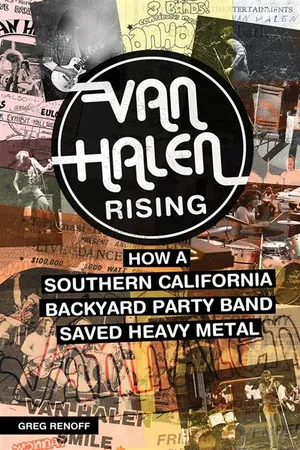
Yes, you can access Van Halen Rising by in PDF and/or ePUB format, as well as other popular books in Media & Performing Arts & Music. We have over 1.5 million books available in our catalogue for you to explore.