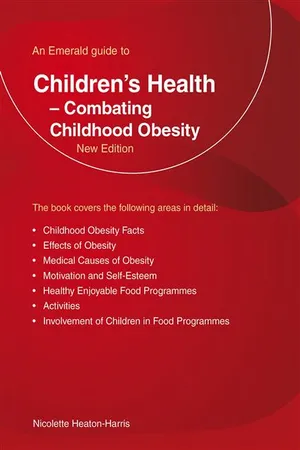
- 128 pages
- English
- ePUB (mobile friendly)
- Available on iOS & Android
eBook - ePub
Information
Topic
MedicineSubtopic
General Health1
FACTS ABOUT OBESITY
Do you ever find yourself defending your child’s weight? Whether to friends, family, or even in your own mind? Do you often find yourself saying/thinking, ‘It’s just puppy fat / They’re big-boned / They’ll grow out of it / They take after me’?
If so, then this book may be for you.
There have been a lot of reports in the media lately about childhood obesity and none of it is positive. The papers and news reporters repeatedly tell us that obesity in children is on the rise, that children are at risk of serious diseases if they do not lose their excess weight.
Well. Is it true? Yes. It is.
So it’s all very well to tell us about a problem, to educate us about a problem, but what can we actually do about it, if we have a child that is overweight or obese?
This book will help you, as a parent, help your child in making informed choices about the food they eat, being active and have the motivation to keep going. Because losing weight is not easy. Especially if you’re used to being allowed to eat what you want, when you want. Especially if the child uses food to medicate themselves when they’re feeling down or depressed.
But this isn’t going to be a program just for your child. It’s going to be for the whole family as a unit. And this is why:
FACT ONE: Many overweight children, have overweight parents
Let’s look at this fact. It will not be true in every single_case, but it seems to be true in the majority of cases. If a child, who is overweight, has overweight parents, then that child does not have good role models when it comes to food. Overweight parents will be eating too much of the wrong foods. Fatty, salty, calorie-laden foods. They may snack often, eat at the wrong times of day, drink lots of fizzy drinks or alcohol and serve huge portions because their child ‘is a growing lad/girl’. These overweight parents will most probably be inactive. They won’t exercise. They may order take-out and not eat fresh fruits or vegetables. Would it be any wonder their child is overweight too?
FACT TWO: Overweight/obese children usually become obese adults. Why? Well it only takes a moment to create a bad habit and sometimes years to break one. A child who has grown up in a home where they can eat unhealthy foods, have large portions, do no exercise and drink lots of pop and do not have informed parents who want to help their child, will continue to grow up through adolescence into adulthood without being able to change.
They get into a vicious cycle. By the time they’ve realized that they’re overweight and their friends at school are making jokes and not wanting to pick them for a sports team, they know nothing better than to go home and make themselves feel better by eating chocolate or a packet of biscuits. They have no-one to motivate them to feel better about themselves or how to change, so this child grows up into an adult who either stays overweight and/or obese with massive health problems, or someone who yo-yo diets because they have no idea of self-control or support.
FACT THREE: Obese children are at risk of severe health problems
This is a scary one. Especially when you look at the list of what health problems can develop just from carrying too much weight. These problems are not there for any other reason. The problems develop because the child is overweight. That’s it. Stark fact. If you do not help your child to change their eating habits and become more active, then your child will be at risk of developing one or more of the health problems I will go into in the next chapter. And let’s not beat about the bush. Some of these problems can be fatal. And if you think I’m trying to scare you, then good. I probably need to scare you. I’m not over-dramatizing either. I just don’t want Fact Four to happen.
FACT FOUR: Parents may soon start outliving their obese children
Just think about that for a moment. No one wants to outlive their children. Of course they don’t. But if the problem of childhood obesity is not tackled, then this may very well happen. If you decide to ignore the ‘puppy fat’ and let your child grow up to become an obese adult, riddled with health problems and being at tremendous risk of heart failure, then you may very well end up burying your child.
FACT FIVE: Obese children are less active than the average pensioner
Can this be true? Yes, it can. Research by the BBC, revealed that the average child is less active in the average day, than an average pensioner. So let’s think about that. We don’t know exactly what the BBC classed as an average child, or an average day, or an average pensioner. But if you try to think about it, it’s still pretty thought provoking.
Imagine a MR Smith, 70 years of age, touch of arthritis or angina. He gets up and ambles around his home getting ready to go out to collect his pension. He drives to the post office, perhaps, stands in line and talks to a few people. Then he goes shopping, pushing the trolley before going home to unpack. If the day is nice, he goes outside and does a spot of gardening, getting those weeds out of his rose bed or mowing the lawn. He might have a dog to walk or a game of bowls to go and play in the evening. Not incredibly active, but active all the same. He’s not pounding away at the treadmill in the gym, but he is being active and that is something that the majority of overweight children are not. Okay, they may do P.E. at school, but do they put any effort into it? Do they try for about five minutes before they go all red in the face and huff and puff because they’re out of breath? Do they run around and play at playtime?
Because MR Smith doesn’t get out of breath after five minutes, but an overweight child will. Because of the strain on the heart to pump so hard around a too-large body that is demanding oxygen rich blood. Think about that.
FACT SIX: The average teenager eats three pre-packaged/ready meals per week
This includes takeaways and fast food too. Why is this? Why would a family need to pay for three (or more) takeaways or fast food per week? That’s expensive. It would be so much cheaper to make their own pizza with fresh, healthy ingredients at home.
So why? It’s because we live in an ‘instant’ culture. We expect, and demand, instant service. We have microwaves to cook food fast. We have drive-throughs for those who can’t be bothered to get out of their car and eat at a proper table. We have computers that instantly load games, when twenty years ago, you had to wait three or more minutes for your Spectrum to load up a tape cassette game. We have instant popcorn, frozen ‘ready’ meals, and tremendous amounts of instant gratification in this ‘instant’ society.
There is no patience. Think of road-rage. Think of stress levels. People today want stuff, and they want it now! They don’t want to wait. Especially children. They ask and they are given. And this occurs with food. They don’t have to wait for the ice-cream man to come round each tea-time, they can have a few tubs of it in the freezer and eat it at breakfast if they want to. They want some chips? They can microwave some in just a minute. They want a burger and fries? They can get one from the local take-away. In minutes, rather than wait for Mum or Dad to make some home made.
It’s laziness. And impatience. But laziness is also a huge problem that contributes towards the even bigger problem of childhood obesity. The other problem with take-out food and ready-prepared meals are the high levels of salt. Too much sodium is also bad for the system, but eating a diet rich in salt can actually alter the taste sensations in your mouth. A body can get used to it and when you try to eat a food without salt, it can taste bland or awful to you, so you ignore it and keep with your salty requirements. Therefore buying more and more take-outs. Therefore ignoring the healthy salt-less foods.
These are just a few facts about obesity, but very important ones. I’m sure there are others, but I won’t bombard you with information that you already know. Because you_do know that your child being overweight or obese in unhealthy. You do know that if you don’t do something about it they’re unlikely to change. And you also know that they’re probably going to have health problems because of it. The first way to tackle a problem is to admit that there is_one. And by picking up this book, then you’ve done that, otherwise you wouldn’t be reading it.
So. There’s a problem. You want to do something about it, but what? Perhaps you ought to know just exactly what you’re up against?
What might happen if you fail to help your child?
Knowing the consequences of failure can be an incredibly motivating factor to actually succeed. So let’s look at what problems can develop.
2
EFFECTS OF OBESITY
Being overweight or obese can cause many different types of health problems. Some of these can be incredibly serious. Dangerous. Even fatal. Some, say, varicose veins, may not seem all that terrible. They can always wear trousers, yes?
No. Why should they? Especially because you can start something now to prevent any or all of these problems from occurring because your child is overweight.
So, let’s look at some of these health risks. I’ll explain exactly what they are in simple terms and how each will affect the human body. What the short term and long term consequences are. What medications might be given to help with a problem and whether these have any long-term effects?
Because this is your child we may be talking about. And you don’t ever like to think your child is in pain or suffering, do you?
Slipped Femoral Epiphysis
Sounds technical, I know. But basically, the femoral epiphysis is the ball of the hip joint in a child. The ball joint normally remains positioned in the socket, however, if the join between the ball joint and the top part of the upper femur (thigh bone) weakens, it begins to slip and allows the affected leg to turn outwards, giving the effect of a bowed leg.
Overweight children between the ages of ten and sixteen seem to suffer from this more than any other and it also seems more prevalent in boys, than girls.
If a slip in the joint between the ball joint and femur occurs slowly (chronic condition) then the child is more likely to complain of pain in their groin area whenever they partake in exercise or some prolonged activity. They may even show signs of a limp, or have a slightly shortened leg. If that child then rests, the pain may gradually go away, or settle.
Some children may complain that their knees hurt with this condition and that is because the nerves that supply the hip, also supply the knee.
Occasionally, a sudden slip in the join, after a period of gradual weakening (acute condition) may cause severe pain in the child and cause difficulty in being able to walk. Thankfully, a sudden slip like this is rare.
In one case in three, both hips may be affected. But why do these slips (weakenings) occur? Well, they occur because the join between the ball joint and upper femur (growth plate) just cannot stand the stress that is placed upon it by obesity. The excess weight on such a joint, over a period of time, weakens the growth plate as it is not meant to take such weight or stress.
Treatment involves being admitted to hospital, where doctors will normally progress by starting with traction, using weights, but usually, surgery is required, a risk in itself upon an overweight person. During surgery, the epiphysis, is pinned. It can be a minor procedure, performed under general anesthetic, requiring a couple of small incisions in the upper thigh area, but if the slip is great and severe deformity of the joint and plate has occurred, the surgery can take longer and require a larger incision.
During the recovery period, your child would need crutches for about four to six weeks after the operation for mobility. They would be in hospital for about a week after the operation and after being discharged, would need to see specialists and have multiple X-rays whilst their bodies were still naturally growing. The long-term risk associated with slipped femoral epiphysis is that of degenerative arthritis in later life. Therefore, if your child complains of groin pain, limps, or complains about their knee or you have any concerns about them having this condition, the quicker you get them to see a doctor, the better.
Benign Intercranial Hypertension
Another technical sounding term. Fortunately, this is a very rare condition, but one that affects those who are overweight. The statistics on occurrence are about one in every two hundred thousand, which isn’t many, and doesn’t sound too bad, unless of course, you’re that one person who does have it, as the condition is not pleasant.
Benign Intercranial Hypertension (BIH) has two other names. Pseudotumour Cerebri (PTC) and Idiopathic Intercranial Hypertension (IIH).
This condition mostly affects women and its symptoms are many; headache, nausea, visual disturbances, memory problems, balance problems, tinnitus (a ringing noise in the ears) neck and back pain. The headaches from this condition can be continuous and in them...
Table of contents
- Cover
- Title
- Copyright
- Contents
- Introduction and Case Studies
- Ch 1.Facts about Obesity
- Ch 2. Effects of Obesity
- Ch 3. Medical Conditions that cause Obesity
- Ch 4. Motivation and Self-esteem
- Ch 5. Healthy Food and Healthy life
- Ch 6. Involving the child in Choice
- Ch 7. Meal Suggestions-Breakfast Ideas
- Ch 8. Summary
- Ch 9. Useful Contacts and Websites
- Index
Trusted by 375,005 students
Access to over 1.5 million titles for a fair monthly price.
Study more efficiently using our study tools.
Frequently asked questions
Yes, you can cancel anytime from the Subscription tab in your account settings on the Perlego website. Your subscription will stay active until the end of your current billing period. Learn how to cancel your subscription
No, books cannot be downloaded as external files, such as PDFs, for use outside of Perlego. However, you can download books within the Perlego app for offline reading on mobile or tablet. Learn how to download books offline
Perlego offers two plans: Essential and Complete
- Essential is ideal for learners and professionals who enjoy exploring a wide range of subjects. Access the Essential Library with 800,000+ trusted titles and best-sellers across business, personal growth, and the humanities. Includes unlimited reading time and Standard Read Aloud voice.
- Complete: Perfect for advanced learners and researchers needing full, unrestricted access. Unlock 1.5M+ books across hundreds of subjects, including academic and specialized titles. The Complete Plan also includes advanced features like Premium Read Aloud and Research Assistant.
We are an online textbook subscription service, where you can get access to an entire online library for less than the price of a single book per month. With over 1.5 million books across 990+ topics, we’ve got you covered! Learn about our mission
Look out for the read-aloud symbol on your next book to see if you can listen to it. The read-aloud tool reads text aloud for you, highlighting the text as it is being read. You can pause it, speed it up and slow it down. Learn more about Read Aloud
Yes! You can use the Perlego app on both iOS and Android devices to read anytime, anywhere — even offline. Perfect for commutes or when you’re on the go.
Please note we cannot support devices running on iOS 13 and Android 7 or earlier. Learn more about using the app
Please note we cannot support devices running on iOS 13 and Android 7 or earlier. Learn more about using the app
Yes, you can access Emerald Guide To Children's Health by in PDF and/or ePUB format, as well as other popular books in Medicine & General Health. We have over 1.5 million books available in our catalogue for you to explore.