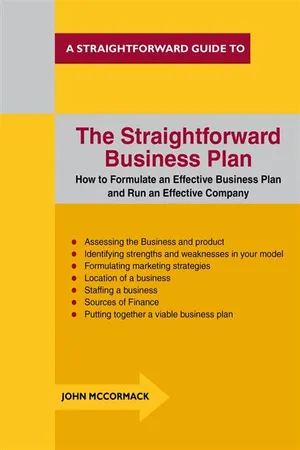
- 128 pages
- English
- ePUB (mobile friendly)
- Available on iOS & Android
eBook - ePub
Information
1
DEFINING A BUSINESS PLAN
What is a business plan?
When answering this question, it is tempting to say that a business plan is a document which the budding entrepreneur can present to his or her bank manager as a means of assuring the latter of the viability of the proposed business, thereby securing start up funding.
In a sense, this is true. Increasingly, banks are refusing to finance small businesses, simply because so many have gone bust over the last ten years. Moreover, they have done so, according to many economic commentators, precisely because such small businesses have not thought about how it is they are going to survive and prosper in what is almost always a very competitive environment; they have not produced a business plan.
It is, therefore, erroneous to see business plan as simply a tool for negotiation with the bank manager. A business plan is, above all, a strategic document which assists the entrepreneur to think very carefully about all the aspects of the business that they are getting involved in. A good business plan will illustrate detailed research and evidence around such aspects of business as:
• The product/service; what exactly is it? It may be obvious to you, but unless you spell it out it may not be clear to your customers;
• The market; is there evidence of demand for your goods and services? Is the competition fierce? Are you entering a niche market? Is the market prone to fluctuation for any reason?
If so, how do you propose to deal with this?
• Your unique selling point (usp); what is it that makes your goods and services better than those of your competitors? Price? Quality? Anything else?
• Yourself; have you got what it takes to be successful in your line of business? What relevant experience/training have you had? How do you propose to remedy any shortcomings in these respects?
• Business development; what sort of life span are you putting on the business? What are your ultimate business objectives? Growth? Diversification?
• Capital funding; what level of funding, if any, do you need to start up your own business? How much money can you afford to put into it?
• Management and personnel; are you intending to employ other people? If so, what will their roles be? How will they relate to you? Are you aware of the legal and cost implications of employing staff.
• Legal requirements; is your proposed business subject to certain legal requirements, e.g., health and safety legislation, fire regulations, VAT, licensing etc.
• Location and premises; from where do you propose to run your business? Does location matter? What size of premises do you need and what do they cost? Is it feasible and/or desirable to work from home?
• Budgeting; what are your overheads and likely level of income? Is there any scope for price variation in order to cope with increased competition?
• Cash flow; at what points in the year will you face big bills? When can you expect an upturn in sales? What level of overdraft, if any, will you need to service the business?
These are the key questions which any good business plan will address, and it is the process of answering them-and thinking about them-which is most beneficial to the entrepreneur.
How long must a business plan be?
There are no golden rules regarding the length of a business plan. Always, the most important aspect of the plan is the quality of research, evidence and information provided. Needless to say, however, if a business plan purports to cover a long period of time, 10,20, 30 years for example-it will inevitably entail the provision of more information, thus elongating the size of the document.
Large businesses sometimes have business plans which cover a period of up to 30 years. Small businesses, if they have a business plan, normally cover a period of 2-3 years. In the case of new businesses, it is sometimes a good idea to have a business plan for the first year of trading only, to “test the water” and to review the plan at the end of the first year, producing what might be a more realistic 2-3 year plan, based on the experiences of the first year. As a rule of thumb, however, a business plan should aim to be around 10-12 sides of paper in length, with relevant appendices attached (cash flow forecast, profit and loss forecast, budget calculations etc)
What resources do you need to produce a business plan?
Large companies producing 20-30 year business plans employ highly qualified accountants and financial experts with highly sophisticated computer equipment to assist them in the drafting of their business plans. As a consequence, the small independent trader may feel somewhat ill qualified to produce such a plan. However, it is possible to produce a business plan without expensive equipment and expert advice. In particular, because the proposed business is small, there are less complications which experts would normally deal with.
A business plan can be produced by a small trader if he/she has the following resources and assets:
• time
• commitment
• numeracy
• literacy
• patience
These are all the human resources required to produce a business plan. The only other things needed are a pen and piece of paper!
Now read the key points from Chapter 1.
Key Points from Chapter 1
• A Business plan is a strategic document which assists the business person to think very clearly and carefully about all aspects of the business they are involved in, or getting involved in.
• A good business plan will illustrate detailed research and evidence around all aspects of business.
• A good business plan will help you to understand your unique selling point as a business.
• There are no golden rules regarding the length of a business plan.
• A business plan can be produced by anyone with basic resources.
2
Ten Quick Tips on Writing Your Plan
Before we look at setting out clear objectives for a business, there are a few pointers which should be followed when producing a plan. Many of these are covered in the following chapters.
Writing your plan for the reader
The starting point for any business plan should be the perspective of the audience. The questions that you need to ask yourself are:
• What is the purpose of the plan-is it to obtain funding, for example? An investor will need clear answers to their questions, such as will they get a return on their investment.
• Have you carried out market research-is your plan detailed enough-without this detail your plan will not clear the necessary hurdles.
• Do you understand the competition?
• Is the plan detailed enough? Business plans should ensure that the reader has enough information to make decisions on whether to fund you, or whatever it is that you are asking them to do.
• Focus on opportunity-if you are seeking investment in your business it is very important to describe the investment opportunity. In short, why should an investor choose your business over and above others.
• Ensure that you cover all key areas in your plan-you should undertake research on what a plan should contain-books like this will go a long way to helping you. However, it does no harm to obtain as much specialist advice as possible.
• Do your sums-when you are outlining the costs involved you should pay as much attention as possible to detail. Potential investors, whoever they are, will turn away if the figures do not stack up.
• Create an executive summary-one of the most important components is the executive summary of the business plan. This is a summary of the entire business plan and is usually contained at the start of the plan. If investors like it they will read on. If not they will pass. If there is no summary they will probably not even consider it.
• Review the plan-once you have completed the plan have it independently reviewed. Select a person detached from the process.
• Implement the plan-a plan should always be viewed as a living document and contain specifics regarding dates, deadlines and specific responsibilities.
Now turn to chapter three.
3
Setting out Clear Objectives for your
Business and Defining a Business Strategy
Before we look at the variables that should be entered into a business plan, we should look generally at the management of a business. In this chapter we will look at the process of setting objectives for a business, i.e. what are your aims and goals. We will also look at the development of a business strategy.
It is absolutely essential to have a crystal clear idea of what the main objectives for your business are. Business objectives relate to a business as a whole and to what you want to achieve in the long and short term. When forming your business plan you will certainly need to be clear about your objectives in the short and long term. Short-term objectives will relate to what you want to achieve on an annual basis, over a period of twelve months. Long-term objectives relate to a period (usually) of five years.
It has become commonplace now to set up a criteria against which you can measure the effectiveness of your business objectives. This is known as ‘SMART’ criteria. Within SMART all the objectives that you set for you...
Table of contents
- Cover
- Title
- Copyright
- Contents
- Introduction
- Chapter One. The Business Plan
- Chapter Two. Ten Quick Tips on Writing Your Plan
- Chapter Three. Setting out Clear Objectives for Your Business and Defining a Business Strategy
- Chapter Four. The Structure of Your Business
- Chapter Five. Location and Premises-Making the Right Choice
- Chapter Six. Marketing
- Chapter 7. Pricing Your Product
- Chapter 8. Financial Control
- Chapter 9. Raising finance
- Chapter Ten. Buying an Existing Business
- Chapter Eleven. Your Business Plan-Finer Points
- Chapter Twelve-Example Business Plan
- Conclusion
- Useful addresses
- Index
Trusted by 375,005 students
Access to over 1.5 million titles for a fair monthly price.
Study more efficiently using our study tools.
Frequently asked questions
Yes, you can cancel anytime from the Subscription tab in your account settings on the Perlego website. Your subscription will stay active until the end of your current billing period. Learn how to cancel your subscription
No, books cannot be downloaded as external files, such as PDFs, for use outside of Perlego. However, you can download books within the Perlego app for offline reading on mobile or tablet. Learn how to download books offline
Perlego offers two plans: Essential and Complete
- Essential is ideal for learners and professionals who enjoy exploring a wide range of subjects. Access the Essential Library with 800,000+ trusted titles and best-sellers across business, personal growth, and the humanities. Includes unlimited reading time and Standard Read Aloud voice.
- Complete: Perfect for advanced learners and researchers needing full, unrestricted access. Unlock 1.5M+ books across hundreds of subjects, including academic and specialized titles. The Complete Plan also includes advanced features like Premium Read Aloud and Research Assistant.
We are an online textbook subscription service, where you can get access to an entire online library for less than the price of a single book per month. With over 1.5 million books across 990+ topics, we’ve got you covered! Learn about our mission
Look out for the read-aloud symbol on your next book to see if you can listen to it. The read-aloud tool reads text aloud for you, highlighting the text as it is being read. You can pause it, speed it up and slow it down. Learn more about Read Aloud
Yes! You can use the Perlego app on both iOS and Android devices to read anytime, anywhere — even offline. Perfect for commutes or when you’re on the go.
Please note we cannot support devices running on iOS 13 and Android 7 or earlier. Learn more about using the app
Please note we cannot support devices running on iOS 13 and Android 7 or earlier. Learn more about using the app
Yes, you can access Straightforward Business Plan by in PDF and/or ePUB format, as well as other popular books in Business & Business Strategy. We have over 1.5 million books available in our catalogue for you to explore.