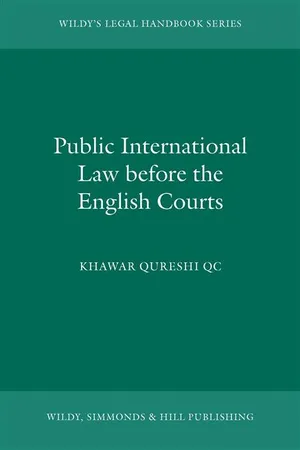
- 324 pages
- English
- ePUB (mobile friendly)
- Available on iOS & Android
eBook - ePub
Information
KEY TREATY/STATUTORY PROVISIONS
ANNEX 1: Charter of the United Nations 1945
Preamble
WE THE PEOPLES OF THE UNITED NATIONS DETERMINED
• to save succeeding generations from the scourge of war, which twice in our lifetime has brought untold sorrow to mankind, and
• to reaffirm faith in fundamental human rights, in the dignity and worth of the human person, in the equal rights of men and women and of nations large and small, and
• to establish conditions under which justice and respect for the obligations arising from treaties and other sources of international law can be maintained, and
• to promote social progress and better standards of life in larger freedom,
AND FOR THESE ENDS
• to practice tolerance and live together in peace with one another as good neighbours, and
• to unite our strength to maintain international peace and security, and
• to ensure, by the acceptance of principles and the institution of methods, that armed force shall not be used, save in the common interest, and
• to employ international machinery for the promotion of the economic and social advancement of all peoples,
HAVE RESOLVED TO COMBINE OUR EFFORTS TO ACCOMPLISH THESE AIMS
Accordingly, our respective Governments, through representatives assembled in the city of San Francisco, who have exhibited their full powers found to be in good and due form, have agreed to the present Charter of the United Nations and do hereby establish an international organization to be known as the United Nations.
Chapter 1: PURPOSES AND PRINCIPLES
Article 1
The Purposes of the United Nations are:
1. To maintain international peace and security, and to that end: to take effective collective measures for the prevention and removal of threats to the peace, and for the suppression of acts of aggression or other breaches of the peace, and to bring about by peaceful means, and in conformity with the principles of justice and international law, adjustment or settlement of international disputes or situations which might lead to a breach of the peace;
2. To develop friendly relations among nations based on respect for the principle of equal rights and self-determination of peoples, and to take other appropriate measures to strengthen universal peace;
3. To achieve international co-operation in solving international problems of an economic, social, cultural, or humanitarian character, and in promoting and encouraging respect for human rights and for fundamental freedoms for all without distinction as to race, sex, language, or religion; and
4. To be a centre for harmonizing the actions of nations in the attainment of these common ends.
Article 2
The Organization and its Members, in pursuit of the Purposes stated in Article 1, shall act in accordance with the following Principles.
1. The Organization is based on the principle of the sovereign equality of all its Members.
2. All Members, in order to ensure to all of them the rights and benefits resulting from membership, shall fulfill in good faith the obligations assumed by them in accordance with the present Charter.
3. All Members shall settle their international disputes by peaceful means in such a manner that international peace and security, and justice, are not endangered.
4. All Members shall refrain in their international relations from the threat or use of force against the territorial integrity or political independence of any state, or in any other manner inconsistent with the Purposes of the United Nations.
5. All Members shall give the United Nations every assistance in any action it takes in accordance with the present Charter, and shall refrain from giving assistance to any state against which the United Nations is taking preventive or enforcement action.
6. The Organization shall ensure that states which are not Members of the United Nations act in accordance with these Principles so far as may be necessary for the maintenance of international peace and security.
7. Nothing contained in the present Charter shall authorize the United Nations to intervene in matters which are essentially within the domestic jurisdiction of any state or shall require the Members to submit such matters to settlement under the present Charter; but this principle shall not prejudice the application of enforcement measures under Chapter VII.
Chapter V: THE SECURITY COUNCIL
Article 25
The Members of the United Nations agree to accept and carry out the decisions of the Security Council in accordance with the present Charter
Chapter VII: ACTION WITH RESPECT TO THREATS TO THE PEACE, BREACHES OF THE PEACE, AND ACTS OF AGGRESSION
Article 39
The Security Council shall determine the existence of any threat to the peace, breach of the peace, or act of aggression and shall make recommendations, or decide what measures shall be taken in accordance with Articles 41 and 42, to maintain or restore international peace and security.
Article 40
In order to prevent an aggravation of the situation, the Security Council may, before making the recommendations or deciding upon the measures provided for in Article 39, call upon the parties concerned to comply with such provisional measures as it deems necessary or desirable. Such provisional measures shall be without prejudice to the rights, claims, or position of the parties concerned. The Security Council shall duly take account of failure to comply with such provisional measures.
Article 41
The Security Council may decide what measures not involving the use of armed force are to be employed to give effect to its decisions, and it may call upon the Members of the United Nations to apply such measures. These may include complete or partial interruption of economic relations and of rail, sea, air, postal, telegraphic, radio, and other means of communication, and the severance of diplomatic relations.
Article 42
Should the Security Council consider that measures provided for in Article 41 would be inadequate or have proved to be inadequate, it may take such action by air, sea, or land forces as may be necessary to maintain or restore international peace and security. Such action may include demonstrations, blockade, and other operations by air, sea, or land forces of Members of the United Nations.
Article 43
1. All Members of the United Nations, in order to contribute to the maintenance of international peace and security, undertake to make available to the Security Council, on its call and in accordance with a special agreement or agreements, armed forces, assistance, and facilities, including rights of passage, necessary for the purpose of maintaining international peace and security.
2. Such agreement or agreements shall govern the numbers and types of forces, their degree of readiness and general location, and the nature of the facilities and assistance to be provided.
3. The agreement or agreements shall be negotiated as soon as possible on the initiative of the Security Council. They shall be concluded between the Security Council and Members or between the Security Council and groups of Members and shall be subject to ratification by the signatory states in accordance with their respective constitutional processes.
Article 44
When the Security Council has decided to use force it shall, before calling upon a Member not represented on it to provide armed forces in fulfilment of the obligations assumed under Article 43, invite that Member, if the Member so desires, to participate in the decisions of the Security Council concerning the employment of contingents of that Member’s armed forces.
Article 45
In order to enable the United Nations to take urgent military measures, Members shall hold immediately available national air-force contingents for combined international enforcement action. The strength and degree of readiness of these contingents and plans for their combined action shall be determined within the limits laid down in the special agreement or agreements referred to in Article 43, by the Security Council ...
Table of contents
- Cover
- Half-title Page
- Also by Khawar Qureshi
- Title Page
- Copyright
- Contents
- Foreword
- Table of Cases
- Introduction
- United Nations Charter
- Treaty Interpretation - The Vienna Convention
- Jurisdictional Immunities of States
- ‘Act of State‘ Doctrine and Non-Justiciability
- Diplomatic Privileges and Immunities
- Public Interest Immunity
- Sanctions
- Key Treaty/Statutory Provisions
Trusted by 375,005 students
Access to over 1.5 million titles for a fair monthly price.
Study more efficiently using our study tools.
Frequently asked questions
Yes, you can cancel anytime from the Subscription tab in your account settings on the Perlego website. Your subscription will stay active until the end of your current billing period. Learn how to cancel your subscription
No, books cannot be downloaded as external files, such as PDFs, for use outside of Perlego. However, you can download books within the Perlego app for offline reading on mobile or tablet. Learn how to download books offline
Perlego offers two plans: Essential and Complete
- Essential is ideal for learners and professionals who enjoy exploring a wide range of subjects. Access the Essential Library with 800,000+ trusted titles and best-sellers across business, personal growth, and the humanities. Includes unlimited reading time and Standard Read Aloud voice.
- Complete: Perfect for advanced learners and researchers needing full, unrestricted access. Unlock 1.5M+ books across hundreds of subjects, including academic and specialized titles. The Complete Plan also includes advanced features like Premium Read Aloud and Research Assistant.
We are an online textbook subscription service, where you can get access to an entire online library for less than the price of a single book per month. With over 1.5 million books across 990+ topics, we’ve got you covered! Learn about our mission
Look out for the read-aloud symbol on your next book to see if you can listen to it. The read-aloud tool reads text aloud for you, highlighting the text as it is being read. You can pause it, speed it up and slow it down. Learn more about Read Aloud
Yes! You can use the Perlego app on both iOS and Android devices to read anytime, anywhere — even offline. Perfect for commutes or when you’re on the go.
Please note we cannot support devices running on iOS 13 and Android 7 or earlier. Learn more about using the app
Please note we cannot support devices running on iOS 13 and Android 7 or earlier. Learn more about using the app
Yes, you can access Public International Law Before the English Courts by in PDF and/or ePUB format, as well as other popular books in Law & International Law. We have over 1.5 million books available in our catalogue for you to explore.