- 240 pages
- English
- ePUB (mobile friendly)
- Available on iOS & Android
eBook - ePub
About this book
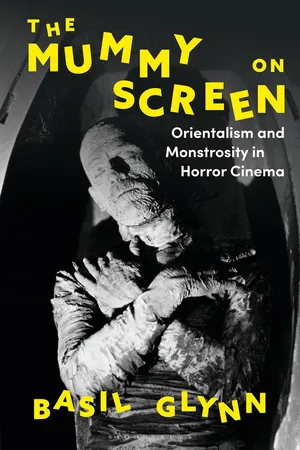
The Mummy is one of the most recognizable figures in horror and is as established in the popular imagination as virtually any other monster, yet the Mummy on screen has until now remained a largely overlooked figure in critical analysis of the cinema. In this compelling new study, Basil Glynn explores the history of the Mummy film, uncovering lost and half-forgotten movies along the way, revealing the cinematic Mummy to be an astonishingly diverse and protean figure with a myriad of on-screen incarnations. In the course of investigating the enduring appeal of this most 'Oriental' of monsters, Glynn traces the Mummy's development on screen from its roots in popular culture and silent cinema, through Universal Studios' Mummy movies of the 1930s and 40s, to Hammer Horror's re-imagining of the figure in the 1950s, and beyond.
Information
1 The creature’s features: Moulding the Mummy and the Mummy movie
The Oriental Mummy as Western projection
In The Mummy (1932) the film’s heroine, Helen, gazes out at the pyramids from the terrace of a dancehall in the company of an occult expert, Dr Muller. ‘Is there’, he asks, ‘a view like this in all the world?’ ‘The real Egypt’, she replies, adding ‘Are we really in this dreadful modern Cairo?’ In the cinema, ‘the real Egypt’ has routinely been viewed through such a Western perspective, its Muslim present as well as its post-pharaonic history looked past in favour of its half-knowable ancient gods, exotic rulers and grand monuments, being commonly understood, as Douglas Drake describes it, as ‘one enormous mausoleum – a vast, sunbaked, sand-choked museum of the past’ (1966: 163–4). Boris Karloff’s Mummy in disguise, Ardath Bey, in The Mummy (1932) and the various Mummy-mastering high-priests who followed thereafter in films like The Mummy’s Hand (1940) belong to this ‘museum of the past’. They may appear to be finely dressed or fez-wearing Arabs, but they are fundamentally timeless Egyptians who still follow the ancient ways. They seem to be proof of Rider Haggard’s eponymous hero’s contention in Smith and the Pharaohs that ‘the East may change its masters and its gods, but its customs never change, and if today Allah wore the feathers of Amen one wonders whether the worshippers would find the difference so very great’ (1912 repr. Stephens 2001: 157). Mummy films acknowledge little difference between the ancient and the modern, with only scant attention given to the Muslim country that Egypt has been since AD 639. The archaeologists of Mummy films repeatedly see Egypt as incapable of looking after its own interests (and by extension, its treasures), with modern Arabs only suitable for either granting permits for Western experts or forming gangs to dig for tombs.
Such a view of the Westerner as active and dynamic and the Oriental as passive and incapable has a history that long predates the Mummy film. Following the translation into English of the Alf Layla wa-Layki (The Arabian Nights) in the eighteenth century, the Orient (the term for Europeans conjuring the Middle East rather than the Far East) became associated with Eastern stagnation and decline and was contrasted with the dynamism of the West: the Arab world newly envisaged as exotic and anaemic with ‘moonlit seraglios, the baths, the genii, the magic rings and caskets, the mysterious, blushing princesses and imperious sultans’ (Mack 1992: xiv). Like India, its intriguing mysticism and luxury, while greatly appealing to the Western imagination, was attributed with having held it back and making it decadent and weak.1 Egypt was an impressive and alluring ‘Other’, but with clearly fading glamour. It was in need of rescuing from its incapable inheritors, the contemporary Egyptians: a view that served to ideologically justify its colonization.
Such an authoritarian imperialistic attitude was prevalent throughout the colonial period and took the form of ‘a hierarchical view of the world in which the white races’ occupied a permanent place on top ‘with the colonized ranged in varying degrees of supposed inferiority’ (Chowdhry 2000: 251). Edward Said suggests Egypt was situated near the bottom of such colonial racial ranking: ‘Egypt was not just another colony: it was the vindication of Western imperialism; it was, until its annexation by England, an almost academic example of Oriental backwardness; it was to become the triumph of English knowledge and power’ (1978: 35).
In spite of such ‘backwardness’, however, the Orient was still a threat in one important respect. The racial distinctions that justified colonialism had a major drawback in the form of mixed-race children being produced from relationships between European men acting as colonial enforcers and local women (Stoler 1989: 634–60). Such children blurred the distinction between races and so in the twentieth century colonial administrators allowed European women to move to colonial territories in order to stem the generation of mixed-race children. While ensuring that their husbands would not procreate with local women, they also prevented their children from being influenced by local customs and ideas thereby ensuring racial segregation.2 As a result, women in the colonies became imperial enforcers too, but at a cost because at the same time they, like their husbands, became highly vulnerable themselves. While serving to prevent their spouses succumbing to temptation in dangerous foreign lands, they did, of course, face temptations of their own. Therefore while reducing the risk of miscegenation on the one hand, they increased it on the other.
The heroine of The Mummy (1932) finds herself in such a position of vulnerability and temptation while in Egypt, drawn to an Egyptian while involved with a Westerner, torn between desire and an unwillingness to betray her own sense of propriety. Egypt in this film is not just a land of remote and incomprehensible history but also a present-day source of overwhelming and mysterious exoticism and eroticism, making it a perfect site for her to succumb and transgress: such yielding to temptation proving an essential ingredient of classic horror of the 1930s. Time and again in horror films of this decade, as Rhona J. Berenstein explains, ‘well-behaved women’ transform after falling ‘under the spell of hypnotic creatures … [and] … exhibit a remarkable degree of sexual allure. … Girl gets boy at the conclusion, but her best times, the moments that give her free rein to throw all caution to the wind, are spent with the monster’ (1996a: 90).
Egypt was the perfect setting for Helen to fall foul of such sexual spells in The Mummy (1932) because the Orient personified that which was forbidden in the West; it was a place where there existed indescribable sexual possibilities, but also great peril. In 1924 E. M. Forster’s novel A Passage to India related how the colonies could prove too much for the fragile psyches of Western women and Sir George Fletcher MacMunn’s account of half-understood Indian history further reveals other ascribed colonial beliefs of the time in his 1931 The Romance of the Indian Frontiers. ‘Astounding indecency’ was understood as commonplace, MacMunn wrote , with ‘bestiality recorded: the mingling of humans and animals in intimate embrace’ because ‘the ancient religions did permit such terrible abominations’ (cited in Harrison 1991: 179).
As MacMunn’s account discloses, there was a dangerous, almost alien sexual world to be encountered when visiting the colonies. Alongside the maddening heat and unfamiliar traditions, the ancient gods still haunted such lands and the draw of suppressed urges or forbidden temptations could be attributed to their combined overpowering and seductive power. Helen in The Mummy (1932) is a woman who succumbs not only to the influence of the Mummy but also to the lure of Egypt itself and its ancient ways that still hold sway. Such self-serving projections onto an alien divinity or a personification of ‘India’ or ‘Egypt’ for those things that are felt to be repressed and outside the sphere of reason or civilized behaviour are today also bound up with the concept of ‘the Other’ that Robin Wood suggests lies at the thematic core of horror. For Wood, ‘the Other’ comprises all that our culture ‘represses or oppresses’ (1984: 171), horror narratives releasing and then ritually re-suppressing what society (as defined chiefly by a white, Western, patriarchal, heterosexual, capitalistic, political and ideological mainstream) denounces. If one accepts Wood’s thesis, one can see the Mummy film as having a formidable formula, with the Orient serving as an effective site and its chief monster functioning as a potent medium for the release of the suppressed. Both Egypt and the Mummy offer heroines in particular unthought-of opportunities, tempting them with the promise of their ‘best times’ if they will only ‘throw all caution to the wind’, violate the accepted boundaries of social and sexual behaviour and give themselves over to losing themselves. That the Mummy genre fails, as Kim Newman contends, because ‘a corpse which has been wrapped up for three thousand years lacks erotic possibilities’ (1996: 225), overlooks the erotic possibilities afforded the heroine.
The risks and appeal of miscegenation, necrophilia, unfaithfulness and other forms of off-limits desire are sources of constant tension throughout the Mummy film. The Egyptian Mummy displays a consistent desire to break sexual boundaries by yearning for a hot-blooded Western woman or displaying passion for a departed lover whose blood has run cold. Male archaeologists, heroic adventurers and female heroines are all drawn to enigmatic corpses and/or racial ‘Others’, being variously hypnotized, transformed, romanced, coerced and/or transported away from their humdrum lives, sometimes through time to re-experience an ancient past in which they once lived, sometimes through space to Egypt where the monster stalks or seduces them.
Western fascination with the Orient and its sexual and spiritual associations lies at the heart of the Mummy genre and its central narratives of colonial incursion, monstrous retaliation and romance, mirroring the troubled politics and sexual politics that have accompanied imperial invasion, the imposition of new values and indigenous resistance. The centrality of the concept of reincarnation to the Mummy’s story, alien to the ancient Egyptians but familiar through Britain’s colonial relationship with India and the Hindu beliefs encountered there,3 underscores the centrality of the colonial experience to the Mummy genre and how Egypt’s actual past was brought into line with the Western imagination, making it another form of ‘Western projection’ (Said 1978: 95) that bears little relationship with ‘the real Egypt’ Helen so longs for at the beginning of The Mummy.
The Mummy genre: Interest and Disinterest
Just as nebulous as the Egypt of the Mummy film is the Mummy film itself. Although the Mummy projected onto the screen has been for the most part both Oriental and monstrous, there have also been occasions when it has been neither, such as in Mercy, the Mummy Mumbled (R. G. Phillips, USA, Ebony, 1918) in which it is both African American and a normal living man. A key question that arises when it comes to the Mummy film, therefore, is not only what a Mummy film ‘means’ but also what it constitutes. How does one define a Mummy film, or genre – or if not qualifying for that term – a subgenre in the cinema? It is a complicated question because, as Rick Altman explains, the notion of genre is a polyvalent concept. Genre acts as a blueprint, ‘as a formula that precedes, programmes and patterns industry production’, as a structure, ‘as the formal framework on which individual films are founded’, as a label, ‘as the name of a category central to the decisions and communications of distributors and exhibitors’, as well as a contract that establishes ‘the viewing position required by each genre film of its audience’ (2000: 14). One method a number of critics have applied to set about this ‘polyvalent concept’ has been to discuss genres through utilizing life-cycle terminology. As Altman (2000) points out, critics including Jane Feuer (1993: 88), John George Cawelti (1986: 200), Brian Taves (1993: 22) and Thomas Schatz (1981: 38) have all discussed how they develop and how they become articulate and self-conscious and then tired, predictable and worn-out. Once they have evolved beyond a certain point, they are seen to peter out, or be replaced, or transform into other cycles. Although horror is arguably a perennially popular genre in the cinema, specific monster cycles can be understood to have thrived and then died out, such as in the 1930s (primarily at Universal),4 the 1940s (again mainly at Universal), the 1950s (with sci-fi aliens taking over at the expense of classic monsters) and the 1960s and 1970s (with the rise and fall of Hammer’s reinterpretations of Universal’s classic monsters ).
Although monsters evidently rise and fall in popularity, to be resurrected anew, the death of the Mummy genre is one that appears to have been actively sought by a number of critics, being pronounced dead on the screen on a number of occasions. Take the 1980s, for example. In 1980 Arnold Madison stated that ‘the enthusiasm for making films about mummies may have ended’ (1980: 80) and in 1983 Tom Hutchinson and Roy Pickard claimed that ‘the era of movies that dealt with … the Mummy … seems to have ended. The vaults of our interest appear to have been finally sealed against those ancient dead “born” from the ancient Egyptian need to embalm’ (1983: 67). Similarly, Richard Davis claimed in 1987 that ‘while the cult of the zombie still attracts film makers and audiences, the subject of Mummies seems to be current...
Table of contents
- Cover
- Half-Title
- Dedication
- Title
- Contents
- List of figures
- Acknowledgements
- Author’s notes
- Introduction: Death is only the beginning – Unravelling the Mummy on Screen
- Part 1 The Mummy in the West and in Western cinema
- Part 2 The Mummy in literature, on stage and on the silent screen
- Part 3 Universal studios and the Mummy of the 1930s and 1940s
- Part 4 Hammer Film Productions and beyond: The Mummy of the 1950s–present
- Bibliography
- Index
- Copyright
Trusted by 375,005 students
Access to over 1.5 million titles for a fair monthly price.
Study more efficiently using our study tools.
Frequently asked questions
Yes, you can cancel anytime from the Subscription tab in your account settings on the Perlego website. Your subscription will stay active until the end of your current billing period. Learn how to cancel your subscription
No, books cannot be downloaded as external files, such as PDFs, for use outside of Perlego. However, you can download books within the Perlego app for offline reading on mobile or tablet. Learn how to download books offline
We are an online textbook subscription service, where you can get access to an entire online library for less than the price of a single book per month. With over 1.5 million books across 990+ topics, we’ve got you covered! Learn about our mission
Look out for the read-aloud symbol on your next book to see if you can listen to it. The read-aloud tool reads text aloud for you, highlighting the text as it is being read. You can pause it, speed it up and slow it down. Learn more about Read Aloud
Yes! You can use the Perlego app on both iOS and Android devices to read anytime, anywhere — even offline. Perfect for commutes or when you’re on the go.
Please note we cannot support devices running on iOS 13 and Android 7 or earlier. Learn more about using the app
Please note we cannot support devices running on iOS 13 and Android 7 or earlier. Learn more about using the app
Yes, you can access The Mummy on Screen by Basil Glynn in PDF and/or ePUB format, as well as other popular books in History & Film & Video. We have over 1.5 million books available in our catalogue for you to explore.