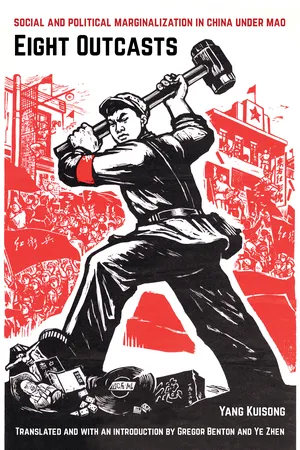
The 1949 Communist Revolution marked a period of earthshaking change in China. Political, economic, ideological, and cultural movements galvanized the country, culminating in dramatic social transformations at all levels, including the persecution of hundreds of thousands of the country’s citizens. Based on normally inaccessible records of confessions, interrogations, trial transcripts, and depositions, Eight Outcasts tells the stories of eight victims of the Maoist dictatorship. It introduces readers to individuals accused of infractions such as corruption, political wrong thinking, homosexuality, illicit sexual activity, foreign ties, or “historical problems” (connections to the former Kuomintang regime) in the period between the revolution and Mao’s death in 1976. Each chapter brings stories of China’s voiceless citizens to light, broadening our knowledge of this important transitional period.
- 296 pages
- English
- ePUB (mobile friendly)
- Available on iOS & Android
eBook - ePub
About this book
Information
Publisher
University of California PressYear
2019Print ISBN
9780520325272
Edition
1eBook ISBN
9780520974241
1
Returning to the People’s Road
The New Regime’s Definition of Hostile Elements
In New China, “the people” is a familiar political concept. Nearly everything is defined by it. The country is the People’s Republic, the government is the People’s Government, the army is the People’s Liberation Army, and the police are the People’s Police. Ultimately, New China’s politics advocate implementing People’s Democracy, or People’s (Democratic) Dictatorship. In a word, “the people are masters of their own affairs.”
What is meant by “the people”? On the eve of the founding of New China, when Zhou Enlai was explaining the draft Common Program adopted by the Chinese People’s Political Consultative Conference (CPPCC), he stressed its class nature or political nature. He said:
There is a difference between ‘people’ and ‘citizen.’ ‘The people’ is the working class, the peasantry, the petty bourgeoisie, the national bourgeoisie, and patriotic democratic elements that have consciously crossed over from the reactionary class. After the expropriation of the property of the bureaucratic bourgeoisie and the redistribution of the land of the landlord class, the reactionary activities of the negative elements are to be severely repressed and the more receptive ones among them are to be forced to do manual labor, so that they are transformed into new human beings. Before their transformation, they do not belong to the people, but they are still Chinese citizens, temporarily deprived of people’s rights, though bound to carry out their obligations as citizens.1
In Old China, it was perhaps enough to be a citizen, but not in New China, where you must at the same time become part of the people. Otherwise, like unreformed bureaucratic bourgeois and landlords, you will be denied political rights and forced to do manual labor in order to become part of the people.
Given this distinction between people and citizens, differentiating politically between members of the nation became not only important but difficult and complex after the founding of New China. This was because after the Revolutionary War the Communists came to believe that a person’s class attribution depended not only on his or her position in the relations of production but on his or her ideological and political choices. It was a simple fact that the working class, the peasantry, the petty bourgeoisie, and the national bourgeoisie included many who in the past had chosen to side with the Kuomintang regime of the reactionary bureaucratic bourgeois and the landlords. After the birth of New China, the new regime retained a large number of employees of the old regime, in order to effect a relatively smooth transition. As a result, it had to screen and sift these people.
Such a task is complicated, and naturally took time. The Communists had to launch political campaigns and adopt various measures to carry out this political and ideological screening to root out “alien elements” hidden among “the people,” as well as newborn “alien elements.” According to Li Ruojian, by the 1960s no less than 0.4 percent had been sifted in this way.2
It is not difficult to imagine that those consigned to this “other” register, that of the disreputable, included many who had been reformed by labor and joined the ranks of Zhou Enlai’s “new human beings.” Typically, they would have been people prominent in the old regime or even war criminals who had fought the Communists on the battlefield. Even people who had helped Emperor Pu Yi in Manchukuo after the Japanese invasion were said to have been reformed, rehabilitated, and returned to the ranks of the people. The question is, among the far larger number of ordinary people originally classified as alien or originally classified as “people” and later identified as aliens, how many underwent transformation and returned to the ranks of “the people”? We seem to lack reliable statistics or research on this.
For some, this transformation was not without effect. Liao Xuechang, of K Municipality in H Province, had occupied a reactionary position in the Kuomintang as a member of a district committee. After the founding of New China, he had initially been accepted as a member of the people and had served as a ranking technical official in the new regime. In 1955, during Sufan, he was found to have concealed some of his past activities and was reclassified as a “counter-revolutionary,” but he had committed no crimes and was therefore not required to wear a counter-revolutionary hat. In 1962, when class struggle became the guiding principle, he was, because of his past historical problems and his poor behavior in his new job, put on the “other” register as one of the four categories and was even handed over to a work unit to do manual labor under supervision.
Thereafter, his behavior improved. He did not adopt the resigned attitude of someone who, having erred, would become dispirited and listless, but achieved a model transformation. However, unlike the “heinous” high-ranking war criminals amnestied after 1959, his improved behavior did not save him. Even after the Cultural Revolution, he continued to serve out his sentence under supervision, and was unable to shake off his four categories label. Not until 1978 did he return to the ranks of the people, in a very unexpected fashion.
SLIPPING THROUGH THE NET BY A SHEER STROKE OF LUCK
In October 1949, at the time of the establishment of the People’s Republic, Liao Xuechang was still a police officer for the Kuomintang, working for the railway police in W Municipality. A month later, the People’s Liberation Army (PLA) occupied W Municipality, and Liao and other members of the railway police were brought under central authority, trained, consolidated, and sent away. Liao took his severance pay and, in early 1950, returned home to K Municipality in H Province. In March 1951, he was introduced by a friend to the K Municipality Construction Bureau, where he worked as an assistant technician, and became a cadre in a construction unit under the new government.
On May 20, 1951, he filled out his “cadre’s biography”, the first of a countless number of forms given him in the years to come.
In the “family background” column he described himself as “urban poor,” and he gave his class origin as “scholar”; in the “schooling” column, he wrote “secondary.”
In the “special skills” column, he wrote “surveying.”
He described his “family economic situation” as: “no houses, no land, just goods worth 250,000 yuan in old currency, equivalent to 25 yuan in the new currency. A family of six, including a father (65 years old), a wife (27), and three sons (7, 4, and 1). The cost of living is borne by income from father’s stall and myself. Monthly income is about 250,000 yuan, a shortfall of around 100,000 yuan.”
In the column “participation in political parties and other organizations,” he said that he had joined the “fake Kuomintang,” but also that he had “already joined the Sino-Soviet Friendship Association.”
In the “social relations” column, he cited a couple of people who obviously had good backgrounds: the “former Y County Township Normal School Principal X, a teacher-student relationship” and the person who had introduced him to the job, “Comrade X, engineer currently in the K Municipality People’s Government’s Construction Bureau, a fellow-student relationship.”
In the column “amount of training received,” he wrote: “W Municipality liberation officials training course, three months.”
For his “biography from the age of eight to the present,” he explained: 1923–24, a pupil at an old-style private school in K Municipality; 1925–30, local primary school; 1931–33, local middle school; 1934–36, K Municipality Rural Teachers’ Training School. After 1937, having taught for two years in an elementary school and the rural teachers’ training school and joined the evacuation to the southwest because of the war, he attended the police academy for three years, and in September 1940 he was assigned to the G Municipality police as a trainee. He then joined the police departments in W Municipality and F County, and eventually rose to become section chief. In 1945, he was transferred to a railway protection team and a railway police division, where he stayed until Liberation.3
What Liao wrote was basically true, but he had failed to mention that he had briefly (between late 1948 and early 1949) served on the Kuomintang’s district committee. The new government had publicly decreed that anyone who had served on a committee at or above branch level in the Kuomintang or the Youth Corps should voluntarily surrender to and register with the relevant local authority. After receiving education during Zhenfan, Liao quickly confessed his service on the committee at a group meeting.
Because he confessed of his own accord, and as he was performing well at work, the K Municipality Public Works Construction Bureau continued to view him favorably. Naturally, at the height of the suppression movement, the personnel department, which was particularly alert to the class struggle, still had some doubts about his statements. The department noted in its political review of Liao Xuechang: “(1) The main sources of the record are his personal confession, others’ comments, and investigations. (2) His behavior at work is noted in it, but there are relatively few political documents. (3) We hereby declare that the summaries we have made in his case are the result of careful consideration, and that we did not arrive at them hastily.”
The personnel department concluded: Liao
at first concealed his history and failed to say that he had joined the Kuomintang. After the confession [movement], he [admitted] at a group [meeting] that he had been a member of the district committee, but he said that though he joined the Kuomintang, he did not work for it. We analyzed whether, as secretary of the Kuomintang police and a committee member, it would have been possible for him not to work for the Kuomintang. He has already been employed in public affairs for more than six months, carrying out daily external inspections. His performance at work has been average, he has never stepped on anyone’s toes.
So the Public Affairs Bureau’s personnel department was not happy about Liao’s failure to reveal his membership in the Kuomintang committee, in accordance with the government’s instruction to repent and register. However, as his subsequent “cadre registration form” showed, he did so out of fear.
On the registration form, Liao had, on one hand, truthfully admitted that while working for the railway he had joined the “fake 60th District Committee”; on the other hand, he had cited many ostensibly positive factors, albeit quite hard to prove, in support of his own “progressive” history. For example, he claimed to have “secretly helped the People’s Self-Defense Force on the eve of Liberation to greet Liberation,” after the liberation of W Municipality, he had “been in charge of the People’s Self-Defense Security Team” and “helped Public Security officers carry out checking and registration,” as well as “participating in a four-month training course organized by People’s Liberation officers,” and so on.
The 1951 Zhenfan movement put the main emphasis on those responsible for “heinous crimes” and did not yet extend to the middle ranks (of cadres) or the inner layer (in the Party). Moreover, Liao had shown himself to be a hard worker and to carry himself with an ease and confidence befitting his position, so the Public Works backbone group had a good impression of him and did not subject his political record to particular scrutiny. It determined that Liao’s “general behavior at work is all right, he is neither particularly active nor particularly passive, he does his job and refrains from speaking out,” “he complies with the various systems, such as study and activities, and always follows instructions from above.” He “takes on heavy responsibilities, he is contracted to a system of payment partly in kind and partly in cash, but he has not allowed pay problems to affect his work.” Despite initially concealing his history, he later took the initiative to confess. In any case the initial concealment was probably due to fear of losing his job at the Construction Bureau. The group concluded that it was hard to say whether he was being completely honest, but found that, given his character and current behavior, he “was unlikely to have any big problems dating back to his time with the police.”4
Cadre investigation required that Liao submit an autobiography. With Zhenfan in full swing and the killing of large numbers underway, Liao tried to p...
Table of contents
- Subvention
- Title
- Copyright
- Contents
- Translators’ Introduction
- Author’s Preface
- Author’s Introduction
- 1. Returning to the People’s Road
- 2. The Consequences of Concealing History
- 3. The Irremovable Hat
- 4. The Price of “Reaction”
- 5. The “Fall” of a Branch Secretary of the Communist Youth League
- 6. Weighty Files
- 7. “Non-Political Detention”
- 8. The Curse of the “Overseas Connection”
- Chronology
- Glossary
- Notes
- Index
Trusted by 375,005 students
Access to over 1.5 million titles for a fair monthly price.
Study more efficiently using our study tools.
Frequently asked questions
Yes, you can cancel anytime from the Subscription tab in your account settings on the Perlego website. Your subscription will stay active until the end of your current billing period. Learn how to cancel your subscription
No, books cannot be downloaded as external files, such as PDFs, for use outside of Perlego. However, you can download books within the Perlego app for offline reading on mobile or tablet. Learn how to download books offline
Perlego offers two plans: Essential and Complete
- Essential is ideal for learners and professionals who enjoy exploring a wide range of subjects. Access the Essential Library with 800,000+ trusted titles and best-sellers across business, personal growth, and the humanities. Includes unlimited reading time and Standard Read Aloud voice.
- Complete: Perfect for advanced learners and researchers needing full, unrestricted access. Unlock 1.5M+ books across hundreds of subjects, including academic and specialized titles. The Complete Plan also includes advanced features like Premium Read Aloud and Research Assistant.
We are an online textbook subscription service, where you can get access to an entire online library for less than the price of a single book per month. With over 1.5 million books across 990+ topics, we’ve got you covered! Learn about our mission
Look out for the read-aloud symbol on your next book to see if you can listen to it. The read-aloud tool reads text aloud for you, highlighting the text as it is being read. You can pause it, speed it up and slow it down. Learn more about Read Aloud
Yes! You can use the Perlego app on both iOS and Android devices to read anytime, anywhere — even offline. Perfect for commutes or when you’re on the go.
Please note we cannot support devices running on iOS 13 and Android 7 or earlier. Learn more about using the app
Please note we cannot support devices running on iOS 13 and Android 7 or earlier. Learn more about using the app
Yes, you can access Eight Outcasts by Yang Kuisong in PDF and/or ePUB format, as well as other popular books in History & Chinese History. We have over 1.5 million books available in our catalogue for you to explore.