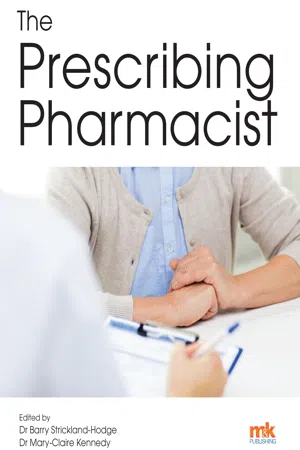
Prescribing has traditionally been the responsibility of medical doctors but independent prescribing courses are now firmly established in the UK and increasing numbers of healthcare professionals have taken on prescribing responsibilities. The Prescribing Pharmacist reflects these changes, beginning with an overview of pharmacist prescribing and continuing with an exploration of consultation, patient clinical assessment, team working, and understanding cultural and religious issues and ethics. Internal and external influences on the new prescriber are considered, as well as medicines optimisation. The authors also look at prescribing for specific patient groups, such as the elderly, the very young, pregnant women and breast-feeding women, and finally move on to specific medicines that require special care when prescribing. Each chapter of the book refers and links to the Royal Pharmaceutical Society framework written in 2016, A Competency Framework for All Prescribers, which is reproduced, with permission.Written by a team of pharmacy experts, this book is intended for any pharmacist who is thinking of becoming an independent prescriber, those on pharmacy courses and those who are already qualified as independent or supplementary pharmacist prescribers, who may use it as a reminder of important points covered on their course.
- English
- ePUB (mobile friendly)
- Available on iOS & Android
eBook - ePub
The Prescribing Pharmacist
About this book
Information
Topic
MedicineSubtopic
Pharmacology1
An introduction to pharmacist prescribing
Asa Auta and Barry Strickland-Hodge
Chapter overview
In the UK and a number of other countries, many healthcare professionals, including nurses, pharmacists, optometrists, radiographers and physiotherapists, are authorised to prescribe medicines (Weeks et al. 2016). This chapter introduces the concept of pharmacist prescribing in the UK and briefly considers how pharmacist prescribing has been accepted and developed in other countries. The laws that govern pharmacist prescribing are considered and the Department of Health objectives for independent prescribing are described.
Introduction
In November 2015, the General Pharmaceutical Council commissioned a survey of all pharmacist prescribers on the GPhC register (GPhC 2016). At that time, the number of pharmacist prescribers was found to be almost 4000 or 8% of the membership. Most pharmacists undertook prescribing in hospital (46%), with 29% in general practice and only 8% in community pharmacy. Other areas identified were primary care organisations, care homes and prisons. The survey identified the main area of concern among prescribing pharmacists as a lack of diagnostic skills in many clinical areas. For this reason, the majority of pharmacists were prescribing only after diagnosis by another healthcare professional. Two other areas of concern were the lack of access to patients’ medical records in the community and the need for a second pharmacist to provide a clinical check. Even if pharmacists intended to act only after diagnosis (adopting a collaborative approach), they still needed to have an understanding of the patient’s condition and likely prognosis.
It is probably thanks to the Cumberlege report in 1986 that pharmacists gained prescribing rights in the UK as soon as they did. This report emphasised the time wasted by district nurses (DNs) and health visitors (HVs) waiting to have prescriptions signed by GPs. The initial formulary offered to DNs and HVs was short and restrictive but still enabled this group of community nurses to improve their service to patients. Once it had been demonstrated that prescribing by DNs and HVs was safe and relevant, a broader range of nurses were included as potential prescribers and more potent medications were added to their formulary.
Although few countries have actively embraced pharmacist independent prescribing, hospital pharmacists in a number of countries have been involved in prescribing medicines under local arrangements with doctors in emergency situations (Doloresco & Vermeulen 2009). In Ghana, Tanzania, Anguilla and Argentina, for example, designated pharmacists are allowed to prescribe narcotic analgesics to cancer patients in emergency situations (Cleary & De Lima 2013). A review of the literature in 2011 showed that nurses have been authorised to prescribe in 22 countries (Bhanbhro et al. 2011) and in rural areas prescribing rights for nurses should be seen as essential. Definitions of what could be prescribed differ. Some countries restrict prescribing to a formulary, others to collaborations with medical practitioners only. In this latter instance the descriptive term is usually ‘collaborative prescribing’ (Weeks et al. 2016).
United Kingdom
In the United Kingdom (UK), the Crown Report (Department of Health 1999) used the Medicines Act (1968) definition of NHS prescribing:
To prescribe within the National Health Service, is ‘to order in writing the supply of a prescription only medicine for a named patient’. However, it was and is commonly used in the UK to authorise, by means of an NHS prescription, the supply of any medicine, at public expense.
Prescribing is separate from supply and administration. Supply was defined in the Crown Report as ‘to provide a medicine directly to a patient or carer for administration’; and to administer is ‘to give a medicine either by introduction into the body, whether by direct contact with the body or not (e.g. orally or by injection), or by external application (e.g. application of an impregnated dressing).’
Historically, prescribing had been the preserve of doctors. With the publication of the Medicines Act in 1968, prescribing was left to doctors and dentists. When the National Health Service (NHS) was developed in the UK in 1948, there were few potent drugs available to the prescriber, other than narcotics and some antibiotics. The first national formulary after 1948 contained about 400 medicines, many of which were to be compounded by the pharmacist. In 1968, when the Medicines Act was published, the number of potent medicines had increased significantly and included such drugs as hypnotics, antidepressants and antipsychotics. Pharmacy became a degree-only profession after 1967 (changing from part-degree, part-apprenticeship, perhaps in anticipation of the explosion of pharmaceuticals that followed in the 1960s, ’70s and ’80s).
The current British National Formulary (BNF) contains monographs for about 6,000 medicines, including different doses, dosage forms and different generic names. Prescribers must continue to keep up to date with the developing evidence when deciding upon a particular treatment for each patient. With the introduction of non-medical prescribing (NMP) – a term which now seems inappropriate as all UK prescribers are to use the same competency framework for prescribing – prescribing has been added to the remit of many additional healthcare professionals. In August 2009, the European Working Time Directive (EWTD) was fully incorporated into UK legislation. The EWTD limited workers to a maximum 48-hour week, averaged over a six-month period. The British Medical Association (BMA) reported that for junior doctors this meant that working hours were reduced from an average of 56 per week to 48, calculated over a period of 26 weeks (BMA 2016). With an ageing population living longer and potentially requiring more medicines to be prescribed, and with doctors working fewer hours, the need for more prescribers was obvious.
The two reports from Dr June Crown relating to the supply and administration of medicines were published at the end of the 1990s. Whereas the first Crown Report mainly reviewed the supply of medicines, it paved the way for Patient Group Directions (PGDs) among other things and strengthened and broadened the way drugs were offered to patients following consultation (Department of Health 1998).
It was the second and final Crown Report, published in 1999, that discussed the idea of prescribers other than doctors and dentists being given more extensive prescribing rights (Department of Health 1999). Nurses had already increased their prescribing capability with the extended formulary following additional training. Legislative change (Health and Social Care Act 2001), following the recommendations of the Crown reports, enabled nurses and pharmacists to prescribe first as supplementary prescribers then as independent prescribers (Department of Health 1998, Department of Health 1999, Cooper et al. 2008).
The final Crown Report suggested two forms of prescribing for other healthcare professionals. The first was supplementary prescribing (initially called dependent prescribing) which was introduced in 2003; and the second was independent prescribing, introduced in 2006 (Tonna et al. 2008). Supplementary prescribing was less controversial, as it was like other countries’ collaborative prescribing in which a doctor or dentist was still required to have overall patient control. The Department of Health (2005, p. 8) definition of supplementary prescribing indicates this. It is:
A voluntary partnership between an independent prescriber (a doctor or dentist) and a supplementary prescriber to implement an agreed patient-specific clinical management plan (CMP) with the agreement of the patient.
In the independent prescribing model (Department of Health, 2006 p.2), this was expanded to give the new independent prescriber autonomy over prescribing decisions. In this system, the prescriber is:
…responsible and accountable for the assessment of patients with undiagnosed or diagnosed conditions and for decisions about the clinical management required, including prescribing.
In this independent prescribing model, pharmacists took sole responsibility for every prescribing decision made, even though they may have worked in collaboration with other members of the healthcare team (Nissen 2011).
The UK Health and Social Care Act (2001) listed many other potential healthcare professionals who could, following additional training, be qualified to prescribe: some only as supplementary prescribers still requiring a doctor or dentist to make the initial diagnosis and commence treatment; others as independent but with a limited formulary. Nurses and pharmacists in the UK now have the whole BNF from which to prescribe, with the exception of three controlled drugs when used for addiction.
The Department of Health objectives for independent prescribing
In 2006, the Department of Health published objectives for the implementation of independent prescribing by those other than doctors. The aims were to:
•Improve patient care without compromising patient safety
•Make it easier for patients to get the medicines they need
•Increase patient choice in accessing medicines
•Make better use of the skills of health professionals
•Contribute to the introduction of more flexible team working across the NHS.
Requirements for independent prescribing pharmacists
The GPhC is the statutory regulator for the pharmacy profession in Great Britain. Universities wishing to offer independent prescribing courses for pharmacists must be accredited by the GPhC. The Nursing and Midwifery Council (NMC) and GPhC approved a draft curriculum and set of learning outcomes which all courses must use when developing prescribing programmes.
Accreditation ensures that universities offering such courses have the right level of support both within the university and from the staff leading and teaching on the courses. Reaccreditation takes place every three years and must meet strict criteria laid down by the GPhC. Students undertaking the prescribing course for pharmacists can be assured that the courses meet the expectation of the profession and will equip pharmacists with the basic skills required to prescribe within their level of expertise.
To qualify as a pharmacist independent prescriber, a pharmacist must currently have at least two years’ post-registration experience in a patient-orientated environment, undergo study at university level equivalent to 26 days of full-time education and also undertake at least a 12-day period of learning in practice with a designated medical practitioner (Stewart et al. 2012). With the development of the new MPharm qualification in the UK incorporating, as it does, a more clinical patient- orientated approach, the requirement to undertake two years’ post-registration experience may change. Likewise, qualified and trained existing pharmacist independent prescribers may become designated prescribing practitioners.
Independent pharmacist prescribers are able to initiate treatment and prescribe medicines for any condition within their clinical competence, with the exception of cocaine, dipipanone and diamorphine for treating addiction (Statutory Instrument 2012). However, in practice, many pharmacist prescribers restrict their prescribing to one specialised clinical area (Lloyd et al. 2010). Prescribing by pharmacists in the UK has been reported in many clinical areas, including infection control, pain management, hypertension, anticoagulation, diabetes, mental health and oncology. (Phelps et al. 2014).
A competency framework for prescribing
A competency framework is a collection of competencies believed to be central to the effective performance of a particular activity. Development of competencies should help individuals to continually improve their performance and to work more effectively (Whiddett & Hollyforde 1999).
Competency frameworks are used in many areas, including medicine. The competencies describe the underpinning knowledge, skills and behaviours of practitioners which must be acquired in order for the individual to be assessed as competent. A single set of competencies has been developed to cover all prescribing practitioners. Th...
Table of contents
- Cover Page
- Title Page
- Copyright
- Contents
- List of contributors
- Foreword
- List of abbreviations
- 1 An introduction to pharmacist prescribing
- 2 The consultation, diagnostic process, diagnosis and influences on prescribing
- 3 Patient clinical assessment
- 4 Patient partnership and prescribing
- 5 Prescribing for specific groups of patients
- 6 Medicines requiring particular care when prescribing
- Appendix: A Competency Framework for All Prescribers: Section 6
- Index
Trusted by 375,005 students
Access to over 1.5 million titles for a fair monthly price.
Study more efficiently using our study tools.
Frequently asked questions
Yes, you can cancel anytime from the Subscription tab in your account settings on the Perlego website. Your subscription will stay active until the end of your current billing period. Learn how to cancel your subscription
No, books cannot be downloaded as external files, such as PDFs, for use outside of Perlego. However, you can download books within the Perlego app for offline reading on mobile or tablet. Learn how to download books offline
Perlego offers two plans: Essential and Complete
- Essential is ideal for learners and professionals who enjoy exploring a wide range of subjects. Access the Essential Library with 800,000+ trusted titles and best-sellers across business, personal growth, and the humanities. Includes unlimited reading time and Standard Read Aloud voice.
- Complete: Perfect for advanced learners and researchers needing full, unrestricted access. Unlock 1.5M+ books across hundreds of subjects, including academic and specialized titles. The Complete Plan also includes advanced features like Premium Read Aloud and Research Assistant.
We are an online textbook subscription service, where you can get access to an entire online library for less than the price of a single book per month. With over 1.5 million books across 990+ topics, we’ve got you covered! Learn about our mission
Look out for the read-aloud symbol on your next book to see if you can listen to it. The read-aloud tool reads text aloud for you, highlighting the text as it is being read. You can pause it, speed it up and slow it down. Learn more about Read Aloud
Yes! You can use the Perlego app on both iOS and Android devices to read anytime, anywhere — even offline. Perfect for commutes or when you’re on the go.
Please note we cannot support devices running on iOS 13 and Android 7 or earlier. Learn more about using the app
Please note we cannot support devices running on iOS 13 and Android 7 or earlier. Learn more about using the app
Yes, you can access The Prescribing Pharmacist by Barry Strickland-Hodge in PDF and/or ePUB format, as well as other popular books in Medicine & Pharmacology. We have over 1.5 million books available in our catalogue for you to explore.