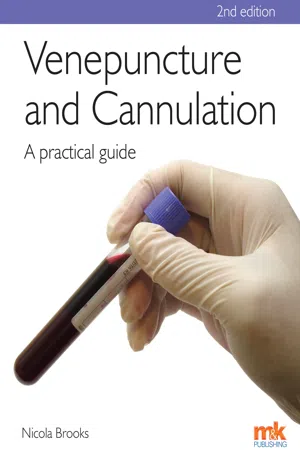
Venepuncture and Cannulation – A Practical Guide offers an easy-to-read, comprehensive account of the practical procedures of venepuncture and intravenous cannulation. It provides the underlying theory and underpinning knowledge required, as well as a step-by-step approach that will enable healthcare practitioners to carry out these procedures safely, efficiently and with confidence.This book is intended as a supplementary resource for those involved in practising or teaching these procedures, for healthcare practitioners wishing to update their knowledge, and for novice practitioners learning these skills for the first time. Each chapter contains intended learning outcomes and points for practice. Some chapters also include helpful illustrations and practical activities, and the book ends with two self-assessment checklists.This second edition has been thoroughly updated and includes a very useful 'Test yourself' chapter at the end of the book. Readers can now test their knowledge by answering the relevant questions. They can also identify any gaps in their current level of knowledge or skill, as well as further learning opportunities that may be required to support their practice.
- English
- ePUB (mobile friendly)
- Available on iOS & Android
eBook - ePub
About this book
Information
Topic
MedicinaSubtopic
Tecniche infermieristicheChapter 1
What are venepuncture and cannulation?
Learning outcomes
At the end of this chapter, the practitioner will be able to:

Defining venepuncture and cannulation
Venepuncture is described as ‘entering a needle into a vein’ (Dougherty & Lister 2011) to obtain a blood sample for laboratory analysis (Lavery & Ingram 2005). Intravenous (IV) cannulation is a procedure whereby a plastic tube is temporarily inserted into a peripheral vein in order to gain access to the circulatory system (Scales 2005).
Both these procedures used to be exclusively performed by medical staff, with up to 80% of hospitalised patients receiving a peripheral venous access device (PVAD) for intravenous therapy at some point during their stay (Dougherty & Lister 2011, Dougherty 2000). With an increasing number of patients being treated for acute and chronic illnesses, venepuncture and cannulation have become two of the most common everyday procedures in healthcare. It is also now widely accepted that these procedures may be carried out by all healthcare professionals, including unregistered practitioners, as part of their extended role.
Individuals wanting to undertake either of these procedures must undergo a period of training and supervision before they can perform them on patients. It is recognised that carrying out venepuncture and IV cannulation not only requires technical skill; it also requires specialist knowledge, good communication skills, time and patience (Davies 1998, Dougherty & Lamb 2008). These procedures can potentially cause pain and distress to patients, especially if the person performing them is not competent.
According to the Standards for Infusion Therapy (RCN 2010), practitioners must undergo theoretical and practical training in the following aspects in order to gain competency in the insertion of a PVAD:

Once assessed as competent by a suitably qualified practitioner, it is essential that an individual maintains their level of competence, and that they get ongoing practice in the procedure. The Nursing and Midwifery Council (2010) state in the NMC Code that ‘to practise competently, you must possess the knowledge, skills and abilities required for lawful, safe and effective practice without direct supervision’. This is echoed for allied health professionals by the Health and Care Professionals Council (2008) who say in their ‘Standards of conduct, performance and ethics’ that an individual must ‘act within the limits of knowledge, skills and experience and, if necessary, refer the matter to another professional’. It is accepted that venepuncture and IV cannulation may also be performed by unregistered practitioners. Although these staff members are not currently registered by a professional body, it is worth checking your local healthcare provider’s policy, procedure or guidelines to check that they are covered to perform these procedures. This will ensure unregistered practitioners’ protection and safety.
Why do we need to perform venepuncture?
Venepuncture is usually requested to assist in diagnosis, to monitor a patient’s condition, or to determine the effectiveness of a particular medical treatment. Blood analysis is one of the most commonly used and important diagnostic tools available to clinicians. We rely on blood results to help us interpret many clinical signs and symptoms. Developing an accurate venepuncture technique can therefore help facilitate holistic and timely treatment for patients.
A sample of circulating blood is taken to the laboratory for one of the following:
Reflection
Think about the specific blood tests that are undertaken within your practice area. What are the usual reasons for blood sampling and the common tests and investigations that are carried out?
Chapter 5 provides a detailed explanation of venepuncture technique and describes the correct procedure for taking blood samples. Detailed explanations of the different blood tests taken (and the reasons for them) can be found in other publications, particularly the titles listed under Further Reading on p. 96, such as Routine Blood Results Explained (Bland 2008) or Blood Results in Clinical Practice (Basten 2013), which are simple texts that are easy to read and understand.
Why do we need to perform cannulation?
There are many ...
Table of contents
- Cover Page
- Title Page
- Copyright
- Contents
- Preface
- About the author
- Acknowledgements
- 1. What are venepuncture and cannulation?
- 2. An overview of the circulatory system and the related anatomy and physiology of the peripheral vascular system
- 3. Vein selection
- 4. Preparing yourself, your environment and your patient
- 5. Venepuncture techniques
- 6. Venepuncture – when things go wrong
- 7. Cannulation
- 8. Cannulation technique
- 9. Cannulation – when things go wrong
- 10. Reducing risks when carrying out venepuncture and cannulation
- 11. Test your knowledge
- Appendix 1: Self-assessment checklist for venepuncture to ensure safe practice
- Appendix 2: Self-assessment checklist for cannulation to ensure safe practice
- Answers to Chapter 11 test questions
- References
- Further reading
- Index
Trusted by 375,005 students
Access to over 1.5 million titles for a fair monthly price.
Study more efficiently using our study tools.
Frequently asked questions
Yes, you can cancel anytime from the Subscription tab in your account settings on the Perlego website. Your subscription will stay active until the end of your current billing period. Learn how to cancel your subscription
No, books cannot be downloaded as external files, such as PDFs, for use outside of Perlego. However, you can download books within the Perlego app for offline reading on mobile or tablet. Learn how to download books offline
We are an online textbook subscription service, where you can get access to an entire online library for less than the price of a single book per month. With over 1.5 million books across 990+ topics, we’ve got you covered! Learn about our mission
Look out for the read-aloud symbol on your next book to see if you can listen to it. The read-aloud tool reads text aloud for you, highlighting the text as it is being read. You can pause it, speed it up and slow it down. Learn more about Read Aloud
Yes! You can use the Perlego app on both iOS and Android devices to read anytime, anywhere — even offline. Perfect for commutes or when you’re on the go.
Please note we cannot support devices running on iOS 13 and Android 7 or earlier. Learn more about using the app
Please note we cannot support devices running on iOS 13 and Android 7 or earlier. Learn more about using the app
Yes, you can access Venepuncture & Cannulation: A practical guide by Nicola Brooks in PDF and/or ePUB format, as well as other popular books in Medicina & Tecniche infermieristiche. We have over 1.5 million books available in our catalogue for you to explore.