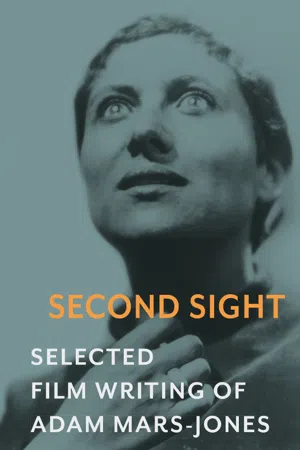
The film review can be a little art form, not just a consumer guide, as this collection shows. Covering more than 30 years of film releases, celebrated critic Adam Mars-Jones guides us through the most entertaining, most appalling, most fantastic films of his viewing lifetime, interleaving his original film reviews with new insights and reflections.
Mars-Jones answers the questions that no other book has even bothered to ask. What is Twister really about? How many Steven Spielbergs are there? (Spoiler: he counts thirteen). How many of them are worth anything? Who had the greatest slow-burn career in the movies. (Clue: he taught Montgomery Clift how to roll a cigarette.) Which science-fiction film features the most haunting use of slime? Funny, combative and revealing, Second Sight is a celebration of the art form that maintains the strongest hold on the modern imagination.
- English
- ePUB (mobile friendly)
- Available on iOS & Android
eBook - ePub
About this book
Information
Subtopic
Film History & CriticismMy Independence
The Independent newspaper, launched on 7 October 1986 and bearing little resemblance to the paper which changed hands for a pound in 2010, was a strange institution, both radical and conservative, hi- and low-tech, but wholly benign, virtually avuncular, in its dealings with me. The paper indulged my quirks for over a decade and allowed me to get, and then service, a mortgage, something that would hardly have been possible for an unproductive writer of fiction who has only made money for his publishers on special occasions (and then in small amounts).
I was on a retainer until 1997 but still technically freelance, after a test case in which it was established that you could still be self-employed as long as you didn’t have a desk and/or a telephone in the office of an employer. So I was both on board the SS Independent and able to splash about on my own to a modest extent, thanks to a lifebelt marked Schedule D. Early contracts sharply restricted what work I could do for other journalistic outlets, but as time passed and there seemed to be little (or no) extra money available, it seemed sensible to negotiate for extra latitude instead.
I had published fiction before I wrote my first review for the Times Literary Supplement, and had no journalistic training or ambitions. During three months spent in Perugia between school and university I had acquired the habit of regular film going. One cinema in the town showed a different film every day, mainly subtitled Hollywood films from a time of golden ferment in the industry. You just had to identify which film it was. Sometimes (Easy Rider) this was hardly a problem. Mainly it was just a matter of elementary Italian vocabulary: Il gruppo selvaggio, Non si uccidono così i cavalli? Occasionally a bit more work was required, to decrypt Fragole e Sangue (Strawberries and Blood) back into The Strawberry Statement; Un Uomo sul Marciapiede (A Man on the Pavement, or, more likely, Sidewalk) into Midnight Cowboy. In Perugia there were people who, surprisingly to me at first, went to the movies so as to argue into the night about, say, Peckinpah’s grievous politics.
In Cambridge cinema-going could also be a thrifty treat, thanks to the Arts Cinema, which programmed seasons of classics as well as a fastidious selection of current releases. I remember going to see Polanski’s Repulsion at the late-night showing, tickled by the paradox that I was technically breaking the law (this would be October 1972) by seeking admittance to an X-rated film while underage, but that my offence evaporated during the screening, when midnight brought my eighteenth birthday with it.
The cold hysteria of that film made quite an impact, and I went back to my room in Trinity Hall wanting to push it out of my mind. But then I reasoned that this was the mistake made by Catherine Deneuve. I must be careful not to disintegrate in my turn, though perhaps not in a west London flat surrounded by sprouting potatoes and a rotting rabbit carcass. You can’t be too careful, and in a student’s room entropy is never far away. I sat down on the bed and thought the film through, until I could be reasonably sure I wasn’t repressing trauma.
I read writing about film only casually. My father subscribed to New Society, and I remember a piece expounding Jaws in terms of the fear of vagina dentata, not the sort of theory that is easily forgotten by anything short of the Catherine Deneuve method. I read Sight and Sound occasionally, and was very struck by an essay on the imagery of cleansing and atonement in Marathon Man (which starts on Yom Kippur, literally the Day of Atonement, has an important scene by a fountain and ends in a water-purification plant), a brilliant piece of interpretation which made the film seem richer, undoubtedly, but somehow no better.
The crucial difference between cinema and theatre has always been repeatability – that a film can be screened again indefinitely, while a play disappears from immediate experience at the end of the run. In practice the difference, in those days, was not so great. When a friend and I saw Claude Miller’s La Meilleure Façon de Marcher (The Best Way to Walk) at the Arts in Cambridge, we disagreed about the ending and what it meant. Our dispute centred on a single shot; of a drawer containing a red dress being pulled open, and who it was that was doing the opening. The only way to resolve it was to go back to the Arts and stump up 40p to see the film again. I don’t remember who was right, which presumably means (given the working practices of the editing suite we call the memory) that I wasn’t.
In 1978 I went to America, in theory to study the Faulkner holdings in the Alderman Library at the University of Virginia in pursuance of a PhD. I never crossed the threshold of the Rare Books Room, but life in Charlottesville seemed to suit me and I stayed on for a couple of years. I could Xerox The Times crossword from the copies arriving at that splendid library, and the Vinegar Hill movie theatre was solidly programmed. Callard & Bowser’s butterscotch was available in the foyer, an imported luxury so precious that it was sold by the individual tablet, like cigarettes in impoverished areas. In the same way that filmgoers used to categorise weepies by the number of hankies needed to staunch the flow of tears, my friends would measure out a film in units of butterscotch. Les Enfants du Paradis was a three-tablet film.
I worked a couple of days a week in a second-hand bookshop which stocked some current magazines, and so was able to read Pauline Kael’s New Yorker pieces. I would rather have seen the film first and read her article later, but the wait was often long for a showing within reach and I didn’t usually have the patience. I remember that her review of The Deer Hunter was almost as extravagantly proportioned as the film it anatomised. The colossal wordage she was allowed meant that she could explore her reactions without the cramping effect of enforced concision on a subtle verdict. She greatly admired the film (its ambition, construction and particularly its editing) but she made no bones about the weakness of Meryl Streep’s role, the shortfall in the female hemisphere of a film trying hard to encompass everything. This was the boys’ movie in excelsis, but a boys’ movie still.
My other favourite film critic took an almost opposite approach to banty, contentious Miss Kael. The existence of Christopher Street magazine was a shock in itself to a British gay readership: a non-pornographic glossy magazine, complete with urbane cartoons and upmarket advertising that was guaranteed to make our humble, high-minded Gay News look shoddy. And now Christopher Street was employing Quentin Crisp as its film reviewer! A man who clearly disliked his own minority, memorably saying that those homosexuals who wanted him to be less flamboyant were like consumptives urging one of their number to refrain from coughing, because it was spoiling the fun of TB for everybody else. It seemed a baffling appointment. Please bear in mind that this was a time when the belief that Americans didn’t understand irony was as close to a religion as some of us got.
Once the surprise had worn off, though, the fit between contributor and magazine was perversely perfect. Crisp always called film stars, and everyone else, by title (Mr, Mrs or Miss) and first name – ‘Miss Madonna’, even – with something that wasn’t quite old-fashioned good manners nor quite camp but something in-between. He must have been the only critic since about 1900 to put into practice the old principle that if you don’t have anything nice to say, you should say nothing at all. Sometimes in the sacred cause of politeness he was reduced to complimenting the decor or the cleanliness of the cinema lavatories. His secret weapon was the longevity of his movie-worship. He remembered the time when cinema was a female cult, almost a matriarchy, while men were catered to only by a few specialised genres.
While I was in America I sometimes had the opportunity to see a film under ideal conditions, namely without having read anything about it. I was in San Francisco the week that Alien opened. I knew nothing about it, but was curious on the basis of Ridley Scott’s first film The Duellists, which I had seen at the Arts in Cambridge. At the showing I attended, there was a couple sitting behind me, clearly on a date. She was saying to him, ‘I love scary movies.’ But after John Hurt’s little on-screen tummy upset, I could hear her hissing, ‘I know what I said. I don’t care what I said, we leave now.’
Cinema was from its beginnings a communal experience, though that potential excitement has steadily leaked away. People used to ‘go to the pictures’, ritually, regularly, without necessarily knowing or greatly caring what was on. The closest I have come to film-going on this model was in Charlottesville in, I suppose, 1980. The cinema in the downtown mall cut its ticket prices from $2.99 to 99 cents. When the manager was asked by the local paper how he could possibly afford to do that, he replied that they should be asking how he had ever thought he could afford to charge the old price. Certainly the movie house used to be thinly attended, and now it was full, at least at weekends. For less than a dollar, audiences would take their chances. The films we were there to see would have to be pretty bad to make them feel cheated.
One such film was good, even extraordinary, but not right for the venue and the occasion. The bulk of the audience strongly resented the scrupulously slow pacing, the deployment of anti-climax, the bleak smooth mood. There were well-managed climaxes, but they obstinately refused to join up and acquire momentum. What we were watching seemed more like an austere meditation on the horror movie than an actual example of the genre. Of course it did – it was The Shining. But for most of the punters in the cheap seats on the downtown mall (and all the seats were cheap) the film seemed to be one long failure to scale the heights of Friday the 13th. These viewers might not have been able to place The Shining in Kubrick’s filmography, but they were pretty authoritative about its appeal to Saturday-night gorehounds. There was scornful backchat, and a popcorn tub was thrown at the screen – an empty one, but still . . .
After the publication of my first book Lantern Lecture I was fractionally in demand as a reviewer of fiction, first of all for the Times Literary Supplement. I was still living with my parents, and when they asked if I was making a living I said that reviewing for the TLS was an honour rather than a job, and no fee was expected. The truth was that I didn’t know. No money was flowing in my direction, even after several months, and the most likely explanation seemed to be the one I gave. I wasn’t to know, and nobody was going to spoil my fun by telling me, that when Rupert Murdoch took over Times Newspapers and started examining his purchase, he found anomalies in the accounts department. While these were being investigated, and those accused were on suspension, that department was running at half strength. TLS monies were not high on the list of priorities. Eventually tiny cheques started to reach me. It was almost a disappointment. I wasn’t operating in a world above money after all, just one where it dripped rather than gushed. I was too well brought-up to think of biffing the tap with a wrench, either then or later.
Then the Financial Times asked if I would review for them on a regular basis. This had to be a step up – they had ‘financial’ right up there in the title, so I was obviously onto a good thing. I didn’t like to mention money. They’d look after me. And they did – I reviewed a pile of books (sometimes as many as seven) in a fiction round-up every three weeks and they paid me £55.
Radio work plays a part in a lot of writers’ lives, since it is by and large conversational rather than gladiatorial and it demands the minimum of preparation in terms of wardrobe and make-up. It’s not exactly a licence to print money, though, or else a licence to print it very slowly, as in some stultifying performance art piece. When Alison Lurie had the heroine of her novel Foreign Affairs keep afloat financially in London with freelance radio work, there was wild laughter in the British reviews written by people who knew better – and everybody did.
Paul Barker at New Society then asked me to review films, and from there I moved on to the New Statesman. The TLS, NS, the Staggers: a standard enough career ladder for a freelance reviewer, though not likely to impress a yuppie of the period, since my ladder gave access not to a penthouse but something more like a tree house, if not the upper accommodation of a split-level hamster cage. Then I was offered a foothold on a wholly different style of rung – belonging to the sort of ladder which descends from a helicopter, in high winds and lashing rain, as it rescues the survivors in the last reel of an action film. The first quality newspaper to be launched in this country for two centuries was looking for reviewers.
The entire newspaper was a novelty, but there was also going to be a novel approach to reviewing. We wouldn’t be specifically a film critic, a theatre critic, a television critic. All of us would do everything – though it was acknowledged that assessing classical music and dance required the technical knowledge of a specialist. I wasn’t the only one to be offered the chance of being winched to safety by The Independent helicopter, the paint hardly dry on its rotors. Others included Marina Warner, Stephen Games and Peter Kemp. We would be a Round Table of critical knights, who would ride out in search of the Holy Grail of excellence, as likely to be found in a hovel as a palace, at a Feydeau farce revival or a Prince concert.
It was this free-range aspect which attracted me. Why should critics be cooped up in a single speciality? I had been very vaguely considered for the job of film reviewer at the Sunday Times (in the last phase of Frank Giles’s editorship), but hadn’t been all that keen. Film reviewers see too many films – it’s a fact. Book reviewers don’t reel from one book to another, and theatre reviewers rarely see more than one play a day. Art critics can take things at their own pace so as to refresh their overstimulated eyes, but press screenings take place in the daytime, one after another.
The mediums work differently in themselves. There’s no motor in a book to keep it moving on – or rather, your brain is the motor whose teeth engage with the sprocket-holes of narrative. No one has ever nodded off while reading The Thirty-nine Steps and woken up with the chase concluded, the mystery solved. It’s true that theatre proceeds independently of the audience’s will, but the presence of breathing people in a shared space delivers an invigorating reproach to drowsiness. There’s always the risk that La Redgrave or Le Sher will meet your eyes as you open them after a yawn and strike you dead with a basilisk bolt of contempt. Even the actors on stage pretending to be asleep (or comatose, or lifeless) are decently awake – dare you insult them by falling below their standard of vigilance?
Film is agreed to be the art form closest to dreaming, which unfortunately means that it’s also the closest to sleep. As this is the art form which most rapidly turns novelty into routine, watching films in succession is a numbing rather than intoxicating experience. What you notice very soon is not the difference between products but the much-of-a-muchness. Differentiation suffers, and the rave review shades into the perfunctory endorsement. Worse, the denunciation fizzing with outrage becomes a weary dismissal.
The Independent’s parliament-of-saints idea would keep us all fresh. The only disadvantage of the system was that every assignment would have to be fought over, but even this could be turned to advantage by the institution of a weekly lunch at which the distribution of labour could be settled. I could look forward to haggling with Marina Warner over whether she could review the new Le Carré as long as I had first dibs on the Pet Shop Boys concert, as if we were 1950s schoolboys doing swapsies with our stamp collections.
The departures from the norm started with the appointment of an arts editor, Tom Sutcliffe, who had never worked on a newspaper. This procedure is fully as orthodox as appointing the village policeman to be the parish priest, and if things had gone a traditional way then I would certainly not hav...
Table of contents
- Front Cover
- Half Title
- Title Page
- Copyright
- Contents
- My Independence
- ‘Being and Viscousness’ (2017)
- Distant Voices, Still Lives (1988)
Trusted by 375,005 students
Access to over 1.5 million titles for a fair monthly price.
Study more efficiently using our study tools.
Frequently asked questions
Yes, you can cancel anytime from the Subscription tab in your account settings on the Perlego website. Your subscription will stay active until the end of your current billing period. Learn how to cancel your subscription
No, books cannot be downloaded as external files, such as PDFs, for use outside of Perlego. However, you can download books within the Perlego app for offline reading on mobile or tablet. Learn how to download books offline
We are an online textbook subscription service, where you can get access to an entire online library for less than the price of a single book per month. With over 1.5 million books across 990+ topics, we’ve got you covered! Learn about our mission
Look out for the read-aloud symbol on your next book to see if you can listen to it. The read-aloud tool reads text aloud for you, highlighting the text as it is being read. You can pause it, speed it up and slow it down. Learn more about Read Aloud
Yes! You can use the Perlego app on both iOS and Android devices to read anytime, anywhere — even offline. Perfect for commutes or when you’re on the go.
Please note we cannot support devices running on iOS 13 and Android 7 or earlier. Learn more about using the app
Please note we cannot support devices running on iOS 13 and Android 7 or earlier. Learn more about using the app
Yes, you can access Second Sight by Adam Mars-Jones in PDF and/or ePUB format, as well as other popular books in Media & Performing Arts & Film History & Criticism. We have over 1.5 million books available in our catalogue for you to explore.