Noise
eBook - ePub

Noise

Living and Leading When Nobody Can Focus

  1. English
  2. ePUB (mobile friendly)
  3. Available on iOS & Android
eBook - ePub

Noise

Living and Leading When Nobody Can Focus

About this book

Teaches managers and leaders to cut through the static and hone their focusing skills

In the current digital age, it is becoming increasingly more difficult to stay focused. Smartphones, tablets, smart watches, and other devices constantly vie for our attention. In both business and life, we are constantly bombarded with tweets, likes, mentions, and a constant stream of information. The inability to pay attention impacts learning, parenting, prioritizing, and leading. Not surprisingly, attention spans have gotten shorter. Already being pulled in a dozen directions every minute, managers and business leaders often struggle to address important issues and focus on everything that needs attention.

Noise: Living and Leading When Nobody Can Focus teaches managers and leaders how to help themselves and others sharpen their focusing skills. In this follow-up to his first book Brief —the proven, step-by-step approach to clear, concise, and effective communication—author Joseph McCormack helps readers cut through the static and devote their attention to what is important. This engaging, informative book will help you:

  • Apply effective, real-world techniques to hone your focus and reduce interference
  • Learn the lessons taught to organizations such as Harley-Davidson, BMO Harris Bank, MasterCard, and the US Army
  • Understand how modern technology can actually strengthen your focus if used correctly
  • Avoid becoming a casualty of "weapons of mass distraction"

Noise: Living and Leading When Nobody Can Focus is a valuable resource for leaders and managers seeking to develop laser-sharp focus and apply it to everything you do.
Frequently asked questions

Yes, you can cancel anytime from the Subscription tab in your account settings on the Perlego website. Your subscription will stay active until the end of your current billing period. Learn how to cancel your subscription.
No, books cannot be downloaded as external files, such as PDFs, for use outside of Perlego. However, you can download books within the Perlego app for offline reading on mobile or tablet. Learn more here.
Perlego offers two plans: Essential and Complete
  • Essential is ideal for learners and professionals who enjoy exploring a wide range of subjects. Access the Essential Library with 800,000+ trusted titles and best-sellers across business, personal growth, and the humanities. Includes unlimited reading time and Standard Read Aloud voice.
  • Complete: Perfect for advanced learners and researchers needing full, unrestricted access. Unlock 1.4M+ books across hundreds of subjects, including academic and specialized titles. The Complete Plan also includes advanced features like Premium Read Aloud and Research Assistant.
Both plans are available with monthly, semester, or annual billing cycles.
We are an online textbook subscription service, where you can get access to an entire online library for less than the price of a single book per month. With over 1 million books across 1000+ topics, we’ve got you covered! Learn more here.
Look out for the read-aloud symbol on your next book to see if you can listen to it. The read-aloud tool reads text aloud for you, highlighting the text as it is being read. You can pause it, speed it up and slow it down. Learn more here.
Yes! You can use the Perlego app on both iOS or Android devices to read anytime, anywhere — even offline. Perfect for commutes or when you’re on the go.
Please note we cannot support devices running on iOS 13 and Android 7 or earlier. Learn more about using the app.
Yes, you can access Noise by Joseph McCormack in PDF and/or ePUB format, as well as other popular books in Business & Small Business. We have over one million books available in our catalogue for you to explore.

Information

Edition
1

Part One
Weapons of Mass Distraction

Chapter 1
Noise, Noise, So Much Noise

To the hard of hearing, you shout.
—Flannery O’Connor
We’re all connected, all day and in every way.
Smartphones, laptops, tablets, and smart watches. Screens in cars, airports, gas stations, classrooms, offices, hospitals, and hotels. The constant buzzing of a 24-hour news cycle. The list goes on.
What? Did you just miss that? Maybe you got another text, news alert, or notification?
The daily experience is to consume information at every turn. It’s nearly impossible to avoid the barrage from morning until night. How much of it is relevant? What’s useful for us, and what is simply a waste of time and energy?
Our brains are hard at work, making it harder to focus and easier than ever to get distracted. Our attention spans are rapidly eroding, and we’re now at risk. Over the years, we adapt. Many of us don’t even notice this decline because we’re too busy fixating on the next distraction, text message, e-mail, meeting invitation, social media post, or funny video clip.
Infobesity is the new normal, and it can have dire consequences. Here’s a snapshot of where we consume information:
  • Overflowing e-mail. Our inboxes are flooded with messages; most of them are irrelevant and yet they keep coming over and over to be read, judged useless, and then deleted.
  • Smartphone notifications. Throughout the day, our phones vibrate and sound the alarm to be picked up and checked.
  • Checking our devices. For most of us, it’s the first and last thing we do every day.
  • Social media streams. We fear missing out on the latest posts and updates and try to keep up on the steady stream of commentary and tidbits being shared every few seconds by our personal and professional networks.
  • 24-hour connectivity. While we sleep, the flow of information doesn’t stop and can be consumed on every imaginable device, at any time.
  • Texting and messaging. Immediate ways to communicate that we can’t seem to resist sending or receiving.
  • News feed frenzy. A story breaks and unleashes the frenetic obsession to cover, repeat, recycle, rehash, argue, and opine until the content and audience are left exhausted.
  • Time spent online. The amount of time online exceeds offline in the age of information overload and constant consumption.
All of this feels like nonstop, won’t-stop noise.
There’s a serious impact when we expose ourselves to these alarming conditions all day long. In a life with always-on access to information, we now face a shrinking, elusive attention span and an overstimulated, overfilled brain.
What can we do to adapt and manage this new reality?

Kenny Chesney Gets It Right

The country singer Kenny Chesney laments this common condition wonderfully in his song ā€œNoise.ā€ His lyrics tell the story of how our society has taken a turn for the worse, with so much noise surrounding us that there is no room for silence. We don’t ask for it, but we’re bombarded with constant chatter from talking heads and distractions from digital devices, and we can’t escape it anymore.
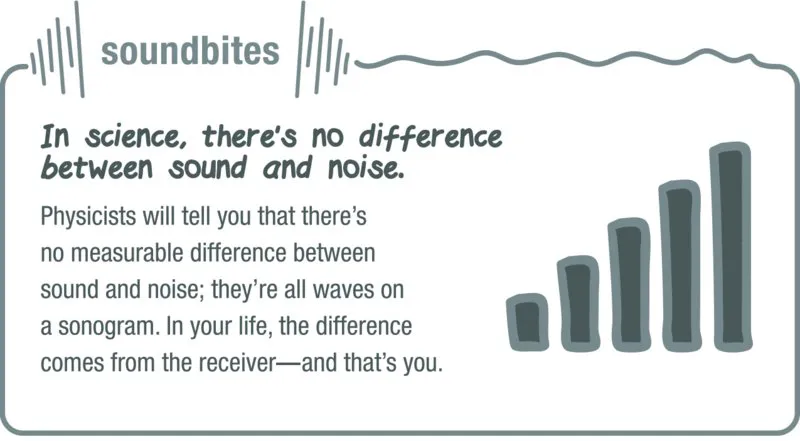
Image of a soundbite in which it is stated that in science, there is no difference between sound and noise, but for the reader, the difference comes from them, the receiver.

Hearing Decline and the Loss of Focus

When I was in college in Chicago, I remember an elderly Jesuit philosophy professor opening every lecture with an impassioned, personal, public service announcement. He would warn us of the impending threat of loud music on our hearing. It was in the late 1980s, and boomboxes and rock concerts were all the rage, along with the advent of portable music devices like the Sony Walkman. His dire concern, backed by extensive research, was that too much loud music would make us all deaf.
And once that happened, he said sternly, we wouldn’t be able to fix the permanent hearing loss.
Sorry.
There is a close connection between hearing loss and declining focus. You have loud music and volume levels and constant information and attention spans. You have listening capacity and mental retention. Noise affects our ability to hear; information overload affects our ability to pay attention.
It’s the perfect storm. Let’s take a look at how these things will impact our future.

Access to Information Will Only Increase

Kevin Kelly is a Wired magazine co-founder and thought leader on the future of communications, launching the first virtual reality conference in early 1990. In his book The Inevitable: Understanding the 12 Technological Forces That Will Shape Our Future, Kelly imagines our world down the road.
He predicts that in the future people will own few things but will have access to everything.
ā€œIn the coming 30 years the tendency toward the dematerialized, the decentralized, the simultaneous, the platform enabled, and the cloud will continue unabated,ā€ he writes. ā€œAs long as the costs of communications and computation drop due to advances in technology, these trends are inevitable. They are the result of networks of communication expanding till they are global and ubiquitous, and as the networks deepen they gradually displace matter with intelligence.ā€1
It won’t matter where you live in the world, this access will be for everyone.
Other industry leaders predict the following:
  • Access to the Internet will be universal. Connectivity will be constant and there will be no need for signing in to a particular stream.
  • Cars will be seamlessly connected and allow users even more time to connect and communicate in traffic because they’ll be self-driving.
  • With everything online and apps running our lives, access to digital information will be needed for every facet of life, from payments, to work, to personal activities, and healthcare.
  • Privacy will be available only if you are willing to pay extra for it.
  • Information will find us instead of us needing to find it, in countless moments throughout our day.
Some of these predictions are already beginning to come true.

Attention Spans Will Remain Elusive

More and more information is competing for our attention.
Our brains feel divided, yet we somehow enjoy it. There’s a reward when we see a comment on social media or a like or share online. Any type of immediate onli...

Table of contents

  1. Cover
  2. Copyright
  3. Dedication
  4. Foreword
  5. Preface
  6. Acknowledgments
  7. Part One Weapons of Mass Distraction
  8. Part Two The Big Tune-Out Is Coming (Imagining the Unthinkable—Six Short Stories to Wake You Up)
  9. Part Three Time for You to Tune In: Awareness Management (AM 101)
  10. Part Four Getting Others to Dial In: Focus Management (FM 101)
  11. Part Five Pre-sets: Simple Programming for Noise Reduction
  12. Recommended Reading
  13. References
  14. About the Author
  15. About The Brief Lab
  16. Index
  17. End User License Agreement