How the world has become much better and why optimism is abundantly justified
Why do so many people fear the future? Is their concern justified, or can we look forward to greater wealth and continued improvement in the way we live?
Our world seems to be experiencing stagnant economic growth, climatic deterioration, dwindling natural resources, and an unsustainable level of population growth. The world is doomed, they argue, and there are just too many problems to overcome. But is this really the case? In Fewer, Richer, Greener, author Laurence B. Siegel reveals that the world has improved—and will continue to improve—in almost every dimension imaginable.
This practical yet lighthearted book makes a convincing case for having gratitude for today's world and optimism about the bountiful world of tomorrow. Life has actually improved tremendously. We live in the safest, most prosperous time in all human history. Whatever the metric—food, health, longevity, education, conflict—it is demonstrably true that right now is the best time to be alive. The recent, dramatic slowing in global population growth continues to spread prosperity from the developed to the developing world. Technology is helping billions of people rise above levels of mere subsistence. This technology of prosperity is cumulative and rapidly improving: we use it to solve problems in ways that would have be unimaginable only a few decades ago. An optimistic antidote for pessimism and fear, this book:
Helps to restore and reinforce our faith in the future
Documents and explains how global changes impact our present and influence our future
Discusses the costs and unforeseen consequences of some of the changes occurring in the modern world
Offers engaging narrative, accurate data and research, and an in-depth look at the best books on the topic by leading thinkers
Traces the history of economic progress and explores its consequences for human life around the world
Fewer, Richer, Greener: Prospects for Humanity in an Age of Abundance is a must-read for anyone who wishes to regain hope for the present and wants to build a better future.
Not too long ago, President Barack Obama said, “If you had to choose any time in the course of human history to be alive, you’d choose this one. Right here . . . right now.”1
In a world suffering from war and rumors of war, environmental destruction, poverty, disease, inequity, and every other form of misery known to man, what was he talking about? What is so special, so desirable, about this time in history?
First of all, we are richer, far richer, than any human population that has ever preceded us. Richer not just in money and goods, but in food, health, longevity, education, culture, safety, and just about everything else that people need and crave.
Second, we are going to continue to get richer. The present state of human achievement is not a brief, shining moment that will all too quickly pass. We are on the verge of the greatest democratization of wealth and well-being that the world has ever known.
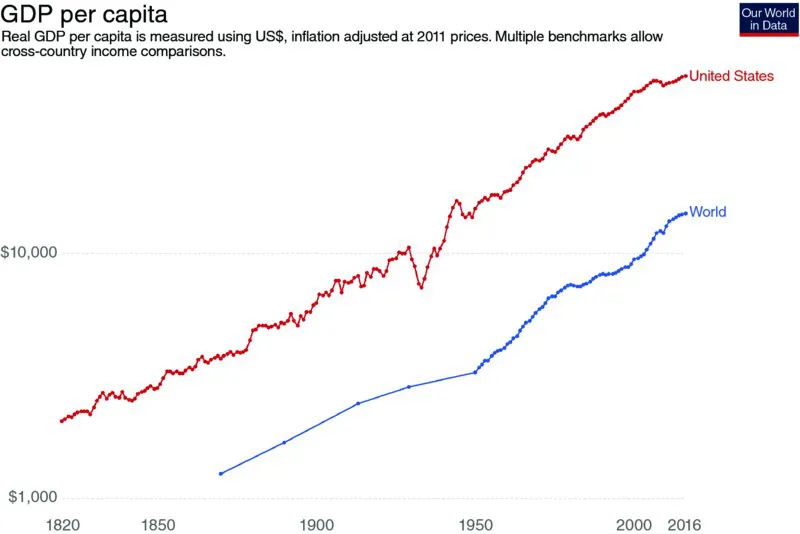
How do I know this? We mostly understand the future by studying the past. Since this is not just an economics book but also a picture book, one that tries to convey its message visually, let’s start right away with a picture of income per person in the United States from 1820 to the present and for the whole world from 1870 to the present, as shown in Figure 1.1.
Figure 1.1Income per capita, 1820 to 2018 (US) and 1870 to 2018 (world), in today’s dollars. 2
Note: “Today’s” dollars are 2011 dollars. To convert to 2019 dollars, multiply by 1.12.
Source: https://ourworldindata.org/economic-growth.2 Maddison Project Database, 2018. Our World in Data. Licensed under CC BY 4.0.
Third, and most importantly, the growth shown for the United States in the top line of Figure 1.1 is finally being experienced by the world at large, including what are historically some of the world’s poorest countries. We in the United States are not alone in our prosperity and in the promise of our future. We do not want to be alone. Economic opportunity, cultural achievement, and human betterment are a precious resource to be shared.
This book is concerned with the past, present, and future of the whole world. If I appear to be US-centric, it’s because much of the available data come from the United States, and I am an American. The United Kingdom, where careful records have been kept for longer than in the United States, is also an important source of information. But these are just examples. The forces that have enriched these countries can enrich anyone, and will.
Looking at Figure 1.1 a little more closely reveals a remarkable fact. In 2016, the average income of all the people in the world was $14,574.3 How far back do you have to go in history to find a year when the average income in the United States was that low? Take a guess. 1800? 1875? 1920?
It was 1949. The United States and its allies had just won World War II, we were enjoying the fruits of a postwar economic boom, and that time in our history is generally remembered fondly. We were the richest country in the world. Yet the world today is as rich as we in America were then.
That is what Barack Obama was talking about. In the Obama quote, I left out “in America”—he actually said, “right here in America, right now”—but I wish he had said, “right here in the world, right now.” Though the developed world has been rich for a while, the Great Fact of our time is that the developing world is catching up with us.4 It’s about time.
The Charming Little House
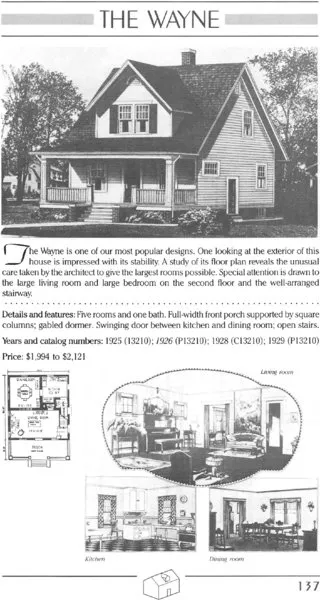
How well did the average American live in 1949, with an income per capita of about $14,500 in today’s money?5 One very visible measure of well-being is housing. Figure 1.2 shows a five-room house that a typical American family might have lived in at that time. I did not select a new house, since most people live in houses that have been around for a while; the house in the drawing was offered for sale two decades earlier. Also, everyone shared one bathroom and all the children would have had to share the one bedroom not occupied by the parents. But it was certainly adequate and, to modern tastes, charming.
Figure 1.2A house that an American family of average means in 1949 might have lived in.
Now, here is what I’ve called the single most amazing fact in economic history: the average person in the world lives about this well now.6
That does not mean the average person lives in this particular way. Patterns of human settlement have changed. An average (that is to say, moderately comfortable by 1949 American standards) family in a developing country is more likely to live in a high-rise, or in a multifamily unit with less green space around it. Today’s average householder might also not live in a home that is quite as charming (according to my old-fashioned, American biases)—or they might love high-rise living; everybody’s different. But they’d have an income consistent with this general level of living, which is the point I’m really trying to make.
A Tale of Three Authors
This book will fill in the details...
Table of contents
Cover
Title Page
Copyright
Foreword
Preface
Acknowledgments
Part I The Great Betterment
Part II Fewer
Part III Richer
Part IV Explorations
Part V Greener
Afterword
Reader’s Guide: Annotated Suggestions for Further Learning
References
Index
End User License Agreement
Trusted by 375,005 students
Access to over 1.5 million titles for a fair monthly price.
Study more efficiently using our study tools.
Frequently asked questions
Yes, you can cancel anytime from the Subscription tab in your account settings on the Perlego website. Your subscription will stay active until the end of your current billing period. Learn how to cancel your subscription
No, books cannot be downloaded as external files, such as PDFs, for use outside of Perlego. However, you can download books within the Perlego app for offline reading on mobile or tablet. Learn how to download books offline
Perlego offers two plans: Essential and Complete
Essential is ideal for learners and professionals who enjoy exploring a wide range of subjects. Access the Essential Library with 800,000+ trusted titles and best-sellers across business, personal growth, and the humanities. Includes unlimited reading time and Standard Read Aloud voice.
Complete: Perfect for advanced learners and researchers needing full, unrestricted access. Unlock 1.5M+ books across hundreds of subjects, including academic and specialized titles. The Complete Plan also includes advanced features like Premium Read Aloud and Research Assistant.
Both plans are available with monthly, semester, or annual billing cycles.
We are an online textbook subscription service, where you can get access to an entire online library for less than the price of a single book per month. With over 1.5 million books across 990+ topics, we’ve got you covered! Learn about our mission
Look out for the read-aloud symbol on your next book to see if you can listen to it. The read-aloud tool reads text aloud for you, highlighting the text as it is being read. You can pause it, speed it up and slow it down. Learn more about Read Aloud
Yes! You can use the Perlego app on both iOS and Android devices to read anytime, anywhere — even offline. Perfect for commutes or when you’re on the go. Please note we cannot support devices running on iOS 13 and Android 7 or earlier. Learn more about using the app
Yes, you can access Fewer, Richer, Greener by Laurence B. Siegel in PDF and/or ePUB format, as well as other popular books in Economics & Economic Theory. We have over 1.5 million books available in our catalogue for you to explore.