Reframing Salvation as Allegiance to Jesus the King
We are saved by faith when we trust that Jesus died for our sins. This is the gospel, or so we are taught. But what is faith? And does this accurately summarize the gospel?
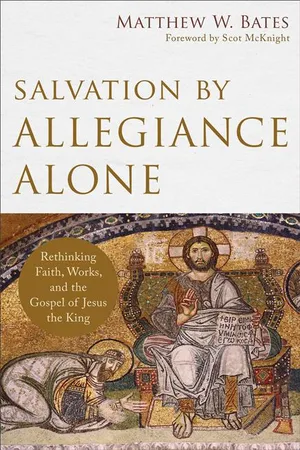
Because faith is frequently misunderstood and the climax of the gospel misidentified, the gospel's full power remains untapped. While offering a fresh proposal for what faith means within a biblical theology of salvation, Matthew Bates presses the church toward a new precision: we are saved solely by allegiance to Jesus the king. Instead of faith alone, Christians must speak about salvation by allegiance alone.
This book includes discussion questions for students, pastors, and church groups and a foreword by Scot McKnight.
eBook - ePub
Salvation by Allegiance Alone
Rethinking Faith, Works, and the Gospel of Jesus the King
- 256 pages
- English
- ePUB (mobile friendly)
- Available on iOS & Android
eBook - ePub
Salvation by Allegiance Alone
Rethinking Faith, Works, and the Gospel of Jesus the King
About this book
Information
1
FAITH IS NOT
Christianity is all about the human response of faith, or so popular teaching and perception would have us believe. Undeniably, faith is essential to Christianity—right? Or is it? I would argue that like rot in an apple, much of the malaise in contemporary Christianity stems from a rotten core. The gospel, salvation, and the Christian life have little to do with “faith” or “belief” as generally defined or understood, and this is the decay in the interior—so much so that it would be best if these words were abandoned with regard to discussions of salvation among Christians. The Greek word pistis, generally rendered “faith” or “belief,” as it pertains to Christian salvation, quite simply has little correlation with “faith” and “belief” as these words are generally understood and used in contemporary Christian culture, and much to do with allegiance. At the center of Christianity, properly understood, is not the human response of faith or belief but rather the old-fashioned term fidelity. Chapters 2–4 will reframe the gospel while developing the concepts of allegiance and fidelity more robustly. Those who are anxious to get to the heart of my argument and evidence are welcome to leapfrog the present chapter. But as I have taught this material in the university classroom, I have found that the best first step is to clear away popular misconceptions. So each subsection in what follows seeks to explain what faith is not.
Not the Opposite of Evidence Assessment
Several years ago some zealous young missionaries happened to knock on the door of my sister’s apartment where I was visiting. These two young women, the radiance of their faces only surpassed by the gleam of their tracts, were eager to do God’s work. As they began to tell us the reason for their mission and the source of their joy, I asked a few probing questions about a sacred text known as The Book of Abraham.
The Book of Abraham is a text that Joseph Smith Jr., the leading figure of the Latter-Day Saints (Mormon) tradition, claimed to have discovered when a traveling mummy exhibit came through Kirtland, Ohio, where Smith was living at the time. Smith asserted that the manuscript was an ancient document called The Book of Abraham, and, after purchasing it, Smith eventually offered his own interpretative translation. Smith claimed it told the story of Abraham’s departure from Chaldea, and that it included nonbiblical traditions, such as Abraham’s being bound to an altar to be sacrificed by a pagan priest. According to Smith, it also contained speculation about Kolob, a creation alleged to be near to God’s celestial residence. Both the pictographs and Smith’s translations are easily available online.
But there are large discrepancies between Smith’s claims and subsequent scholarly findings. For example, Smith takes the first image as a representation of a pagan priest seeking to sacrifice Abraham on an altar, translating: “And it came to pass that the priests laid violence upon me [Abraham], that they might slay me also, as they did those virgins upon this altar; and that you may have a knowledge of this altar, I will refer you to the representation at the commencement of this record.”1 So Smith asserts that an image in the manuscript and the words associated with the image describe a pagan attempt to sacrifice Abraham. But scholars of the ancient world have determined The Book of Abraham to be from a class of Egyptian funerary documents known from elsewhere as “Books of Breathings,” and that this particular document was “copied for a Theban priest named Hor.”2 As to the alleged near-sacrifice of Abraham, it is actually a representation of “the resurrection of the Osiris Hor on the customary lion-headed funerary couch.” Meanwhile, an authoritative translation of the words associated with the image reads: “[Osiris, the god’s father], prophet of Amon-Re, King of the Gods, prophet of Min who slaughters his enemies, prophet of Khonsu” (and so forth).3 So there is significant publicly available evidence that Smith’s The Book of Abraham has nothing to do with Abraham at all if ordinary methods of scholarship and translation are applied.
These young women were unflappable when presented with these evidence-based questions, simply stating, “We believe that we can only know the truth by faith,” and inviting us all to consider through prayer whether or not we might have a warm sensation in our hearts as we considered the truth of their presentation.
I tell this story not to nitpick the Mormon tradition (which is complex and intellectually diverse) but rather because I think this story captures well a fundamental misperception about the nature of faith for many in our contemporary culture. Faith is for many of us, much as it was for these exuberant and well-intentioned missionaries, the opposite of evidence-based assessment of truth. A truth claim had been made—“Mormonism is the one fully true story” (including the role of The Book of Abraham in the Mormon worldview since this is an authoritative text as part of The Pearl of Great Price)—but the assessment of the truth value of that claim was deemed by these young women to be a matter of faith or belief totally apart from publicly available evidence that might be pertinent to the value of the truth claim. Faith or belief was being put forward as the opposite of reasoned judgment in consideration of the evidence. Indeed such evidence was deemed immaterial in advance! Faith was reckoned not just an alternative but a superior way of knowing what is true and what is false. Judgment could be rendered on the basis of inward feelings alone. For these women, and they are not alone in our culture, faith is defined as something one simply must privately and personally affirm regardless of whatever contrary public evidence exists. In short, for many today faith is defined as the opposite of evidence-based truth. This is neither a biblical nor a Christian understanding of faith.
In its more egregious forms, such as in the story of the missionaries just recounted, it is perhaps easy to see that this definition of faith is both naive and dangerous because the error is so overt. However, this private, experiential, anti-evidential notion of faith (often called fideism in scholarly circles) is not unique to groups such as the Mormons. It also sneaks into the mainstream church in more subtle modes.4 For instance, we find belief or faith being defined in this basic manner when an inquirer asks a tough question about evolution and creation (on the basis of data available in the public arena) and receives a curt anti-evolutionary response simplistically affirming, “The Bible says it, and I personally have found the Bible to be true, so I believe it,” a response that does not attempt to deal seriously with all the available data (including complexities in the Bible itself). Regardless of precisely how one comes down on the complex creation or evolution (or both!) debate, we should all agree that the “faith” God requires of us has nothing to do with ignoring relevant evidence that is easily available when adjudicating truth claims. And is it not largely due to this abusive use of “faith” and “belief” that so many, past and present, are quick to dismiss Christianity and religion in general, seeing it as purely “faith” based, while taking “faith” to mean the opposite of evidence-based truth?5 True Christian faith is not fideism.
Not a Leap in the Dark
As Christians, we are frequently encouraged to step out in faith, to do something bold for God or for Jesus that intentionally pushes us outside our comfort zone: to travel halfway around the world, to build an orphanage in a third-world country, to contribute money to a kingdom-growing project beyond what we think our finances can bear, or to befriend the socially disadvantaged. All of these things are undoubtedly worthwhile endeavors—but is this at the heart of faith? And is the reason for doing them really that we should “step out”? Is it true that we should—like the hero in Indiana Jones and the Last Crusade (in a movie clip that is sometimes shown at churches to encourage such action)—take a step off of a ledge into a dark chasm, obediently following arcane instructions, even when no obvious path to safety can be achieved by making the leap? To be a true Christian, so it is asserted, or at least to foster maturity in the faith, we must plunge into the darkness, launching into what appears to be utter nothingness, knowing that the unfailing God will catch us. This, so it is claimed, is not an irrational leap, because we know that God will indeed safely cradle us.
It is not just popular Christianity that would encourage this type of faith. The Danish existential philosopher and theologian Søren Kierkegaard, reacting with strong aversion to the predominant but all-too-easy Christian culture in which he found himself (what he calls Christendom), waxes eloquent when he considers Abraham.6 For Kierkegaard, Abraham is the greatest example of faith in the Bible—a paragon of faith—because of his unquestioning obedience to God’s command with regard to Isaac. In Genesis 22, Abraham is commanded to do the unthinkable, to offer his son as a sacrifice to God. And not just his son, but his beloved son Isaac, who, after years of infertility and frustration, was given in fulfillment of God’s promise. Contrary to natural paternal instinct and all basic laws of moral decency, Abraham must kill his own son on the altar. For Kierkegaard, Abraham in his unquestioning obedience is a knight of faith, willing to do what is irrational, what is in fact by mere human standards immoral, in obedience to the divine commandment. In Genesis 22 it is clear that Abraham never wavers; he is single-mindedly committed to executing the divine will until the angel calls out, restraining Abraham’s hand even as he is about to plunge the knife. Kierkegaard summons us to act with the same faith as Abraham, to abandon ourselves recklessly to the necessary leap in the dark, because it is only in midflight that we truly encounter God.7
This stepping-out-from-security definition captures an essential component of biblical faith but simultaneously introduces a dangerous half-truth when it is coupled with an irrational leap-in-the-dark notion. The truth portion of this half-truth is best illustrated by examining the most straightforward definition of faith given in the Bible. The author of the Letter to the Hebrews defines pistis, saying, “Now faith [pistis] is the underlying substance [hypostasis] toward which hope is directed, the conviction of things not seen” (Heb. 11:1). The point of this definition—as is made clear by examples in the rest of Hebrews 11—is that by means of pistis, the true people of God are willing to act decisively in the visible world not for reasons that are immediately apparent but because an unseen yet even more genuine underlying substance (hypostasis), God’s reality, compels the action. This willingness to act on the deeper, truer, but nonetheless hidden reality is “faith” for the author of Hebrews. And we should eagerly agree that true knowledge of God and saving “faith” are often bound up with such a notion.8 For example, Noah was saved when he acted on things not yet seen, responding to the command of God to build an ark, even in the absence of tangible, this-present-world evidence (Heb. 11:7)—all of which is instructive for our salvation (1 Pet. 3:20–21; 2 Pet. 2:5).
Yet—and now for the way in which this leap-in-the-dark idea is a dangerous half-truth—it must be remembered that neither Noah nor Abraham launched out into the void, but rather each responded to God’s command. They acted in response to the call of a promise-fulfilling God with whom they had experience. Abraham was asked to sacrifice Isaac by the God who had miraculously provided Isaac—a God who had proven to be trustworthy to Abraham through a lengthy life journey together. One might even dare to say that in so acting Noah and Abraham above all showed allegiance to God as the sovereign and powerful Lord who speaks all human affairs into existence, but more on this later.
The key point is that true pistis is not an irrational launching into the void but a reasonable, action-oriented response grounded in the conviction that God’s invisible underlying realities are more certain than any apparent realities. Stepping out in faith is not intrinsically good in and of itself, as if God is inherently more pleased with daring motorcycle riders than with automobile passengers who cautiously triple-check their seatbelt buckles; it is only good when it is an obedient response to God’s exercised sovereignty. We are not to leap out in the dark at a whim, or simply to prove to ourselves, God, or others that we “have faith.” But the promise-keeping God might indeed call us to act on invisible realities of his heavenly kingdom.
If the call is genuine, we may indeed be bruised by the leap. Yet if it is genuine, in gathering the bruises from the hard landing, we can be certain that we will come to look more like the wounded Son, which is the final goal of redeemed humanity. If the call to leap is not genuine but an idolatrous response to a false god of our own making, we may jump into the emptiness only to find ourselves unable to gain secure footing or to reverse course. True pistis is not an irrational leap in the dark but a carefully discerned response to God’s reign through Jesus over his kingdom and that kingdom’s frequently hidden growth.
Not the Opposite of Works
I grew up in a fundamentalist, King-James-Version-only Bible church in Northern California. In this brand of Christianity the Bible sometimes has a way of taking on a certain luminous quality. The Bible was certainly not worshiped, but some of the hymnody perhaps unwittingly encouraged a covert bibliolatry. For instance, each and every Sunday, prior to the Sunday school service, the leader would hold up a worn leather Bible, and the congregation would enthusiastically belt out, “The B-I-B-L-E, yes that’s the book for me! I’ll stand alone on the Word of God, the B-I-B-L-E!” If no one bowed face-down on the dusty carpet in homage to the book, a few knees might have ever so slightly buckled.
My pastor at that time was (and still is) a kindhearted man, deeply devoted to God, Jesus, the church, the unsaved, his family, and the Bible—perhaps not in that precise order. When I reflect on his role in my life, I can only speak with gratitude. Although my mother had introduced me to Jesus and the Christian life when I was a young child, during my teenage years my pastor’s formal teaching awakened something new—a brighter light, a moral rigor, a passion for God’s ways, and above all else a reverence for Scripture. I am profoundly grateful for his role in my life.
Yet in retrospect the preached message I heard weekly growing up was subtly confused. No matter what passage of Scripture was being exposited, regardless of the liturgical season (my church was not exactly into following the ecclesial calendar), despite whatever contemporary political or societal affairs might be pressing, virtually every sermon had the same conclusion—a presentation of “the gospel” and an invitation “to accept Jesus into your heart.” Now, do not misu...
Table of contents
- Cover
- Title Page
- Copyright Page
- Dedication
- Contents
- Foreword by Scot McKnight
- Acknowledgments
- Abbreviations
- Introduction
- 1. Faith Is Not
- 2. Loyalty and the Full Gospel
- 3. Jesus Proclaims the Gospel
- 4. Faith as Allegiance
- 5. Questions about Allegiance Alone
- 6. Resurrection into New Creation
- 7. Restoring the Idol of God
- 8. Justification and Allegiance Alone
- 9. Practicing Allegiance
- Bibliography
- Author Index
- Scripture and Ancient Writings Index
- Notes
- Back Cover
Trusted by 375,005 students
Access to over 1.5 million titles for a fair monthly price.
Study more efficiently using our study tools.
Frequently asked questions
Yes, you can cancel anytime from the Subscription tab in your account settings on the Perlego website. Your subscription will stay active until the end of your current billing period. Learn how to cancel your subscription
No, books cannot be downloaded as external files, such as PDFs, for use outside of Perlego. However, you can download books within the Perlego app for offline reading on mobile or tablet. Learn how to download books offline
Perlego offers two plans: Essential and Complete
- Essential is ideal for learners and professionals who enjoy exploring a wide range of subjects. Access the Essential Library with 800,000+ trusted titles and best-sellers across business, personal growth, and the humanities. Includes unlimited reading time and Standard Read Aloud voice.
- Complete: Perfect for advanced learners and researchers needing full, unrestricted access. Unlock 1.5M+ books across hundreds of subjects, including academic and specialized titles. The Complete Plan also includes advanced features like Premium Read Aloud and Research Assistant.
We are an online textbook subscription service, where you can get access to an entire online library for less than the price of a single book per month. With over 1.5 million books across 990+ topics, we’ve got you covered! Learn about our mission
Look out for the read-aloud symbol on your next book to see if you can listen to it. The read-aloud tool reads text aloud for you, highlighting the text as it is being read. You can pause it, speed it up and slow it down. Learn more about Read Aloud
Yes! You can use the Perlego app on both iOS and Android devices to read anytime, anywhere — even offline. Perfect for commutes or when you’re on the go.
Please note we cannot support devices running on iOS 13 and Android 7 or earlier. Learn more about using the app
Please note we cannot support devices running on iOS 13 and Android 7 or earlier. Learn more about using the app
Yes, you can access Salvation by Allegiance Alone by Matthew W. Bates in PDF and/or ePUB format, as well as other popular books in Theology & Religion & Biblical Criticism & Interpretation. We have over 1.5 million books available in our catalogue for you to explore.