- 192 pages
- English
- ePUB (mobile friendly)
- Available on iOS & Android
eBook - ePub
About this book
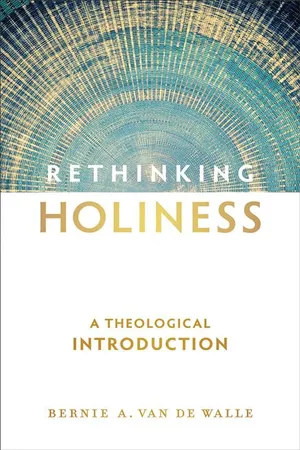
Holiness is experiencing a renaissance both within and beyond the church today. Based on years of conversations with students, this approachable theological introduction to the Christian doctrine of holiness challenges the commonly held idea that holiness is primarily a moral category. The author explains that holiness is grounded not in ethics but in the basic nature of God; it is essentially and exclusively a divine property. The book highlights the Bible's necessary and corrective role in defining holiness and shows how individual holiness is grounded in the community that is the church catholic.
Information
Topic
Theology & ReligionSubtopic
Christian Theology1
The Desire and Need for Holiness
I am a bit of a pack rat. While I have not reached hoarder status, I continue to hold on to a lot of things for which I have no current use. The only value these items have is sentimental, and sometimes even that is questionable. Among this growing pile of keepsakes, my most prized possession is the navy blue, nylon jacket I was issued when I made the baseball team in the second grade. At first I wore that jacket everywhere. I wore it at home. I wore it at school. I wore it at the dinner table. On more than one occasion, I wore it to bed. I even have a vague recollection of trying to wear it in the bath, but I am pretty sure my mother would have put a stop to that. That jacket and I were inseparable. When I was in the second grade, it meant the world to me; even now it continues to mean a lot. Yet today its well-worn frame sits in a chest with other memorabilia from my life: newspaper clippings, pennants, medals, shirts, and my high school letterman jacket. I love to keep that little blue jacket close by. I can’t imagine ever bringing myself to get rid of it even though I and my kids have long outgrown it. So there it sits in a chest in the hallway, an artifact from days gone by but with no impact on my current day-to-day life. It means a lot to me, but I rarely ever see it.
Holiness, even in the church, may seem to be something from a bygone era. Yet in the late nineteenth century, something called the Holiness movement deeply impacted the North American landscape. Its practical and unceasing emphasis on holiness deeply influenced both the church and general culture, and its impact was felt far and wide. It was, one could say, the height of fashion. All sorts of people “wore” their holiness wherever they went. They wore it to church. They wore it at work. They wore it at home. They wore it everywhere. It meant the world to them.
Today an emphasis on holiness seems to have all but disappeared not only from general society but even in the church. Every once in a while we pull it out of storage, talk about how important and great it was, and then put it back. We behave either as though holiness is out of fashion or as though we have outgrown its usefulness. The truth, however, is that holiness is never out of fashion. It is not passé. It does not belong to a bygone era. Quite the opposite is true. Those who have eyes to see will note that not only is holiness still useful, but it is also as “fashionable” as it ever was. As counterintuitive as it may seem, there currently exists a growing desire and need for holiness.
The Current Desire for Holiness
It should not be surprising that some people in any given era, including the present one, long for holiness. But what I am asserting is that there is more than just a longing. The current desire for holiness is not something that is held by a select few but is rather, in a categorical sense, universal. In one way or another, it is found everywhere. The desire for holiness is held by those within the church, by those outside the church, and especially by God.
Desire within the Church
The desire for holiness among many within the church can be seen in six forms:
1. The move to ancient and countercultural forms of worship.
2. The move to a holistic gospel that is concerned not only with one’s eventual destiny and with one’s soul but also with one’s present life and with the whole of one’s being.
3. The rejection of isolationism and the renewal of evangelical activism.
4. The attempt to see God.
5. The desire to have God in Christ seen through the church.
6. The scrutiny of various generations and groups by one another.
Each of these forms is discussed below.
Ancient Worship
Much has been made in recent years of the number of Christians, young and old alike, who find themselves increasingly attracted to worship styles other than those in which they were raised. Particularly, there seems to be a tendency among many evangelicals, again young and old alike, to participate in worship styles that are ancient, more liturgical, and consequently countercultural in style. There is a growing appreciation of forms of worship that evangelicals have traditionally considered obsolete at best and demonic at worst. One could even argue that these forms of worship are in part the very practices from which evangelicalism initially sought to free itself.
Yet those who are leaving behind contemporary evangelical worship for more ancient forms recognize that the goals of these two models of worship are significantly different. The primary goal of the liturgy to which they are drawn is faithfulness: faithfulness to the commands and instructions of Scripture, faithfulness to the historical liturgical practice of the church, and faithfulness to the nature of the God it professes to worship. They would argue that the goals of the worship style they are leaving behind—the contemporary evangelical model—is a well-meaning but misdirected acceptance of the culture’s tastes and priorities. They would argue that instead of flowing from a desire to be faithful, contemporary evangelical worship flows from a desire to be acceptable: acceptable to the culture, acceptable to the unbeliever, and acceptable to one’s personal preferences. Consequently, contemporary worship services that are understood to be most effective are often casual, familiar, frenetic, loud, conceptual, and complex. In response, the worship that many desire and seek out is formal, mysterious, peaceful, quiet, symbolic, and simple.
While much has been written about this trend, Robert Webber’s books, including Evangelicals on the Canterbury Trail, The Younger Evangelicals, and his Ancient-Future series, are deeply respected and have served as both a stimulus to and a barometer of this trend.1 Another sign of the trend toward the liturgical is the relatively recent publication of the multivolume Ancient Christian Commentary on Scripture, edited by Methodist theologian Thomas C. Oden. That this series, which assembles the interpretations of the church fathers on the entirety of Scripture, is published by a historically evangelical publisher is further evidence of this trend among evangelicals.2
This trend is at least in part a rejection of the perceived accommodation of much of evangelical church life, including its forms of and goals for worship, to the character of the contemporary secular society. Rather than being something that flows from the history of the church, the character of the God being worshiped, or the biblical instructions on what is proper and fitting, contemporary evangelical worship is perceived to be a reflection of the tastes and priorities of the culture. Those who move to more liturgical forms of worship seek to find room for what they understand to be biblical virtues and practices not embraced—and sometimes even rejected outright—by the current church culture: holiness and mystery. They are thus drawn to practices such as silence, the use of images, and the regular practice of the Eucharist, which are central to a liturgical service but are looked on with grave suspicion by many contemporary evangelicals.
A Holistic Gospel
Throughout the ages Christians have been tempted to understand their faith not only as one that is interested in humanity’s spiritual welfare but often as one that is solely interested in such. While such teaching has repeatedly been shown to be out of alignment both with the Scriptures and with orthodox Christian theology, it has proved to be resilient. In spite of its high view of Scripture and its emphasis on sound theology, evangelicalism has been particularly susceptible to this error. It often has placed such an emphasis on the state of one’s soul that it has inversely devalued caring for the state of one’s physical welfare. In some circles, if one were to express concern for someone’s living conditions and health, that person might be branded a “liberal” and thereby dismissed or even opposed.
This emphasis on the state of one’s soul—and its resulting overemphasis on the future aspect of salvation—can be seen in the methods of evangelism sometimes employed by evangelicals in the twentieth century and still today. For example, Evangelism Explosion, an evangelism program that was popular in the latter half of the twentieth century, leads the would-be evangelist to set the stage for the realization of salvation as an event in the future, particularly in the throne room of God after one’s death. It is here (and seemingly here alone) that salvation finds its payoff, as one is ushered into heaven. With such an emphasis on one’s eternal destiny, such approaches show little understanding of, and therefore little concern for, the consequences that God’s saving work may have here and now.3
Recently, however, there has been a resurgence of interest in what might be called a holistic anthropology—an understanding of humans as complex beings, composed of both the physical and the spiritual. According to this view, both aspects are essential to humanity. Moreover, these two aspects are understood to be deeply integrated and therefore inseparable from each other—or at least less readily and neatly separable as has often been thought.4 One needs to go no further than the incarnation of Jesus to realize that true humanity is composed of that which is both spiritual and physical; to deny that the physical is essential to humanity is to deny the effectiveness and necessity of the incarnation. Evangelicals are increasingly adopting such a holistic anthropology and thereby rejecting an understanding of humanity that elevates the spiritual at the expense of the physical.
One might wonder what all of this has to do with holiness. First, we must remember that God’s purpose in creating humanity was to have humans relate to him. As the Shorter Catechism of the Westminster Confession of Faith expresses it, humanity’s “chief aim is to glorify God, and to enjoy him forever.”5 Second, Scripture repeatedly reminds us that God created the human as both physical and spiritual (e.g., 1 Thess. 5:23; Heb. 4:12). Furthermore, this complex being—this being of body and spirit—was part of what God pronounced “very good.” At the very least, this pronouncement meant that God recognized that the being he created was well-suited to the purpose for which he created it—namely, to relate to him. While one might suggest that the physical nature of humanity may be superfluous to this God-given purpose, the teaching of Jesus in Mark 12:30 (referencing Deut. 6:5) suggests otherwise. According to Jesus, the most important commandment is that we love God with the entirety of our being—our heart, our soul, our mind, and our strength. Our love is not to come solely from that which is spiritual. If humans were created to relate to God in such a holistic fashion, then doing anything less cannot be considered good or whole or holy.
Evangelical Activism
In its pursuit of holiness, the church often finds it necessary to isolate itself from the balance of society, knowing that “bad company corrupts good character” (1 Cor. 15:33). Yet the church’s understandable and obedient caution in regard to its interaction with the world has sometimes mutated into a condemnation of the world. The church’s ministry to the world moved from being one that was insulated, taking appropriate steps to avoid contamination, to one that was isolated, avoiding contact of any kind by ensuring a constant distance from the world. This even included a growing isolation from other Christians whose orthodoxy or piety were possibly suspect. Historically, some have labeled this view “come-outism,” a term used in reference to various movements that sought to detach themselves not only from the world but also from other Christians whose theological opinions and ethical positions were thought to be beneath their own.6 I have often called this approach “cultural fundamentalism,” a separation from fellowship with any who do not live to the same high standards that we believe we do.
Currently, there exists a movement within these historically isolationist churches that rejects the seemingly holier-than-thou attitude of a previous cultural fundamentalism that refused to dirty its hands or compromise its character by involving itself in the world or its problems. While still striving to protect their own integrity of life and belief, such groups are engaging the world. Realizing that the world is no longer beating down the doors of the church to discover what it has to say, these people are venturing onto the turf of the world—including previously forbidden places such as theatres, clubs, and pubs—in order “to seek and to save the lost” (Luke 10:19).
These same people also dismiss what has often been an attendant quietism that was willing to stand back, do nothing, and allow the world to hurtle toward its destruction (and sometimes to watch the destruction with an almost demonic glee). Instead, while realizing that the task of altering the world’s trajectory is gargantuan, this recent movement is committed to doing all it can to resist the world’s downward spiral.
The older isolationist and quietist approaches lacked a critical understanding of either contemporary society or its own cultural trappings. They were based on a move that failed to distinguish between separation, which is at the heart of holiness, and isolation, which is not. While separation is the command of God and in a certain way the essence of the church, the church is nevertheless called to live and minister in the world, even as the church is not of the world.
The Attempt to See God
During the Reformation of the sixteenth century, Martin Luther (1483–1546) “rediscovered” the doctrine of justification by faith alone—sola fide—through his reading of Scripture, particularly that of Romans 1:17.7 In short, this doctrine asserts that people are not saved by the number or the excellence of their moral or religious works that are intended to garner favor with God. Rather, the salvation of humanity can come only from the merits of Christ. Salvation is not gained; it may only be received. It is appropriated only by the believers who place their faith in Christ. Religious and moral works, Luther argued, have nothing to do with obtaining salvation, which is received sola gratia—by grace alone, not by works.
While Luther and the other Reformers were correct in regard to sola fide and sola gratia, there has been a regular misunderstanding of these doctrines ever since. Rather than simply understanding that religious and moral works do not merit salvation, many have assumed that there is no relationship at all between works and salvation. But this raises the question: If there is no relationship between the two, why should someone be concerned with religious and moral works at all? On the chance that works might g...
Table of contents
- Cover
- Title Page
- Copyright Page
- Dedication
- Contents
- Preface
- 1. The Desire and Need for Holiness
- 2. A Biblical Definition of Holiness
- 3. A Theological Investigation of Holiness
- 4. Holiness and the Nature and Purpose of Humanity
- 5. Holiness and the Nature and Problem of Sin
- 6. Holiness and the Nature and Goal of Salvation
- 7. Holiness and the Nature and Goal of the Church
- Conclusion
- Notes
- Index
- Back Cover
Trusted by 375,005 students
Access to over 1.5 million titles for a fair monthly price.
Study more efficiently using our study tools.
Frequently asked questions
Yes, you can cancel anytime from the Subscription tab in your account settings on the Perlego website. Your subscription will stay active until the end of your current billing period. Learn how to cancel your subscription
No, books cannot be downloaded as external files, such as PDFs, for use outside of Perlego. However, you can download books within the Perlego app for offline reading on mobile or tablet. Learn how to download books offline
Perlego offers two plans: Essential and Complete
- Essential is ideal for learners and professionals who enjoy exploring a wide range of subjects. Access the Essential Library with 800,000+ trusted titles and best-sellers across business, personal growth, and the humanities. Includes unlimited reading time and Standard Read Aloud voice.
- Complete: Perfect for advanced learners and researchers needing full, unrestricted access. Unlock 1.5M+ books across hundreds of subjects, including academic and specialized titles. The Complete Plan also includes advanced features like Premium Read Aloud and Research Assistant.
We are an online textbook subscription service, where you can get access to an entire online library for less than the price of a single book per month. With over 1.5 million books across 990+ topics, we’ve got you covered! Learn about our mission
Look out for the read-aloud symbol on your next book to see if you can listen to it. The read-aloud tool reads text aloud for you, highlighting the text as it is being read. You can pause it, speed it up and slow it down. Learn more about Read Aloud
Yes! You can use the Perlego app on both iOS and Android devices to read anytime, anywhere — even offline. Perfect for commutes or when you’re on the go.
Please note we cannot support devices running on iOS 13 and Android 7 or earlier. Learn more about using the app
Please note we cannot support devices running on iOS 13 and Android 7 or earlier. Learn more about using the app
Yes, you can access Rethinking Holiness by Bernie A. Van De Walle in PDF and/or ePUB format, as well as other popular books in Theology & Religion & Christian Theology. We have over 1.5 million books available in our catalogue for you to explore.