
eBook - ePub
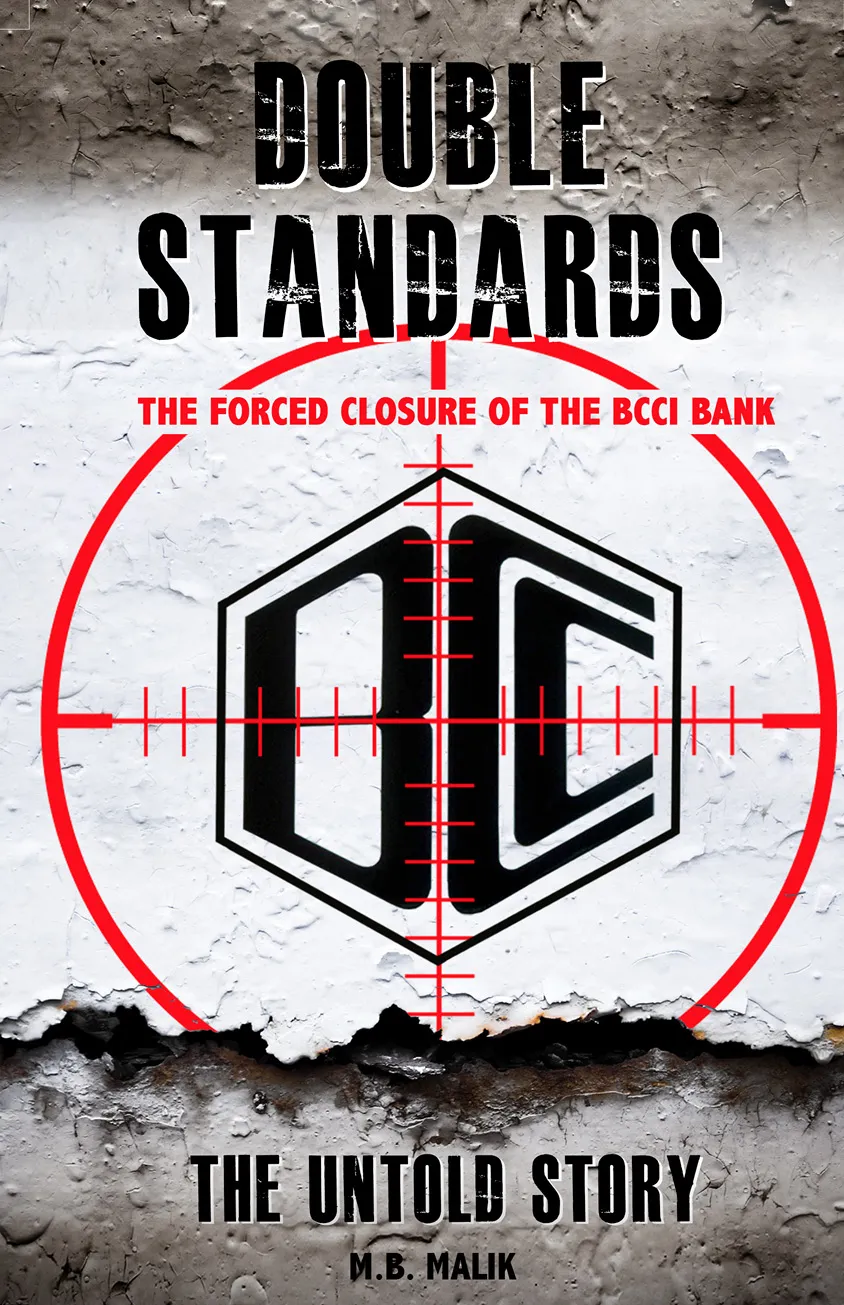
Double Standards
M.B. Malik
Copyright © 2016 M.B. Malik
The moral right of the author has been asserted.
Apart from any fair dealing for the purposes of research or private study,
or criticism or review, as permitted under the Copyright, Designs and Patents
Act 1988, this publication may only be reproduced, stored or transmitted, in
any form or by any means, with the prior permission in writing of the
publishers, or in the case of reprographic reproduction in accordance with
the terms of licences issued by the Copyright Licensing Agency. Enquiries
concerning reproduction outside those terms should be sent to the publishers.
The views and opinions expressed in this book
are purely those of the author of the text in a personal capacity.
The personal views of the author in this book are not shared by his friends,
colleagues, clients or employer and they do not reflect their views.
The author alone is responsible for the material printed in the book
and his clients/employer bear no responsibility for the printed content.
Matador
9 Priory Business Park,
Wistow Road, Kibworth Beauchamp,
Leicestershire. LE8 0RX
Tel: 0116 279 2299
Email: [email protected]
Web: www.troubador.co.uk/matador
Twitter: @matadorbooks
ISBN 978 1785895 203
British Library Cataloguing in Publication Data.
A catalogue record for this book is available from the British Library.
Matador is an imprint of Troubador Publishing Ltd
Dedicated to my beloved late father, who taught me everything I know. Papa, you are missed daily - it is all for you. For my mother, to whom I owe everything., and my motivation – my niece – Ilyana.
Contents
Preface
Chapter One
Chapter Two
Chapter Three
Chapter Four
Chapter Five
Chapter Six
Chapter Seven
Chapter Eight
Chapter Nine
Chapter Ten
Chapter Eleven
Chapter Twelve
Chapter Thirteen
Chapter Fourteen
Chapter Fifteen
Chapter Sixteen
Epilogue: By John Hilbery
Acknowledgements
Note on Sources:
Bibliography and Websites accessed
Preface
February 9th 1988
State dinner at President House Lahore, Pakistan
Few would reminisce a more high-powered dinner table than Pakistani President General Muhammad Zia-ul-Haq and the Ruler of UAE HH Sheikh Zayed Al Nahyan. The important men were busy devouring the main course of traditional Lahori mutton kebab tikkas, fish and biryani, while the President’s staff were on standby to refill any plate that looked as though it was nearing depletion.
Just as dessert was about to be served, one of Sheikh Zayed’s aides whispered into his ear at which point he promptly wiped his mouth with the embroidered silk table napkin, abruptly stood up and made his way towards the exit of the state dining hall.
At this point the entire table, including General Zia-ul-Haq stood up and were in shock as to what grave insult or culinary crime had been committed that could have offended His Royal Highness. Less than a minute later, the President’s personal advisor whispered into his ear, which caused him to immediately excuse himself from the table and he also made his way out of the dining hall.
Suddenly the pin-drop silence turned into a hurried frenzy as the president’s protocol officers gathered their personnel to escort the high-powered leaders and their entourages to their destination which was unknown to the rest of the table until the leaders had left.
Rumours were beginning to spread but security officers kept everything very hush. The destination: Sheikh Zayed Hospital Lahore.
The whisper into Sheikh Zayed’s ear “Your Highness, Mr. Abedi has suffered a severe heart attack and is in critical condition”
Who was the man who caused the State dinner to end and led the world’s most powerful men to be by his hospital bedside within a matter of minutes?
His name was Agha Hasan Abedi, the President of one of the largest banks in the world.
Humble beginnings
Pakistan is indeed a funny place. For it nurtures an uncanny knack for disgracing its fallen heroes and shaming them constantly. It’s almost as bad as my mother’s obsession with me, being the only son, although without the nostalgic claustrophobia attached.
Now being a British-born Londoner with parents of Pakistani descent, I somewhat found myself warming to this ‘troubled’ nation of 180 million people. As a kid growing up, I would be supporting the green shirts in almost all the Cricket matches where England were not the opposition. The litmus test of my Britishness was however in the summer of 1992 when Graham Gooch’s boys were up against Imran Khan’s cornered tigers at the World Cup Cricket Final in Melbourne. My loyalties came under immense scrutiny by my fellow nine-year-old school buddies at St. Martin’s Prep School in Northwood, a quiet green and leafy suburb in North West London. As the great Khan lifted up the cup, a nine-year-old me was jubilating up and down the corridors of Prep School with my milk and biscuits (pre-Thatcherite babies will understand) dribbling all over the place.
It is at this time I began questioning my own self, regarding identity and belonging in a nation where I had never lived and the only ties I had were my parents and the language we spoke at home. Then at the tender age of thirteen I was sent off to a place to be further confused in this identity crisis: A quintessentially-English boarding school in a predominantly Jewish inhabited area of North London. At first, I used to burst out in Oscar-winning tears most nights on the phone, blackmailing my poor old parents, branding them ‘cruel’ for the crime of sending me to ‘prison’ as I would term it. My emotionally-wrecked mother then having to send me home-cooked meals on almost a daily basis, circumventing the strict rules of parents visiting on Sundays only. Unfortunately, we were the only school in the vicinity to have conscripted Saturday school which constituted morning chapel service followed by afternoon sporting activities. The rationale that our Headmaster gave was that ‘there isn’t enough time in the conventional week to fulfill our full academic and extra-curricular programme’. Bollocks – was my initial reaction. “We are all going to become Prime Ministers and leaders of our generation” said Simon Ratzker, a fellow housemate who was celebrated to become our future Olympic hero.
I later realized that our headmaster at the time was quite correct. As I look back and seeing the world I live in today, the boarding-school days were probably the best days of my life. I didn’t quite fit in at the beginning while sharing a dormitory with twelve other bright-eyed thirteen year olds. I was a typical and indicative ‘Mummy’s boy’ as it were, who was too shy to speak to girls (this changed very rapidly as girls were introduced to the school in the sixth form). To add to my socially-reclusive demeanor, I despised alcohol ferociously. So much so that the slightest smell of alcohol seemed repugnant to me, which is why I found it difficult to socialise at parties after rugby and cricket matches that we played in. I remember distinctly when I got selected to play for the First XI cricket tour to Barbados in 1996. I was merely thirteen and was playing with the senior squad in the West Indies, which to me was an enormous boost to my self-confidence as well as a real shot at the Under nineteen Middlesex County selections later on. On the very same trip, one evening we were all out in Bridgetown, Barbados’s capital, and the boys put all their efforts in trying to make me drink, going as far as tipping the most beautiful waitresses to send me drinks for free. But all their attempts failed which is when I knew that the years ahead would be quite tough indeed.
However at the time I didn’t know that those same people with whom I shared an incommodious space with in bunk beds, would grow on to become the closest and most cherished friends I possess. Even later in life, I learnt the paradigmatic saying ‘it’s the quality of friends, not quantity that counts’ to be very true.
I very much doubted some of my peers’ abilities to be PM, however the older I got, I became acutely aware of the privileged environment that had been bestowed upon me. The nineties were a great time to grow up in, as many would agree. Spitting Image was a family television fixation with a blue-faced John Major being humiliated on a weekly basis and the joke never got old. In any case, even the thought of the idea of boarding school was daunting, with the older boys flushing my head down the toilet on my birthday and filling the bathtub with all sorts of liquid and then throwing me in.
However at the ripe old age of thirty-two, entering my first phase of mid-life crisis and imminent financial squeeze in the midst of the worst quadruple-dip financial mess this world has ever seen, suddenly I realize that those five years spent at boarding school were unquestionably the best years of my life. Things changed considerably when the school’s board of governors decided to introduce the opposite sex into the sixth form which saw a variable impact on our A-level grades. This in turn led me to ditch the coconut oil for hair gel and I also stole my dad’s aftershave to take with me in my dormitory. Those really were the days!
...Table of contents
- Contents
- Preface
Trusted by 375,005 students
Access to over 1.5 million titles for a fair monthly price.
Study more efficiently using our study tools.