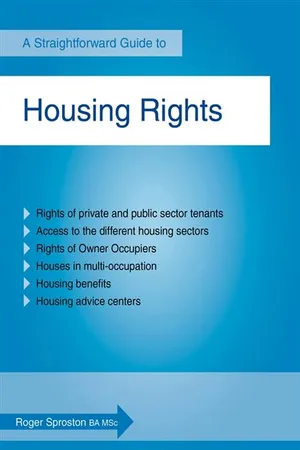
- 184 pages
- English
- ePUB (mobile friendly)
- Available on iOS & Android
eBook - ePub
Information
1
HOUSING RIGHTS GENERALLY
Whether to rent or buy
Currently, buying a home in most areas is still only an option for those who can afford the prices and get a mortgage. We are in a market where the majority of first time buyers are still excluded from buying a home. The pattern changes as you move from the south-east to the Midlands and the North, with getting on to the housing ladder still a possibility. There are distinct advantages to buying a property, if you can. They are as follows:
• When buying you will have a wider choice of property and areas, obviously depending on the price range you can afford.
• You will have more control over your home than when renting.
• You can only normally lose your home if you do not keep up your mortgage repayments.
• In the longer term, it can be cheaper than renting and over the years you will build up equity in the property until you eventually own it.
There are disadvantages to owning, as follows:
• The costs in the early years are usually higher than renting a property, particularly from a local authority or housing association, although usually lower than the private sector.
• There is an initial high cost to buying a house, whereas this is not the case with rented property.
• As an owner-occupier you will be responsible for all repairs and maintenance which can be expensive.
• There is very limited help with your housing costs if your income drops.
Obviously, the ideal landlord from whom to rent is a local authority or a housing association. The advantages of this are:
• Costs are usually lower than the private sector and rents are regulated. However, rents are steadily climbing, particularly in the public sector following changes to rent setting and the government announcement in 2015 that anyone earning over £40,000 in London and £30,000 in London will no longer enjoy rent subsidies.
• If your income drops you are usually eligible for housing benefit although there have been significant changes to benefit entitlement since April 2013.
• Most of the repairs and maintenance will be carried out by the landlord, from rental income.
• You will only lose your home if you breach the terms of the tenancy agreement.
• The public sector is non-profit making and will usually be good landlords.
There are disadvantages to renting from a local authority or housing association:
• In some areas there is a very long waiting list for properties. When you eventually are housed it may not be in an area of choice.
• The rent will gradually increase, reaching levels higher than those who own and you will not build up any equity in your property.
Private landlords have increased greatly over the last 15 years, particularly with the advent of buy-to-let. There are some advantages to renting from a private landlord. They are:
• There will be a wider choice of areas and properties than in the public sector, if you have the means to rent them.
• There is rarely a waiting list.
• You can get help with your rent if your income drops. Most of the repairs and maintenance will be met by the landlord out of rent.
There are, as always, disadvantages to renting in the private sector:
• Rents can be very high. This is the case particularly in the south east.
• Rent will go up over time, usually more than the public sector.
• Tenants in the private sector have limited protection. In the public sector, tenancies are usually for life, subject to breach of contract. Homeowners own the property they live in. Private sector tenants are in the weakest position, with six-month tenancies being the norm.
Different types of house and tenancy will suit different people at different times of their lives, depending on their circumstances. There are many things to consider when making a decision, these being outlined below.
Renting from a local authority
Council homes are, along with housing association property and, in some cases, housing co-operatives, the most affordable type of housing. However, they are also the most difficult to obtain. The allocation of council housing will depend on your need and those in the most need will usually be given priority over others. This has been a bone of contention for many years, however, as need is measured in a scientific way, with points allocated according to different circumstances. Most local authorities run a bidding system which has made it more difficult for people to both obtain or swap housing.
You can find out from the council housing department about how to go about making an application for housing. If you are being actively considered for an offer of housing then the council will usually send someone to visit you. In most cases, it is necessary to reregister on the housing register each year, in order to keep an active list of those in need.
The housing register
Councils will keep a list, or register of people who apply for housing. This has been a requirement for some years now. This register is also sometimes known as a ‘waiting list’ although this is misleading since length of time on the list is certainly not the only factor taken into account when it comes to being rehoused. In the main, councils now operate a list where people bid for housing in an area.
A council can decide that a person is not eligible for housing if they have been guilty of behaviour that would entitle them to evict that person as a council tenant.
People arriving from abroad
Some people from abroad are not allowed to register on the housing list. This includes people who are subject to immigration control, people who are allowed to stay subject to not benefiting from public funds and sponsored immigrants who have been in the United Kingdom for less than five years. Also, people who fail the habitual residence test for welfare benefits or who are in breach of EU Rights of Residence Directive. If a local authority refuses to put your name on the housing register, you have the right to ask them to review their decision within 21 days. There are special arrangements for asylum seekers who will be directed towards accommodation in limited areas of the country.
Homelessness
Local authorities have a legal duty to provide help to certain people who are homeless or threatened with homelessness. You will qualify for help if you are 'eligible for assistance', legally homeless or threatened with homelessness and not intentionally homeless. In England, Wales and Northern Ireland, you must also be in priority need. This test was abolished in Scotland on 31 December 2012. The local authority may also investigate whether you have a local connection with the area.
Local social services authorities also have responsibility for some homeless people. They have a duty to provide accommodation for children and young people over 16 who are leaving care, or who are in need for other reasons.
Local authorities must not discriminate against you. For example, if you don't understand English, the local authority should provide help and information in your own language
Eligible for Assistance
Certain people who arrive in this country, or who are returning from a period living abroad do not qualify for housing under homelessness laws. For example, many asylum-seekers (but not all) are excluded, as is someone who has spent significant time living away from the UK even if they are a UK citizen.
The rules on eligibility are complex and if you are arriving in or returning to the UK, you should seek specialist advice at, for example, at a Citizens Advice Bureau.
Homelessness or threatened with homelessness
You will be considered legally homeless if you have no accommodation which is available and reasonable for you and your household to live in. This includes accommodation in another country. You will also be homeless if you have accommodation but cannot get into it. For example, if you have somewhere to stay with friends or relatives but have been asked to leave, or you are at risk of violence in your home. You will be considered to be threatened with homelessness, if you are likely to be homeless within 28 days (in Scotland, two months).
Priority need
You will be counted as having a 'priority need' for housing if you are homeless and:
• you are pregnant
• you have dependent children under 16, or under 19 if they are in full-time education
• you are homeless because of an emergency such as a flood or a fire
• you are aged 16 or 17.
You may also be in priority need if you fall into one of the following groups. In some cases, you may have to show that your situation has made you vulnerable:-
• you are elderly, or have a physical or mental illness or disability
• you are over 18 but at risk of exploitation or have been in care
• you are at risk of domestic violence, racial violence or other threats of violence
• you are homeless after leaving hospital, prison or the armed forces.
The groups of people who have a priority need are different depending on whether you live in England, Wales or Northern Ireland, or in Scotland before the test was abolished.. If you think you fall into a priority need group you can check this with a specialist adviser, for example, at a Citizens Advice Bureau.
Intentionally homeless
You may be considered 'intentionally homeless' if you have deliberately done something which has made you lose your home. However, the definition of intentionally homeless is complicated and a decision made by your local authority can often be successfully challenged. For example, if you have become homeless because of rent or mortgage arrears you should not automatically be considered to be intentionally homeless. The local authority must look at each case individually. If you lost your home because of genuine financial problems you will not be homeless through your own fault.
Priority need
The local authority may refuse to accept responsibility if it thinks that you have no connection with the area where you are looking for help with housing. You would usually be expected to live, work or have family links to have a local connection. In this situation, you may be referred to an area where you do have a connection.
What action must the local authority take?
If the local authority needs time to carry out enquiries (and if it seems that you are homeless and, in England, Wales and Northern Ireland, in priority need), it must make sure you have somewhere to live while it investigates your situation.
If you qualify as homeless, the local authority will have to help you. It does not have to provide accommodation from its own properties. It can house you in various ways, for example, by referring you to a housing association, or arranging accommodation with a private landlord.
If the local authority decides that you are not homeless, it does ...
Table of contents
- Cover
- Title
- Copyright
- Contents
- Introduction
- 1. Housing Rights Generally
- 2. Private Tenants Finding a Property
- 3. Private Tenants and The Law
- 4. Assured Tenants
- 5. Joint Tenancies
- 6. Rent and Sources of Rent
- 7. The Right to Quiet Enjoyment of a Home
- 8. Landlord and Tenant Repairing Obligations
- 9 What should be Provided Under the Tenancy
- 10. Taking back Possession of a Property
- 11. Public Sector Tenancies
- 12. Private Tenancies in Scotland
- 13. The law and Owner Occupiers
- 14. Obligations of freeholder and Leaseholder
- 15. Service Charges
- 16. Buying a Freehold and extending a Lease
- 17. Relationship Breakdown and Housing Rights
- 18. The Law and Mobile Homes
- 19. Residential Houseboats-General Advice
- 20. Housing Advice
- Useful Addresses
- Index
Trusted by 375,005 students
Access to over 1.5 million titles for a fair monthly price.
Study more efficiently using our study tools.
Frequently asked questions
Yes, you can cancel anytime from the Subscription tab in your account settings on the Perlego website. Your subscription will stay active until the end of your current billing period. Learn how to cancel your subscription
No, books cannot be downloaded as external files, such as PDFs, for use outside of Perlego. However, you can download books within the Perlego app for offline reading on mobile or tablet. Learn how to download books offline
Perlego offers two plans: Essential and Complete
- Essential is ideal for learners and professionals who enjoy exploring a wide range of subjects. Access the Essential Library with 800,000+ trusted titles and best-sellers across business, personal growth, and the humanities. Includes unlimited reading time and Standard Read Aloud voice.
- Complete: Perfect for advanced learners and researchers needing full, unrestricted access. Unlock 1.5M+ books across hundreds of subjects, including academic and specialized titles. The Complete Plan also includes advanced features like Premium Read Aloud and Research Assistant.
We are an online textbook subscription service, where you can get access to an entire online library for less than the price of a single book per month. With over 1.5 million books across 990+ topics, we’ve got you covered! Learn about our mission
Look out for the read-aloud symbol on your next book to see if you can listen to it. The read-aloud tool reads text aloud for you, highlighting the text as it is being read. You can pause it, speed it up and slow it down. Learn more about Read Aloud
Yes! You can use the Perlego app on both iOS and Android devices to read anytime, anywhere — even offline. Perfect for commutes or when you’re on the go.
Please note we cannot support devices running on iOS 13 and Android 7 or earlier. Learn more about using the app
Please note we cannot support devices running on iOS 13 and Android 7 or earlier. Learn more about using the app
Yes, you can access Housing Rights by in PDF and/or ePUB format, as well as other popular books in Law & Housing & Urban Development Law. We have over 1.5 million books available in our catalogue for you to explore.