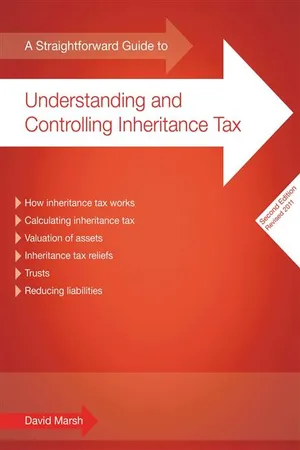
- 180 pages
- English
- ePUB (mobile friendly)
- Available on iOS & Android
eBook - ePub
Information
Chapter 1
Explaining Inheritance Tax-General Principles
In this chapter we will be looking at the following areas:
• Definition of inheritance tax (IHT)
• The law underpinning IHT
• The concept of domicile and IHT
• The making of gifts and transfers of value
• Items excluded from IHT
• Items that attract IHT
• Exempt gifts
A definition of inheritance tax
Inheritance tax is, basically, a tax on giving before death in the form of gifts or after death through a will or through the administration of a person’s affairs if a will is not left. For general purposes, anything over £325,000 (2011-2012) is payable at 40%. There are a number of ways to minimise inheritance tax liability as we will see.
The Legislation covering inheritance tax
The law governing inheritance tax is based on the Inheritance Tax Act 1984 as amended. Fundamentally, inheritance tax becomes payable after death or when there is what is known as a transfer of value as the result of a transfer of property (such as the making of a gift or gifts) or a failure to act, unless the transfer or failure is within one of the exemptions allowed for, which will be outlined later. In this case it is known as an exempt disposition. A transfer is also exempt if the property in respect of which the transfer takes place is an excluded property or excluded gift. The tax payable is less if the inheritance relief’s specified in the Act notionally reduce either the value of the property or the tax itself.
The Concept of Domicile
Although there are other taxes, none of these are affected by domicile as is IHT (domicile or tax residence arises if the taxpayer has his or her residence in the state where he or she spends most of their time). If a taxpayer has his or her residence in the United Kingdom, or is deemed to have it there, inheritance tax is charged whenever there is a gratuitous transfer of value (other than exemptions) in respect of assets in whatever country they may be.
If the taxpayer’s domicile is outside the UK, the tax only applies to those assets that are situated in the UK.
A person will have his or her domicile in the state which he considers to be his permanent home, even though he might not have the right of residence there.
For inheritance tax purposes it is important to understand the nature of domicile. At birth, a person will have the domicile of his mother if he is illegitimate or his father is dead, other wise he will have the domicile of his father. A person can exchange the domicile of origin (or birth) for one of choice once over the age of 16 and mentally capable. If there is an intention to live there indefinitely, whether legally or not, then this will be deemed to be the domicile of choice. If a person is dependent on another, whether mentally incapable or under 16, this will be known as a domicile of dependency.
Deemed domicile
Deemed domicile affects those who live in the UK for a long period of time without acquiring domicile of choice here. Once one has lived in the UK for 17 out of the last 20 years, one is deemed domiciled for IHT purposes only. At this stage a non-domiciled spouse would benefit from the same IHT treatment as a fully domiciled spouse, i.e. all transfers to that spouse upon the death of their husband and wife would be exempt from IHT, but up to that point an onerous tax burden could arise.
Inheritance tax and transfers of value
The Inheritance Tax Act 1984 defines transfer of value as ‘a disposition by a person…as a result of which the value of his estate immediately after the disposition is less than it would be but for the disposition; and the amount by which it is less is the ‘value transferred’ by the transfer’.
Deciphering this, calculation of inheritance tax is based upon the reduction the transaction causes to the wealth of the giver and not the increase in the recipients wealth.
Taxable and non-taxable giving
Some transactions which cause a reduction in the taxpayer’s wealth are declared by the Act as not to be transfers of value and therefore are exempt. Section 10 of the Inheritance Tax Act 1984 states ‘A disposition which is not intended…to confer any gratuitous benefit and which is either entered into at arms length between ‘persons not connected with each other’ or which is ‘such as might be expected to be’ entered into at ‘arms length between persons not connected with each other’ is not taxable.
Persons connected with each other for this purpose are the taxpayer’s family including spouse or civil partner, ancestors, lineal descendants, brothers and sisters, uncles and aunts, nephews and nieces, the spouse or the civil partner of the above family members and the relatives in the same categories of the taxpayers spouse or civil partner.
Except in respect of commercial transactions relating to partnership assets, the taxpayer’s business partner and the partners spouse or registered civil partner are also considered to be connected to him.
In addition, transfers made during the taxpayers lifetime in favour of a spouse, registered civil partner or a child of the taxpayer or child of his spouse or registered civil partner, for the purpose of family maintenance are exempt. This exemption applies not only during the subsistence of the relationship but also in respect of arrangements made on the annulment or dissolution of the relationship. It also provides for transfers for the reasonable maintenance of a dependant relative. In the case of a child it only applies to transfers of value for the maintenance, education or training of the child until he attains 18 years of age or until he ceases full time education if later.
One other exemption is the grant of an agricultural tenancy for full consideration, payable in money or moneys worth.
Property excluded from inheritance tax
Certain property (property is not limited to bricks and mortar) is not liable to incur inheritance tax as below:
• Savings Certificates and Premium bonds owned by people who are domiciled in the Channel Islands or the Isle of Man.
• Certain British Government stock owned by those living abroad.
• Certain overseas pensions and lump sums payable on death.
• Emoluments and tangible movable property which is owned by visiting armed forces.
• Property of service people who die as a result of active military service.
• By concession, decorations awarded for valour or gallantry which have never been transferred in return for money or moneys worth. The decoration need not have been solely a medal or remain in the same family.
• Property situated outside the United Kingdom which belongs to a person who is domiciled outside of the United Kingdom.
• Foreign currency bank accounts with most banks in the UK that are held by people who are of foreign domicile and who are not resident or ordinarily resident in the UK.
• Most reversionary interests, i.e. most presently owned rights to property upon the death of someone who is currently entitled to their property during their lifetime under a trust.
Assets that incur inheritance tax liability
The assets that attract inheritance tax liability (unless excluded) are as follows:
1. Everything that the taxpayer owns (including shares of property co-owned with someone else.
2. Everything that he has given away in the last seven years of his life unless they are exempted gifts
3. Every non-exempt gift he has made from which he has reserved a right to benefit in the last seven years.
4. Everything owned by someone else from which the taxpayer is entitled to benefit for the remainder of the taxpayers life or for any other limited period (known as a life tenancy) or the assets of any trust fund of which the taxpayer has a right to the income for the rest of his life, if the life tenant was entitled as a disabled person under a trust for the disabled (see chapter on trusts)
– the life tenancy was created by a will or intestacy and began immediately upon the death, or
– the life tenancy was created by an arrangement or trust created before 22 March 2006, or
– the life tenancy follows immediately upon a life tenancy in existence on April 6th 2006 that ended before April 6th 2008, or
– the life tenant was the spouse or the civil partner of a person who was a life tenant under a pre-April 2006 trust at that date who died on or after 6th April 2008 and the life tenants entitlement immediately followed on that of his spouse or civil partner, or
– the life tenancy is the first or a subsequent life tenancy in a trust created before 22nd March 2006 which is a trust of a life policy or life policies, provided that there has been no break in the sequence of life tenancies.
1, 2 and 3 above are known as the taxpayer’s free estate and 4 as the settled estate.
From the total of these assets it is permissible to deduct the debts and financial liabilities transferred with the assets to which they relate and if the transfer of value takes place as a result of the taxpayer’s death, the amount of the taxpayer’s debts and reasonable funeral expenses.
However, if the taxpayer is insolvent it is not allowed to deduct any deficiency in the free estate from the settled estate.
Gifts that are exempt
Gifts that are exempt from inheritance tax are the following:
• Gifts made by the taxpayer more than seven years prior to his death without retaining any benefit from the gift, unless the gift is made to a company or a trust (other than a trust for the disabled). These gifts are known as immediately chargeable gifts. With the exception of immediately chargeable gifts, gifts only remain potentially liable to inheritance tax for the seven years after they have been made and are known as PET’s (Potentially exempt transfers). If the donor survives the making of a PET by seven years the PET is exempt from IT. Gifts that count as a PET are gifts that you, as an individual, make to another individual, a trust for someone who is disabled or a bereaved minor’s trust. This is where, as the beneficiary of an Interest in possession Trust you decide to give up the right to receive anything from that trust or that right comes to an end for any other reason during your lifetime. See chapter on trusts.
• Gifts of any amount to a spouse or civil partner, unless the taxpayer is domiciled in the UK, but the spouse or civil partner is not, in which case the exemption is limited to £55,000.
• Gifts of not more than £3000 in total made in any tax year during the lifetime of the taxpayer. Any unused benefit from this exemption can be carried forward for one tax year and the annual exemption for any current tax year is used up before the unused balance of the annual exemption from any previous tax year.
• Gifts made during the taxpayer’s lifetime which are made as part of the normal expenditure of the taxpayer out of his income and not from capital and which do not reduce his standard of living. Normal expenditure is expenditure which is in accordance with a settled pattern of the donor’s expenditure.
• Wedding gifts made before the ceremony during the taxpayer’s lifetime, up to £5,000 to his child, up to £2,500 to his grandchild and up to £1000 in the case of anyone else.
• Gifts made in the taxpayer’s lifetime for the maintenance of a spouse, ex spouse, civil partner, ex civil partner, dependant relatives and dependant children who are under the age of 18 or are in full time education.
• Gifts to registered charities for charitable purposes.
• Gifts for certain national purposes including gifts to most museums and art galleries and to political parties which have at least two sitting members of the House of Commons or which have one sitting member and whose candidate polled 150,000 votes at the next general election.
• Gifts of land to registered housing associations.
Gifts in any number of the above classes can be made to the same person without losing the benefit of the exemption and under the small gifts exemption any number of gifts up to £250 can be made in a tax year provided that no other gift has been made to the same person in the same tax year. If the sum given under the small gifts exemption exceeds £250 the benefit of the exemption is lost and the...
Table of contents
- Cover
- Title
- Copyright
- Contents
- Introduction
- Chapter 1. Explaining Inheritance Tax General principles
- Chapter 2. Inheritance Tax Calculation
- Chapter 3. Valuing Assets
- Chapter 4. Pre-owned Assets Tax Charge
- Chapter 5. The Various Inheritance Tax Relief’s
- Chapter 6. Trusts
- Chapter 7. Payment of Inheritance Tax
- Chapter 8. Inheritance Tax-Reducing Your bill
- Chapter 9. Valuing an Estate and Applying for Probate
- Chapter 10. Wills and Inheritance
- Useful addresses
- Glossary of terms
- Index
Trusted by 375,005 students
Access to over 1.5 million titles for a fair monthly price.
Study more efficiently using our study tools.
Frequently asked questions
Yes, you can cancel anytime from the Subscription tab in your account settings on the Perlego website. Your subscription will stay active until the end of your current billing period. Learn how to cancel your subscription
No, books cannot be downloaded as external files, such as PDFs, for use outside of Perlego. However, you can download books within the Perlego app for offline reading on mobile or tablet. Learn how to download books offline
Perlego offers two plans: Essential and Complete
- Essential is ideal for learners and professionals who enjoy exploring a wide range of subjects. Access the Essential Library with 800,000+ trusted titles and best-sellers across business, personal growth, and the humanities. Includes unlimited reading time and Standard Read Aloud voice.
- Complete: Perfect for advanced learners and researchers needing full, unrestricted access. Unlock 1.5M+ books across hundreds of subjects, including academic and specialized titles. The Complete Plan also includes advanced features like Premium Read Aloud and Research Assistant.
We are an online textbook subscription service, where you can get access to an entire online library for less than the price of a single book per month. With over 1.5 million books across 990+ topics, we’ve got you covered! Learn about our mission
Look out for the read-aloud symbol on your next book to see if you can listen to it. The read-aloud tool reads text aloud for you, highlighting the text as it is being read. You can pause it, speed it up and slow it down. Learn more about Read Aloud
Yes! You can use the Perlego app on both iOS and Android devices to read anytime, anywhere — even offline. Perfect for commutes or when you’re on the go.
Please note we cannot support devices running on iOS 13 and Android 7 or earlier. Learn more about using the app
Please note we cannot support devices running on iOS 13 and Android 7 or earlier. Learn more about using the app
Yes, you can access Straightforward Guide To Understanding And Controlling Inheritance Tax by in PDF and/or ePUB format, as well as other popular books in Law & Property Law. We have over 1.5 million books available in our catalogue for you to explore.