- 256 pages
- English
- ePUB (mobile friendly)
- Available on iOS & Android
eBook - ePub
Information
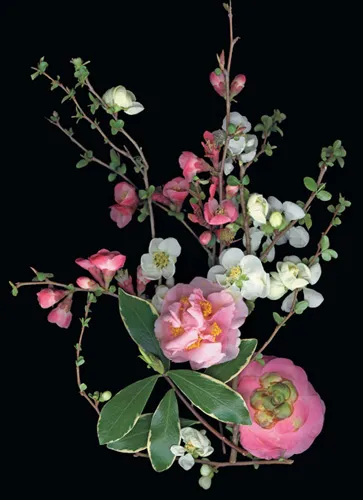
In early March, Louise Wrinkle’s Birmingham, Alabama, garden is already colorful with pink and white flowering quinces (Chaenomeles speciosa varieties), double pink Camellia japonica ‘Debutante’, and the white-edged dark green leaves of fragrant Daphne odorata ‘Variegata’ .

I’m sure you’ve heard at least one gardener lament: “If only you could have been here yesterday!” I know from experience that many things only last a day. The fleeting bloom of a daylily is a good example—here today and gone tomorrow. But rather than a particular flower, it’s those perfect, ephemeral moments of just being in the garden that I most miss when they go by.
I don’t want to freeze these occasions. I want instead to be truly present, and all too often, I am not. Traveling away from the garden makes being there all the more precious. (I’m writing this in winter, when thankfully, the memory of noxious weeds has faded, and I’ve recovered enough from the tough tasks to be thinking again of plants and next year’s garden. In a month, I’ll be champing at the bit to get back out there.)
There will be a day in early spring when the breeze blowing across my face feels warm for the first time. There will be the summer days when combinations, planned for years, finally click and come together. There will be the crescendo of autumn colors. And yes, there will also be the first snowfall with flakes as big as postage stamps or as fine as dust, coating the earth and turning the messy tangle of faded perennials angel white.
Author Allen Lacy wrote in his 1992 book, The Gardener’s Eye, “Gardeners, like everyone else, live second by second and minute by minute. What we see at one particular moment is then and there before us. But there is a second way of seeing. Seeing with the eye of memory, not the eye of our anatomy, calls up days and seasons past and years gone by.”
It’s funny to admit in a book like this with its feasts for the eyes, that all of my senses are delighted by the garden. The sensations that summon the dearest recollections are often smells. There are the sweet perfumes of summer roses and autumn aromas like the caramel and toast of the weeping katsura tree’s turning leaves (Cercidiphyllum japonicum ‘Pendula’). Perhaps the smell that conjures the strongest memories for me is the earth as it begins to thaw: The plants stir and come back to life in nature’s first season—spring.
Thankfully, Ellen’s scans capture something about these moments—forever.
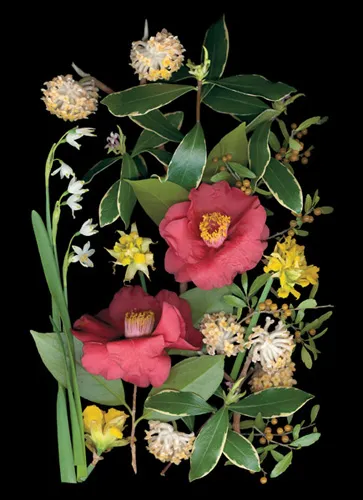
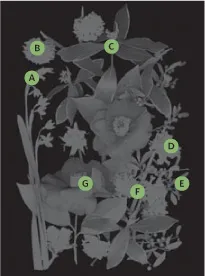
Mid-March, Alabama: A Leucojum vernum; B Edgeworthia chrysantha flowers; C Daphne odorata ‘Variegata’; D split-cup double yellow daffodil; E Ilex vomitoria (yaupon holly); F Edgeworthia chrysantha; G Camellia japonica.

According to the calendar, the New Year begins on January 1, but nature’s New Year begins in spring. When does spring start in your climate? The sight of the first robin used to be a sure sign of winter’s end, but according to Ohio wildlife expert Jim McCormac, you’re apt to see robins year-round now since their migration patterns began changing in the 1990s. If we are judging by the earth and sun, winter ends on March 20, the equinox when darkness and daylight both last for the same number of hours. That date is pretty much in line with the earliest things in my garden—crocus, Eranthis, Iris reticulata—but the saucer magnolias in my friend Tom Koster’s neighborhood in Oakland, California, are already in full bloom by then.
When Louise Wrinkle’s garden in Birmingham, Alabama, presents a surprise every single day, the calendar claims it’s still winter. By March 21, her camellias have been blooming for months, the buds of the flowering quince (Chaenomeles varieties) are opening, and Daphne odora ‘Variegata’ fills the air with its spicy fragrance. The plants were scanned in February.
At least I can count on daffodils to herald spring— early spring—the first one to bloom in my Brooklyn garden, a cyclamineus type, opens in January. The daffs continue to flower by variety, through ‘Toy Boat’ and ‘Irish Coffee’ to ivory ‘Thalia’ until the very last one fades—in early July. Spring daffodils pay no attention to what month it is.
Most people think of daffodils as being yellow with trumpets and collars (corona and perianth), but there are, depending on whom you consult, between 20 and 50 Narcissus species, and over 25,000 named and registered hybrids and cultivars in 13 divisions of the official classification system.
A few times when I was giving lectures, I took an informal, unscientific poll of my gardening audience, and asked them in what month they were born. The response was surprising. Many gardeners were born in the spring. The number one month was April. March and May were close seconds: Aries and Taurus for those of you into astrology (I’m not). Perhaps people associate their birthday celebrations with the coming of the new growing season, specks of green leaves on twigs, the first flowers. I told my findings to a friend, and he said that was ridiculous. His mother was the best gardener he ever knew, and she was born in November. After further discussion, I discovered she was born in the Southern Hemisphere. Go figure.
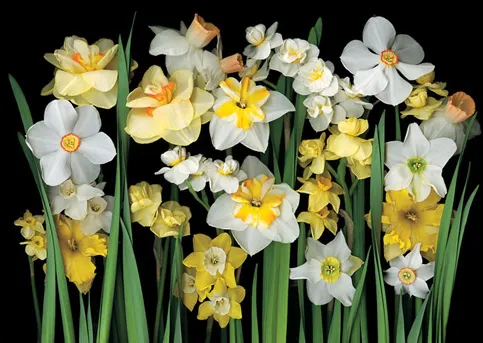
Many varieties of early May “daffs” in Sandi Blaze’s Connecticut garden.
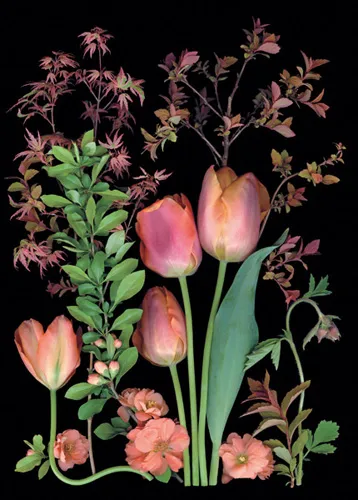
Late April, northwest New Jersey. New growth on Japanese maple ‘Butterflies’; tulip ‘Orange Emperor’; double-flowered quince Chaenomeles speciosa ‘Cameo’; tulip ‘Prinses Irene’; reddish new growth on Spiraea x bumalda ‘Magic Carpet’; Geum rivale bud.

Allen Haskell, the late landscape designer, once said, “Anyone can do spring.” He was dismissing proud homeowners’ achievements with a flippant remark. I know what he meant. You can drive around old neighborhoods in March, April, or May depending on where you live, and see the riotous colors of evergreen Kurume azaleas—hot orange, magenta, and violet. And how about those spring-flowering bulbs that come with the blossom already formed and stored in the center of their onion-like layers. What do you have to do to get color from these plants? Stick ’em in the ground and forget ’em.
Nature’s on the gardener’s side.
The alpine plant authority Geoffrey Charlesworth wrote something nicer: “Spring makes its own statement, so loud and clear that the gardener seems to be only one of the instruments, not the composer.”
Anyone can do spring, but not everyone takes advantage of nature’s more subtle gifts. Salix chaenomeloides is a pussy willow that begins its display of silvery catkins every February in my Zone 6 garden—more than a month before S. caprea, the variety usually seen in public and private gardens, or sold as cut branches. The large shrub also bears handsome matte gray-green leaves.
There are even more surprises that appear weeks before the flaming azaleas. For instance, plants’ newly emerging leaves and shoots—“pubescent growth.” The flower buds on the wild red maple (Acer rubrum) trees swell, and the highway near my New Jersey garden appears as if a pale crimson fog has settled in the hollows between the hills.
The gold-leaved Spiraea japonica varieties have amber new growth that lasts for months before its leaves attain their mature chartreuse color. I’ve planted the early tulip ‘Orange Emperor’ and later ‘Prinses Irene’ next to S. ‘Magic Carpet’ for a color echo. The flowering quince variety ‘Cameo’ blossoms in the background to continue the color scheme.
Baptisia species, herbaceous perennial members of the pea family, look like asparagus when they begin to emerge. The shoots on the cultivar ‘Purple Smoke’ are nearly black. Beneath these perennials, small, early “minor bulbs” bloom, including the pale pink glory-of-the-snow (Chionodoxa forbesii ‘Pink Giant’), white Puschkinia scilloides ‘Alba’, and an understated baby pink grape hyacinth (Muscari ‘Pink Sunrise’).
Sure, yellow daffodils and red tulips and, forgive me, those garish azaleas pack a punch. Yet, there are so many other, more restrained plants that personalize the vernal performance. By selecting the most interesting plants and putting them together thoughtfully and beautifully, you can be the conductor of your own spring symphony.
Early April, central New Jersey: Sc...
Table of contents
- Cover
- Title Page
- Copyright Page
- Dedication Page
- Contents
- Preface
- Introduction: The Time of Their Lives
- Part One: Seasons
- Part Two: Families
- Part Three: Form Follows Function
- Part Four: Color
- Part Five: Spirit of Place
- Part Six: Themes
- Afterword
- Appendix: Edible Flowers
- Language of Flowers
- Acknowledgments
- Index of Search Terms
Trusted by 375,005 students
Access to over 1.5 million titles for a fair monthly price.
Study more efficiently using our study tools.
Frequently asked questions
Yes, you can cancel anytime from the Subscription tab in your account settings on the Perlego website. Your subscription will stay active until the end of your current billing period. Learn how to cancel your subscription
No, books cannot be downloaded as external files, such as PDFs, for use outside of Perlego. However, you can download books within the Perlego app for offline reading on mobile or tablet. Learn how to download books offline
We are an online textbook subscription service, where you can get access to an entire online library for less than the price of a single book per month. With over 1.5 million books across 990+ topics, we’ve got you covered! Learn about our mission
Look out for the read-aloud symbol on your next book to see if you can listen to it. The read-aloud tool reads text aloud for you, highlighting the text as it is being read. You can pause it, speed it up and slow it down. Learn more about Read Aloud
Yes! You can use the Perlego app on both iOS and Android devices to read anytime, anywhere — even offline. Perfect for commutes or when you’re on the go.
Please note we cannot support devices running on iOS 13 and Android 7 or earlier. Learn more about using the app
Please note we cannot support devices running on iOS 13 and Android 7 or earlier. Learn more about using the app
Yes, you can access Natural Companions by in PDF and/or ePUB format, as well as other popular books in Biological Sciences & Horticulture. We have over 1.5 million books available in our catalogue for you to explore.