Kaffe Fassett has led an extraordinary life and is a captivating storyteller with a vivid memory. Born in 1937, he spent much of his youth in Big Sur, California, where his parents bought a cabin from Orson Welles and transformed it into the world-famous Nepenthe restaurant, a gathering place for artists and bohemians. After attending a boarding school run by the disciples of Krishnamurti, an Indian guru, he studied painting at the School of the Museum of Fine Arts in Boston, then traveled to England, where he made his home. After an inspiring trip to Inverness, Scotland, Fassett began designing knitwear for Bill Gibb, and then the Missonis, Vogue magazine, and private clients like Lauren Bacall and Barbra Streisand, and, in the process, revolutionized the handknitting world with his explosive use of color. Further explorations led him to needlepoint, mosaics, rugmaking, tapestries, yarn and fabric design, costume and set design, and quilting. Now in his seventies, Fassett continues to produce new work and to travel worldwide to teach and lecture. In this intimate autobiography, Fassett shares rich, detailed stories about his lifelong creative journey as well as hundreds of glorious photos taken along the way. Praise for Kaffe Fassett: Dreaming in Color: Kaffe Fassett is to color what Julia Child was to French cooking. Knitters Review Lavishly illustrated with photographs from his life and work and dishing on everyone from Dustin Hoffman to Princess Margaret, Dreaming in Color describes a charmed life filled with creativity, big personalities, travels and not a little serendipity. Vogue Knitting Shapes and patterns are everywhere; they lie waiting for the person who wants to see them. It's the bricolage aspect behind his work and, arguably, Fassett himself: arranging disparate things to create something dynamic and new. Vogue Knitting This book would be a beautiful gift to receive or give. It is like finding the pot of gold at the end of the rainbow. Examiner.com A glance through his new autobiography shows that this is a man who, in design terms, hit the ground running and has never stopped. Selvedge magazine Dreaming in Color, lavishly illustrated with 500 color pictures, is a feast for the eyes. Shelf Awareness Reading this book is like peeling an orange on a gray winters dayevery single one of your senses is sparked as you get sprayed with infectious creativity. Knitty.com Kaffe Fassett is a luminary in the world of textiles and knitting, spreading the gospel of color in his books and travels. The Houston Chronicle It is a beautiful book, no question. Beautifully designed, thoughtfully composed, well-written, Kaffe takes you on his creative journey. We allquilters, knitters, needlepointers, and just plain art loversare indeed very fortunate that he would share all of this with the world. Getting Stitched on the Farm Fassett is a kind of Harrison Ford of the knitting world. The Washington Post Kaffe Fassett is a luminary in the world of tex

- 224 pages
- English
- ePUB (mobile friendly)
- Available on iOS & Android
eBook - ePub
About this book
Information
Print ISBN
9781584799962
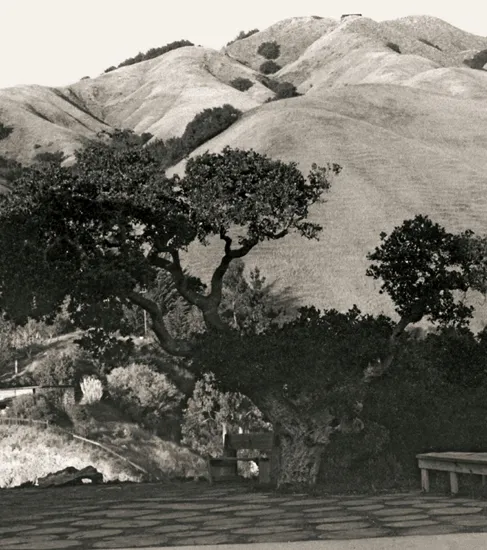
The magnificent Santa Lucia Mountains as seen from the terrace of Nepenthe. The patio is made of cut redwood rounds.
chapter one
1937–1956
Childhood
in California
in California
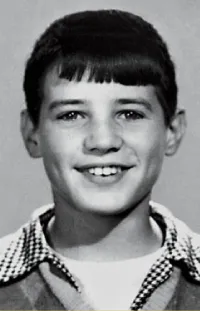
School photo, aged 12, taken at my tiny Big Sur school.
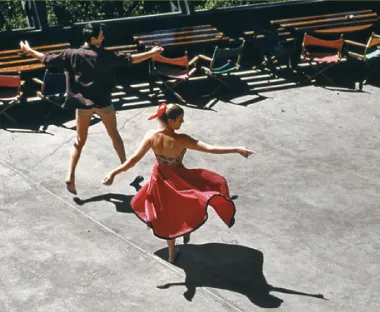
My sister Dorcas and I dancing on the terrace of Nepenthe, the family restaurant in Big Sur.
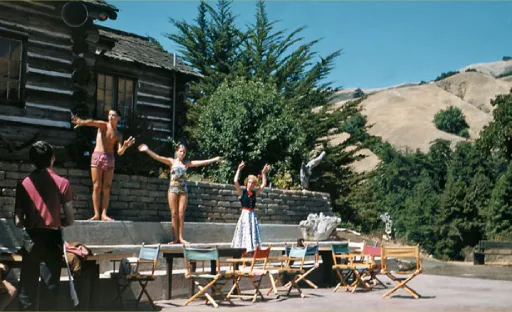
The Fassett family trying out ballet positions on the Nepenthe bleachers, with our log cabin home in the background.
When I was nine, my parents built a stunning modern restaurant perched on the cliffs of Big Sur, California, where the whole family lived and worked. As a barefoot boy on the California coast, I loved the rugged terrain . . . redwood canyons, beaches, and steep mountains. This spectacular, isolated setting turned out to be a big draw for artists, writers, musicians, and actors, and our family-run business became a magnet for interesting people—both staff and visitors—from across the globe. Meeting these larger-than-life characters stimulated my young mind and was a powerful influence. Their confident personalities and colorful stories about the exotic worlds of Europe and the Orient filled me with longing to experience those places for myself. The progressive boarding school I attended as a teenager, which was full of cultured teachers and inquiring students, would further intensify my burgeoning enthusiasm for a creative life of my own.
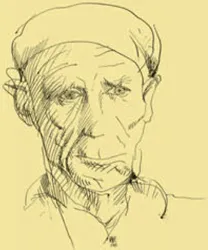
My drawing of Chaco, our favorite Russian maintenance man at Nepenthe.
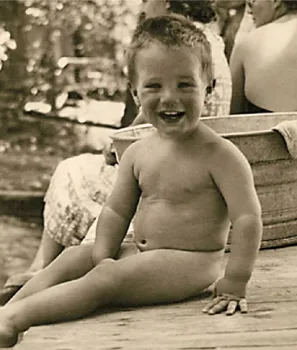
Me in 1938. I’m told I was always laughing as a baby.
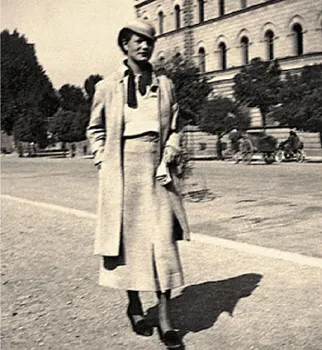
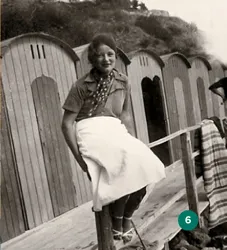
Mom stepping out in Capri in the early 1930s.
1937–1946
My early years in San Francisco and Carmel
I was born on December 7, 1937, at 2:47 a.m., at the Children’s Hospital in San Francisco—December 7 would later become the infamous Pearl Harbor day. My parents, Bill and Lolly Fassett, were both twenty-six at the time and already had a one-year-old in tow, my brother Griff. Dad and Mom debated about a name for me. Griff had been named after Dad’s maternal grandfather, William Eliot Griffis, so Dad said, “Why not please your family and name him after your grandfather?” Mom had adored her maternal grandfather Frank Powers, and she readily agreed, signing my birth certificate “Frank Powers Fassett.”
My antecedents were an eclectic mix of art philanthropists, entrepreneurs, academics, artists, suffragettes, and writers. This made my parents encourage creativity in anyone who crossed their paths. Mom was a great romantic and loved the color in life, and Dad loved drama. Neither had cultivated an art or craft, so they didn’t impose any particular artistic discipline on their kids. Still, they were always keen to promote celebration and heightened fun.
Mom had been a very handsome young woman in her early life and had traveled around Europe with her painter grandmother, Jane Gallatin Powers, wife of Frank Powers. After Frank’s death in 1920, Jane emigrated to Europe, taking her two youngest daughters—her oldest daughter, my grandmother, was already married and had had my mother by that time, so she stayed behind in San Francisco. At the age of seventeen, my mother left California and went over to join Jane. Mom would regale us with tales of her six years spent in Paris, Rome, and Capri. One story I loved was how on arriving at grand hotels, my great-grandmother would unscrew the door handles and replace them with her own more decorative ones.
Mom also told us about the dashing, unusual clothes she wore during her years in Europe. She often described an apple green satin dress she had worn, for which she had made one peacock blue shoe and one emerald green. Is it any wonder I should develop a passion for color with inspirational visions like that embedded in my memory? One of Mom’s aunts married the governor of Capri, so Mom spent many summer days swimming and evenings attending receptions and dancing at grand balls.
My father was tall and handsome with a wicked sense of humor that gained more of a sadistic edge as he really got to know you. His personality would have made him a good twenty-first-century TV presenter, prying out embarrassing stories from unsuspecting people. He was also an eclectic and avid reader. Politics, religion, and the American Civil War were among his favorite subjects. He talked often of writing a great book, but those plans remained in the realm of talk—a sad fact that motivated me to act on my own dreams.
Dad’s upbringing, mostly in California, was rather bohemian for the time, and after finishing Cornell University, where he studied hotel management, he returned to California and started working as a merchant marine. He lived next door to Mom in San Francisco, and it was only a matter of time before these two handsome people would get together. They were both born in 1911 and married at twenty-four.
At the time of my birth, my mother and father were living in the Powers family home on Steiner Street in San Francisco where my mother had grown up. Her maternal grandparents, Frank and Jane Gallatin Powers, were the founders of the artist colony in Carmel-by-the-Sea on the beautiful wild coast of California. They had bought a house on the edge of the Carmel beach called The Dunes when they were developing the colony, but they also had this San Francisco house, as Frank had his law practice there. Jane’s father was Albert Gallatin, a wealthy California businessman who was an early pioneer of hydroelectric power and power transmission, and was the president of the largest hardware, iron, and steel company on the West Coast. A self-made man, he built himself a large house in Sacramento that later became the governor’s mansion for thirteen California governors.
My father’s antecedents were pretty impressive as well. His maternal grandfather, William Eliot Griffis, was a noted American Orientalist and writer who had been decorated in Japan for his work in education there. Dad’s birth father was Edward Lee McCallie, whose family had founded the McCallie School, a renowned boy’s school, in Chattanooga, Tennessee, but his mother, Kevah, divorced and remarried when he was still a baby. His wealthy stepfather, Newton Crocker Fassett, was William’s best friend and the man who, by adopting Dad, gave our family their surname.
The past family glories didn’t seem to offer my young parents much financial privilege. I always remember them struggling pretty hard to make ends meet during my childhood. But the advantage passed down to me was probably the cultured upbringing my parents had had—it ensured that I was exposed to the arts from a young age.
My very first memories are of the Powers family’s Steiner Street house and its garden. The house seemed huge to me then, but it came down to size when I was to see it a couple of decades later—a kind of average-size four-story San Francisco Victorian. I lived there with my parents and older brother until I was four and Griff was five.
Being so young, I don’t remember much about living on Steiner Street. What I do recall is the delicious feeling of lying down in my little red wagon and gazing up at clouds and the berries on the holly tree till I dozed off. The next thing I knew, my mother’s voice was booming out of the upstairs window. “What are you doing? Come up to bed if you want to sleep.” Naps were compulsory for Griff and me, and we hated having to take them. We were active boys and disliked being told, “Oh, you are overtired,” whenever we complained about anything. One afternoon when we were really resisting shutting our eyes at naptime, Dad said, “You’ll love having a nap one day.” Indeed, I have come to treasure a short power nap during my working day in the studio. It need only be ten to fifteen minutes to set me up for an afternoon’s hard work. Often when guests are here for lunch, I’ll slip out as they are having a cup of tea after the meal and be back before they get up from the table.
A story I often heard my mother tell regarded my “real” name. When I was old enough to go to nursery school in San Francisco, my father signed me in there as Frank Powers Fassett. A year later, when I required a vaccination, the school needed my birth certificate, so they sent off for it. When it arrived, my astonished teacher rang my mother to ask, “Doesn’t your husband even know his own child’s name?”
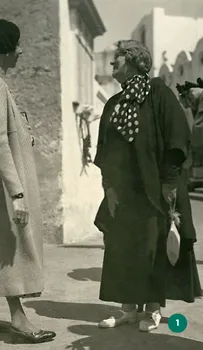
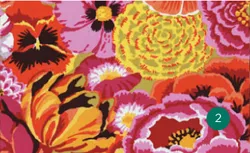
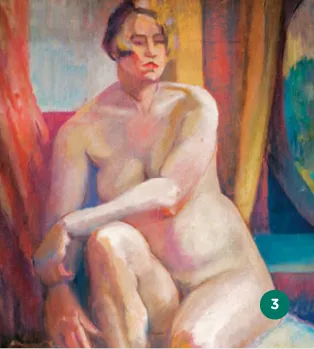
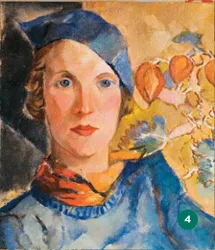
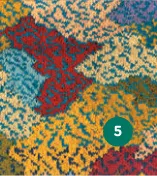
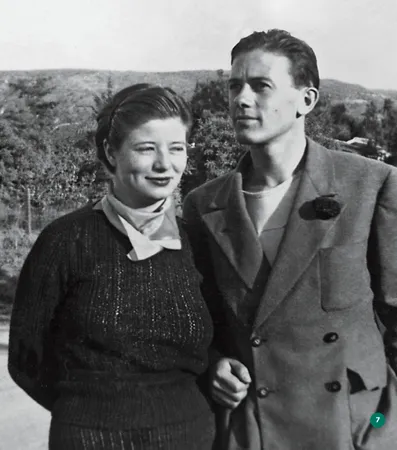
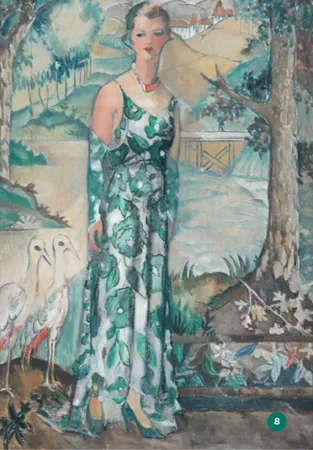
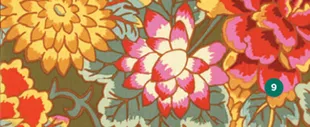
1, 3, 4: My great grandmother, artist Jane Gallatin Powers, in Italy, where she lived and painted in the 1920s and 1930s, and two of her paintings from that era. 2, 5, 9: Jane would have approved of my patchwork fabrics from the nineties—Bekah and Cloisonné—and my Fair Isle knitting from the eighties. 6, 8: Mom in Capri in the early 1930s, when she was living with her grandmother; and Jane’s portrait of her. 7: Mom and Dad looking content on their wedding day in 1935.
“Why, what did he sign him in as?” she asked.
“Frank Powers Fassett. But I have his birth certificate in front of me, and it says Frank Havrah Fassett!” My mother had never heard the name Havrah, so she called Dad at his office to get an explanation. My father was so shocked when he heard the story that he dropped the phone. When Dad was born to his astrologically obsessed mother, Kevah, she gave him the middle name Havrah, a name thought to have great stability because it had an “h” at each end. Dad hated it as he grew up and never used it or told anyone about it, including Mom. Kevah had passed away a few years before I was born, but my mother always felt she must have wanted the name Havrah in the family so much that she had “arranged” it from the other side. I feel sure that Kevah was a forceful creature, capable of doing that. Educated at Vassar in the early twentieth century and quite a bohemian, she was divorced twice and married three times in the days when divorce was a very rare occurrence. She became active in the early movement for women’s rights and worked with Margaret Sanger, the founder of Planned Parenthood.
Our family had another addition in 1941 when my sister Dorcas Jane Fassett was born, and in the same year we moved to a ranch just outside Marin City, a couple of miles northwest of downtown Sausalito. With three small children under five, my parents were trying to make a go of running a horse ranch, and Dad joined the World War II effort working in the Sausalito shipyards, at the north end of the Golden Gate Bridge. Housing in Marin City itself was building up rapidly at the start of the war to accommodate more than 70,000 shipyard workers flooding into Sausalito to...
Table of contents
- Cover
- Title Page
- Dedication & Copyright Page
- Contents
- Introduction
- chapter one 1937 – 1956 Childhood in California
- chapter two 1956 – 1964 Striking Out On My Own
- chapter three 1964 – 1969 England in the Swinging Sixties
- chapter four 1970 – 1979 My Design Work Takes Off
- chapter five 1980 – 1989 The Glorious Eighties
- chapter six 1990 and Beyond Finding Color in a Gray World
- Resources
- Acknowledgments
- Photo Credits
- Index of Searchable Terms
Trusted by 375,005 students
Access to over 1.5 million titles for a fair monthly price.
Study more efficiently using our study tools.