Growing up in the late 1970s through the mid-1980s meant that a boombox in some way, shape, or form had to have been a major part of your life.
It was certainly a part of mine.
I distinctly remember the act of pressing play on a tape deck, activating the mechanical jaw of the audio head to grasp the magnetic strand of cassette tape ribbon held inside its mouth.
This simple act of engineering wizardry conjured to life the anthems of my youth.
Once alive and whirling out an audio assult, a boombox became the sonic campfire in any environment.
It was the place that people would gather around to exchange thoughts, mellow out to, or start the party.
The boombox left an indelible and lasting impression on many lives; igniting a generation of innovation by facilitating bonding over music, sports matches, romances and news events. LO
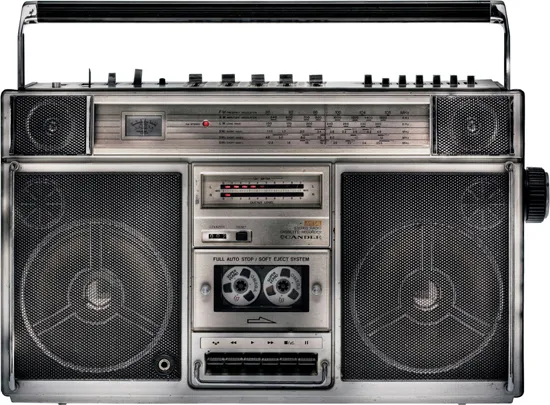
CANDLE JTR-1251
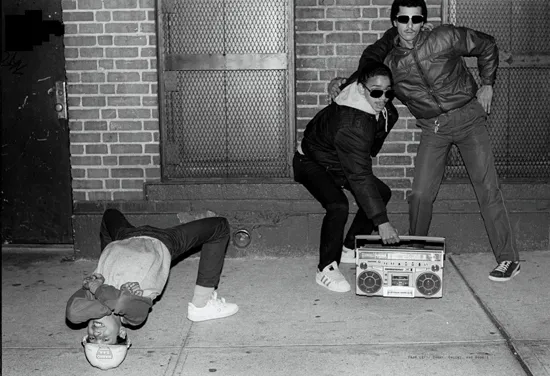
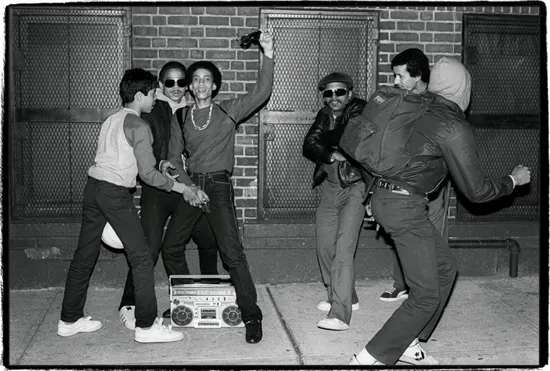
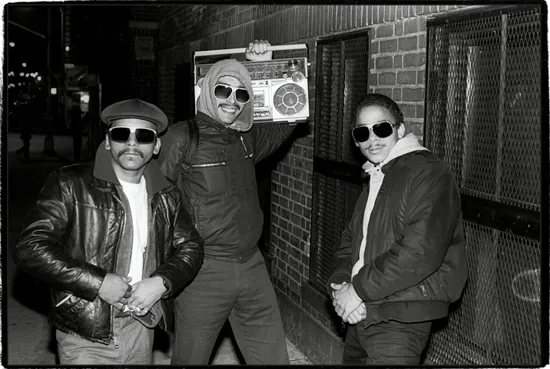
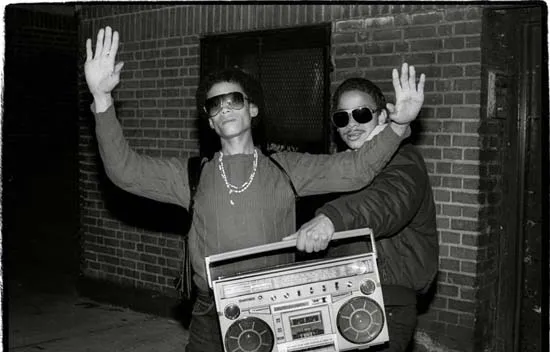
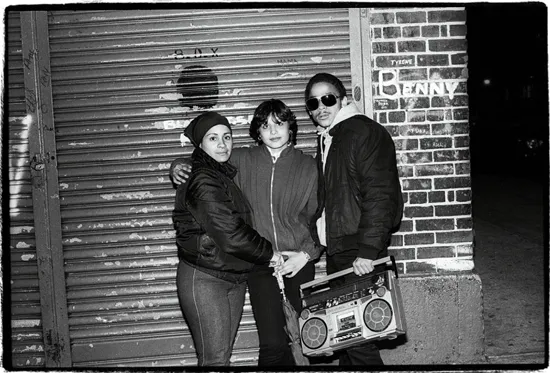
NEXT 6 IMAGES WERE TAKEN BY RICKY FLORES ON FOX STREET, SOUTH BRONX, NEW YORK, MID-’80S
FROM LEFT: DANNY, CHICKY, AND BOOGIE
FROM LEFT: DANNY, CHICKY, GEORGIE, PIMP, BOOGIE, AND CARLOS
PIMP, CARLOS, AND CHICKY
GEORGIE AND CHICKY
YOLANDA, DIANA, AND CHICKY
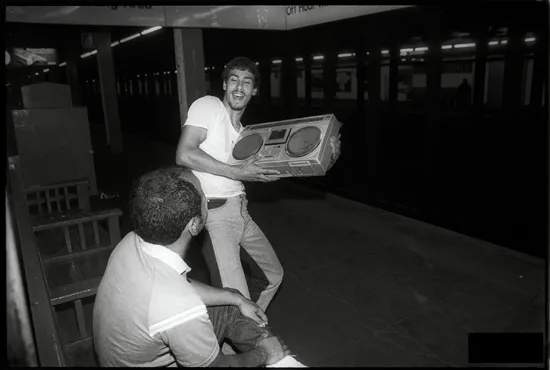
PIMP AND FRIEND LONGWOOD AVENUE TRAIN STATION RICKY FLORES
PLAY
During the postwar years of the fifties through the late sixties, the radio as a home stereo went through a rapid downsizing. Innovations in solid-state technologies such as transistors and integrated circuits reduced the size of radios, allowing for even greater portability. What was once literally tethered to the living room floor of most families’ homes could now be carried around by hand. In Japan, where living space is at a premium, it was very apparent that there was a public need to create small but excellent-sounding stereos. What began initially as a device to facilitate the movement of Japan’s youth from their parents’ homes to small urban dwellings ended up birthing an entirely new genre of electronic contraptions. The rapidly spreading need (and somewhat of a rage) for quality sounding portable stereos in Japan took on an audible stature of sorts in America (and the rest of the world), and the “boombox” gained notoriety.
Recording changed the way we listened to music. By popularizing the phonograph, Thomas Edison set the tone for the rest of the twentieth century. And the boombox is the inheritor of what he was going for with portability in sound—the early phonographs were meant for recording and playback. That had never happened in human history before. If you wanted to see something and hear it, you had to be there physically. Recording changed that and, like the phonograph, the boombox embodies a sense of portable experience.
— Paul Miller / DJ Spooky(MUSICIAN / ARTIST)
The early models of these portable stereos, first introduced in the 1970s, were dual-speaker monoliths of sound that came from a number of different manufacturers, such as Sharp, JVC, AIWA, Sanyo, and Sony. Immediately upon their arrival to stores they were a hit with the general public. Initially the goal was to try to replace the homebound hi-fisystem. The first models to be unleashed on consumers were small and heavy, with somewhat rudimentary features. However, the true birth of the really large beasts of sound (the hallmark of the boombox) occurred when stereo capabilities were added to the portable radio cassette player. Soon after the launch of these first models, advances in speaker design and cassette fidelity met together with an explosion of industrial design creativity and audio ingenuity that peaked during the golden era of models rolled out during the mid-eighties.
Music went from home collective to public collective. Around ‘77, ‘78, I noticed music took a step from being in somebody’s apartment to cats literally taking their speakers and turning them outside their windows. These were people who were not DJs, who were just sharing music. This was not like an opportunity to dance. This was just “I love music, and I’m sharing it with my peers.” So once that public form of sharing was introduced with the speakers in the windows, then the next sort of public forum was those speakers becoming mobile . . .
— Bobbito Garcia(DJ / WRITER)
Based on their sonic power, boomboxes played a seminal roll in the development of modern music tastes and pop culture both on a visual and auditory level. The golden era of the boombox did not last long, but it definitely made a major impact on society at large. Before they topped out in size (then disappeared from sight to take up residence in our collective memory) what defined a boombox was the presence of two or more loudspeakers, an amplifier, a radio tuner, and a cassette deck housed in a boxlike shape that could be carried around with an oversize lunch bucket–type handle. The main feature was that this device was transportable, making it easy to take your musical taste with you and share it with others. As consumer demand grew, more powerful and more sophisticated models were introduced to customers (over a roughly ten-year period, literally thousands of models flooded the market). The larger and louder they became, the more they gained a deeper foothold within youth culture—which led to the era of breakdancing and the incubation of hip-hop. As urban culture grew and expanded from the inner city outward, the major manufacturers tried to outdo one another, each attempting to produce a louder, bigger, flashier, more bass-pumping, and totally unique-looking boombox (with flickering LEDs, flashing equalizer lights, and VU meters as icing on the cake). They’ve changed a lot over the years, but their undeniable sonic footprint is indelibly tied to the good memories and creative output of a distinctive generation. LO
The boombox became a means of how to listen. And then you could move around with it, flex your street style and your whole persona. Having a boombox and a bigger box, it was almost like a car in a way, if you think about how essential a thing that can be for someone’s image.
— Fab 5 Freddy(PIONEER GRAFFITI ARTIST)
When I closed my door and turned on my boombox, the world around me disappeared! My room became my bomb shelter, my escape, my cave. Music was my first love, and my boombox created my sanctuary to the chaotic world surrounding me. Losing a family and mother, being shipped around from house to house, relative to relative, and school to school didn’t matter any more. When my boombox turned on, my world opened and “their” world closed.
— Billy Graziadei(BIOHAZARD / SUICIDE CITY)
The boombox reflects a more public use of the radio that hearkens back to radio’s first years, when speakers and amplification were part of the technological package, particularly in the 1930s and ‘40s when radio was a people magnet, and it was a much more public sort of thing.
— Mike Schiffer (WRITER, THE PORTABLE RADIO IN AMERICA)
The beat box was just so much more than a transistor radio; it was like bringing your entire living room stereo out in the open with you—on the street, on the beach, in the park. Before that, portable radios were very small—basically had a two- to three-inch speaker. It was a tinny little sound . . . They made certain types of portable record players, but that was a little suitcase that you could set up maybe at a party or bring to college with you, and even then, records were large and heavy. But the combination of the cassette tape and the quality player that was totally portable—that made the music so much more available everywhere. It wasn’t until the boombox that people even had the concept of traveling with their music.
— Bob Gruen(ROCK ’N’ ROLL PHOTOGRAPHER)
It wasn’t long before they became status symbols, with guys wanting the biggest one with the most lights and the most chrome. I was never really into that.
— Don Letts(DJ / MUSICIAN / DIRECTOR)
The boombox was an essential part of the hip-hop culture, like that was your PA system, that was your concert device, you know, that was your MPC, that was y...
Table of contents
Cover
Title Page
CONTENTS
Cover Ya’ Ears — FOREWORD BY SPIKE LEE
Weapons of Mass Distraction — INTRODUCTION BY LYLE OWERKO
1 / Play — SIZE DOES MATTER
2 / Pause
3 / Record — CASSETTE CULTURE / THE DJ AND THE MC / THE SUBCULTURES / RAP
4 / Fast Forward
5 / Rewind
Stop — BIOGRAPHIES
Copyright Page
Trusted by 375,005 students
Access to over 1.5 million titles for a fair monthly price.
Study more efficiently using our study tools.
Frequently asked questions
Yes, you can cancel anytime from the Subscription tab in your account settings on the Perlego website. Your subscription will stay active until the end of your current billing period. Learn how to cancel your subscription
No, books cannot be downloaded as external files, such as PDFs, for use outside of Perlego. However, you can download books within the Perlego app for offline reading on mobile or tablet. Learn how to download books offline
Perlego offers two plans: Essential and Complete
Essential is ideal for learners and professionals who enjoy exploring a wide range of subjects. Access the Essential Library with 800,000+ trusted titles and best-sellers across business, personal growth, and the humanities. Includes unlimited reading time and Standard Read Aloud voice.
Complete: Perfect for advanced learners and researchers needing full, unrestricted access. Unlock 1.5M+ books across hundreds of subjects, including academic and specialized titles. The Complete Plan also includes advanced features like Premium Read Aloud and Research Assistant.
Both plans are available with monthly, semester, or annual billing cycles.
We are an online textbook subscription service, where you can get access to an entire online library for less than the price of a single book per month. With over 1.5 million books across 990+ topics, we’ve got you covered! Learn about our mission
Look out for the read-aloud symbol on your next book to see if you can listen to it. The read-aloud tool reads text aloud for you, highlighting the text as it is being read. You can pause it, speed it up and slow it down. Learn more about Read Aloud
Yes! You can use the Perlego app on both iOS and Android devices to read anytime, anywhere — even offline. Perfect for commutes or when you’re on the go. Please note we cannot support devices running on iOS 13 and Android 7 or earlier. Learn more about using the app
Yes, you can access Boombox Project by in PDF and/or ePUB format, as well as other popular books in Media & Performing Arts & Music. We have over 1.5 million books available in our catalogue for you to explore.