
- 208 pages
- English
- ePUB (mobile friendly)
- Available on iOS & Android
eBook - ePub
GETTING STARTED
CHAPTER 1
Research and Planning
CHAPTER 2
Fabrics and Materials
CHAPTER 3
Costume Sewing Basics
CHAPTER 4
Alterations and Modifications
CHAPTER 5
Trims and Embellishments
CHAPTER 1
RESEARCH AND PLANNING
We all know that choosing which character to cosplay isn’t always a rational decision. If you’re going to put your time, money, and creative energy into a costume, the most important thing is to choose a character—and an outfit—that you’re in love with. If you’re really excited about your work, it won’t matter if you have to spend hours and hours sewing, adjusting a pattern, or setting rhinestones. If you’re not enchanted with the project, it’s not worth it—even if you can throw it together in a weekend—because you won’t enjoy wearing it. That said, it does help to consider a few practicalities as you’re setting out: skill level, time constraints, access to materials, and budget. If you’re brand-new to sewing, you may not want to tackle a tailored jacket right out of the gate. (Beginners, you’ll learn about all the techniques used in this book in Chapter 3, Costume Sewing Basics, this page.) If you’re on a tight budget, you may not want to choose a ball gown that requires 10 yards (9 m) or more of fabric (unless you’re willing to make some serious compromises on the quality of that fabric). And if the convention is next weekend, this really isn’t the moment to start an outfit with extensive hand embroidery. Look for a project that speaks to these criteria. The goal is to challenge yourself, but not to set yourself up for frustration. Although you may run into some hitches along the way, if you’re realistic from the outset, you should still be able to power through and end up with a successful result. Not actually sure what you’re ready for? Read on! First, I’ll help you figure out what goes into the research for and planning of a potential costume. Once you have a good idea of what the making of your costume will involve, you’ll be able to decide whether to scale back your ambitions or reach for the stars. Here’s how to get started, in five easy steps.
STEP 1
Gather References
Whether you’re sewing, commissioning, or assembling your costume from found pieces, the first step in most cosplay projects will be gathering references. Keep in mind that you’re not just looking for cool pictures, but for images that show you how the costume comes together in as much detail as possible. In order to accurately replicate a character design, you’ll want to have clear views of the front, sides, and back of your outfit. Try to get some pictures of the costume in motion as well, since this will help you to determine what kind of fabric you’re looking at, how much fullness you need in the skirt or sleeves, and other useful information that might not be obvious from a basic static pose. Beginning on this page, we’ll discuss the specific design elements and construction techniques you need to understand in order to transform 2-D art into a real wearable garment, but for now, just think about collecting as much information (and inspiration) as possible.
As cosplay grows more widely recognized, some creators are making detailed reference images available for their characters. If you’ve picked one of these, collecting the necessary information can be as simple as an Internet search. Often, though, you may need to be a little more creative to get the most useful material. Screenshots from games and animated TV shows can be a good starting point, but since the visuals in these media are often simplified for better performance or lower production costs, you may find more detail in promotional posters, art books, strategy guides, figurines, or other peripheral materials. If you’re working from a movie or live-action show, you may find that behind-the-scenes photos make great references since they’re less likely to be obscured by dramatic angles and lighting.
STEP 2
Consider Its Parts
Once you’ve collected your references, you’ll need to study them to find out how your costume is going to come together. Break the outfit down into its component parts and look at each item individually, as in the illustration on this page. Even very complicated costumes are often composed of several familiar garments layered together, so as far as construction is concerned, you’ll want to consider each item independently.
In addition to the main garments, look at any accessories or add-ons and decide which can be made and which would be better to buy. You’ll most likely need to buy shoes, but making shoe covers are an option if the style is unusual or a difficult color. You may also need gloves, hats, bags, belts, or other pieces to complete your outfit. Many of these can be made yourself, and making is the best option if you need the pieces to match exactly, but be realistic about how much time you can spend on them. Gloves in particular can be fussy and time-consuming to sew, so they might be overwhelming if you’re new at this. Even if you have to buy some pieces of your costume, you can still customize them with your own details and embellishments.
Next, take a good look at the information in front of you. Where are the seams? This tells you how the item was constructed. What fabrics are used—are they stretchy, drapey, or stiff—and how are they embellished? How does the character get into his or her outfit? If the answer to that question is “It gets sprayed on with a magical costume hose,” where can you add an unobtrusive zipper? This is one practical detail you can’t overlook, because you do have to wear it! Does the costume need to shape and support the body inside it, as a corset does, or do parts of it need to stand up on their own, like a big theatrical collar or body armor? Start thinking about what materials you might need, including fabrics and embellishments as well as linings and any necessary structural support. If you’re fairly new to sewing and are not sure what to look for, take a look at Chapter 2 (see this page) for an overview of fabric and other materials that help build your costume.
If you’re puzzled by how an item might be constructed, try looking for similar garments in your closet, in stores, or online. This may give you some ideas about how the pieces are sewn together or how the desired silhouette is achieved. If you’ve got an old garment you can dissect, so much the better—just make sure you take notes about how it was originally put together, lest you find yourself with a useless pile of scraps. Get in the habit of looking at garment tags, or at the descriptive text if you’re looking at things online, and pay attention to what materials the clothes are made from, since this will help you when you start shopping for fabric.
Keep a folder or inspiration board full of images you find useful, either because they help to pin down the details of your intended costume or because they give you hints about materials and construction. Also make note of any particularly useful search terms in case you need to look for more information later. Jot down accessories from your reference images that you may need to source elsewhere—hats, gloves, shoes, crowns, and so forth—so you can keep an eye out for those items while you gather the rest of your materials.
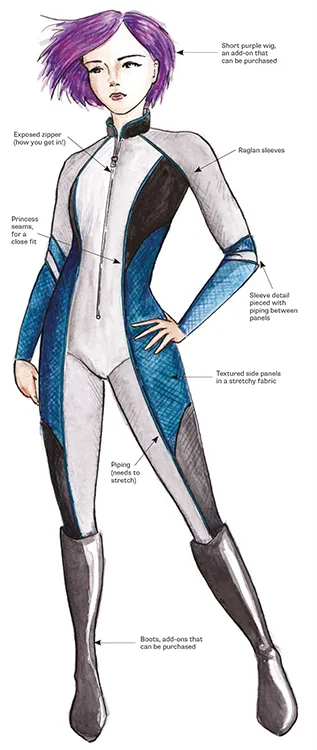
short purple wig—an add-on that can be purchased, raglan sleeves, sleeve detail pieced with piping between panels, textured side panels in a stretchy fabric, piping (needs to stretch), boots—add-ons that can be purchased, princess seams—for a close fit, exposed zipper (how you get in)
Finally, at some point you may have to make some educated guesses. If you’re working from a TV or movie costume, your refs should give you a good idea of where the seam lines are and how each item of clothing is shaped. But if you’re working from a graphic novel, animation, or game, there may be more room left for interpretation based on the style of the artist who created the image. Seams in clothing are often subtle enough that individual artists may choose to omit them, so even for a relatively straightforward outfit, the art might not give you the whole picture. Some art styles are better at communicatin...
Table of contents
- Cover
- Title Page
- Contents
- Introduction
- Getting Started
- Glossary
- Glossary of Style Elements
- Resources
- Acknowledgments
- Index of Searchable Term
- Copyright Page
Trusted by 375,005 students
Access to over 1.5 million titles for a fair monthly price.
Study more efficiently using our study tools.