- 224 pages
- English
- ePUB (mobile friendly)
- Available on iOS & Android
eBook - ePub
Information
Topic
ArchitectureSubtopic
Interior DesignCHAPTER 1
FARMHOUSE INSPIRATION
Designing your home is a lot like falling in love. Before you can wrap your heart and soul around a space, you need to feel an emotional attachment to it. When the look of an old worn cupboard, the faded hues of centuries-old wallpaper, or the nubby textures of homespun fabrics tug at your heartstrings, that’s love speaking to you in the form of farmhouse inspiration.
In the world of design, many things are beautiful. You can appreciate various styles and periods, but when you long to bring a particular look home and build a lifestyle around it, then you’ve truly found your style. This love affair (and inspiration to create) never really ends. It is a constant journey of searching, reinventing, and finding inspiration all over again.
When you are inspired, your desire to learn increases. There’s no better teacher than your own eye. Study old pieces you are attracted to and look closely at how they are constructed: Examine whether they are finely crafted or lovingly made by the untrained hand. Feel the surfaces and take in the authentic experience of objects that are worn by a storied past. Over time, you will not only have a better understanding of the things you love but also a deeper appreciation for their age, their past, and the hand that created them.
THE WAY WE WERE
The rural farmhouse: nothing tells the story of America’s past quite like it. More than just a shelter, it was the heart of the farming family and the central workplace for cooking, canning, churning, and a multitude of other tasks that supported family, field hands, and the farming lifestyle. Most country farmhouses had a simple layout: a kitchen, a front room or parlor for the celebrations of life—engagements, weddings, christenings, baptisms, and reunions—and bedrooms, which were usually small. Because farm families were often large, it was common for several siblings to share a room.
Today, our idea of the old farmhouse is fragmented: It comes to us through salvaged (and discarded) remnants and in collections of vintage pieces that we find along the way. To have the opportunity to literally step back in time to study an authentic farmhouse in its original state is rare. Thanks to conservators of the past like Chris and Laurie Popp, an 1890s Gothic Revival farmhouse in Tennessee stands to tell its story. Original painted beadboard, wallpaper, hardwood floors, and architectural elements remain intact as a testament to all that is authentically farmhouse style. They inspire a passionate desire to salvage, to search out, to renew, to transform, to gather, and to rebuild the past in our own homes.
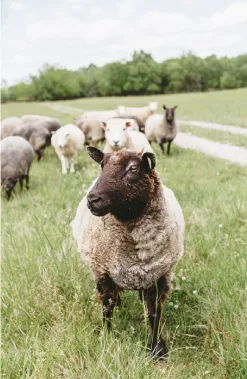
The Popps raise Cheviot sheep on the farm, using sustainable practices borrowed from past generations. Laurie, a well-known folk artist, uses the wool from her flock in her fiber sculptures.
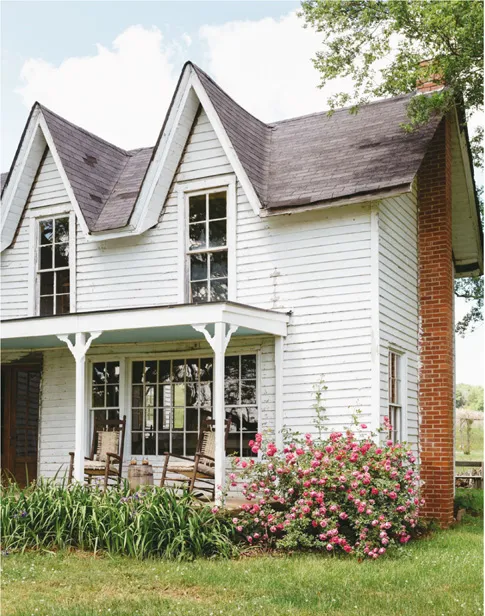
The sheep graze freely on pastures that Laurie says are pure and chemical-free. It’s all part of the authentic beauty of the old homeplace.
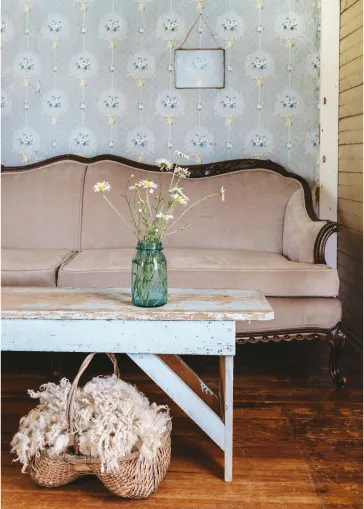
A primitive farm bench squares off with the curves of a Victorian sofa for a simple study in beauty and contrast. The Popps were able to save one large section of the original wallpaper, which was applied over yellow-painted beadboard. Traditionally, cotton or muslin was used as a liner to fill gaps in paneling before decorative paper was applied.
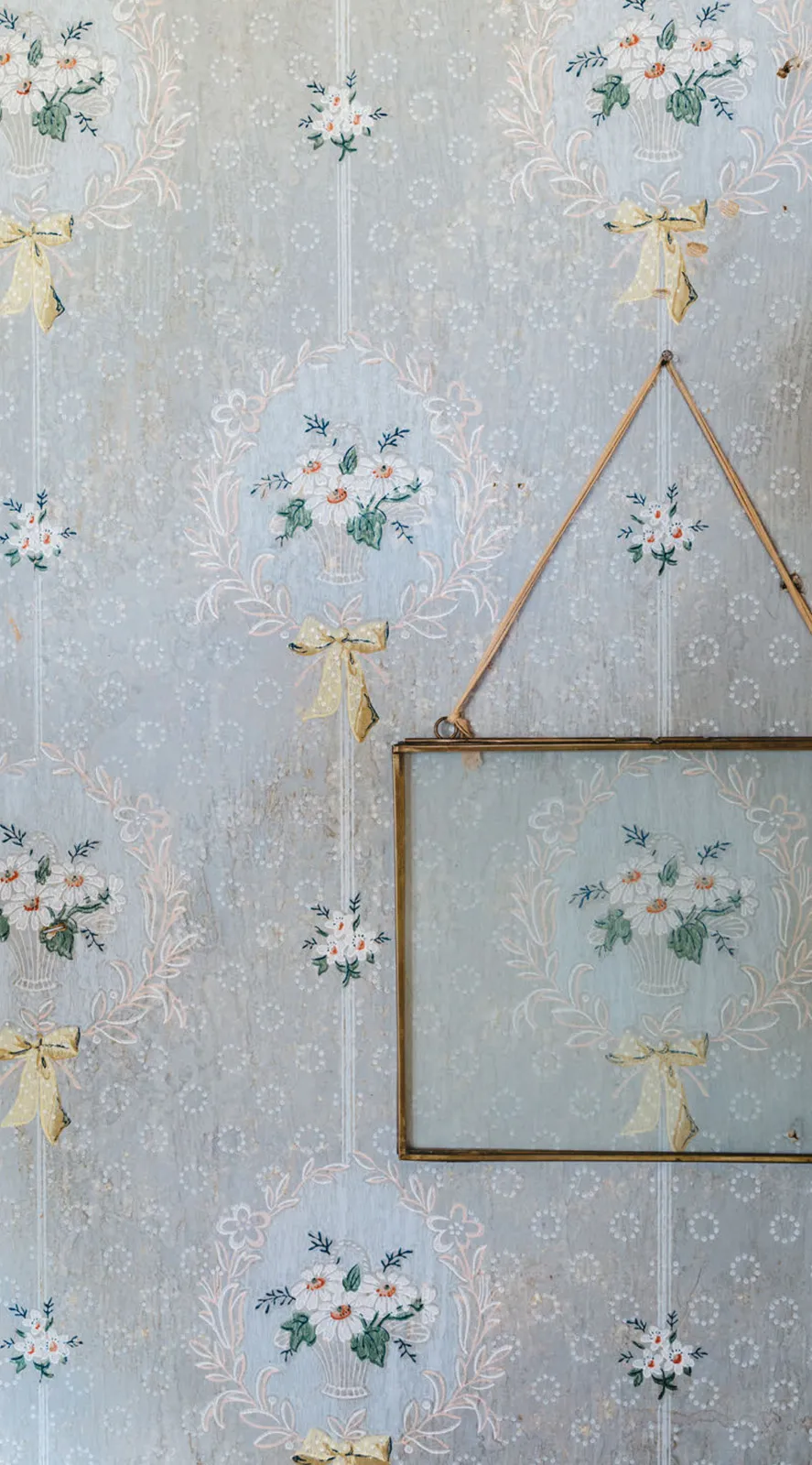
Early-twentieth-century wallpaper featured delicate patterns and soft colors that were more in line with the farmhouse aesthetic than with gaudy Victorian styles. Wallpaper was hand-painted, block-printed, stenciled, and, starting in the late 1700s, machine-printed on rolls of paper using new manufacturing methods. You can still find vintage wallpaper rolls (many sources are online).
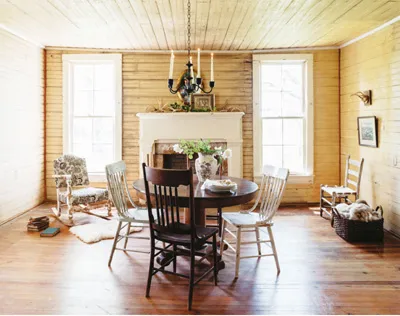
You may find a few mechanical issues as you dig for architectural gold, but that’s the price we pay when we trade a newly built structure for a house with a past. The Popps stripped out old wiring that had been cobbled together over the years and, in a surprise move, for the most part they didn’t replace it! Instead, candle chandeliers and sconces flicker with candlelight and kerosene lamps create a soft glow. For Laurie, illuminating rooms the old-fashioned way makes the atmosphere truly authentic.

An old photograph is an ode to the people who paved the way for this house … and for all of us, really. It shows the family of Andrew H. Chamber, a prominent mill owner and the pioneer and original owner of the property.

Running counter to contemporary tastes for manufactured, uniform goods, farmhouse style prizes the unique character of things collected over time: Pieced together from heirlooms and individual finds, this mismatched silverware serves up that kind of humble history, born of necessity.

Testament to the fact that this is still a working farm, and a viable way of life, the corner of the dining room is filled with traditional baskets, still used to gather the raw wool sheared from the Popps sheep, before it is cleaned, carded, and spun into yarn. Laurie sells her wool in one-ounce balls, mostly to farmhouse enthusiasts who display the rolled wool in baskets and antique dough bowls.

The authentic beauty of an old farmhouse comes from things being handmade—and repaired with what is at hand—rather than purchased in a store. Current case in point: Laurie replaced the worn-out rush seats of these ladder-back chairs with her own braided and felted wool. In the past, chair seats were often repaired with rope, jute, or leather straps.

As the middle class grew in number and economic success during the nineteenth and twentieth centuries, the piano (and piano lessons) became more affordable—and piano playing, more popular as a pastime. During this period, many musical scores were written for two players, seated side by side: The piano was useful for courtship, since the piano bench was an acceptable place for a couple to sit (cozily) together yet within earshot of other members of the household.

WHEN WALLS DO TALK … ABOUT PAINT
Before the widespread use of factory-made paints at the turn of the twentieth century, paint was mixed by hand using coarsely ground pigment—ochre yellows, iron-oxide reds, and copper-oxide greens—and linseed oil. The finish did not dry evenly, and the coarse brushes early painters used left striated brush marks and a decorative finish that is almost impossible to duplicate today. If you aren’t lucky enough to have these historic painted finishes in your own home, shop for sections of wall paneling from salvage or antique dealers. Or you can mimic the appearance by using modern-day ground pigments (mixed into paint) and distressing to achieve a faux aged look. (Unearthed Paints, Earth Pigments, Amy Howard Home Toscana Milk Paint, and Miss Mustard Seed Milk Paint are excellent choices for quality pigments and each have options for blending.)

Nothing quite compares to the humble, handcrafted beauty of a true farmhouse antique. This highchair seat was made from the slats and bottom of a crate; the legs are stripped and hand-whittled hickory branches. Today we call this folk art; back then, it was called rural resourcefulness.

Did you know that a burlap-swaddled Mason jar is the make-do ancestor of the thermos? Burlap is made from loosely woven jute, a plant fiber with insulating properties. Just as in modern thermos design, the burlap insulated a central container (usually a glass jar) and helped keep drinks warm or cold.
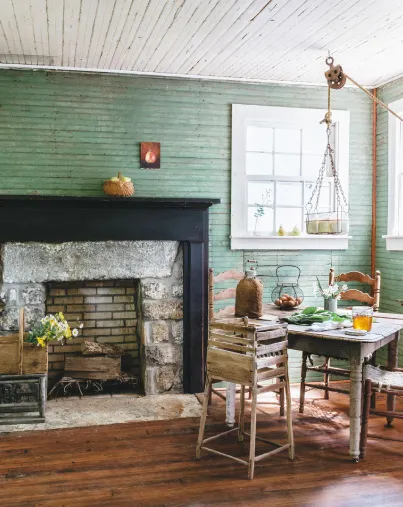
Before cast-iron stoves took over, the kitchen fireplace was a necessity for warmth and for whipping up a hot meal. This one is constructed of hand-hewn stone found on the property. It includes a large stone lintel cross section above the hearth for structural stability.
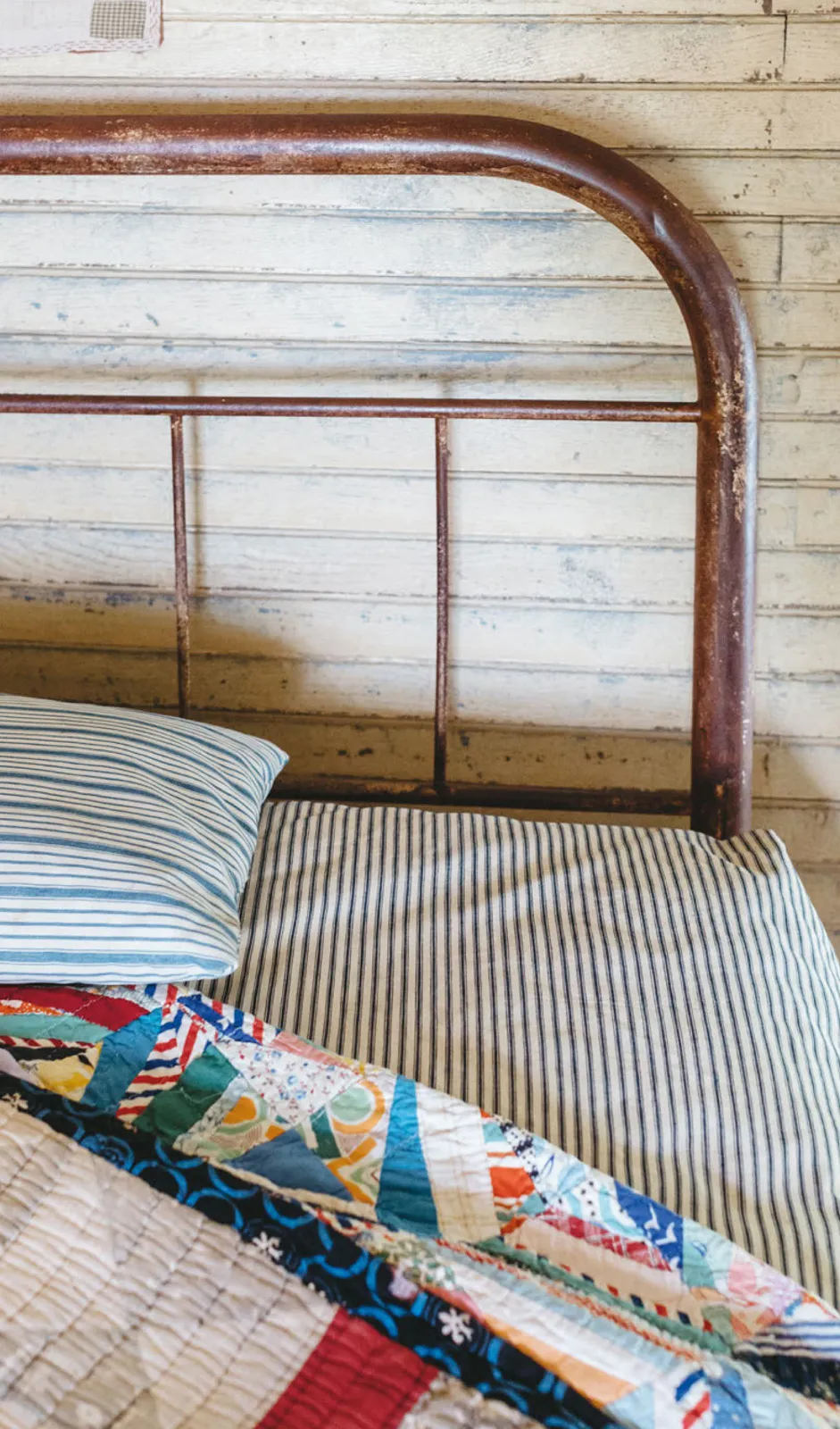
Nothing bolsters a room’s farmhouse charm like ticking. A cotton fabric with a familiar striped pattern, ticking is popular for upholstery, throw pillows, aprons, even curtains. But back in the day (way back, in fact; the pattern has been in evidence for at least a thousand years), the sturdy, woven twill had a specific duty: bundling feathers into soft pallets and pillows for sleeping. Since rural folk stuffed their bedding with chicken feathers rather than soft, luxurious goose down, tightly woven ticking kept the sharp feather shafts from poking through. When mass-produced mattresses became an option, manufacturers still chose inexpensive, über-durable ticking as a covering, which is why the fabric is often called mattress ...
Table of contents
- Cover
- Title Page
- Copyright Page
- Contents
- Foreword By Rachel Hardage Barrett
- Introduction
- Chapter 1 Farmhouse Inspiration
- Chapter 2 The Uptown City Farmhouse
- Chapter 3 The Suburban City Farmhouse
- Chapter 4 The Creative City Farmhouse
- Chapter 5 Pickin’ Places
- About the Author
Trusted by 375,005 students
Access to over 1.5 million titles for a fair monthly price.
Study more efficiently using our study tools.
Frequently asked questions
Yes, you can cancel anytime from the Subscription tab in your account settings on the Perlego website. Your subscription will stay active until the end of your current billing period. Learn how to cancel your subscription
No, books cannot be downloaded as external files, such as PDFs, for use outside of Perlego. However, you can download books within the Perlego app for offline reading on mobile or tablet. Learn how to download books offline
Perlego offers two plans: Essential and Complete
- Essential is ideal for learners and professionals who enjoy exploring a wide range of subjects. Access the Essential Library with 800,000+ trusted titles and best-sellers across business, personal growth, and the humanities. Includes unlimited reading time and Standard Read Aloud voice.
- Complete: Perfect for advanced learners and researchers needing full, unrestricted access. Unlock 1.5M+ books across hundreds of subjects, including academic and specialized titles. The Complete Plan also includes advanced features like Premium Read Aloud and Research Assistant.
We are an online textbook subscription service, where you can get access to an entire online library for less than the price of a single book per month. With over 1.5 million books across 990+ topics, we’ve got you covered! Learn about our mission
Look out for the read-aloud symbol on your next book to see if you can listen to it. The read-aloud tool reads text aloud for you, highlighting the text as it is being read. You can pause it, speed it up and slow it down. Learn more about Read Aloud
Yes! You can use the Perlego app on both iOS and Android devices to read anytime, anywhere — even offline. Perfect for commutes or when you’re on the go.
Please note we cannot support devices running on iOS 13 and Android 7 or earlier. Learn more about using the app
Please note we cannot support devices running on iOS 13 and Android 7 or earlier. Learn more about using the app
Yes, you can access City Farmhouse Style by in PDF and/or ePUB format, as well as other popular books in Architecture & Interior Design. We have over 1.5 million books available in our catalogue for you to explore.