- 184 pages
- English
- ePUB (mobile friendly)
- Available on iOS & Android
eBook - ePub
Information
Topic
DesignSubtopic
Fashion DesignCHAPTER 1
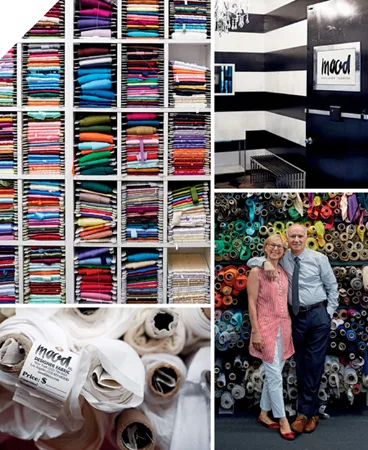
Mood’s New York store reflects the vision of founder Jack Sauma (bottom right, with his wife Janet), who got his start as a fashion designer in Sweden before owning clothing lines and a garment factory in New York.
The Fabric of Their Lives THE FASHIONABLE HISTORY OF MOOD
Mood Fabrics has all the elements of a classic American success story: an odyssey of oppression and emigration spanning three continents; a dash of true love; a splash of runway glamour; and years of blood, sweat, and tears. It’s a family business in the truest sense of the term—and fabric and fashion are embedded in the Sauma family’s DNA. Founder Jack Sauma is the son of fabric vendors; he now owns and operates Mood with his own sons, Phillip and Eric. Jack’s wife Janet is descended from a long line of tailors; she and her daughter Amy, while currently less involved on a day-to-day basis, have both spent years helping to build the business. The family’s tale is every bit as inspiring as the designer textiles on Mood’s shelves.

Brothers Phillip and Eric Sauma on 37th Street in New York City, just outside the entrance to Mood.
FOUNDATIONS
Jack Sauma was born in 1951 in the Mesopotamian capital of Hassake (Al-Hasakah), Syria, where his father owned a small fabric shop in the city center. Seven years later, Syria merged with Egypt to form the short-lived United Arab Republic; Egyptians flooded into Syria, igniting tensions with locals and especially with the Assyrian Christian ethnic group to which the Saumas belonged. When a group of Egyptian soldiers stormed into the store and one spit in the elder Sauma’s face, the family fled to Lebanon the next day. There, young Jack was sent to a monastery. Nine years later, the Saumas were among the first hundred or so Assyrians to receive asylum in politically neutral Sweden through the World Council of Churches.
In Stockholm, the senior Saumas found their niche operating ready-to-wear factories, overseeing cutting, sewing, and finishing for Scandinavian fashion designers. Teenaged Jack, observing the process from start to finish, resolved to make his way into the creative side of the industry. “I figured, why should my family work for other people when I could be the guy to sell my product?” he recalls. And so, after high school, he enrolled in the design program at Stockholm’s prestigious Anders Beckmans Skola (now Beckmans Designhögskola). His graduation collection in 1974 caused a veritable sensation. Reporters and photographers from local papers came to cover it; store buyers were intrigued. “It was the Gatsby look,” Jack says. “High-end sportswear, velvets, cottons, denims.” H&M—at the time, a department store that sold clothing from outside labels—snapped up the entire range, and a business was born. “I thought I’d be making maybe two or three hundred pieces to start,” Jack says. “It was more like forty, fifty thousand.”
Yves Saint Laurent. Givenchy. Dior. Jack Sauma of Sweden. At boutiques and department stores throughout northern Europe, Sauma’s fledgling label hung alongside fashion’s best and brightest. “I was young and very happy about it,” Jack recalls with characteristic understatement. His spectacular early run as a designer took a detour, however, on a family trip to Istanbul. On a previous trip there, Jack’s mother had met, through a priest, a beautiful young Assyrian woman named Janet—the daughter of a tailor and the perfect bride, she was convinced, for her son. Jack was dubious. “That was the old tradition, and I said, ‘I will never, ever do this,’” he remembers. “But I went to Istanbul just for fun. And it was love at first sight.” Janet’s brothers were tailors in New York’s Garment District, and the young couple flew in for a visit. After the ambitious Jack had a taste of the Big Apple, there was no turning back. He married Janet in New Jersey, shut down Jack Sauma of Sweden, and in 1976, they moved to New York.
The Saumas set up house on Long Island, where in the late ’70s and early ’80s their children, Phillip, Amy, and Eric, were born. Jack trained his sights on the fashion industry, where he’d try his luck as a sewing contractor for other designers, just as his parents had done before him. The new business was called La Mouche Sportswear—“because I had a moustache,” he says, playfully outlining the shape on his now-clean-shaven face. Though he had few connections when he arrived in the big city, Jack quickly became a popular guy. His client list (and group of friends) grew to include the crème de la crème of New York fashion: Norma Kamali, Geoffrey Beene, Giorgio di Sant’Angelo, and Pierre Cardin, to name just a few designers. (The Sauma kids were along for the ride, hanging out after school and on weekends and doing their homework on the cutting-room floor. “We’d have swordfights with the cardboard tubes of fabric rolls,” remembers Phillip.) Buoyed by La Mouche’s success, Jack went on to launch several successful clothing lines of his own, such as Isaiah and Joyce Jordan. From Bergdorf’s to Blooming-dale’s to Bendel’s, “my clothing was in every window,” he says.
“Our basement, garage, and storage barn were filled with fabric. We all helped out. My father would sell it by the pound, by the suitcase, anything to just ip it.”
— ERIC SAUMA
JACK’S SECOND ACT
It was a golden era for New York fashion—until the economy came to a screeching halt with the stock-market crash of October 1987. Customers stopped shopping, department stores slid into bankruptcy, and Jack grew increasingly frustrated waiting for payments that never came. In search of a new revenue stream, he began selling old fabrics from his collection to wholesale customers, and was surprised at how quickly he recouped his investment. “It worked like 1-2-3,” Jack says. He reached out to his famous friends and former clients, offering to buy their leftover fabric, and the operation quickly took over the Saumas’ lives. “Our basement, garage, and storage barn were filled with fabric,” recalls Eric of his childhood. “We all helped out. My father would sell it by the pound, by the suitcase, anything to just flip it.”
The success of this new venture prompted Jack to find a permanent home in the Garment District for Mood Designer Fabrics, which opened its doors in 1991 at 250 West 39th Street, on the tenth floor. Thousands of fabric rolls were lugged up the elevator and onto the shelves by young Phillip and his friends, high-school freshmen at the time. (As for the name? It came from one of Jack’s many ’80s clothing lines.) In the early years, Mood was strictly a fabric wholesaler; when fashion-conscious home sewers came knocking, they were politely turned away. Sensing an opportunity, Janet Sauma decided in 1993 to spearhead an expansion into retail sales. Word about the fabric store with the best stock steadily spread—thanks in no small part to the efforts of the Sauma boys. “We would stand on the streets in the Garment District holding fliers and shouting, ‘Fabric sale! Fabric sale! Finest fabrics you can find, on the tenth floor,’” recalls Eric, who was twelve when enlisted for the job. “We’d take girls by the hand and walk them up to the store. They would see a cute little kid and say, ‘OK, I’ll trust this kid.’ They’d come up and have a great experience and tell other people about it, and that’s what built the retail end of our business. Hard work does pay off.”
SWATCH
Mascot
Favorite fabric:
“Anything with a textured, fuzzy feel”—faux fur, polar fleece—“because it resembles his bed,” says owner Eric Sauma.

He may not be the most helpful Mood employee, but Swatch the Boston terrier is certainly the most beloved. Owner Eric Sauma estimates that 100 visitors per day come to the New York store solely to take photos of Swatch, who shot to fame on Project Runway and now models outfits on the Sewciety blog on Mood’s web site. Fans bring him chew toys and treats (“That’s why he’s a little on the pudgy side,” says Eric) and have sewn him leather jackets, raincoats, leashes, and collars. Mood is a dog-friendly store, and Swatch has a way of rounding up packs and leading them around.
Swatch is also smart: He’s capable of riding the elevator by himself from the third floor to the eleventh floor, home of Mood’s sister wholesale business, Preview Textile. (If the elevator stops before the eleventh floor, or before the third floor on its way down, he won’t get out.) Ever the diplomatic salesperson, Swatch also can sense when a customer is afraid of him, and will retreat behind the counter to make that person more comfortable. If he’s not trotting around the sales floor, he can usually be found during lunch hour in the break room, waiting for crumbs to fall, or napping on the floor, legs peeking out from beneath the fabric shelves. Says Eric: “He’s a boy inside of a dog’s body.”
Mood kept expanding its footprint until there was nowhere left to go in the building, and in 2001, the store moved into its current location at 225 West 37th Street, with 40,000 square feet spread out over three floors. A second location debuted in Los Angeles in 2007, serving not only designers and home sewers but also the Hollywood film and television industry, whose creative talents frequent the store to costume their casts and whip up Oscar gowns from the finest silks in the West. The large classroom area inside hosts top-of-the-line sewing equipment and a roster of top costumers and designers teaching daily classes—almost like a mini-university for the local crafter community.
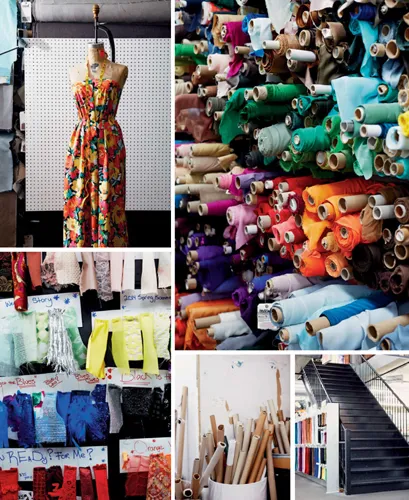
Mood is a resource for designers, who come to swatch fabrics for their collections under the watchful eye of Swatch the dog.
THE PROJECT RUNWAY REVOLUTION
In 2002, a small production crew walked into Mood on 37th Street and asked the Saumas about filming the pilot for a TV reality show inside the store. “They looked like kids,” recalls Eric. “We’d done photo shoots in the store before, so we figured, why not?” Project Runway instantly became one of the most successful reality shows of all time, introducing phrases like “Make it work!” and “Thank you, Mood” into the vernacular and inspiring a generation of viewers to pursue fashion careers or simply try their hand at sewing. Mood—and its dizzying array of fine fabrics, trims, and notions—became an indispensable resource for the contestants, and the breakout star of the show. By the third season, paparazzi would camp out outside the store during filming. “It’s a mecca now,” says Jack. “People from all over the world come to see it, and we’re happy to welcome them.” In fact, some of the hundreds of tourists who pop into the New York City store each day don’t even sew; they’re simply hoping to catch a glimpse of Tim Gunn, Swatch the dog, or one of the many Project Runway alumni who now call the s...
Table of contents
- Cover
- Title Page
- Copyright Page
- CONTENTS
- FOREWORD / TIM GUNN
- INTRODUCTION
- 1 / The Fabric of Their Lives
- 2 / Social Fabric
- 3 / Fabric 101
- 4 / Fabric and Design
- 5 / Cotton, Linen, and Hemp
- 6 / Wools
- 7 / Knits
- 8 / Silks
- 9 / Other Fabrics
- PHOTO CREDITS
- QUOTE SOURCES
- INDEX OF SEARCHABLE TERMS
- ACKNOWLEDGMENTS
Trusted by 375,005 students
Access to over 1.5 million titles for a fair monthly price.
Study more efficiently using our study tools.
Frequently asked questions
Yes, you can cancel anytime from the Subscription tab in your account settings on the Perlego website. Your subscription will stay active until the end of your current billing period. Learn how to cancel your subscription
No, books cannot be downloaded as external files, such as PDFs, for use outside of Perlego. However, you can download books within the Perlego app for offline reading on mobile or tablet. Learn how to download books offline
Perlego offers two plans: Essential and Complete
- Essential is ideal for learners and professionals who enjoy exploring a wide range of subjects. Access the Essential Library with 800,000+ trusted titles and best-sellers across business, personal growth, and the humanities. Includes unlimited reading time and Standard Read Aloud voice.
- Complete: Perfect for advanced learners and researchers needing full, unrestricted access. Unlock 1.5M+ books across hundreds of subjects, including academic and specialized titles. The Complete Plan also includes advanced features like Premium Read Aloud and Research Assistant.
We are an online textbook subscription service, where you can get access to an entire online library for less than the price of a single book per month. With over 1.5 million books across 990+ topics, we’ve got you covered! Learn about our mission
Look out for the read-aloud symbol on your next book to see if you can listen to it. The read-aloud tool reads text aloud for you, highlighting the text as it is being read. You can pause it, speed it up and slow it down. Learn more about Read Aloud
Yes! You can use the Perlego app on both iOS and Android devices to read anytime, anywhere — even offline. Perfect for commutes or when you’re on the go.
Please note we cannot support devices running on iOS 13 and Android 7 or earlier. Learn more about using the app
Please note we cannot support devices running on iOS 13 and Android 7 or earlier. Learn more about using the app
Yes, you can access Mood Guide to Fabric and Fashion by in PDF and/or ePUB format, as well as other popular books in Design & Fashion Design. We have over 1.5 million books available in our catalogue for you to explore.