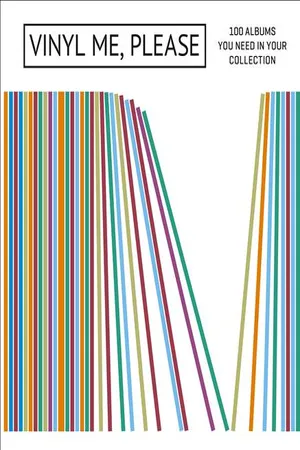
- 256 pages
- English
- ePUB (mobile friendly)
- Available on iOS & Android
eBook - ePub
Information
Subtopic
Music
A-D
Ryan Adams
Afrika Bambaataa & Soulsonic Force
Arcade Fire
The Band
The Beach Boys
Beach House
Beastie Boys
The Beatles
Beck
Beyoncé
Big Star
Bikini Kill
The Black Keys
James Blake
Bon Iver
The Books
David Bowie
Burial
Captain Beefheart & his Magic Band
The Chills
The Clash
Clipse
John Coltrane
D’Angelo
Daft Punk
Miles Davis
Def Leppard
Dirty Projectors
DJ Shadow
The Doobie Brothers
Nick Drake
Bob Dylan
RYAN ADAMS
LIVE AT CARNEGIE HALL
by Luke Winkie
When all’s said and done, Ryan Adams might have the most ridiculous career in the history of pop music. Rollicking Whiskeytown Ryan Adams; sad-boy derelict Heartbreaker Ryan Adams; Grammy-nominated, “New York, New York”–era Gold Ryan Adams; slightly infuriating “Wonderwall”-covering weirdo Ryan Adams; divergent, heavy-metal, are-we-sure-he’s-okay Ryan Adams, and of course the equally divergent, Taylor Swift–covering, aren’t-we-lucky-to-have-him Ryan Adams. He’s released 15 albums, written two books, left one insane voicemail, and has worn out countless jean jackets. It’s occasionally not been easy being a Ryan Adams fan, but it’s certainly never been boring. I suppose that’s all you can ask for.
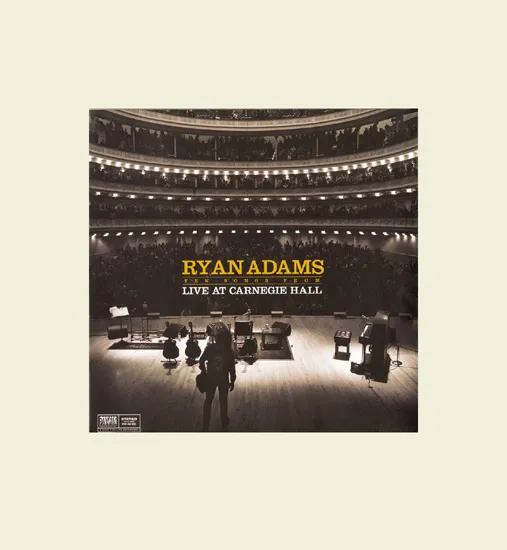
On the other side of our last 15 years with Ryan Adams, we have a man who seems happy, artistically fulfilled, and big enough to play Carnegie Hall. The album cover artwork captures this neatly: Adams’s rapt audience packing out the vast hall; the man himself hovering between the shadows and the spotlight. That’s what you get on Live at
Carnegie Hall: 42 tracks spanning two nights in the winter of 2014; just Ryan, his guitar, harmonica, and honeysuckle voice. Stripping everything down to an equal level, dodging his more polarizing work, and giving fans what they want. And you know what? Not a lot of people on earth can step to an opening triptych like “Oh My Sweet Carolina,” “My Winding Wheel,” and “Dirty Rain.”
The vinyl release of Live at Carnegie Hall is particularly handsome—a box set spanning six 180-gram records, imbued with all the ultra-limited fetishistic qualities that make collecting a worthy hobby. And while it might not be the definitive Ryan Adams suite (like it or not, you have to include albums like 29 and Orion in the biography), it might be the Ryan Adams I enjoy the most. Calm, peaceful, and actually kind of funny. “I would assume many of you, probably like 86 percent of you, are on Paxil, so you understand about depression,” he says during one particularly inspired bit of banter. “You’re at a fucking Ryan Adams show, you know what I mean?”
Like this?
Check out these three too
Check out these three too
Ryan Adams
Heartbreaker
Heartbreaker
Bob Dylan
Blood on the Tracks
Blood on the Tracks
Whiskeytown
Pneumonia
Pneumonia
AFRIKA BAMBAATAA & SOULSONIC FORCE
PLANET ROCK: THE ALBUM
by Gary Suarez
Like so many members of hip-hop’s first wave, Afrika Bambaataa came up during an era of gang factionalism and violent turf wars in New York City. A South Bronx native, he rose in the ranks of the Black Spades to become a warlord, a powerful title charged with some obvious responsibilities and duties. In the wake of 1971’s historic Hoe Avenue Peace Meeting and that street summit’s resultant treaty, Bambaataa built what would become a unifying, more peaceable organization ultimately dubbed the Universal Zulu Nation.
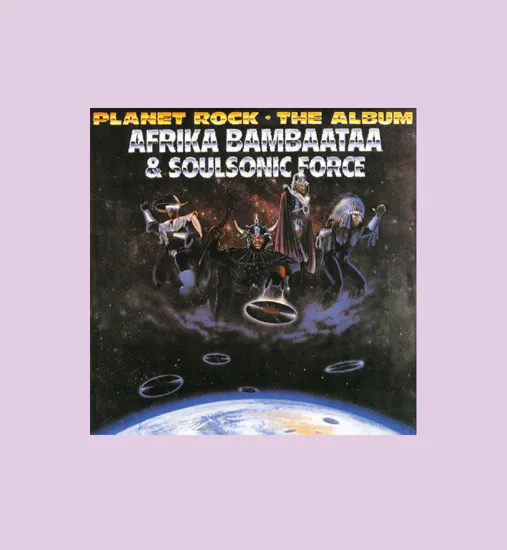
DJ Kool Herc’s legendary parties brought everyone together regardless of affiliation, prompting the former warlord to pursue his own musical path (though the Afrofuturist artwork on the cover gives a nod to Bambaataa’s warrior status). With co-production by dance-music pioneers Arthur Baker and John Robie, “Planet Rock” drew from Kraftwerk and Yellow Magic Orchestra to make something undeniably hip-hop, fusing two nascent genres in the process. A milestone in modern music history, the track was followed by the electro anthems “Looking for the Perfect Beat” and “Renegades of Funk,” making for a potent trio of early 1980s singles.
With seminal funk collaborations “Frantic Situation” with Shango, and “Go Go Pop” with Trouble Funk, Planet Rock: The Album is more than mere compilation, but a veritable Rosetta Stone for understanding late 20th-century American music. Much like George Clinton’s Parliament-Funkadelic saw their vision expand and multiply with the masses, these Soulsonic Force records aided in spearheading genre and cultural movements they didn’t necessarily even intend.
Detroit-techno originator Juan Atkins derived inspiration from Bambaataa’s work, in turn producing masterful Afrofuturist music of his own as Model 500 and other monikers. Bambaataa’s records like “Looking for the Perfect Beat” ushered in not only the 1980s electro scene but also the urban Latino sound known as Freestyle. Without Bambaataa, a teenaged Andre Young might never have become Dr. Dre, whose work as part of World Class Wreckin’ Cru and on early N.W.A. cuts like “Panic Zone” owes a great deal to Bambaataa’s vital template. For that latter example alone, Planet Rock: The Album merits replay after replay.
Like this?
Check out these three too
Check out these three too
Eric B. & Rakim
Paid in Full
Paid in Full
Grandmaster Flash & The Furious Five
The Message
The Message
Kool Moe Dee
Kool Moe Dee
Kool Moe Dee
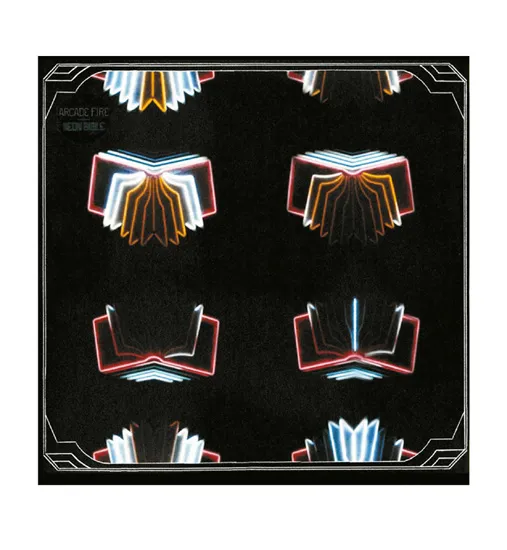
ARCADE FIRE
NEON BIBLE
by Levi J Sheppard and Joshua Lingenfelter
In early 2007, the news of a follow-up to Arcade Fire’s breakout release was everywhere. At the time, Arcade Fire had already amassed such a high level of critical acclaim from Funeral that everyone wanted to know if they could measure up to expectations. Fans could anticipate something dark, but no one knew which direction Win Butler would focus his gaze. Before the album hit shelves, the band went on a short concert tour of churches in Ottawa, Montreal, London, and New York City, a setting that was altogether appropriate and ironic. Like the experience of listening to the album, it felt like something sacred.
Funeral was universally accepted, in spite of—or perhaps thanks to—its dark and depressing themes of personal loss; Neon Bible takes the listener in a different direction, defiantly exploring personal and political issues—showing believable desperation in Butler’s voice when he sings, “I don’t wanna work in a building downtown” on “(Antichrist Television Blues).” The songs vary in tempo and intensity, but they all stand as expressions of discontentment and rebellion. In the echo of the tragic tones of Funeral, Neon Bible moves sadness further up the emotional scale to anger, while still holding on to hopefulness. The subject matter of the songs has as much to prove to the listener as the band did to the music industry upon the album’s release.
Here, the Bible is neon because the worship of advertising and materialism has become commonplace. This image serves to epitomize what this album is asking of the listener: to see the truth behind the bright lights. It’s a cathartic experience; a shelter from the pressures and absurdities of modern life; somewhere to feel consoled and to take comfort in the confessions of another; a place to get angry and then to feel the relief of finding that, outside your own windowsill, things might not be so bleak. Solidifying Arcade Fire’s reputation as being an honest band that sings about serious and urgent topics—a reputation that has continued to evolve well beyond the limits of their breakout efforts—Neon Bible is an album that proved Arcade Fire could still mine the depths of the well, for the purpose of lifting us to the lighthouse.
Like this?
Check out these three too
Check out these three too
Islands
Return to the Sea
Return to the Sea
Talking Heads
Fear of Music
Fear of Music
Wolf Parade
At Mount Zoomer
At Mount Zoomer
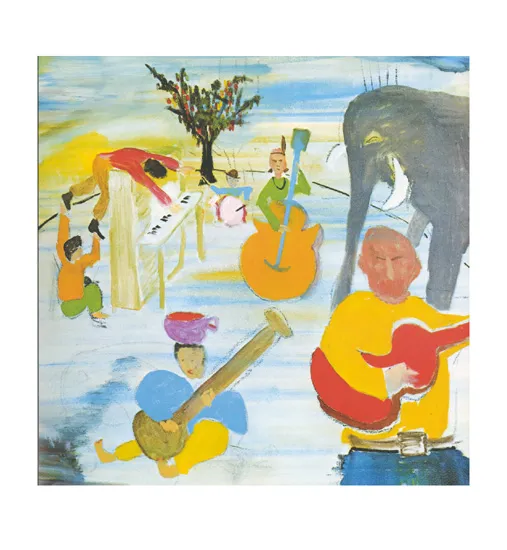
THE BAND
MUSIC FROM BIG PINK
by Jes Skolnik
Big Pink is a real house (yes, with siding the color of cotton candy) in West Saugerties, New York, not that far from Woodstock. It’s where Bob Dylan and The Band (then Hawks, the band that backed him on his infamous 1965–6 electric tour) would write and record what would become The Basement Tapes while Dylan recovered from his notorious motorcycle accident. It was where The Band began to find their own independent voice, where they composed much of the lovingly named Music from Big Pink (for which Dylan produced the bright, naïve cover art).
Growing up the daughter of erudite hippies who are both musicians themselves, Music from Big Pink loomed large in my childhood. The album, which bridges nearly every genre popular with my parents’ cohort at that time (rock, country, and folk, with bluesy R&B arrangements), didn’t sound terribly unique or interesting to my young ears. It wasn’t until I started reading about Dylan and The Band in my parents’ basement library of ’60s and ’70s rock journalism that I realized that Music from Big Pink had had such an inexorable impact on so much of the “classic rock” that had come after it—Clapton’s post-Cream bands, Pink Floyd, and so forth—that I was collapsing the experimental history-making template into everything it had influenced.
There’s “This Wheel’s on Fire,” a Dylan-penned basement song that offers ...
Table of contents
- Cover
- Title Page
- Contents
- Contributors
- Introduction
- A-D
- E-L
- M-R
- S-Z
- Index of Searchable Terms
- Picture Credits
- Afterword
- Acknowledgments
- Copyright Page
Trusted by 375,005 students
Access to over 1.5 million titles for a fair monthly price.
Study more efficiently using our study tools.
Frequently asked questions
Yes, you can cancel anytime from the Subscription tab in your account settings on the Perlego website. Your subscription will stay active until the end of your current billing period. Learn how to cancel your subscription
No, books cannot be downloaded as external files, such as PDFs, for use outside of Perlego. However, you can download books within the Perlego app for offline reading on mobile or tablet. Learn how to download books offline
Perlego offers two plans: Essential and Complete
- Essential is ideal for learners and professionals who enjoy exploring a wide range of subjects. Access the Essential Library with 800,000+ trusted titles and best-sellers across business, personal growth, and the humanities. Includes unlimited reading time and Standard Read Aloud voice.
- Complete: Perfect for advanced learners and researchers needing full, unrestricted access. Unlock 1.5M+ books across hundreds of subjects, including academic and specialized titles. The Complete Plan also includes advanced features like Premium Read Aloud and Research Assistant.
We are an online textbook subscription service, where you can get access to an entire online library for less than the price of a single book per month. With over 1.5 million books across 990+ topics, we’ve got you covered! Learn about our mission
Look out for the read-aloud symbol on your next book to see if you can listen to it. The read-aloud tool reads text aloud for you, highlighting the text as it is being read. You can pause it, speed it up and slow it down. Learn more about Read Aloud
Yes! You can use the Perlego app on both iOS and Android devices to read anytime, anywhere — even offline. Perfect for commutes or when you’re on the go.
Please note we cannot support devices running on iOS 13 and Android 7 or earlier. Learn more about using the app
Please note we cannot support devices running on iOS 13 and Android 7 or earlier. Learn more about using the app
Yes, you can access Vinyl Me, Please by Vinyl Me Please in PDF and/or ePUB format, as well as other popular books in Media & Performing Arts & Music. We have over 1.5 million books available in our catalogue for you to explore.