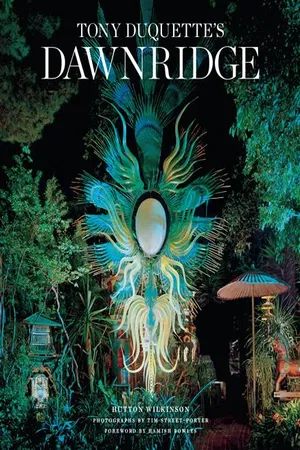
Designer Tony Duquette's legendary Dawnridge, located in Beverly Hills, is one of the most creatively designed private homes in America. Built in 1949 by Duquette and his wife, Elizabeth, the original structure was a modest 30 x 30 foot box. Hutton Wilkinson purchased the home following Duquette's death in 1999, and he has since breathed new life into the estate, broadening the property, adding houses of his own design, and incorporating remarkable objects designed and created by the Duquettes. Written by Wilkinson, Tony Duquette's Dawnridge chronicles the luxe and historic home's transformation. The book is organized by the three main houses, and Wilkinson elaborates on the spectacular design elements in each room and shares the stories behind the spaces. Tim Street-Porter's photographs show both the original and redesigned rooms.
- 256 pages
- English
- ePUB (mobile friendly)
- Available on iOS & Android
eBook - ePub
About this book
Information
Topic
ArchitectureSubtopic
Interior Design
CHAPTER TWO
Dawnridge
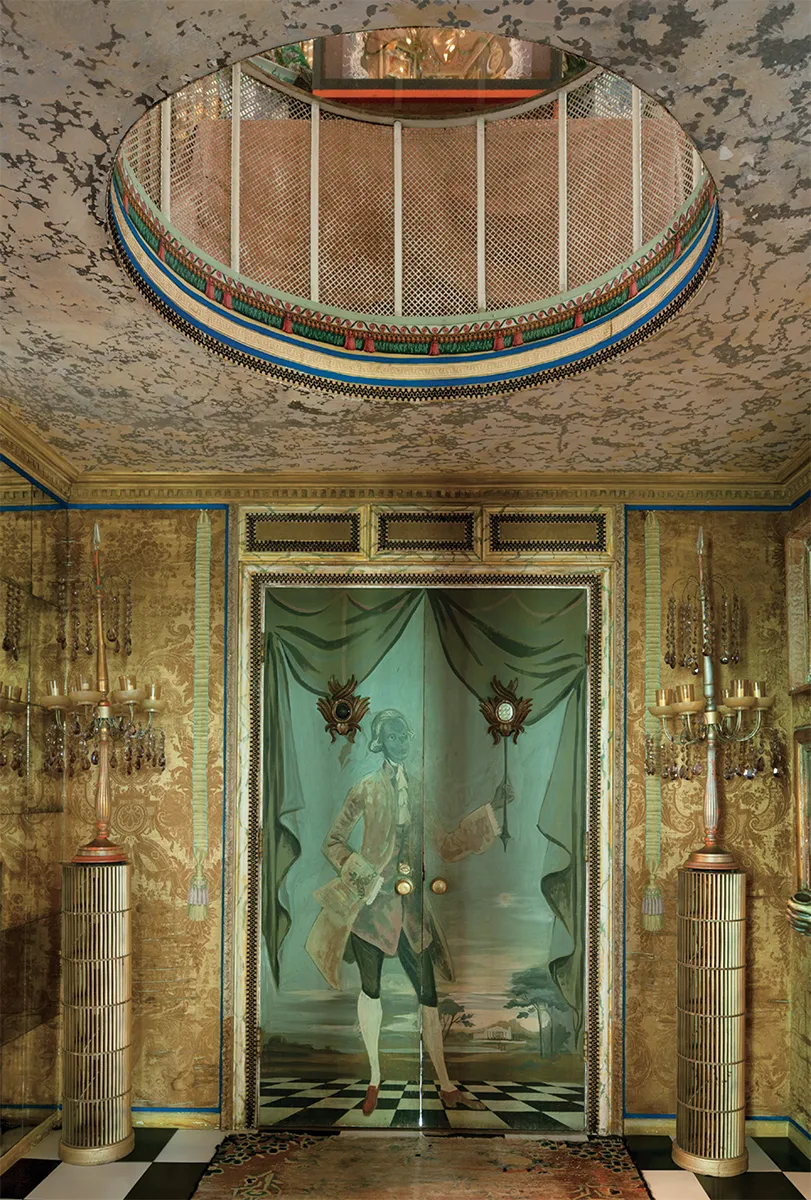
The entrance hall, 2018. On either side of the front door are ironic columns, which are made from discarded air filters, and hold Tony Duquette electrified crystal girandoles.
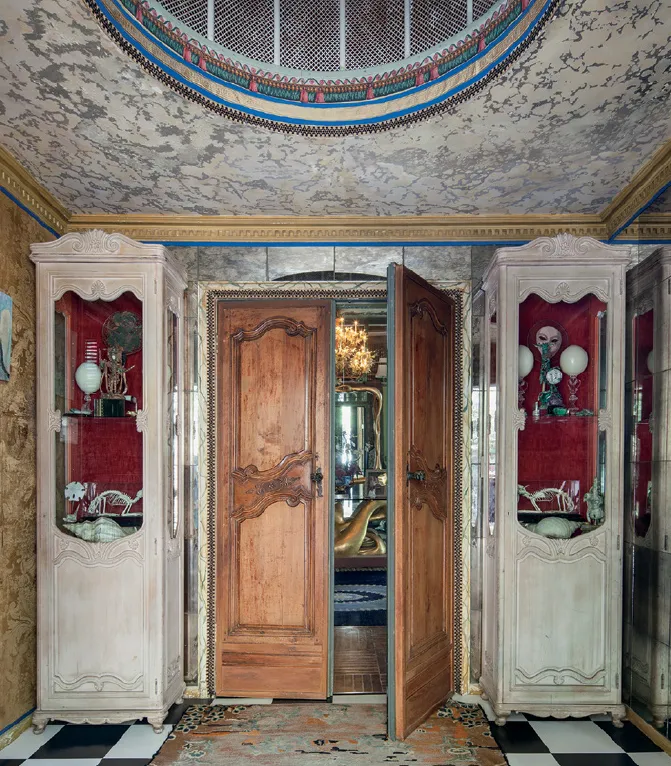
The entrance to the Drawing Room is now flanked by two French display cabinets, which were originally at the Robertson Boulevard studio.
The Entrance Hall
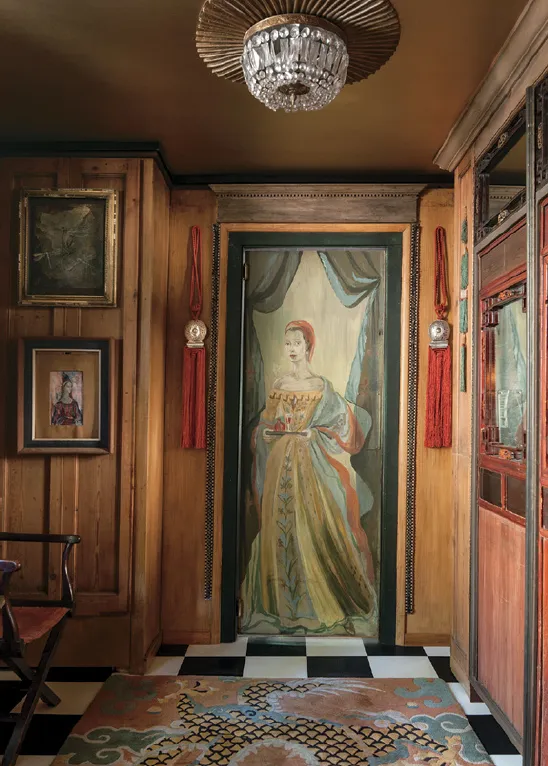
In 1949 Tony and Elizabeth covered two walls in the entrance hall with eighteenth-century citrine-colored damask backed with paper; the other two walls were paneled with squares of antique mirror. Beegle painted the door frames and crown molding with a fantasy faux marble in shades of yellows and blues. They created the doors leading into the Drawing Room from a pair of eighteenth-century French armoire doors, paneling the backs with sheets of clear mirror; antique Venetian bronze hands were used for the front and back door pulls. In the corners, on either side of the front door, there were two eighteenth-century Italian columns holding urn-shaped lamps with shades. Next to one of the lamps was a portrait of an eighteenth-century gentleman framed with seashells; below, a miniature bracket held an antique Spanish colonial retablo surrounded by a silver sunburst. On the opposite wall, on each side of the doors leading into the Drawing Room, a pair of eighteenth-century Italian polychromed figural stands purchased from designer James Pendleton held Tony Duquette coral-encrusted electrified crystal girandoles. The floor was made of black-and-white marbleized linoleum laid out in a checkerboard pattern. The back of the front door was painted by Beegle with the figure of a footman in eighteenth-century livery; the two pocket doors led into a vestibule and powder room on the the left, and a compact kitchen on the right. These doors also featured her artwork—images of ladies in court gowns, one leaving the kitchen with a tray of food and the other seen from the back entering the powder room.
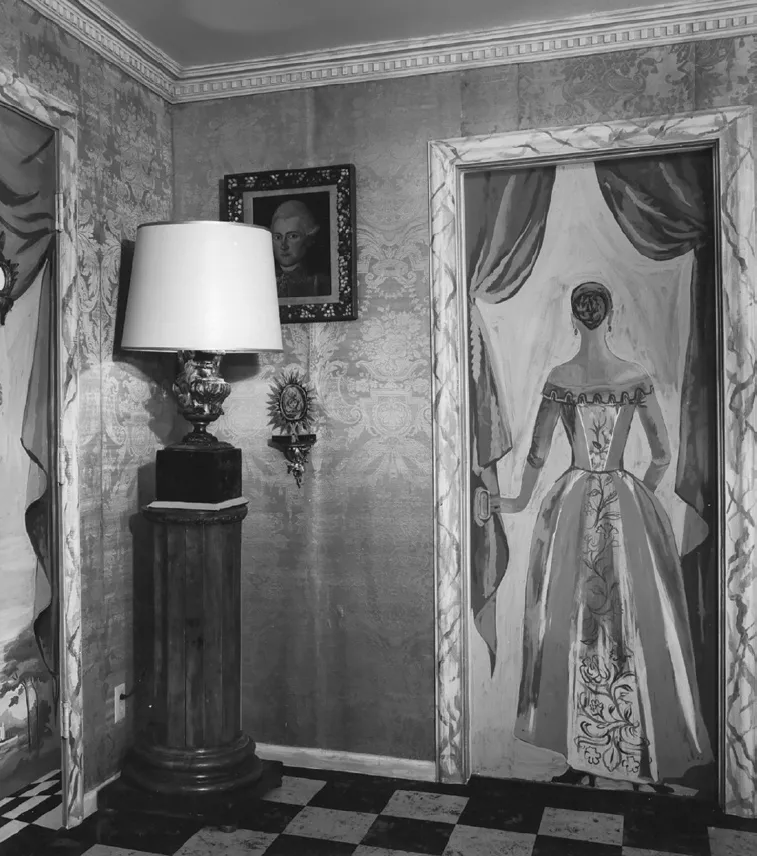
The entrance hall, 1949. Two of the walls are covered with paperbacked eighteenth-century yellow silk damask, and standing on both sides of the front door are eighteenth-century Italian fruitwood columns that hold carved and gilded urn-shaped lamps.
After Tony and Elizabeth moved back into Dawnridge in the 1970s, the only major change to the entrance hall was the addition of blue grosgrain ribbon around the silk damask and the placement of three wooden panels over the doors, which were also enhanced with edges of decorative trim. When the house next door burned down in 1974, the heat in Dawnridge's entrance hall was so intense that it caused the paint on the ceiling to blister and peel. Tony liked this visually . . . so he lacquered over the damage and it remains that way today. Beegle then painted the trompe l’oeil tassels on either side of the front door to disguise water stains caused by the humidity in the room after the fire. During this time, the Duquettes also removed the Italian columns by the door, replacing them with a pair of Roman stools with silk velvet upholstery that had been worn down to the nap.
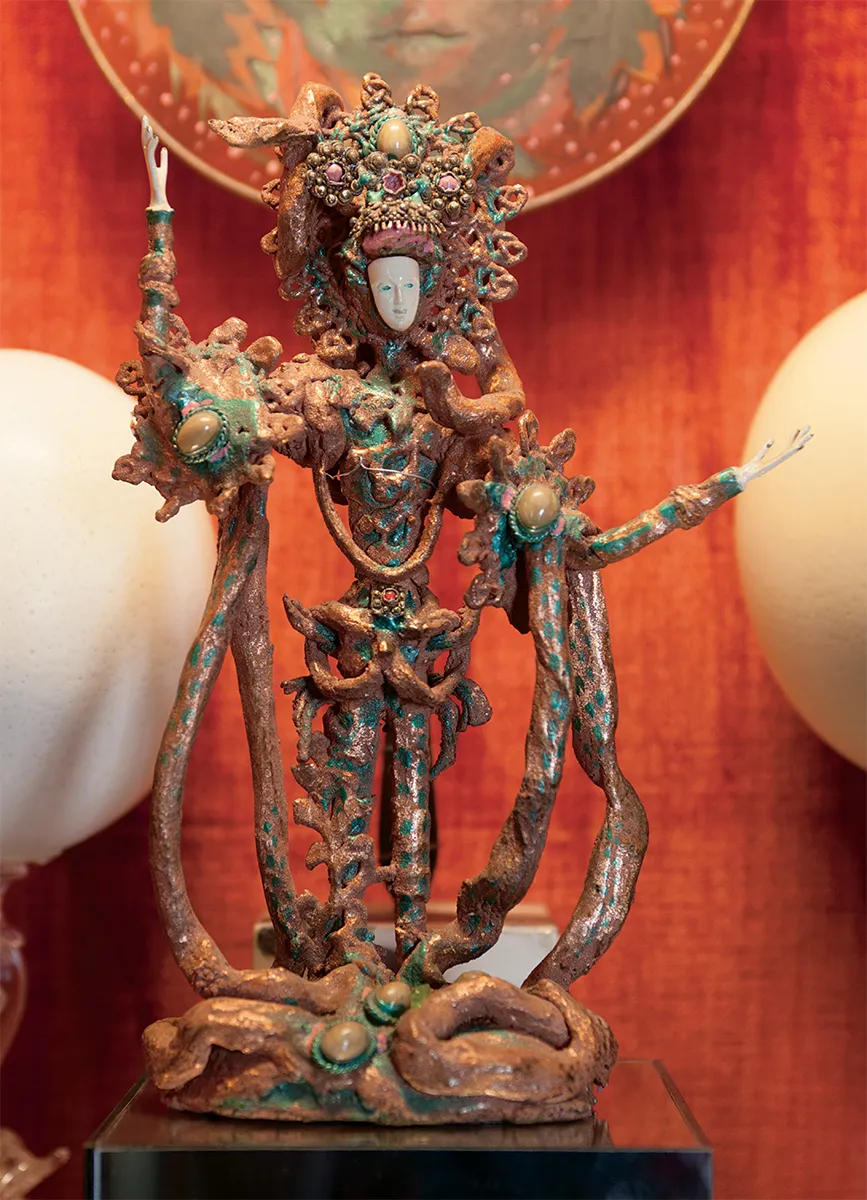
When my wife and I purchased the house in 1999, we had to rearrange the entrance hall because most of the antiques had gone to Christie’s. We replaced Pendleton’s stands with French vitrines—which used to stand on either side of the entrance to the ballroom at the Duquette Studio on Robertson Boulevard—and we filled them with objects including Tony’s wire-and-plaster figurines; ostrich eggs on Venetian glass stands; the Tony Award for Best Costume Design which he won for the original Broadway production of Camelot; cat skeletons, seashells, and corals; and the stuffed toads playing musical instruments that Tony and Beegle had purchased in Tijuana and painted to look like blue-and-white porcelain. Also displayed are the rocks the Duquettes picked up on the Malibu beach when they were beachcombing with their pal, artist Eugene Berman, who later painted faces on them and signed them E. B. 1944. Best of all are the two masks Tony constructed around the frames of a pair of antique Chinese fans, which he painted in 1951 for himself and Elizabeth to wear to the Vicomtesse Marie-Laure de Noailles’s ball La Lune Sur La Mer in Paris. Sitting on the same shelf are a Ming figure of Buddha in turquoise-glazed ceramic and a gilded bronze toad.
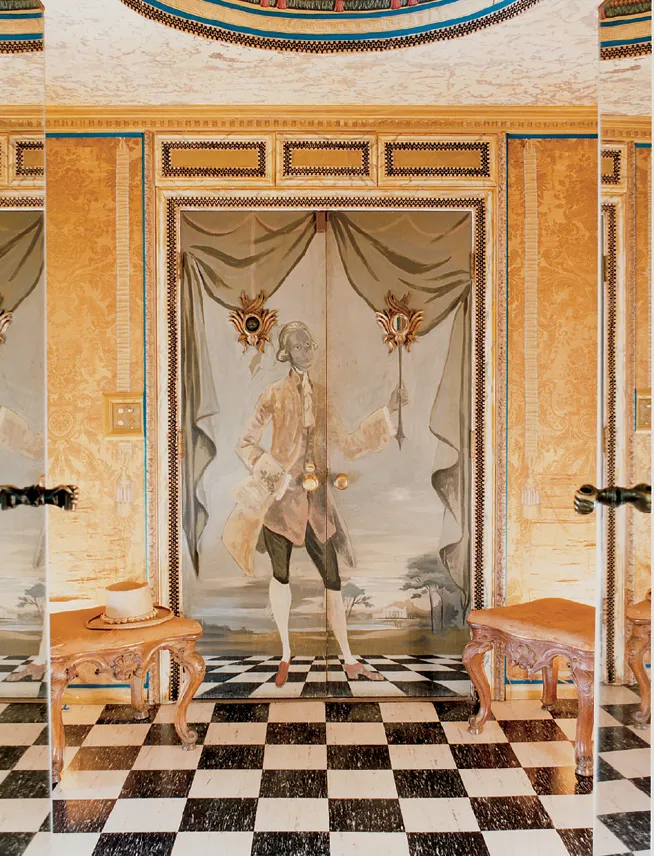
The entrance hall, 1975. Gone are the Italian columns, now replaced by a pair of eighteenth-century Roman stools where Tony conveniently threw his favorite straw hat with a feathered band.
On each side of the front door, I’ve placed what I call ironic columns—instead of Ionic columns. I made these from discarded air filters, which I stacked together and gilded. These hold a pair of Tony Duquette electrified crystal girandoles, which were salvaged from Cow Hollow, the Duquette house in San Francisco. The amber cups covering the light bulbs are made from plastic drinking glasses purchased from Pic 'N' Save. Photographer Tim Street-Porter once said, “Tony is the only man I know who can spend $999 in one visit to the 99¢ store!” The carpet is antique Chinese and sits on top of the new, more graphic linoleum floor, which is similar to the material first selected by Tony in 1949. Finally, I removed the sliding pocket doors—painted with Beegle’s figures—because they were forever hiding within the walls. They were moved to new locations and are now installed as swing doors.
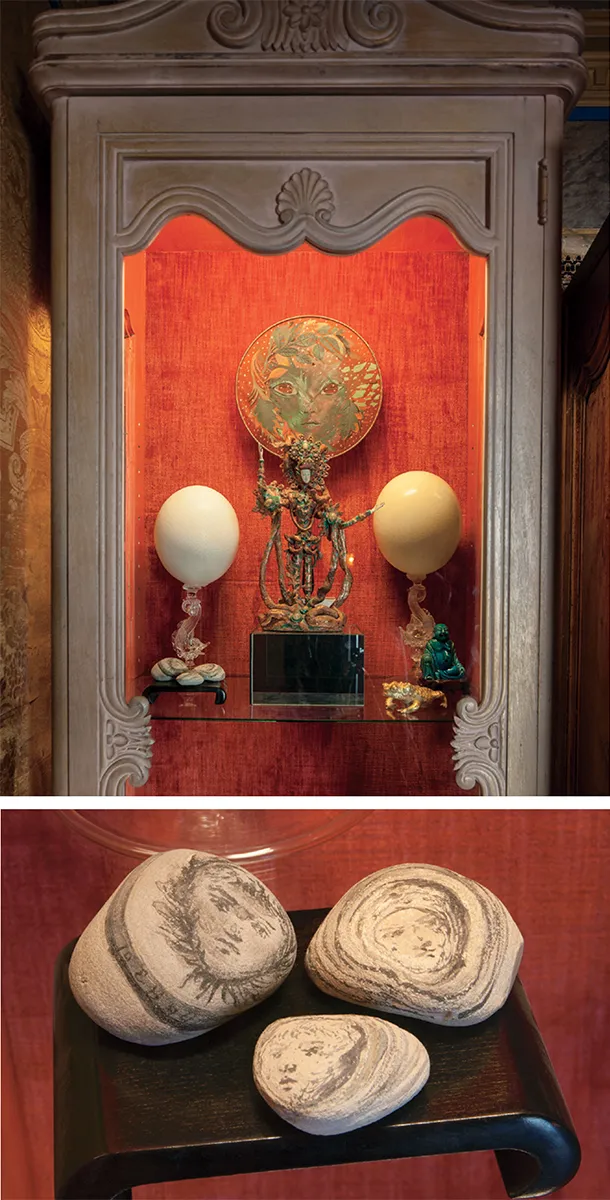
Details of the French display cabinet, 2018. The cabinet holds a number of objects cherished by Tony, including ostrich eggs on Venetian glass stands and a gilded bronze toad (top), three rocks picked up while beachcombing in Malibu with Eugene Berman (bottom), and a wire-and-plaster figurine made by Tony to display jewelry (next).

View from the bar across the entrance hall and into the Camelot Room, 2018. Originally a vestibule, I converted the space into a bar in 2000.
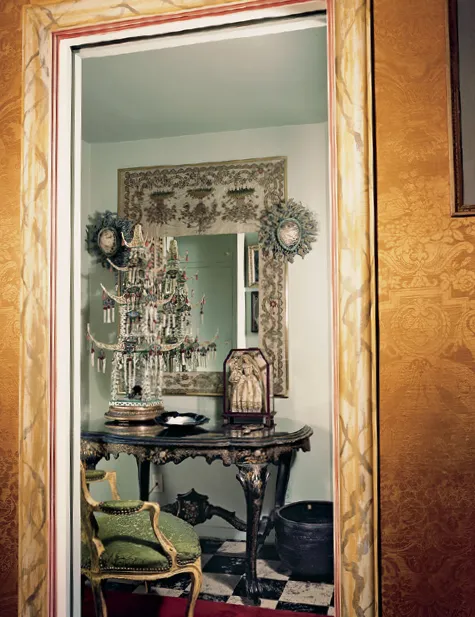
The vestibule, 1949
The bar, 2018. I removed the pocket door painted by Beegle and installed it as a swing door that leads into the new kitchen.
The Bar
In 1949 Tony decorated the vestibule with a nineteenth-century black lacquer papier-mâché table inlaid with mother of pearl, which he purchased from Jimmy Pendleton and later sold to Agnes Moorehead. On top of the table was a bead-encrusted Chinese pagoda designed by Tony as a Christmas decoration. He also created the mirror on the wall by framing an antique remnant of embroidered-and-bead-encrusted satin and then having only a portion of the glass “silvered” to show the textile’s elaborately worked borders. Elizabeth painted the pocket door (pushed into the wall) with the figure of a lady entering the room.
The former vestibule is now a bar. I moved the pocket door painted by Beegle and installed it as a swing door leading into the new kitchen. The room is decorated with paintings by Beegle, including one she created for the MGM film The Sandpiper, directed by Vincente Minnelli and starring Elizabeth Taylor and Richard ...
Table of contents
- Cover
- Dedication Page
- Title Page
- Foreword by Hamish Bowles
- A Living House
- One: The Dream
- Two: Dawnridge
- Three: The Gardens
- Four: The Casas
- Afterword: The Pleasure of your Company
- Index of Searchable Terms
- Photo Credits
- Acknowledgments
- Appreciation
- Copyright Page
Trusted by 375,005 students
Access to over 1.5 million titles for a fair monthly price.
Study more efficiently using our study tools.
Frequently asked questions
Yes, you can cancel anytime from the Subscription tab in your account settings on the Perlego website. Your subscription will stay active until the end of your current billing period. Learn how to cancel your subscription
No, books cannot be downloaded as external files, such as PDFs, for use outside of Perlego. However, you can download books within the Perlego app for offline reading on mobile or tablet. Learn how to download books offline
We are an online textbook subscription service, where you can get access to an entire online library for less than the price of a single book per month. With over 1.5 million books across 990+ topics, we’ve got you covered! Learn about our mission
Look out for the read-aloud symbol on your next book to see if you can listen to it. The read-aloud tool reads text aloud for you, highlighting the text as it is being read. You can pause it, speed it up and slow it down. Learn more about Read Aloud
Yes! You can use the Perlego app on both iOS and Android devices to read anytime, anywhere — even offline. Perfect for commutes or when you’re on the go.
Please note we cannot support devices running on iOS 13 and Android 7 or earlier. Learn more about using the app
Please note we cannot support devices running on iOS 13 and Android 7 or earlier. Learn more about using the app
Yes, you can access Tony Duquette's Dawnridge by in PDF and/or ePUB format, as well as other popular books in Architecture & Interior Design. We have over 1.5 million books available in our catalogue for you to explore.