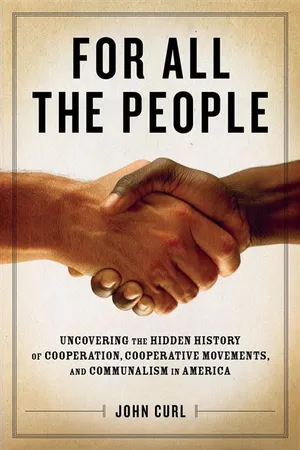
- 487 pages
- English
- ePUB (mobile friendly)
- Available on iOS & Android
eBook - ePub
Information
1
COOPERATIVES & COOPERATIVE MOVEMENTS
1.
Early Cooperation in America
NATIVE AMERICAN COOPERATION
The first North Americans to practice collectivity, cooperation, and communalism were, of course, Indigenous. The hundreds of tribes and nations north of Mexico each had its own distinct culture, language, traditions, and history, yet almost every account stresses community over individualism as their overriding core value, even among comparatively individualistic peoples. Cultural patterns of economic cooperation were clearly engrained in the fabric of every tribe. While this is a vast and complex area of study, some very general observations can help put what follows into perspective.1
The typical unit of an Indian society was the extended family, with a number of related adults in the same household who shared a common store of provisions and tools, and worked for the common benefit. Groups of extended families were organized into larger cooperative units, clans and bands. The collection of these family groups, clans, and bands made up the tribe. The concept of individual private property in land or natural resources was unknown. Tools were commonly shared within the communal group. It was unthinkable, for example, for one Inuit in a band to have two harpoons while another had none.2
Hunting and gathering peoples followed their food sources around with the seasons; food availability and the methods of gathering determined the size of the living group. At certain times of year, usually scattered groups would join into larger units for cooperative production, using methods not possible in smaller units.3
Shoshone families wandering west of the Wyoming Rockies would gather periodically with other families in their bands for cooperative rabbit hunts with nets. A successful hunt was not possible without a large enough number of coordinated people. They would form the nets into a semi-circle hundreds of feet long, then beat the brush and chase the startled rabbits into the trap. The Shoshone traditionally divided the catch equally among the families until common survival needs were met. Any family without nets—the means of production—usually got a slightly smaller share. They considered this fair because there was much work involved in tying, repairing and hauling the nets around, and because they made nets from readily available materials, accessible to any family who chose to put in the labor. These mutual-aid gatherings were not only for work, but were also social celebrations, and formed an integral part of Shoshone societal structure.4
The introduction of horses made hunter cooperation on a larger scale possible for the Lakota and many other tribes. Horses spread to the Western Native nations several generations before contact with whites, and a culture arose based on them, resulting in those celebrated epic buffalo hunts across the Great Plains involving hundreds of hunters. These were similar to the rabbit hunts but on a larger scale. They were mutual-aid gatherings of usually scattered bands, combining work and social connection. “The buffalo hunt was under the supervision of chosen and responsible leaders… It was understood that the herd was the prey of the entire community and that the chase was to be a united, group activity.”5 Hunters could win a larger share of the kill by their prowess, but no one went without. Preparing the great feasts that followed were cooperative and collective endeavors.6
Cooperation and collectivity also formed the backbone of the way of life of agriculture-oriented peoples. Since ancient times, the Southwest Pueblos have practiced collective and cooperative farming (and later herding). The Rio Grande valley Pueblos used cooperative irrigation and, in the high desert further west, the Hopi practiced cooperative dry farming.7
The Northwest coast tribes such as the Hupa, Yurok, Tillamook, and Chinook were based upon collective fishing. The tribe channeled the entire catch to an elder whose only power was to assure an equitable distribution according to need.8
Some form of collective democracy formed part of almost every Native social system north of Mexico. The Iroquois confederacy developed inter-tribal democracy on a large scale. Their Council of Sachems consisted of male elders from the various tribes appointed by female elders, and made decisions by unanimous collective consensus. Variations of the council-consensus system are the most typical form of Native political organization.9
Even today, sheep herding is largely pooled in a traditional Navajo extended family, although the animals are individually owned. The Navajo extended family members work collectively in many of their economic and domestic chores, such as harvesting planted fields. The group lives in a cluster of hogans (and today, houses) centered on an older woman, and includes her husband, unmarried children, married daughters with their husbands and children, and possibly other relatives. If they move to another location due to weather, foliage for the animals, or to seasonal camps for harvesting piñon nuts, they move as a group. A married man often visits his mother’s or sisters’ extended families and joins in their work.10
Despite the ravages of European invasion, collectivity, communalism, and cooperation remain the dominant texture of Indian life today, particularly of those tribes able to hold onto their land. Many tribes have tribal enterprises and production cooperatives, organized on partly traditional, partly “modern” lines. Collectivity and communalism are as integral to Native American culture and religion as are the tribe and the land.11
Today’s powwows are inter-tribal in essence, based on traditions combined from many tribes, yet with an infinite number of ever-changing variations. “Every summer there are powwows on every reservation and in urban communities where there is more than one Indian. We eat and dance and we have a good time. But there is more to it than that. We are sharing. We share the food, the dances, and the good times.”12
THE EARLY COLONIAL TRADITIONS
Close community survival cooperation permeated the entire way of life in Colonial America. This was true of all the waves of settlers: British, French, and Spanish. Settlers raised houses and barns, plowed fields, and built fences cooperatively and collectively. Mutual aid events like corn-husking bees, log-rolling bees (to clear land), sewing and quilting bees, apple paring bees, grain rings (threshing), bull rings (slaughtering), and ship launchings also served as social structures and gatherings that welded together the fabric of the working community of settlers in the same way that similar gatherings did among the Native peoples.13 As one historian has commented, “This power of the newly arrived pioneers to join together for a common end without the intervention of governmental institutions was one of their marked characteristics.”14
Barter and labor exchanges were widely practiced. Money was scarce and in many areas used only sporadically, making early country stores mostly barter centers. The incessant waves of displaced humanity found warmth and shelter on these troubled shores through cooperation, mutual aid, and sharing. As another historian noted, settlers banded together “because they needed each other. Westward-moving pioneers everywhere found group travel and group living normal.”15 Cooperation, not competition, resounded as the dominant chord across the continent among the working population.
THE SPANISH COLONIES
The Spanish settled the territories that are now the American Southwest through land grants made by the King of Spain to groups of emigrant families, usually twenty or more, beginning in the late 1600s.16 The Spanish Crown initiated this system to entice Mexican colonists to frontier areas with an offer of free land, which appealed to landless groups.17
“Community land grants,” issued to groups of ten or more married settlers, contained large sections of common lands called ejidos set aside for the use of the entire community. “Individual land grants,” made to particular people and families, also usually designated ejidos for general communal use, and common areas for pasture, watering, wood gathering, or hunting. Grants were also often made to newly founded towns, providing adjacent common lands for use by all residents. In addition, land grants were made to Indian pueblos, often simply confirming ancient rights to these territories, in exchange for their recognition of the Spanish Crown. These land grant policies governed settlement in all the colonies of Spanish America, and were modeled on similar customs in medieval Spain.18 The ejido system also had roots in indigenous Mexico. The basic unit of Aztec social organization was a group of interrelated families who farmed cooperatively called a calpulli.19 Mexican Indians usually accompanied colonist groups traveling north. After independence in 1821, the Mexican government continued these policies of land distribution. Spain and Mexico made a total of 295 land grants in the territory that eventually became the American Southwest, of which 154 were community land grants, including 23 grants of communal lands to the indigenous Indian pueblos.20 In 1848, most of the territory was still sparsely populated, with only a few large towns, and most of the approximately 60,000 settlers lived in these subsistence agricultural communities.21
Community land grants typically kept about 90 percent of their land in common, including pastures and forests, for collective use. The common ejido land could not be sold. Beyond that, each family owned a house and a farmable plot. The ejidos were self-governing and all males had a vote in biennial elections. Much work was done cooperatively and, on occasions, the whole village joined in projects for the common good, such as annual repairs of irrigation systems and roads. Tools were often collectively owned and used. The system was geared for group self-sufficiency under harsh conditions.22
Under the Treaty of Guadalupe Hidalgo, which formally ended the US-Mexican war in 1848, Mexico ceded a vast area to the US, including California, Nevada, Arizona, New Mexico, Utah, and parts of Colorado, Wyoming, Oklahoma, and Texas. The US in turn agreed to recognize all existing property ownership in the territories. But in practice, the US often did not protect the property of Mexican-Americans and their descendants, and in particular the common lands of community land grants. These have been in dispute ever since.23
In Mexico below the Rio Grande, ejidos were also under attack by land grabbers, and their restoration became one of the central goals of the Zapatistas in the Mexican Revolution of 1910.24 According to a celebrated account about the almost-mythic Emiliano Zapata, a full-blooded Indian, “In early 1914 some emissaries from a Michoacán rebel came to his camp at Pozo Colorado, to see if he was sincere. What was he really fighting for? How could he prove it? He had Robles [his aide] bring the Anenecuilco [his home village] documents, and he showed them to his visitors. ‘Por esto peleo,’ he said. ‘For this I am fighting.’”25 The documents that had been entrusted to him were the almost-sacred land grants of his village, written in the Nahuatl language and representative of the collective rights of the people to the land. New Mexico land grantees felt similarly about their ejidos, and many of their descendants, displaced from their ancestral lands, continue to do so today.26
THE ENGLISH COLONIES
During their first three years in America, from 1620 to 1623, the Pilgrims of Plymouth farmed and worked communally, depositing all the products of their work into a common warehouse and taking their needs from a common store.27 The first New England colony began as a commune, and later reorganized into a cooperative community. As an early historian stated, “Any attempt to treat of the cooperative efforts in Massachusetts without commencing...
Table of contents
- Cover Page
- Title Page
- Copyright Page
- Dedication
- Contents
- Introduction
- PART I: COOPERATIVES & COOPERATIVE MOVEMENTS
- PART II: COMMUNALISM
- Conclusion
- Appendices
- Bibliographic Essay
- Notes
- Illustration Credits
- Index
Trusted by 375,005 students
Access to over 1.5 million titles for a fair monthly price.
Study more efficiently using our study tools.
Frequently asked questions
Yes, you can cancel anytime from the Subscription tab in your account settings on the Perlego website. Your subscription will stay active until the end of your current billing period. Learn how to cancel your subscription
No, books cannot be downloaded as external files, such as PDFs, for use outside of Perlego. However, you can download books within the Perlego app for offline reading on mobile or tablet. Learn how to download books offline
Perlego offers two plans: Essential and Complete
- Essential is ideal for learners and professionals who enjoy exploring a wide range of subjects. Access the Essential Library with 800,000+ trusted titles and best-sellers across business, personal growth, and the humanities. Includes unlimited reading time and Standard Read Aloud voice.
- Complete: Perfect for advanced learners and researchers needing full, unrestricted access. Unlock 1.5M+ books across hundreds of subjects, including academic and specialized titles. The Complete Plan also includes advanced features like Premium Read Aloud and Research Assistant.
We are an online textbook subscription service, where you can get access to an entire online library for less than the price of a single book per month. With over 1.5 million books across 990+ topics, we’ve got you covered! Learn about our mission
Look out for the read-aloud symbol on your next book to see if you can listen to it. The read-aloud tool reads text aloud for you, highlighting the text as it is being read. You can pause it, speed it up and slow it down. Learn more about Read Aloud
Yes! You can use the Perlego app on both iOS and Android devices to read anytime, anywhere — even offline. Perfect for commutes or when you’re on the go.
Please note we cannot support devices running on iOS 13 and Android 7 or earlier. Learn more about using the app
Please note we cannot support devices running on iOS 13 and Android 7 or earlier. Learn more about using the app
Yes, you can access For All The People by in PDF and/or ePUB format, as well as other popular books in History & North American History. We have over 1.5 million books available in our catalogue for you to explore.