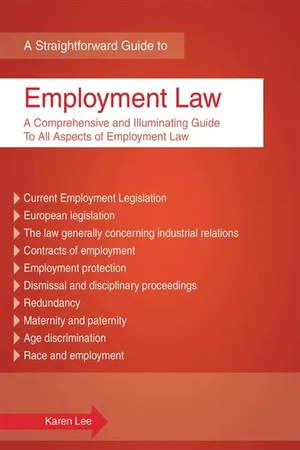
- 144 pages
- English
- ePUB (mobile friendly)
- Available on iOS & Android
eBook - ePub
Information
1
Overview of Employment Law
The framework of employment law applies as soon as a job is applied for. Employers have legal obligations when drawing up a job description, specification and shortlist for a particular job. Essentially, prospective employers must not discriminate against a candidate on the grounds of age, sex, race, religion or disability. There are laws to prevent this. Nor can any other factor such as trade union membership serve to work against you.
References
Prospective employers usually ask for references either prior to appointment or prior to interview. References vary but usually a previous employer should not provide a blatantly discriminatory reference which could jeopardise the chance of getting a job. However, they are under an obligation not to conceal certain facts, such as reasons for dismissal. The courts have taken the view that the duty is to provide a reference that is in substance true, accurate and fair. This was established in the key case of Spring v Guardian Assurance (1994) IRLR 460 where the complainant argued that a reference provided by a former employer was in breach of an implied term in the contract of employment that any reference would be compiled with all reasonable care. The House of Lords (Supreme Court) concluded that an employer has a duty to take reasonable care in compiling a reference by ensuring the accuracy of the information upon which it is based.
Application forms
When filling in an application form, it is clear that you should stick to the truth. In all cases, if it is found that you have lied when filling in an application form then that is a reason for dismissal. Few employers check educational qualifications and professional qualifications. This meant that in the past people were being employed to carry out jobs that they were not necessarily qualified to do. Companies now exist to check out CVs so honesty is the best policy.
Under the Immigration, Asylum and Nationality Act 2006 (which came into force on 29/2/2008), and which replaced the 1996 Immigration and Asylum Act, your employer must ask you for a National Insurance number or some evidence that you have the right to work in the UK. Employers have an obligation to carry out this check on all new employees. For employees who started work between 27/1/1996 and 28/2/2008 the 1996 Act applies. For full details of the kind of checks that need to be carried out and the sanctions against employers who do not comply visit the Home Office website on www.ukba.homeoffice.gov.uk.
Employers must also ask for criminal convictions. You do not have to reveal these if they are `spent'. This means that they happened long enough ago for the Rehabilitation of Offenders Act 1974 to allow you to keep them secret. lf you are required to work with children or vulnerable adults, you will need to provide a certificate of disclosure. This is an official document which can be obtained from the Disclosure and Barring Service which has replaced the Criminal Records Bureau under the Protection of Freedoms Act 2012. It lists any relevant previous convictions More information about the Disclosures and Barring Service can be found on the Home Office website..
Also, your prospective employer must check with the police that you have no convictions regarding children.
As soon as you have accepted a job, you will enter into a contract with your employer, even if you have received nothing in writing. The basic terms of offer and acceptance apply. See Chapter two for more details of contracts of employment.
Other rights in the workplace
There are many rights (and obligations) at work, which begin from the day your employment commences. These are covered in depth throughout this book. To summarise a few of the fundamental ones:
Time off for public and workforce duties
All employees are entitled to reasonable time off to perform public duties, including serving as a magistrate or a local authority councillor. Your contract of employment may give you a right to paid time off for such duties. In addition, trade union representatives, union learning representatives, company pension trustees and designated health and safety representatives are also entitled to paid time off work to carry out duties.
Losing or leaving a job
Both employer and employee are entitled to a minimum period of notice of termination of employment. After one months employment you must give your employer at least one weeks notice. Your employer must give you at least one weeks notice after one month’s employment up to 2 years and one week for every year after 2 years up to a maximum of 12 weeks, unless you are guilty of gross misconduct. Once you have had your job for at least a year, you can ask for a written statement of reasons for dismissal. You should be given one automatically if you get the sack while you are pregnant or on maternity leave.
The Unfair Dismissal and Statement of Reasons for Dismissal (Variation of Qualifying Period) Order 2012 increased the qualifying period for the right to claim unfair dismissal to two years for employees whose employment commenced on or after 6 April 2012.1 Before this, section 108 of the Employment Rights Act 1996 provided that employees had to have been continuously employed by their employer for at least one year to claim protection against unfair dismissal. In a variety of unfair dismissal cases specified by legislation, particular reasons for dismissal will be “automatically unfair”. In these cases there is normally no requirement for a continuous period of employment.
Relocation of work
If your employer moves the location of their business, your situation depends firstly on the terms of your contract of employment. Some contracts include a mobility clause which says you have to move within certain limits. The notice period to move has to be reasonable as do all the other aspects of moving. You may decide not to move because of increased travel time and costs, moving house, family situation or children’s education. If you don’t have a mobility clause in your contract, and the relocation is more than a short distance, you can decide not to move. In this case, your employer may make you redundant. See Chapter 6, Being Made Redundant. When you are facing redundancy there is a right to a trial period in any alternative job that you have been offered. Redundancy is a dismissal so if you feel badly treated you may be able to claim for unfair dismissal.
If your employer decides to relocate:
• Check your contract of employment to see if there is a mobility clause
• Find out whether your employer is offering a relocation package and, if so, whether you think it is reasonable
• Discuss the matter of moving with your employer and state your intentions. If you decide to move talk to your employer about a trial period in the job
• If you decide not to relocate and your employer considers that you are being unreasonable and refuses you a redundancy payment, you can take the matter to an Employment Tribunal (see Chapter 9) for them to decide whether you or your employer are being unreasonable.
Public and bank holidays
There is no statutory right to public and bank holidays as paid leave. This will generally be incorporated in your contract. Your employer may also count public and bank holidays as part of your annual leave. This is legal under the Working Time Regulations 1998 (see further in this book).
Transfer of a business
If your company is taken over, or if you work for the public sector and your job is transferred to the private sector, your terms and conditions of employment transfer automatically to the new employer. Continuity of employment is guaranteed. You have the right to raise objections about your contract being transferred to another company. However, this can he fraught with problems.
The transfer of contracts is known generally as the transfer of undertakings and is complex. Refer to the chapter on redundancy for more information. If you have a problem you will certainly need specialist advice from a union or other advice agency.
Sunday working
Certain groups of workers have protection in relation to working on a Sunday. They include shop workers and people who work in the betting industry. The aim was to allow those who do not wish to work on a Sunday to resist pressure to do so. However, if you have agreed a contract of employment that says you will work on Sunday then you do not have protection. Only employees who work in the above occupations have protection. For all other occupations, Sunday is just another day. There is also no legal right to extra pay for work on a Sunday although most contracts of employment will incorporate agreed overtime rates.
Insolvency of employer
If your employer goes bankrupt and cannot pay wages, the state will make up at least part of the pay. You can claim for statutory redundancy pay, wages up to a maximum of £430 (2012) for up to eight weeks. As well as basic ages you can claim any holiday pay up to 6 weeks, unpaid pension contributions and the basic award for unfair dismissal. You must apply to the employer's representative, usually the liquidator or receiver. You will be given a form which you should fill in and send off to the address on the form. HMRC will pay you any statutory sick pay, statutory maternity pay, statutory paternity pay and statutory adoption pay.
Suspension on medical grounds
In certain situations, usually for health and safety reasons, employers may feel obliged to suspend an employee from work on medical grounds. There are certain regulations under which medical suspension can apply - these usually involve working with chemicals or radioactive material or lead. There are also certain regulations in the Food Preparation industry which might lead to a suspension. This is because your Employer feels that you are a danger to your fellow employees!
Finally, if a pregnant woman is not able to carry out her normal duties, and no suitable alternative work can be provided, she can also be medically suspended from work.
If you are suspended from work on medical grounds in line with one of the qualifying regulations or conditions, then you are entitled to full pay for up to 26 weeks (as long as you have at least 1 months service). Any dismissal during this protected period is unfair. This does not apply if you are physically or mentally unfit for work. (If this is the case you will be entitled to some sick pay). It purely means that you are not capable of carrying out certain activities due to your condition. If you are offered suitable alternative work but refuse this, then no payment may be due to you. If your employer does not pay you, you can take a claim to an employment Tribunal, within three months.
Employment through agencies
Whereas once agency employment was tenuous, to say the least, all agency workers have some degree of protection under the 1973 Agencies Act. Recent legislation (Agency Workers Regulations 2010) has strengthened these rights. If you are working for an employment agency you may or may not be legally an employee. At the very least you will be a worker hired out to an employer to perform a service. Whether or not you are an employee, agency workers have basic rights:
All agency workers are covered by health and safety law, where the agency has a responsibility not to place you in a job for which you are not appropriately qualified and the company hiring you has a responsibility for providing a healthy and safe working environment.
-All agencies, and therefore agency workers, are covered by discrimination law, which also covers the hiring company.
-All agency workers are entitled to be paid the National Minimum Wage.
-All agency workers are entitled not to work more than an average of 48 hours a week unless you sign an agreement with the agency to the contrary.
-All agency workers should receive five weeks and three days paid annual leave once you have worked for more than 13 weeks.
Some agencies have been circumventing this by saying that your pay includes holiday pay and that they therefore do not have to pay extra if you take a break. It is unclear as to whether this is legal or not.
As an agency worker you may also be entitled to statutory maternity pay or paternity pay, depending on your earnings and how long you have worked for the agency. You are also allowed to join a union.
If you are an agency worker and you accept a permanent post then you are expected to work out a period of notice as an agency temp before becoming permanent. The company can also agree to pay the employer a lump sum to release you from your contract.
Other basic protections for agency workers are:
-You have the right to be paid by your agency, on the agreed day, even if the hiring company has not paid the agency.
-You must be consulted before any changes are made to the terms of employment or terms and conditions of employment.
Trade Union rights
A person has the right to decide whether they want to join a trade union or not. Employers are not entitled to know whether they are in a union. They should certainly not be asked questions at an interview about union membership, views or activity. Since 2004, Employers have not been allowed to offer incentives to an employee to leave a union, for example a higher pay rise to non-union employees.
If a person thinks they have been turned down for a job, or overlooked for promotion, because of their union membership or activity they should take further advice as this is a form of discrimination which is unlawful. The same applies if they think that they have been dismissed due to union membership or union activity. A special level of compensation is available for this.
A person can join any union of their choice, but obviously it is sensible to join a union whic...
Table of contents
- Cover
- Title
- Copyright
- Contents
- Introduction
- 1. Overview of Employment Law
- 2. Employment Contracts
- 3. Employment Contracts-terms of Contract
- 4. Employment Contracts-Implied Duties of the Employer/Employee
- 5. Pay and Conditions
- 6. Terminating Employment
- 7. Discrimination in the Workplace
- 8. Being Made Redundant
- 9. Health and safety at Work
- 10. The Role of Trade Unions
- 11. Solving Grievances Arbitration and Tribunals
- Useful Information
- Index
Trusted by 375,005 students
Access to over 1.5 million titles for a fair monthly price.
Study more efficiently using our study tools.
Frequently asked questions
Yes, you can cancel anytime from the Subscription tab in your account settings on the Perlego website. Your subscription will stay active until the end of your current billing period. Learn how to cancel your subscription
No, books cannot be downloaded as external files, such as PDFs, for use outside of Perlego. However, you can download books within the Perlego app for offline reading on mobile or tablet. Learn how to download books offline
Perlego offers two plans: Essential and Complete
- Essential is ideal for learners and professionals who enjoy exploring a wide range of subjects. Access the Essential Library with 800,000+ trusted titles and best-sellers across business, personal growth, and the humanities. Includes unlimited reading time and Standard Read Aloud voice.
- Complete: Perfect for advanced learners and researchers needing full, unrestricted access. Unlock 1.5M+ books across hundreds of subjects, including academic and specialized titles. The Complete Plan also includes advanced features like Premium Read Aloud and Research Assistant.
We are an online textbook subscription service, where you can get access to an entire online library for less than the price of a single book per month. With over 1.5 million books across 990+ topics, we’ve got you covered! Learn about our mission
Look out for the read-aloud symbol on your next book to see if you can listen to it. The read-aloud tool reads text aloud for you, highlighting the text as it is being read. You can pause it, speed it up and slow it down. Learn more about Read Aloud
Yes! You can use the Perlego app on both iOS and Android devices to read anytime, anywhere — even offline. Perfect for commutes or when you’re on the go.
Please note we cannot support devices running on iOS 13 and Android 7 or earlier. Learn more about using the app
Please note we cannot support devices running on iOS 13 and Android 7 or earlier. Learn more about using the app
Yes, you can access Straightforward Guide To Employment Law by in PDF and/or ePUB format, as well as other popular books in Law & Labour & Employment Law. We have over 1.5 million books available in our catalogue for you to explore.