- 210 pages
- English
- ePUB (mobile friendly)
- Available on iOS & Android
eBook - ePub
Information
Topic
MedicineSubtopic
General HealthChapter One
How Cancer Affects Nutritional Status
Not everyone who is diagnosed with cancer experiences nutritional problems. However, many people experience nutritional problems before they are diagnosed with cancer-losing weight and suffering symptoms such as nausea – and may become depleted in nutrients early on. In addition, some cancer treatments are known to have negative effects on nutritional status – so for those people not experiencing nutritional problems early on, it would be sensible to consider adopting nutrition therapy principles to help ‘build up’ for treatment.
Regardless of current nutritional status, it is important to engage in some form of nutritional therapy as early as possible, as up to 80% of people diagnosed with cancer experience some degree of under-nutrition at some point during cancer treatment.
Cancer can have an impact on nutritional status in a number of different ways.
Weight loss is a common symptom experienced by people with cancer. Around 4 out of 10 people (40%) have unintentional weight loss when their cancer is diagnosed. The commonly used terms; cachexia (kak ex ee a) or wasting syndrome describe the complex state of weight loss and under-nutrition associated with cancer. Cachexia comes from the Greek words Kakos, meaning ‘bad’ and Hexis, meaning ‘condition’.
The weight loss caused by cancer is associated with losses of both muscle and fat. It is caused by a combination of changes in metabolism and often a reduction in dietary intake, due to the side effects of the cancer and its treatment. The weight loss caused by cancer is very different to weight loss through diet or exercise where the majority of weight loss is fat.
Changes in metabolism impacting on nutritional status
The bodies’ normal process of metabolism (the breakdown and usage of the different nutrients) is affected by cancer. Cancer actually changes the way our body breaks down and uses fat, protein and carbohydrates.
Changes in metabolism caused by cancer:
• Changes in fat metabolism – The stores of fat in the body are broken down much more quickly and the rate that the body stores fat is reduced. This means that overall stores of body fat are decreased.
• Changes in protein metabolism – The human body does not have any stores or reserves of protein. This is because all the protein within the body has important functions to fulfil. Most of the protein within the body is used to make up muscle, but protein also plays a major role in the immune system. Cancer causes the breakdown of these vital body proteins and reduces the generation of new proteins. When the body breaks down its own proteins, a process known as catabolism, this can have effects on body weight, muscle strength, organ function and the immune system.
• Changes in carbohydrate metabolism – The body is not able to use carbohydrate as efficiently as should. This inefficiency may account for up to 300kcals a day of lost energy.
Due to these changes in metabolism, it can be very difficult to reverse weight loss associated with cancer and this is why early and continued nutritional therapy is really important. Trying to protect and minimise the loss of body proteins and fat stores should be a major goal of nutritional therapy.
In addition to these changes in metabolism, cancer also increases Basic Metabolic Rate (BMR). BMR is the rate at which food (calories) is used up. When BMR is raised, the body is said to be in a state called ‘hyper metabolism’. This means that the bodies’ overall nutritional requirements are increased. So, despite eating a seemingly sufficient diet, weight may be lost because the body is burning calories much faster than normal.
Figure 1.1 Hierarchy of metabolism
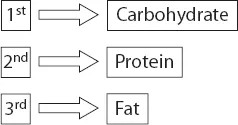
Figure 1.1 illustrates the hierarchy of metabolism – the way that different food groups are used as energy in the body. Figure 1.1 shows that the first source of energy the body will use is carbohydrates. During periods of reduced dietary intake or more specifically reduced carbohydrate intake, body proteins and then fat stores are called upon for energy to fuel the body. In a state of hyper metabolism, these energy sources are called upon more quickly to ensure there is sufficient fuel for the body.
If the way different food groups are used for energy is considered, it is clear that in the first instance, having sufficient carbohydrates is crucial to help protect against the breakdown of body proteins and fat stores.
Loss of appetite impacting on nutritional status
Loss of appetite may sometimes be called anorexia. It is a common symptom of cancer. Appetite is created by, and controlled through, complex processes in the body. The environment around us and how we think and feel can also influence appetite. The loss of appetite often experienced by people with cancer is thought to be caused, in part, by the cancer itself. It is thought that cancer releases chemicals into the body, which directly decrease appetite. Loss of appetite may also be experienced due to symptoms of the cancer and side effects of treatment.
Whatever the cause, loss of appetite has major effects for people with cancer and can be difficult to overcome. It is important to try and identify the causes for the loss of appetite, in order to use specific nutritional therapy to help overcome them.
Symptoms of cancer impacting on nutritional status
As already discussed, weight loss, due to a combination of loss of appetite and changes in metabolism, is a major symptom of cancer. Tiredness and fatigue are also common side-effects with most types of cancers. There are also other less obvious, or less well-known symptoms, which can become major obstacles to optimising nutritional intake for people with cancer.
Different types of cancer can have specific nutritional problems associated with them and each need to be identified and individually addressed.
The diagnosis of cancer impacting on nutritional status
Coping with a diagnosis of cancer may have an affect on eating and drinking. A diagnosis of cancer can be life changing and it can be frightening. It may cause feelings of anxiety, low mood and around 40% of people with cancer report difficulties concentrating and a lack of energy. Support during this difficult time is essential for everyone and counselling may help to cope.
Cancer treatment impacting on nutritional status
Cancer treatments may have side effects which can contribute to under-nutrition. Some treatments may have a direct impact on a person’s ability to eat and in some cases nutritional support may be required.
A note on weight gain
Some cancer treatments can in fact contribute to weight gain. However, the weight gain experienced by some may be associated with the natural aging process, rather than the treatment itself.
Being a healthy weight is important for health, but actively trying to lose weight whilst undergoing cancer treatment is certainly not advisable. During treatment, having a healthy, well-balanced diet may help to prevent gains in weight. Once treatment is complete, it may be useful to seek support from a registered dietitian, support group or slimming club.
The most effective way to lose weight is by focusing on having a healthy, balanced diet and increasing physical activity levels.
Key Points
Cancer can have an impact on nutritional status in a number of different ways. Each problem requires specific nutritional therapy to address and help overcome it.
Readers Notes on Chapter One: How Cancer affects Nutritional Status.
Chapter Two
Why Nutrition is so Important for People with Cancer
The physical effects of under-nutrition, namely weight loss, are easy to recognise. However, under-nutrition can affect all body cells, organs and functions and can also have an impact on social and psychological health.
Being well nourished can help a person to:
• Cope with the side effects of cancer treatment.
• Handle the most beneficial dose of certain cancer treatments.
• Recover and heal.
• Fight off infections.
• Feel strong.
• Maintain energy levels.
• Have a shorter hospital stay.
When the body is under-nourished all body functions can be affected.
An inadequate intake of nutrients, not only means an inadequate intake of energy, but also means a lack of essential vitamins and minerals. And hence, the effects of under-nutrition can be wide ranging.
The effect of under-nutrition on body functions
The body is made up of billions of body cells that maintain life and growth. Body cells are produced, perform a function and then die. Some body cells tend to live, performing their function, for longer than others.
Body cells that only live for a short period of time (i.e. are produced, perform a function and then die relatively quickly), are known as ‘rapid turnover’ cells. These cells can be seriously affected by under-nutrition because constant supplies of nutrients are needed to produce them. Therefore the functions of the body that uses these rapid turnover cells can also be seriously affected by under-nutrition.
Functions of the body, which use rapid turnover cells include:
1. Digestion
2. Blood cell produc...
Table of contents
- Cover
- Title
- Copyright
- Contents
- Introduction
- Chapter One: How Cancer Affects Nutritional Status
- Chapter Two: Why Nutrition is so Important for People with Cancer
- Chapter Three: Understanding and Support
- Chapter Four: How to Measure Nutritional Status
- Chapter Five: The Goals of Nutrition Therapy
- Chapter Six: Nutritional Therapy
- Chapter Seven: Principles of Food Hygiene
- Chapter Eight: Problems Affecting Nutritional Intake
- Chapter Nine: Fortifying the Nutritional Content of the Diet
- Chapter Ten: Nutritional Supplements
- Chapter Eleven: Artificial Nutrition Support
- Useful Cancer Charities
- Appendices – Nutritional Status Monitoring Forms
- Index
- About the Author
Trusted by 375,005 students
Access to over 1.5 million titles for a fair monthly price.
Study more efficiently using our study tools.
Frequently asked questions
Yes, you can cancel anytime from the Subscription tab in your account settings on the Perlego website. Your subscription will stay active until the end of your current billing period. Learn how to cancel your subscription
No, books cannot be downloaded as external files, such as PDFs, for use outside of Perlego. However, you can download books within the Perlego app for offline reading on mobile or tablet. Learn how to download books offline
Perlego offers two plans: Essential and Complete
- Essential is ideal for learners and professionals who enjoy exploring a wide range of subjects. Access the Essential Library with 800,000+ trusted titles and best-sellers across business, personal growth, and the humanities. Includes unlimited reading time and Standard Read Aloud voice.
- Complete: Perfect for advanced learners and researchers needing full, unrestricted access. Unlock 1.5M+ books across hundreds of subjects, including academic and specialized titles. The Complete Plan also includes advanced features like Premium Read Aloud and Research Assistant.
We are an online textbook subscription service, where you can get access to an entire online library for less than the price of a single book per month. With over 1.5 million books across 990+ topics, we’ve got you covered! Learn about our mission
Look out for the read-aloud symbol on your next book to see if you can listen to it. The read-aloud tool reads text aloud for you, highlighting the text as it is being read. You can pause it, speed it up and slow it down. Learn more about Read Aloud
Yes! You can use the Perlego app on both iOS and Android devices to read anytime, anywhere — even offline. Perfect for commutes or when you’re on the go.
Please note we cannot support devices running on iOS 13 and Android 7 or earlier. Learn more about using the app
Please note we cannot support devices running on iOS 13 and Android 7 or earlier. Learn more about using the app
Yes, you can access Ultimate Nutrition Guide For Cancer Sufferers, Their Family And Friends by in PDF and/or ePUB format, as well as other popular books in Medicine & General Health. We have over 1.5 million books available in our catalogue for you to explore.