
- 160 pages
- English
- ePUB (mobile friendly)
- Available on iOS & Android
eBook - ePub
Information
1
Introduction: Encounters in Marikana
Luke Sinwell, Thapelo Lekgowa,
Botsang Mmope and Bongani Xezwi
Botsang Mmope and Bongani Xezwi
On a blistering hot afternoon in Marikana just a few weeks after the brutal massacre of 16 August 2012, 10,000 striking workers carrying knobkerries and tall whips waited patiently in the sun. Four of us, researchers from the University of Johannesburg, found ourselves in the midst of the crowd. The mood was unclear, but seemed volatile. The workers were singing ‘makuliwe’ [isiXhosa for ‘let there be a fight’]. We felt the force of the movement. One wrong move by the police could shift this peaceful moment into yet another bloody affair.
Following the massacre, workers had started moving in tight-knit battalions, using these formations to protect themselves, especially the strike’s leaders. In what has become an emblemic feature of this workers’ resistance movement, the group stopped and kneeled about 20 metres from the police vehicles. At this point five madoda [men] stepped forward to negotiate. As the workers explained, ‘we can all sing, but we can’t all speak at once’. The five madoda are the voices of the masses behind them, and they could be alternated at any time depending on negotiating capabilities and who they were speaking with. Their plan was to head for the smelter (where the platinum is processed and refined) demanding that it shut down its operations. At this stage, 95 per cent of workers at Lonmin, the third largest platinum mine in the world, were on strike. The smelter was the only unit still operating and the marchers wanted the workers there to join the strike.
Marikana was in effect witnessing an undeclared state of emergency. Police and Lonmin were on one side, and the workers were on the other. Over the next week, a thousand troops were deployed and orders were given by the police that people must stay off the streets. On this particular day, 12 September, the carloads of local and international media that had been camping out at the scene sped off quickly. It seemed like an evacuation. We wondered if we were in the wrong place at the wrong time. Two of us thought it was unsafe and wanted to flee; the other two felt we should stay and observe. In the end we didn’t have much choice. Suddenly the mass of workers kneeled to the ground. There was no space to drive our car away, so we too kneeled down. We learned later from the workers that this was to ensure a calm and quiet environment for the five madodas’ negotiations. The workers were also very cautious. They crouched with their weapons down and to their side, as they did on 16 August when they were attacked. At the same time, they were ready to pick them up and fight, but only if it was necessary to defend themselves.
There was no academic training that could have prepared us for our experiences that day, or for others that came before and after. Each one offered us new challenges as researchers and, more importantly, as human beings. As we learned more about this merciless and bloody massacre through the workers’ voices and eye-witness accounts, we came to the realisation that this was not only preventable, it had been planned in advance. In contrast to the dominant view put forth by the media, government and the National Union of Mineworkers (NUM), which suggests that the workers were an unruly and dangerous mob who needed to be controlled and contained, we learned that the workers were, and remain, disciplined, peaceful and very well organised. The consciousness of South Africans and others has been scarred by media footage that makes it seem like strikers were charging the police, and defending themselves against savages. As several of the eye-witness accounts of workers who were on the mountain during the massacre testify, and as Peter Alexander recounts, workers were not on the offensive, but were literally running for their lives on 16 August. Some were even shot in the back or in the back of the head while running away.
This is the first book that attempts to understand the massacre on 16 August. It can only provide a starting point for future scholarship and it does not attempt to explain what happened from the perspective of all stakeholders involved. Moreover, when framing the raw interviews that follow, we have extended beyond superficial journalistic accounts, probing into the experiences and lives of the miners. This has only been possible because of a concern to build relationships of trust in a tumultuous, albeit very short, period of time. Too often, researchers go into a locality in order to obtain information from respondents but have limited commitment and never return. This can create a situation in which locals are sceptical of future researchers and refuse to share what they know. We have sustained relationships with many of the workers and have, in small but certain ways, acted in solidarity with them. Of course it would be naïve to assume that this limited engagement over only a few months could produce ethnographic depth, but we hope that it will be the start of a longer engagement.
While the primary focus of our research and interviews was the men who were on the mountain, our most hard-hitting and heartwrenching experiences were often with the family members, wives and children of the victims. Interviews and other forms of research can take an emotional toll both on the respondent and on the researchers. For Thapelo and Luke, our most painful experience was visiting the families of the deceased in the Eastern Cape, where we began creating biographies of the 34 men who were killed. We attended two funerals and visited seven families in total; entering hut upon hut, seeing family upon family in their rural villages in the poorest province of South Africa, from which most of the workers have migrated. The families were in their mourning period, but still they opened their hearts to us.
We watched six young children playing—none of them had any idea that their father was dead. Rather, as is the tradition, they were told ‘Daddy won’t be coming home anymore’. It is only later in life that they will learn that their father was killed by police for the ‘crime’ of fighting for his right to a better life. To these children things were just normal. We felt helpless when the families asked us for immediate help. People poured out their problems and told us what the solution might be, hoping that we would pass on the message to the powers that be. The words are still haunting us: ‘Go ask government and Lonmin who will be feeding these kids.’
We stayed late one night in Marikana West, the township where many workers live. Bongani and Luke were interviewing one of the workers who had been arrested on 16 August, but he did not want to give us information without the approval of his lawyer. He asked us to walk, through the dark and empty streets, to his home where he had the business card of his lawyer. When we arrived we realised that he was a backyard dweller who was staying in a tiny zinc shack. As we were about to get to his door his wife came out, very distressed, and stated quietly but firmly and in an angry tone: ‘My brothers, get inside! I want to know why are you here?’ As we went inside she demanded proof of our identities. She then explained:
I am asking because there are people around our area who call themselves researchers. Who come to our houses and take our husbands for an interview. And that will be the end of us seeing our husbands. That thing happened in Bop [Western Platinum] Mine when a husband was taken by interviewers and he was never found.
We tried to explain the purpose of our research and why we were in Marikana. We showed them our University of Johannesburg identity cards. After a few minutes she became calmer and accepted our purpose. As we walked out of the shack we became really aware of the tension the community was dealing with. No one felt safe and people believed that outsiders could even kidnap and kill their loved ones. This was the environment of post-massacre Marikana. We decided to avoid speaking to people at night as much as possible, both because we feared for our own safety and because we did not want to make residents feel more uncomfortable.
Late in the afternoon, Botsang entered Nkaneng, an informal settlement in Marikana from which one can see the mountain where the workers were killed. What follows was remembered clearly: I felt uneasy and I shivered. I had never walked in that settlement alone and I did not know how the people there would react to me. It seemed as if everyone was looking at me, and with my yellow University of Johannesburg bag, they could tell that I was a stranger. I was taken by a man into a one-room shack where a woman, a widow of one of the mineworkers killed on 16 August, sat on the bed. One young girl was in the room making tea. That one room was used for sleeping, as a living room, for bathing and for cooking.
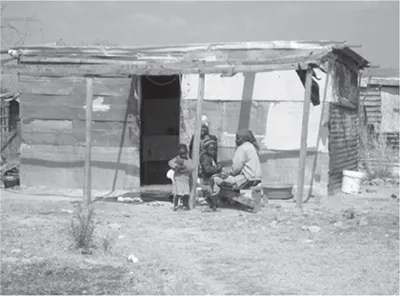
A shack in Nkaneng informal settlement, which provides a home for many mineworkers and their families.
The widow and I were left alone and I explained to her the purpose of the research we were doing—so that the next generation could understand what happened during the massacre. She began to open up. I asked her if her husband had ever discussed what happened during the strike. She explained that her husband was earning about R4,000 before he passed away. Her husband’s back, she said, had been full of scars. He was a rock drill operator (RDO), the group that initially led the strike in Lonmin, and the rocks would fall on his back, injuring him. She recounted that on 16 August he was arrested and murdered by the police while he was on strike with others fighting for better pay. The family found him in a mortuary in Rustenburg. It looked as though his skull had been slashed with something like a panga, and the mortuary refused her and the family entry when they wanted to see the rest of the body. She then asked me:
Actually, who ordered the police to kill our husbands, was it Lonmin? Or, was it the government that signed that the police must kill our husbands? Today I am called a widow and my children are called fatherless because of the police. I blame the mine, the police and the government because they are the ones who control this country.
I then proceeded to ask her about the future of her children and she responded:
Our future is no more and I feel very hopeless because I do not know who will educate my children. My husband never made us suffer. He was always providing for us. The government has promised us that they will support us for three months with groceries, but they only gave us three things: 12.5 kg of mealie meal, 12.5 kg of flour and 12.5 kg of samp. That’s it. My husband was sending us money every month and we had enough to eat. Now the mine has killed him. The children of the police who killed him eat bread and eggs every morning while my children eat pap with tea.
Her family consists of six children, five of whom are in school while one is looking for work. The other day, the younger son was asking his older sister: ‘Why is Daddy not coming home?’ He had heard that his father and others were fighting with the police at the foot of the mountain. ‘Where is he?’ he inquired further. A nine-year-old girl asked her [mother], ‘Mommy, why are the police killing Daddy, while we are still so young?’
The above encounters highlight that we did not go to Marikana untouched by people’s experiences with life, death and struggle. The neutral researcher who is detached or not affected by his or her own positionality and perceptions of what is taking place is an illusion. The call to end the strikes and the statement that the workers were threatening the economy or the value of the rand, something we read in the newspapers every day, are providing one story. There is another, that, when compared with their bosses, the workers deserve R12,500, which was their demand, and that they were brutally murdered in the interests of capitalist labour relations of production. While the former ignores the structural and actual living and working conditions of the miners, the latter has received virtually no attention in mainstream analyses.
Perhaps nowhere has the conflict between working-class power and capitalist interests been more acute, and rarely has it spilled more blood. The Marikana Judicial Commission of Inquiry, launched on 1 October 2012 without the knowledge of the families or victims, and with very few workers actually present, may conclude otherwise. It aims to provide ‘truth and justice’ on the basis of evidence presented to the commissioners, but it has not observed working conditions underground and operates in a courtroom environment alienating for ordinary people. In fact, key leaders of the workers’ committee have been arrested, intimidated and tortured during the time in which the commission has taken place, and we therefore question the extent to which the commission is able to provide a space that is not biased against the workers’ perspective. One of the main aims of this book is to fill this gap. Whatever the official conclusion, we maintain that Marikana was not just a human tragedy, but rather a sober undertaking by powerful agents of the state and capital who consciously organised to kill workers who had temporarily stopped going underground in order to extract the world’s most precious metal—platinum.
But not all has been bleak. While we have been saddened, we have also been inspired. The strike at Lonmin symbolised, as much as ever, raw working-class power—unhindered by the tenets of existing collective bargaining and middle-class politics. The workers developed their own class analysis of the situation at Lonmin and, instead of being silenced and falling back when the steel arm of the state mowed down 34 of their colleagues, they became further determined, and more workers united until all of Lonmin came to a standstill.
Workers realised that NUM was too close to the bosses and obstructed their struggle, and that the other union involved, the Association of Mineworkers and Construction Union (AMCU), lacked the formal bargaining rights that could advance their demands. In order to be strong, they needed to unite amongst themselves. There had been earlier meetings of representatives from the various shafts, but it was the first general meeting, held on 9 August, that brought together all Lonmin’s RDOs in order to formulate a memorandum that reflected the demands of the entire work population—for a salary of R12,500. An independent workers’ committee was elected representing the three segments of Lonmin—Eastern, Western and Karee—and it became directly accountable to the workers.
The leaders were elected on the basis of their historical leadership in recreational spaces, the community and the workplace. Mambush, or ‘the man in the green blanket’, one of the leaders who was killed during the massacre, had obtained his nickname from a Sundowns’ soccer player named ‘Mambush Mudau’. He was chosen since he had organised soccer games and always resolved minor problems in the workplace. He was particularly well known for having a mild temperament and for his conflict-resolution skills both at the workplace and at his home in the Eastern Cape. Others were chosen because they had previously dealt with emergencies that had occurred in the communities where the miners had originated, including the Eastern Cape, Lesotho, Swaziland, Mozambique and elsewhere. When someone passes away in Wonderkop, workers often show their leadership by taking responsibility for the process of alerting the family of the miner and organising to ensure that the body gets to the respective home and that miners are transported to the funeral. They also manage and collect donations from co-workers to give to the family of the deceased. The workers’ committee was reconstituted several times—some gave up, others were killed, while some remained on the committee from its inception on 9 August until after the strike.
This workers’ agency and leadership is no obscure radical rhetoric or theory of ivory tower academics or non-governmental organisations (NGOs). Rather, it is the unfettered praxis of the working class—which could not be contained, even with national security, the ANC, NUM, and the ideology of the ruling class pitted against it. This book provides a history from below—a story of ordinary people who had previously been relegated to the margins of society. Here, we acknowledge them for their involvement in the strike and for their bravery during an extraordinary and tragic moment in time. The pain of the workers seeps through their stories. It is tangible, sometimes gut-wrenching. We hope you can understand the massacre through the lens of the victims, those who continue to mourn the deaths of their loved ones and colleagues.
In the core of the book, we let the Marikana workers speak for themselves. NUM leaders deny certain of the testimonies given. We undertook more than 30 formal interviews, joined workers’ and community representatives for their meetings, participated in protests, and engaged in countless unrecorded conversations. Finally, we were privileged to be able to meet with a reference group of 14 strikers, many of them part of the leadership, six representatives from the community and two AMCU leaders. We included interviews in this book that are largely representative of the workers’ voices. The interviews that we excluded do not challenge the narrative put forward in the book. Rather, they tend to confirm it.
A large number of the interviews were conducted under the mountain, where workers held meetings in the open air, others were on the streets and some were in people’s homes. Some of the interviews contain material that deals with personal biographies of mineworkers in order to help the reader to understand how and why they came to Marikana. We do not draw this out extensively, but rather allow the readers to form their own impressions.
In the beginning we engaged with almost anybody prepared to talk with us, but later were able to interview leaders of the strike. The people we interviewed stood a very real chance of being victimised by the police or Lonmin, so we have made them anonymous. Anonymity was an undertaking made to our interviewees, and it is one that perhaps contributed to gaining testimony unvarnished by public exposure. For the most part our research was completed before lawyers started taking statements, at which point narratives may have become formalised and less spontaneous. We do not know of previous academic interviews gained so soon after a massacre, and we hope that this contributes to the unique character of the volume.
For the book, space constraints compelled us to make a selection from our main interviews. These are preceded by three background interviews. The first of these is with the president of AMCU, a union that sympathised with the strikers and to which many of them belonged. We think the interview is important because the union’s voice has been under-represented and widely misrepresented in the media, sometimes maliciously so. A second interview is with an RDO, who talks about his job, and a third is with a miner’s wife. We then include sections of three speeches given in the days immediately after the massacre; the first two by strike leaders, the third by the general secretary of AMCU. Ten interviews with mineworkers follow the speeches.
Before the interviews and speeches, there is a narrative account of events lea...
Table of contents
- Cover
- Title
- Copyright
- Contents
- About the authors
- Acknowledgements
- Maps of the area
- 1 Introduction: Encounters in Marikana
- 2 The massacre: A narrative account based on workers’ testimonies
- 3 Background interviews
- 4 Speeches
- 5 Interviews with mineworkers
- 6 Analysis and conclusion
- They died at Marikana
Trusted by 375,005 students
Access to over 1.5 million titles for a fair monthly price.
Study more efficiently using our study tools.
Frequently asked questions
Yes, you can cancel anytime from the Subscription tab in your account settings on the Perlego website. Your subscription will stay active until the end of your current billing period. Learn how to cancel your subscription
No, books cannot be downloaded as external files, such as PDFs, for use outside of Perlego. However, you can download books within the Perlego app for offline reading on mobile or tablet. Learn how to download books offline
Perlego offers two plans: Essential and Complete
- Essential is ideal for learners and professionals who enjoy exploring a wide range of subjects. Access the Essential Library with 800,000+ trusted titles and best-sellers across business, personal growth, and the humanities. Includes unlimited reading time and Standard Read Aloud voice.
- Complete: Perfect for advanced learners and researchers needing full, unrestricted access. Unlock 1.5M+ books across hundreds of subjects, including academic and specialized titles. The Complete Plan also includes advanced features like Premium Read Aloud and Research Assistant.
We are an online textbook subscription service, where you can get access to an entire online library for less than the price of a single book per month. With over 1.5 million books across 990+ topics, we’ve got you covered! Learn about our mission
Look out for the read-aloud symbol on your next book to see if you can listen to it. The read-aloud tool reads text aloud for you, highlighting the text as it is being read. You can pause it, speed it up and slow it down. Learn more about Read Aloud
Yes! You can use the Perlego app on both iOS and Android devices to read anytime, anywhere — even offline. Perfect for commutes or when you’re on the go.
Please note we cannot support devices running on iOS 13 and Android 7 or earlier. Learn more about using the app
Please note we cannot support devices running on iOS 13 and Android 7 or earlier. Learn more about using the app
Yes, you can access Marikana by in PDF and/or ePUB format, as well as other popular books in Economics & Labour Economics. We have over 1.5 million books available in our catalogue for you to explore.