- 288 pages
- English
- ePUB (mobile friendly)
- Available on iOS & Android
eBook - ePub
Information
Part 1
Sport in a capitalist society
Chapter 1
CAPITALISM AND THE BIRTH OF MODERN SPORT
The political and economic changes of the 17th and 18th centuries produced unprecedented prosperity for those who rode the wave of capitalist development. An explosion of innovation and invention mirrored, and was underpinned by, the thriving economy. For more than a century England would consider itself the centre of scientific enquiry, intellectual progress and industrial advance. It would also become the birthplace of codified sport.
Jack Broughton produced the first written rules for boxing in 1743. He had enjoyed a successful career as a bareknuckle fighter under the patronage of the Duke of Cumberland before opening his own amphitheatre in London, staging bouts and exhibitions for a wealthy clientele. In the world of horseracing the Jockey Club was formed sometime around 1752, although at this stage its influence did not extend much beyond the confines of Newmarket. It was, according to Mike Huggins, “a particularly select, self-elected, aristocratic, private club”.1 Much the same could be said of the Marylebone Cricket Club (MCC), whose members were drawn from the privileged elite, and which produced a revised set of rules for the game in 1788 (the first written rules had been produced by a select group of “Noblemen and Gentlemen” in 1744 and were updated 30 years later). As Mike Marqusee has written, “The same people who passed [the] laws in parliament drew up the Laws of Cricket, and for much the same purpose”.2
The codification of sports echoed the development of the modern nation state. The ideas employed by the ruling class to organise their games were inspired by those deployed in their organisation of society: written “laws” replaced custom; “independent” officials passed judgement on transgressions of these rules; and a “neutral” authority would preside over disputes. This was especially important given that the immediate trigger for codification was gambling.
Betting on the outcome of sporting events had become something of a national obsession, allowing the rich an ideal opportunity to flaunt their wealth. The legendary George Osbaldeston, a one-time member of parliament, ran up a £200,000 gambling debt before his death in 1866. Often the outcomes of matches were contested and aggrieved parties would appeal to the courts in a bid to have bets honoured. Standardised rules were designed to keep disputes to a minimum. We therefore find stipulations to cover gambling in cricket’s early articles of association, while in boxing, three of Broughton’s rules outlined what constituted victory while another dictated how prize money was to be distributed.
It would be a mistake, therefore, to see these early examples of codification as attempts to create frameworks for national sports. The evidence suggests people wrote rules purely to formalise the game that they themselves were playing. Indeed the MCC and, to a certain extent, the Jockey Club were reluctant to accept and exercise their growing power. In part their evolution towards governing bodies was fuelled by perceptions of social class. Clubs would appeal to their “social superiors”, asking them to adopt the role of adjudicator. This is apparent in horse racing where, “in the desire to avoid disputes ending up in the law courts, many courses placed themselves under the club’s jurisdiction”.3 Even then their development was slow and fraught with argument. As cricket developed from a parochial pastime, practised in pockets of the country, towards a national sport, the MCC prevaricated on all sorts of issues—much as they do today. Overarm bowling was finally permitted in 1864, while the number of players allowed on each team was not standardised until 1884. They did at least fare better than the early attempt to create an organisation to oversee boxing. The Pugilism Club was formed in 1814 but would last only a decade, folding in 1824.
There was also an economic imperative driving codification. The popularity of the sport as a spectacle was clear as early as 1743 when 10,000 people watched a cricket match at the Artillery Ground in Finsbury.4 Entrepreneurs were quick to spot this emerging market. The wider moves in society towards enclosure found their echo in the establishment of “grounds” on which matches were played. When Thomas Lord purchased the land which would become the home of the MCC he erected a fence round the ground and charged sixpence for admission. Simultaneously people were excluded from the game and transformed into paying spectators.
Grandstands were built at racecourses across the country and entrance fees applied. The stand at Epsom was built in 1830 and could hold 5,000 people; Ascot’s appeared in 1837. Given the financial success of these developments it was inevitable that other areas of courses would be enclosed. At Epsom the main betting ring and the saddling enclosure were both sectioned off in the decade following the construction of the grandstand. At all sporting venues the sale of food and drink (particularly alcohol) provided another potentially lucrative revenue stream and helped to solidify the relationship between sport and business. Bureaucrats, bookies and brewers combined to commercialise sport, turning pastimes into industries. To that end changes to rules could help make games more entertaining and attractive. The MCC reduced the time between each innings to speed up games of cricket, and the monotony of long batting innings was tackled by allowing round arm bowling. Such changes were not always successful. The result of a revised code for boxing issued in 1838 was a series of dull, overly-long fights which left crowds cold.5
The popularity—and profitability—of sport was aided by a number of other developments. Railways allowed teams and spectators to travel further for matches, bouts and meets, and their results were reported quicker than ever before thanks to the advent of the electric telegraph. The sporting press grew in size and popularity. Papers had long carried information about sporting events—the Weekly Journal was advertising fights in 1715—but there was now an explosion of titles providing coverage: the Sunday Times and Bell’s Life in London appeared fortnightly from the 1820s, and the Sporting Review once every month.
During the 19th century, as its popularity grew, sport acquired an ideological role that ran parallel to its commercial value. Public schools promoted and developed team games which they believed would instil the qualities of manliness and leadership in the children of the upper middle class. In addition middle class reformers put an end to working class blood sports, and the clergy preached the virtues of a healthy body and a healthy mind under the auspices of “Muscular Christianity”. But it was the 18th century that had acted as the midwife of modern sports, imprinting it with its own distinctive markings: “The primacy of cold cash, and with it the subjugation of all to the rule of law”.6
Capitalism and the poor at play
Most people in the 18th century lived rural lives, scratching out an existence from agricultural labour. The harshness of existence was offset by numerous fairs and festivals, which proved ideal opportunities for playing games. Taverns and public houses also played a central role in the lives of the poor in town and country alike: “The yards, greens and grounds of the drinking place provided the spaces in which sports as diverse as skittles, quoits, bowls, boxing, wrestling, tennis, foot-racing, cricket and any number of activities featuring animals could be staged”.7
One of the more well-known games played at the time was folk or festival football, versions of which took place across the country and are often seen as the forerunners of football and rugby. In contradistinction to modern sport, folk football would invite mass participation. As Guttmann argues, “There was room for everyone and a sharply defined role for no one. The game was played by the entire village”.8 Certain areas made provision for separate children’s games and it seems that matches were not purely the preserve of the village men. The poet Sir Philip Sydney wrote in the 16th century, “A tyme there is for all, / My mother often sayes, / When she, with skirt tuck’t very high, / With girls at football playes”.9
It would, of course, be a mistake to say that there were no rules in the various football games, although to the untrained eye the mass of bodies often looked like a sea of lawlessness. In 1602 Richard Carew produced a vivid description of the Cornish game of hurling detailing the rules that governed the match:
The Hurlers are bound to the observation of many lawes, as, that they must hurle man to man, and not two set upon one man at once; that the Hurler against the ball, must not but, nor hand-fast under girdle; that he who hath the ball, must but onely in the others brest; that he must deale no Foreball, viz. he may not throw it to any of his mates, standing neere the goale, than himselfe.10
This account would suggest a game with a relatively sophisticated set of rules, but one in which codification is absent. The rules, though often customary, were the products of the players. There were no lawmakers outside of the game itself and no governing bodies overseeing the games’ development. Similarly the matches themselves were devoid of officials, the players themselves dealing with any transgressions of accepted practice.
Unsurprisingly the ruling class has never been very keen on the lower orders having fun. “The idea that the poor should have leisure”, as Bertrand Russell said, “has always been shocking to the rich”.11 Between 1300 and 1650 folk football was banned on at least 30 separate occasions.12 For example Edward III had outlawed football as it interfered with archery practice, while in 1603 James I issued a Royal Decree which stated, “I debarre all rough and violent exercises, as the foot-ball, meeter for mameing than making able users thereof”.13 These sporadic attempts to prohibit playful recreation should come as no surprise. What is interesting is that they failed.
Capitalism’s dynamic was driving changes that would leave no corner untouched and, unlike the previous attempts to curtail the leisure activities of the poor, its expansion would systematically erode the old ways of playing. Malcolmson suggests that “around 1800 the undermining of popular recreations was already well under way, and the process was to continue for at least another half century”.14
The enclosure movement represented the most fundamental attack on the lives of the poor. Between 1700 and 1845 parliamentary acts led to the privatisation of half the ground that was formerly considered public space. Without common rights people faced the stark choice of starvation or searching out employment in the growing industrial urban economy.
Inevitably the quest for private ownership of land also eroded the space available for games and pastimes. By 1824 Robert Slaney could say that, “owing to the enclosure of open lands and commons, the poor have no place in which they may amuse themselves in summer evenings, when the labour of the day is over, or when a holiday occurs”.15
Those driven from the land into the welcoming arms of the early industrialists were to undergo a profound change in the way they experienced time itself. The rhythms of life dictated by changing seasons were replaced by the demands of the factory. It was, as E P Thompson surmised, “the contrast between ‘nature’s’ time and clock time”.16
The leisure of the new working class was an impediment to productivity and profitability. The difficulty in forcing the inexperienced workforce to accept work-time discipline stemmed in no small part from their adherence to a number of holidays. Gradually the old feast days and festivals were eliminated. In 1761 there were 47 public holidays; by 1834 this figure had been reduced to four.17 It was through “the division of labour; preachings and schoolings; the suppression of fairs and sports—[that] new labour habits were formed, and a new time-discipline was imposed”.18 Capitalism had revolutionised the world of work and in so doing had also fundamentally transformed the world of play.
Chapter 2
IN DEFENCE OF SPORT
The revolution will inevitably awaken in the British working class the deepest passions which have been so skilfully restrained and suppressed by social conventions, the church and the press, and diverted along artificial channels with the aid of boxing, football, racing and other forms of sport.
—Leon Trotsky1
Some chapters in this collection will criticise aspects of sport, while others will show how sport can be used to challenge certain aspects of capitalism. However, there are elements within sport that are often underplayed or ignored and yet are worthy of celebrating; specifically its potential for fun, grace, beauty, human drama, excellence, excitement and spectacle.
While socialists readily appreciate a wide range of cultural activities, including music, art, theatre, Scandinavian and (certain) US TV drama series, sport finds it difficult to make the cut and often faces a hostile reception. In this chapter I want to argue that to dismiss sport, its participants and fans is patronising and that, as with much under capitalism, things are contradictory. Can you be a revolutionary socialist and still enjoy sport? Does sport encourage “un-socialist” ideas of competition? Why is wanting England to lose seen as politically progressive? In this piece I’ll try to address these questions and, accepting that sport is contradictory, suggest that a more subtle approach is needed than that typically offered.
To dismiss sport as simply a modern-day opiate or “bread and circuses” is to adopt a one-dimensional, crude Marxist approach that fails to adequately explain its popularity, misjudges its content and underestimates its potential.
Defending sport often sees one pigeonholed as a dupe who is guilty of not exercising sufficiently critical analysis. It may be that socialists who don’t enjoy sport have never done so and that not everyone appreciates the simple pleasure gained from running, jumping, kicking, throwing and catching. Without wishing to trivialise things, are the most vociferous critics of sport those who were the last to be picked in the school yard? Socialists need to engage with (but not necessarily in) sport and, maybe along the way, they might get to appreciate certain aspects. I don’t like the jazz played by Miles Davies or John Coltrane, nor do I like modern dance, but, and here’s the point, I accept that other people might like them.
As some in this collection will suggest, the charge...
Table of contents
- Cover
- Title
- Copyright
- Acknowledgements
- Contributors
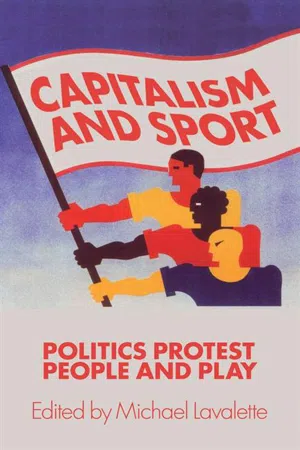
- Introduction: Capitalism and Sport: Politics, Protest, People and Play: Michael Lavalette
- Part 1: Sport in a capitalist society
- Part 2: Global sport
- Part 3: The sporting gods that failed
- Part 4: Sporting divisions
- Part 5: People
- Part 6: Resistance
- Part 7: Alternative futures?
- Conclusion: The contradictions of capitalist sport: Michael Lavalette
- Notes
Trusted by 375,005 students
Access to over 1.5 million titles for a fair monthly price.
Study more efficiently using our study tools.
Frequently asked questions
Yes, you can cancel anytime from the Subscription tab in your account settings on the Perlego website. Your subscription will stay active until the end of your current billing period. Learn how to cancel your subscription
No, books cannot be downloaded as external files, such as PDFs, for use outside of Perlego. However, you can download books within the Perlego app for offline reading on mobile or tablet. Learn how to download books offline
Perlego offers two plans: Essential and Complete
- Essential is ideal for learners and professionals who enjoy exploring a wide range of subjects. Access the Essential Library with 800,000+ trusted titles and best-sellers across business, personal growth, and the humanities. Includes unlimited reading time and Standard Read Aloud voice.
- Complete: Perfect for advanced learners and researchers needing full, unrestricted access. Unlock 1.5M+ books across hundreds of subjects, including academic and specialized titles. The Complete Plan also includes advanced features like Premium Read Aloud and Research Assistant.
We are an online textbook subscription service, where you can get access to an entire online library for less than the price of a single book per month. With over 1.5 million books across 990+ topics, we’ve got you covered! Learn about our mission
Look out for the read-aloud symbol on your next book to see if you can listen to it. The read-aloud tool reads text aloud for you, highlighting the text as it is being read. You can pause it, speed it up and slow it down. Learn more about Read Aloud
Yes! You can use the Perlego app on both iOS and Android devices to read anytime, anywhere — even offline. Perfect for commutes or when you’re on the go.
Please note we cannot support devices running on iOS 13 and Android 7 or earlier. Learn more about using the app
Please note we cannot support devices running on iOS 13 and Android 7 or earlier. Learn more about using the app
Yes, you can access Capitalism And Sport by in PDF and/or ePUB format, as well as other popular books in Social Sciences & Sociology. We have over 1.5 million books available in our catalogue for you to explore.