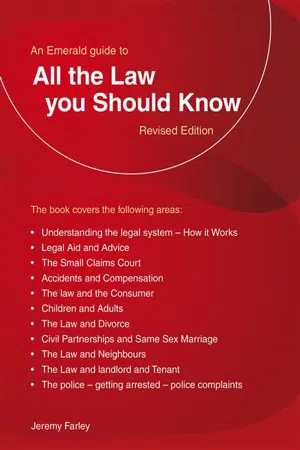
- 176 pages
- English
- ePUB (mobile friendly)
- Available on iOS & Android
eBook - ePub
Information
Print ISBN
9781847166432
Ch. 1
Understanding the Legal System-How it Works
Legal terms explained
There is a glossary of terms at the back of this book which deals with commonly used legal jargon. However, it is useful to highlight the most common terms right at the outset, as they will be used frequently throughout the book:
Claimant – when legal proceedings are brought, the person or persons, or organisation, bringing the case is called the claimant.
Defendant – The individual or organisation being sued, and therefore defending, is called the defendant.
Solicitor – a solicitor is the lawyer you will see for legal advice relating to your case. This person will have undertaken many years of study and passed all the necessary legal examinations. We will be discussing solicitors in more depth a little later.
Barrister – A Barrister is a lawyer who is a specialist in what is known as advocacy, i.e. speaking in court. A Barrister will have been called to the bar by one of the Inns of Court and passed the barristers professional examinations. A solicitor will instruct a barrister to represent you in court proceedings. However, barristers will not normally be the persons giving individuals legal advice in the first instance. The legal profession is, basically, split into two, barristers and solicitors, both of whom are lawyers.
Writ – A judicial writ is issued to bring legal proceedings. Civil cases are started in the courts by issuing and serving a writ. This document is completed either by an individual bringing the case or by a solicitor on behalf of the individual. It is issued by the court.
Litigant in person – a litigant is someone who is bringing legal proceedings or suing. A litigant-in-person is someone who chooses to represent themselves in court, without a lawyer.
Damages – Civil claims in the courts are for damages, which is money claimed from the defendant to compensate the claimant for loss arising from the action of default of the defendant. An example might be the sale of a good that has caused injury to a person and it is alleged that the good was faulty at the time of purchase.
Using the legal system to resolve disputes
If you are contemplating any form of legal action, with or without solicitors, it is necessary to have a basic idea of how the system works. The more that you understand the processes underlying the legal system, the more effective you will be, both as a citizen and as a potential litigant.
The structure of the court system
The court system in the United Kingdom deals, in the main, with civil and criminal cases. They are heard in either the county court (civil cases) and the Magistrates and Crown Courts (criminal cases).
Civil cases are those that typically involve breaches of contract, personal injury claims, divorce cases, bankruptcy hearings, debt problems, some employment cases, landlord and tenant disputes and other consumer disputes, such as faulty goods.
Criminal cases are those such as offences against the person, theft, damage to property, murder and fraud. These cases, if of a non-serious nature, are heard in the magistrate’s courts. If of a serious nature, then they will be heard in the Crown Court and tried by jury.
Criminal cases
The more serious criminal cases are tried on the basis of a document called the indictment. The defendant is indicted on criminal charges specified in the indictment by the prosecutor. In most cases, the prosecution is on behalf of the Crown (State) and is handled by an official agency called the Crown Prosecution Service, which takes the case over from the police who have already investigated most of the evidence. The first stage will be to decide whether there is a case to answer. This process, called committal, will be dealt with by a magistrate on the basis of evidence disclosed in papers provided by the prosecutor. If the case proceeds, it is heard in the Crown Court. There are about 70 Branches of the Crown Court in the United Kingdom. The trial is before a judge and jury. The judge presides over the trial and considers legal issues. The jury will decide on the facts (who is telling the truth) and applies the law to those facts. In criminal cases, the prosecution has to prove, beyond reasonable doubt, that the defendant is guilty. The defendant does not have to prove innocence. However, it is the jury who will observe the prosecutor and defending lawyer and decide the case.
In less serious criminal cases (which comprise over 90% of criminal cases) the case is sent for summary and trial in one of over 400 magistrates courts. A summary trial means that there is no committal or jury. The case is decided by a bench of magistrates. In most cases there are three magistrates who are lay (unqualified) persons but are from the local community. However, there are now an increasing number of ‘stipendiary’ magistrates, paid magistrates who are qualified lawyers.
Those defendants in criminal cases who are dissatisfied with verdicts may be able to appeal, as follows:
• from the Magistrates courts there is an appeal to the Crown Court on matters of fact or law.
• From the Crown Court, it might be possible to appeal to the Criminal Division of the court of Appeal on matters of fact or law.
• Certain legal disputes arising in the Magistrates court or the Crown Court can be taken before the divisional court of the High Court.
• Matters of important legal dispute arising in the Crown Court can be taken to the Supreme Court.
Civil cases
The majority of people who buy this book will be taking civil action of one form or another. Increasingly, people are becoming litigants-in-person as this enables people to access the courts and obtain justice without incurring high costs. The only real costs are the court fees and other incidental costs such as taking time off work and so on.
The county court
The county court deals with civil cases, which are dealt with by a judge, or a district judge. A case can be started in any county court but can be transferred back to the defendant’s local court.
All cases arising from regulated credit agreements must be started in the county court, whatever their value.
County courts deal with a wide range of cases ranging from bankruptcy and family matters to landlord and tenant disputes. The most common cases are:
• Consumer disputes, for example faulty goods or services
• Personal injury claims, caused by negligence, for example traffic accidents, accidents caused by faulty pavements and roads, potholes etc
• Debt problems, for example someone seeking payment Some undefended divorce cases and some domestic violence cases
• Race and sex discrimination cases
• Employment problems, usually involving pay.
Small claims in the county court
A case in the county court, if it is defended, is dealt with in one of three ways. These ways are called ‘tracks’ The court will, when considering a case, decide which procedure to apply and allocate the case to one of the following tracks:
• The small claims track
• The fast track
• The multi-track
The small claims track is the most commonly used and is the track for claims of £5000 or less. Overall, the procedure in the small claims track is simpler than the other tracks and costs are not usually paid by the losing party.
Following a brief summary of the other courts in the United Kingdom, we will be looking in more detail, in chapter 4, at how to commence and process a small claim. In the main, readers of this book will be concerned with the small claims track and it is therefore necessary to outline that process in depth. We will also be looking, in chapter 2, at the legal help scheme. This scheme enables those with a low income to get free legal advice from a solicitor and assistance with preparing a case.
The magistrates’ court
As we have seen, magistrate’s courts deal with criminal cases in the first instance and also deal with some civil cases.
The cases are heard by Justices of the Peace or by District Judges (magistrates courts). All cases heard in a magistrate’s court are from within their own area.
Criminal offences in the magistrate’s court
Magistrate’s courts deal with criminal offences where the defendant is not entitled to a trial by jury. These are known as ‘summary offences’ and involve a maximum penalty of six months imprisonment and/or a fine up to £5000. Magistrates also deal with offences where the defendant can choose trial by jury. If this is the case, the case is passed up to the Crown Court.
The youth court
The youth court deals with young people who have committed criminal offences, and who are aged between 10-17. The youth court is a part of the magistrate’s court and up to three specially trained magistrates hear the case. If a young person is charged with a very serious offence, which in the case of an adult is punishable by 14 years imprisonment or more, the youth court can commit him/her for trial at the Crown Court.
Civil cases in the magistrates’ court
As we have seen, the vast majority of civil cases are dealt with in the county courts. However, the magistrate’s court can deal with a limited number of cases, as follows:
• Some civil debts, e.g. arrears of income tax, national insurance contributions, council tax and Value added Tax arrears
• Licences, for example, licences for clubs and pubs
• Some matrimonial problems, e.g. maintenance payments and removing a spouse from the matrimonial home
• Welfare of children, e.g. local authority care orders or supervision orders, adoption proceedings an...
Table of contents
- Cover
- Title
- Copyright
- Contents
- Introduction
- 1. Understanding the legal system-How it Works
- 2. The Legal Profession
- 3. Legal Aid and Advice
- 4. The Small Claims Court
- 5. Accidents and Compensation
- 6. The law and the Consumer
- 7. Children and Adults
- 8. The Law and Divorce
- 9. Civil Partnerships
- 10. The Marriage (same Sex Couples) Act 2013
- 11. Bereavement and the Law
- 12. The Law and Neighbours
- 13. The Law and landlord and Tenant
- 14. The police – getting arrested – police complaints 1
- Index
- Useful addresses
Trusted by 375,005 students
Access to over 1.5 million titles for a fair monthly price.
Study more efficiently using our study tools.