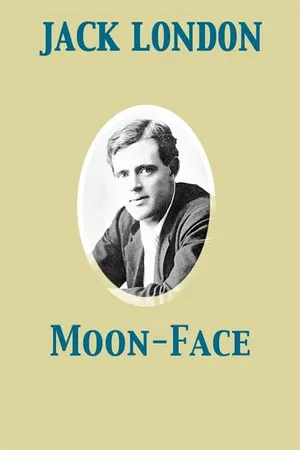
eBook - ePub
Moon-Face
Information
Subtopic
Historical FictionIndex
LiteraturePLANCHETTE
“It is my right to know, ” the girl said.
Her voice was firm-fibred with determination. There was no hint of pleading in it, yet it was the determination that is reached through a long period of pleading. But in her case it had been pleading, not of speech, but of personality. Her lips had been ever mute, but her face and eyes, and the very attitude of her soul, had been for a long time eloquent with questioning. This the man had known, but he had never answered; and now she was demanding by the spoken word that he answer.
“It is my right, ” the girl repeated.
“I know it, ” he answered, desperately and helplessly.
She waited, in the silence which followed, her eyes fixed upon the light that filtered down through the lofty boughs and bathed the great redwood trunks in mellow warmth. This light, subdued and colored, seemed almost a radiation from the trunks themselves, so strongly did they saturate it with their hue. The girl saw without seeing, as she heard, without hearing, the deep gurgling of the stream far below on the canyon bottom.
She looked down at the man. “Well? ” she asked, with the firmness which feigns belief that obedience will be forthcoming.
She was sitting upright, her back against a fallen tree-trunk, while he lay near to her, on his side, an elbow on the ground and the hand supporting his head.
“Dear, dear Lute, ” he murmured.
She shivered at the sound of his voice— not from repulsion, but from struggle against the fascination of its caressing gentleness. She had come to know well the lure of the man— the wealth of easement and rest that was promised by every caressing intonation of his voice, by the mere touch of hand on hand or the faint impact of his breath on neck or cheek. The man could not express himself by word nor look nor touch without weaving into the expression, subtly and occultly, the feeling as of a hand that passed and that in passing stroked softly and soothingly. Nor was this all-pervading caress a something that cloyed with too great sweetness; nor was it sickly sentimental; nor was it maudlin with love's madness. It was vigorous, compelling, masculine. For that matter, it was largely unconscious on the man's part. He was only dimly aware of it. It was a part of him, the breath of his soul as it were, involuntary and unpremeditated.
But now, resolved and desperate, she steeled herself against him. He tried to face her, but her gray eyes looked out to him, steadily, from under cool, level brows, and he dropped his head upon her knee. Her hand strayed into his hair softly, and her face melted into solicitude and tenderness. But when he looked up again, her gray eyes were steady, her brows cool and level.
“What more can I tell you? ” the man said. He raised his head and met her gaze. “I cannot marry you. I cannot marry any woman. I love you— you know that— better than my own life. I weigh you in the scales against all the dear things of living, and you outweigh everything. I would give everything to possess you, yet I may not. I cannot marry you. I can never marry you. ”
Her lips were compressed with the effort of control. His head was sinking back to her knee, when she checked him.
“You are already married, Chris? ”
“No! no! ” he cried vehemently. “I have never been married. I want to marry only you, and I cannot! ”
“Then— ”
“Don't! ” he interrupted. “Don't ask me! ”
“It is my right to know, ” she repeated.
“I know it, ” he again interrupted. “But I cannot tell you. ”
“You have not considered me, Chris, ” she went on gently.
“I know, I know, ” he broke in.
“You cannot have considered me. You do not know what I have to bear from my people because of you. ”
“I did not think they felt so very unkindly toward me, ” he said bitterly.
“It is true. They can scarcely tolerate you. They do not show it to you, but they almost hate you. It is I who have had to bear all this. It was not always so, though. They liked you at first as. . . as I liked you. But that was four years ago. The time passed by— a year, two years; and then they began to turn against you. They are not to be blamed. You spoke no word. They felt that you were destroying my life. It is four years, now, and you have never once mentioned marriage to them. What were they to think? What they have thought, that you were destroying my life. ”
As she talked, she continued to pass her fingers caressingly through his hair, sorrowful for the pain that she was inflicting.
"They did like you at first. Who can help liking you? You seem to draw affection from all living things, as the trees draw the moisture from the ground. It comes to you as it were your birthright. Aunt Mildred and Uncle Robert thought there was nobody like you. The sun rose and set in you. They thought I was the luckiest girl alive to win the love of a man like you. 'For it looks very much like it, ' Uncle Robert used to say, wagging his head wickedly at me. Of course they liked you. Aunt Mildred used to sigh, and look across teasingly at Uncle, and say, 'When I think of Chris, it almost makes me wish I were younger myself. ' And Uncle would answer, 'I don't blame you, my dear, not in the least. ' And then the pair of them would beam upon me their congratulations that I had won the love of a man like you.
“And they knew I loved you as well. How could I hide it? — this great, wonderful thing that had entered into my life and swallowed up all my days! For four years, Chris, I have lived only for you. Every moment was yours. Waking, I loved you. Sleeping, I dreamed of you. Every act I have performed was shaped by you, by the thought of you. Even my thoughts were moulded by you, by the invisible presence of you. I had no end, petty or great, that you were not there for me. ”
“I had no idea of imposing such slavery, ” he muttered.
"You imposed nothing. You always let me have my own way. It was you who were the obedient slave. You did for me without offending me. You forestalled my wishes without the semblance of forestalling them, so natural and inevitable was everything you did for me. I said, without offending me. You were no dancing puppet. You made no fuss. Don't you see? You did not seem to do things at all. Somehow they were always there, just done, as a matter of course.
"The slavery was love's slavery. It was just my love for you that made you swallow up all my days. You did not force yourself into my thoughts. You crept in, always, and you were there always— how much, you will never know.
"But as time went by, Aunt Mildred and Uncle grew to dislike you. They grew afraid. What was to become of me? You were destroying my life. My music? You know how my dream of it has dimmed away. That spring, when I first met you— I was twenty, and I was about to start for Germany. I was going to study hard. That was four years ago, and I am still here in California.
“I had other lovers. You drove them away— No! no! I don't mean that. It was I that drove them away. What did I care for lovers, for anything, when you were near? But as I said, Aunt Mildred and Uncle grew afraid. There has been talk— friends, busybodies, and all the rest. The time went by. You did not speak. I could only wonder, wonder. I knew you loved me. Much was said against you by Uncle at first, and then by Aunt Mildred. They were father and mother to me, you know. I could not defend you. Yet I was loyal to you. I refused to discuss you. I closed up. There was half-estrangement in my home— Uncle Robert with a face like an undertaker, and Aunt Mildred's heart breaking. But what could I do, Chris? What could I do? ”
The man, his head resting on her knee again, groaned, but made no other reply.
“Aunt Mildred was mother to me, yet I went to her no more with my confidences. My childhood's book was closed. It was a sweet book, Chris. The tears come into my eyes sometimes when I think of it. But never mind that. Great happiness has been mine as well. I am glad I can talk frankly of my love for you. And the attaining of such frankness has been very sweet. I do love you, Chris. I love you. . . I cannot tell you how. You are everything to me, and more besides. You remember that Christmas tree of the children? — when we played blindman's buff? and you caught me by the arm so, with such a clutching of fingers that I cried out with the hurt? I never told you, but the arm was badly bruised. And such sweet I got of it you could never guess. There, black and blue, was the imprint of your fingers— your fingers, Chris, your fingers. It was the touch of you made visible. It was there a week, and I kissed the marks— oh, so often! I hated to see them go; I wanted to rebruise the arm and make them linger. I was jealous of the returning white that drove the bruise away. Somehow, — oh! I cannot explain, but I loved you so! ”
In the silence that fell, she continued her caressing of his hair, while she idly watched a great gray squirrel, boisterous and hilarious, as it scampered back and forth in a distant vista of the redwoods. A crimson-crested woodpecker, energetically drilling a fallen trunk, caught and transferred her gaze. The man did not lift his head. Rather, he crushed his face closer against her knee, while his heaving shoulders marked the hardness with which he breathed.
“You must tell me, Chris, ” the girl said gently. “This mystery— it is killing me. I must know why we cannot be married. Are we always to be this way? — merely lovers, meeting often, it is true, and yet with the long absences between the meetings? Is it all the world holds for you and me, Chris? Are we never to be more to each other? Oh, it is good just to love, I know— you have made me madly happy; but one does get so hungry at times for something more! I want more and more of you, Chris. I want all of you. I want all our days to be together. I want all the companionship, the comradeship, which cannot be ours now, and which will be ours when we are married— ” She caught her breath quickly. “But we are never to be married. I forgot. And you must tell me why. ”
The man raised his head and looked her in the eyes. It was a way he had with whomever he talked, of looking them in the eyes.
“I have considered you, Lute, ” he began doggedly. “I did consider you at the very first. I should never have gone on with it. I should have gone away. I knew it. And I considered you in the light of that knowledge, and yet. . . I did not go away. My God! what was I to do? I loved you. I could not go away. I could not help it. I stayed. I resolved, but I broke my resolves. I was like a drunkard. I was drunk of you. I was weak, I know. I failed. I could not go away. I tried. I went away— you will remember, though you did not know why. You know now. I went away, but I could not remain away. Knowing that we could never marry, I came back to you. I am here, now, with you. Send me away, Lute. I have not the strength to go myself. ”
“But why should you go away? ” she asked. “Besides, I must know why, before I can send you away. ”
“Don't ask me. ”
“Tell me, ” she said, her voice tenderly imperative.
“Don't, Lute; don't force me, ” the man pleaded, and there was appeal in his eyes and voice.
“But you must tell me, ” she insisted. “It is justice you owe me. ”
The man wavered. “If I do. . . ” he began. Then he ended with determination, “I should never be able to forgive myself. No, I cannot tell you. Don't try to compel me, Lute. You would be as sorry as I. ”
“If there is anything. . . if there are obstacles. . . if this mystery does really prevent. . . ” She was speaking slowly, with long pauses, seeking the more delicate ways of speech for the framing of her thought. “Chris, I do love you. I love you as deeply as it is possible for any woman to love, I am sure. If you were to say to me now 'Come, ' I would go with you. I would follow wherever you led. I would be your page, as in the days of old when ladies went with their knights to far lands. You are my knight, Chris, and you can do no wrong. Your will is my wish. I was once afraid of the censure of the world. Now that you have come into my life I am no longer afraid. I would laugh at the world and its censure for your sake— for my sake too. I would laugh, for I should have you, and you are more to me than the good will and approval of the world. If you say 'Come, ' I will— ”
“Don't! Don't! ” he cried. “It is impossible! Marriage or not, I cannot even say 'Come. ' I dare not. I'll show you. I'll tell you. ”
He sat up beside her, the action stamped with resolve. He took her hand in his and held it closely. His lips moved to the verge of speech. The mystery trembled for utterance. The air was palpitant with its presence. As if it were an irrevocable decree, the girl steeled herself to hear. But the man paused, gazing straight out before him. She felt his hand relax in hers, and she pressed it sympathetically, encouragingly. But she felt the rigidity going out of his tensed body, and she knew that spirit and flesh were relaxing together. His resolution was ebbing. He would not speak— she knew it; and she knew, likewise, with the sureness of faith, that it was because he could not.
She gazed despairingly before her, a numb feeling at her heart, as though hope and happiness had died. She watched the sun flickering down through the warm-trunked redwoods. But she watched in a mechanical, absent way. She looked at the scene as from a long way off, without interest, herself an alien, no longer an intimate part of the earth and trees and flowers she loved so well.
So far removed did she seem, that she was aware of a curiosity, strangely impersonal, in what lay around her. Through a near vista she looked at a buckeye tree in full blossom as though her eyes encountered it for the first time. Her eyes paused and dwelt upon a yellow cluster of Diogenes' lanterns that grew on the edge of an open space. It was the way of flowers always to give her quick pleasure-thrills, but no thrill was hers now. She pondered the flower slowly and thoughtfully, as a hasheesh-eater, heavy with the drug, might ponder some whim-flower that ...
Table of contents
- MOON-FACE AND OTHER STORIES
- MOON-FACE
- THE LEOPARD MAN'S STORY
- LOCAL COLOR
- AMATEUR NIGHT
- THE MINIONS OF MIDAS
- THE SHADOW AND THE FLASH
- ALL GOLD CANYON
- PLANCHETTE
- Copyright
Trusted by 375,005 students
Access to over 1.5 million titles for a fair monthly price.
Study more efficiently using our study tools.
Frequently asked questions
Yes, you can cancel anytime from the Subscription tab in your account settings on the Perlego website. Your subscription will stay active until the end of your current billing period. Learn how to cancel your subscription
No, books cannot be downloaded as external files, such as PDFs, for use outside of Perlego. However, you can download books within the Perlego app for offline reading on mobile or tablet. Learn how to download books offline
Perlego offers two plans: Essential and Complete
- Essential is ideal for learners and professionals who enjoy exploring a wide range of subjects. Access the Essential Library with 800,000+ trusted titles and best-sellers across business, personal growth, and the humanities. Includes unlimited reading time and Standard Read Aloud voice.
- Complete: Perfect for advanced learners and researchers needing full, unrestricted access. Unlock 1.5M+ books across hundreds of subjects, including academic and specialized titles. The Complete Plan also includes advanced features like Premium Read Aloud and Research Assistant.
We are an online textbook subscription service, where you can get access to an entire online library for less than the price of a single book per month. With over 1.5 million books across 990+ topics, we’ve got you covered! Learn about our mission
Look out for the read-aloud symbol on your next book to see if you can listen to it. The read-aloud tool reads text aloud for you, highlighting the text as it is being read. You can pause it, speed it up and slow it down. Learn more about Read Aloud
Yes! You can use the Perlego app on both iOS and Android devices to read anytime, anywhere — even offline. Perfect for commutes or when you’re on the go.
Please note we cannot support devices running on iOS 13 and Android 7 or earlier. Learn more about using the app
Please note we cannot support devices running on iOS 13 and Android 7 or earlier. Learn more about using the app
Yes, you can access Moon-Face by Jack London in PDF and/or ePUB format, as well as other popular books in Literature & Historical Fiction. We have over 1.5 million books available in our catalogue for you to explore.