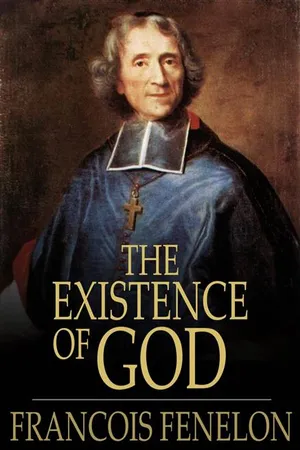
eBook - PDF
Information
Topic
Theology & ReligionSubtopic
ReligionTable of contents
- Title
- Contents
- Introduction
- Section I - Metaphysical Proofs of the Existence of God Are Not Within Everybody's Reach
- Section II - Moral Proofs of the Existence of God Are Fitted to Every Man's Capacity
- Section III - Why so Few Persons Are Attentive to the Proofs Nature Affords of the Existence of God
- Section IV - All Nature Shows the Existence of Its Maker
- Section V - Noble Comparisons Proving that Nature Shows the Existence of Its Maker First Comparison, Drawn from Homer's "Iliad"
- Section VI - Second Comparison, Drawn from the Sound of Instruments
- Section VII - Third Comparison, Drawn from a Statue
- Section VIII - Fourth Comparison, Drawn from a Picture
- Section IX - A Particular Examination of Nature
- Section X - Of the General Structure of the Universe
- Section XI - Of the Earth
- Section XII - Of Plants
- Section XIII - Of Water
- Section XIV - Of the Air
- Section XV - Of Fire
- Section XVI - Of Heaven
- Section XVII - Of the Sun
- Section XVIII - Of the Stars
- Section XIX - Of Animals, Beasts, Fowl, Birds, Fishes, Reptiles, and Insects
- Section XX - Admirable Order in Which All the Bodies that Make Up the Universe Are Ranged
- Section XXI - Wonders of the Infinitely Little
- Section XXII - Of the Structure or Frame of the Animal
- Section XXIII - Of the Instinct of the Animal
- Section XXIV - Of Food
- Section XXV - Of Sleep
- Section XXVI - Of Generation
- Section XXVII - Though Beasts Commit Some Mistakes, Yet Their Instinct is, in Many Cases, Infallible
- Section XXVIII - It is Impossible Beasts Should Have Souls
- Section XXIX - Sentiments of Some of the Ancients Concerning the Soul and Knowledge of Beasts
- Section XXX - Of Man
- Section XXXI - Of the Structure of Man's Body
- Section XXXII - Of the Skin
- Section XXXIII - Of Veins and Arteries
- Section XXXIV - Of the Bones, and Their Jointing
- Section XXXV - Of the Organs
- Section XXXVI - Of the Inward Parts
- Section XXXVII - Of the Arms and Their Use
- Section XXXVIII - Of the Neck and Head
- Section XXXIX - Of the Forehead and Other Parts of the Face
- Section XL - Of the Tongue and Teeth
- Section XLI - Of the Smell, Taste, and Hearing
- Section XLII - Of the Proportion of Man's Body
- Section XLIII - Of the Soul, Which Alone, Among All Creatures, Thinks and Knows
- Section XLIV - Matter Cannot Think
- Section XLV - Of the Union of the Soul and Body, of Which God Alone Can Be the Author
- Section XLVI - The Soul Has an Absolute Command Over the Body
- Section XLVII - The Power of the Soul Over the Body is Not Only Supreme or Absolute, but Blind at the Same Time
- Section XLVIII - The Sovereignty of the Soul Over the Body Principally Appears in the Images Imprinted in the Brain
- Section XLIX - Two Wonders of the Memory and Brain
- Section L - The Mind of Man is Mixed with Greatness and Weakness Its Greatness Consists in Two Things First, the Mind Has the Id
- Section LI - The Mind Knows the Finite Only by the Idea of the Infinite
- Section LII - Secondly, the Ideas of the Mind Are Universal, Eternal, and Immutable
- Section LIII - Weakness of Man's Mind
- Section LIV - The Ideas of Man Are the Immutable Rules of His Judgment
- Section LV - What Man's Reason Is
- Section LVI - Reason is the Same in All Men, of All Ages and Countries
- Section LVII - Reason in Man is Independent of and Above Him
- Section LVIII - It is the Primitive Truth, that Lights All Minds, by Communicating Itself to Them
- Section LIX - It is by the Light of Primitive Truth a Man Judges Whether What One Says to Him Be True or False
- Section LX - The Superior Reason that Resides in Man is God Himself; And Whatever Has Been Above Discovered to Be in Man, Are Ev
- Section LXI - New Sensible Notices of the Deity in Man, Drawn from the Knowledge He Has of Unity
- Section LXII - The Idea of the Unity Proves that there Are Immaterial Substances; And that there is a Being Perfectly One, Who i
- Section LXIII - Dependence and Independence of Man His Dependence Proves the Existence of His Creator
- Section LXIV - Good Will Cannot Proceed but from a Superior Being
- Section LXV - As a Superior Being is the Cause of All the Modifications of Creatures, so it is Impossible for Man's Will to Will
- Section LXVI - Of Man's Liberty
- Section LXVII - Man's Liberty Consists in that His Will by Determining, Modifies Itself
- Section LXVIII - Will May Resist Grace, and Its Liberty is the Foundation of Merit and Demerit
- Section LXIX - A Character of the Deity, Both in the Dependence and Independence of Man
- Section LXX - The Seal and Stamp of the Deity in His Works
- Section LXXI - Objection of the Epicureans, Who Ascribe Everything to Chance, Considered
- Section LXXII - Answer to the Objection of the Epicureans, Who Ascribe All to Chance
- Section LXXIII - Comparison of the World with a Regular House a Continuation of the Answer to the Objection of the Epicureans
- Section LXXIV - Another Objection of the Epicureans Drawn from the Eternal Motion of Atoms
- Section LXXV - Answers to the Objection of the Epicureans Drawn from the Eternal Motion of Atoms
- Section LXXVI - The Epicureans Confound the Works of Art with Those of Nature
- Section LXXVII - The Epicureans Take Whatever They Please for Granted, Without Any Proof
- Section LXXVIII - The Suppositions of the Epicureans Are False and Chimerical
- Section LXXIX - It is Falsely Supposed that Motion is Essential to Bodies
- Section LXXX - The Rules of Motion, Which the Epicureans Suppose Do Not Render it Essential to Bodies
- Section LXXXI - To Give a Satisfactory Account of Motion We Must Recur to the First Mover
- Section LXXXII - No Law of Motion Has Its Foundation in the Essence of the Body; And Most of Those Laws Are Arbitrary
- Section LXXXIII - The Epicureans Can Draw No Consequence from All Their Suppositions, Although the Same Should Be Granted Them
- Section LXXXIV - Atoms Cannot Make Any Compound by the Motion the Epicureans Assign Them
- Section LXXXV - The Clinamen, Declination, or Sending of Atoms is a Chimerical Notion that Throws the Epicureans into a Gross Co
- Section LXXXVI - Strange Absurdity of the Epicureans, Who Endeavour to Account for the Nature of the Soul by the Declination of
- Section LXXXVII - The Epicureans Cast a Mist Before Their Own Eyes by Endeavouring to Explain the Liberty of Man by the Declinat
- Section LXXXVIII - We Must Necessarily Acknowledge the Hand of a First Cause in the Universe Without Inquiring Why that First Ca
- Section LXXXIX - The Defects of the Universe Compared with Those of a Picture
- Section XC - We Must Necessarily Conclude that there is a First Being that Created the Universe
- Section XCI - Reasons Why Men Do Not Acknowledge God in the Universe, Wherein He Shows Himself to Them, as in a Faithful Glass
- Section XCII - A Prayer to God
Trusted by 375,005 students
Access to over 1.5 million titles for a fair monthly price.
Study more efficiently using our study tools.
Frequently asked questions
Yes, you can cancel anytime from the Subscription tab in your account settings on the Perlego website. Your subscription will stay active until the end of your current billing period. Learn how to cancel your subscription
No, books cannot be downloaded as external files, such as PDFs, for use outside of Perlego. However, you can download books within the Perlego app for offline reading on mobile or tablet. Learn how to download books offline
Perlego offers two plans: Essential and Complete
- Essential is ideal for learners and professionals who enjoy exploring a wide range of subjects. Access the Essential Library with 800,000+ trusted titles and best-sellers across business, personal growth, and the humanities. Includes unlimited reading time and Standard Read Aloud voice.
- Complete: Perfect for advanced learners and researchers needing full, unrestricted access. Unlock 1.5M+ books across hundreds of subjects, including academic and specialized titles. The Complete Plan also includes advanced features like Premium Read Aloud and Research Assistant.
We are an online textbook subscription service, where you can get access to an entire online library for less than the price of a single book per month. With over 1.5 million books across 990+ topics, we’ve got you covered! Learn about our mission
Look out for the read-aloud symbol on your next book to see if you can listen to it. The read-aloud tool reads text aloud for you, highlighting the text as it is being read. You can pause it, speed it up and slow it down. Learn more about Read Aloud
Yes! You can use the Perlego app on both iOS and Android devices to read anytime, anywhere — even offline. Perfect for commutes or when you’re on the go.
Please note we cannot support devices running on iOS 13 and Android 7 or earlier. Learn more about using the app
Please note we cannot support devices running on iOS 13 and Android 7 or earlier. Learn more about using the app
Yes, you can access Existence of God by in PDF and/or ePUB format, as well as other popular books in Theology & Religion & Religion. We have over 1.5 million books available in our catalogue for you to explore.